
An octopus can taste with its suckers, vanish into a reef, and inspect a puzzle without a single bone getting in the way.
These octopus trivia questions explore anatomy, behavior, camouflage, habitats, and species differences with the cephalopod facts kept straight.
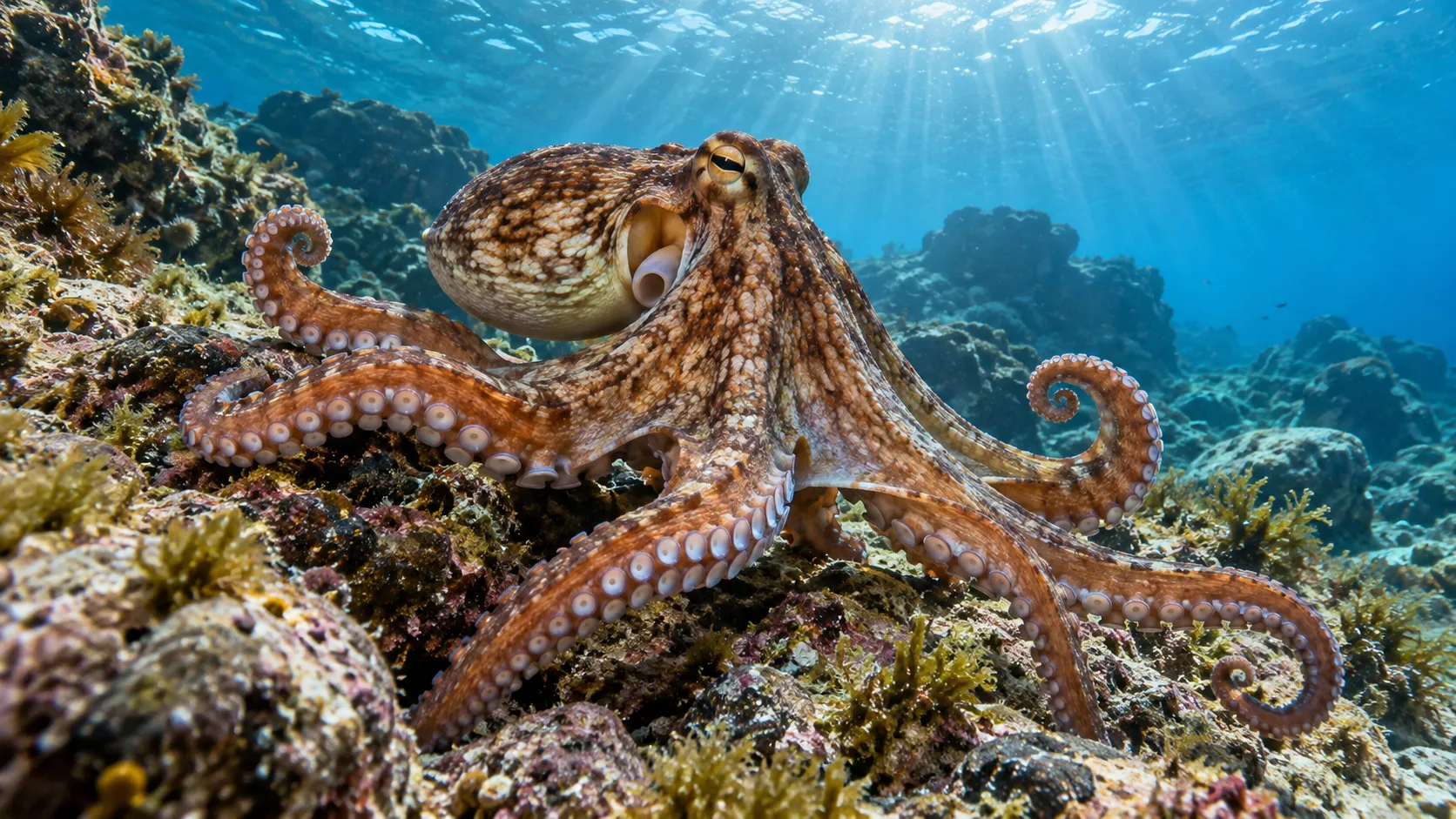
Eight Arms and One Remarkable Body
Start with the soft-bodied anatomy that makes an octopus both flexible and unmistakable.
- How many arms does an octopus have?
Answer: Eight - Are octopus appendages arms or tentacles in zoological terminology?
Answer: Arms - What body part houses most internal organs?
Answer: The mantle - What hard, beak-like structure does an octopus use to bite?
Answer: A beak - What rasping feeding structure works with the beak?
Answer: The radula - What is the funnel beneath the head also called?
Answer: The siphon - How many hearts does an octopus have?
Answer: Three - What do two branchial hearts pump blood through?
Answer: The gills - What does the systemic heart pump blood to?
Answer: The rest of the body - What copper-containing molecule carries oxygen in octopus blood?
Answer: Hemocyanin - What color can oxygenated hemocyanin make the blood appear?
Answer: Blue - Does an octopus have an internal or external shell?
Answer: Neither in most living octopus species - What ring of nerve tissue surrounds the esophagus?
Answer: The central brain - Where are many octopus neurons located?
Answer: In the arms - What protects the opening to the mantle cavity?
Answer: The mantle and muscular body wall
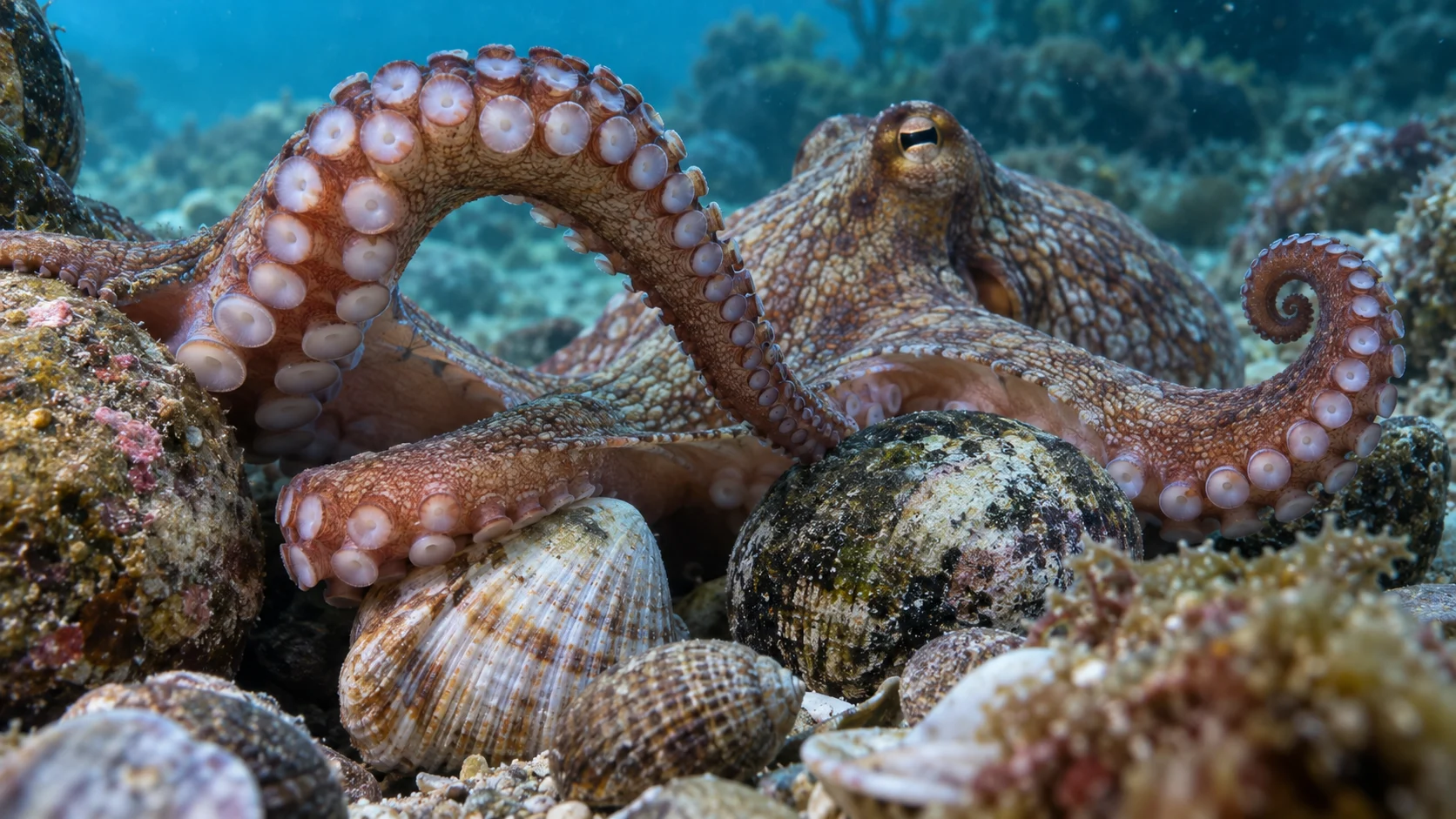
Suckers, Senses, and Nervous-System Skills
Octopus arms gather chemical, tactile, and visual information with striking independence.
- What structures line the underside of octopus arms?
Answer: Suckers - What can octopus suckers detect?
Answer: Touch and chemical cues - Can an octopus taste with its suckers?
Answer: Yes - How does an octopus eye resemble a camera?
Answer: It has a lens, iris, and retina - Do octopus eyes have the vertebrate blind spot caused by nerves crossing the retina?
Answer: No - Can most octopuses see color the way humans do?
Answer: Evidence suggests most have limited or no conventional color vision - What visual property can octopuses detect especially well?
Answer: Polarized light - What organs help an octopus sense balance and movement?
Answer: Statocysts - Can a severed octopus arm perform some reflexive movements?
Answer: Yes - What allows arms to bend in almost any direction?
Answer: Muscular hydrostats without bones - Can different arms explore separate objects at once?
Answer: Yes - What is proprioception?
Answer: Sensing the position and movement of one's body - How does water carry odors to an octopus?
Answer: Dissolved chemicals reach chemoreceptors - Why is the beak a limiting point for squeezing through openings?
Answer: It is the main rigid body structure - What simple task demonstrates octopus learning?
Answer: Opening containers or solving maze-like problems
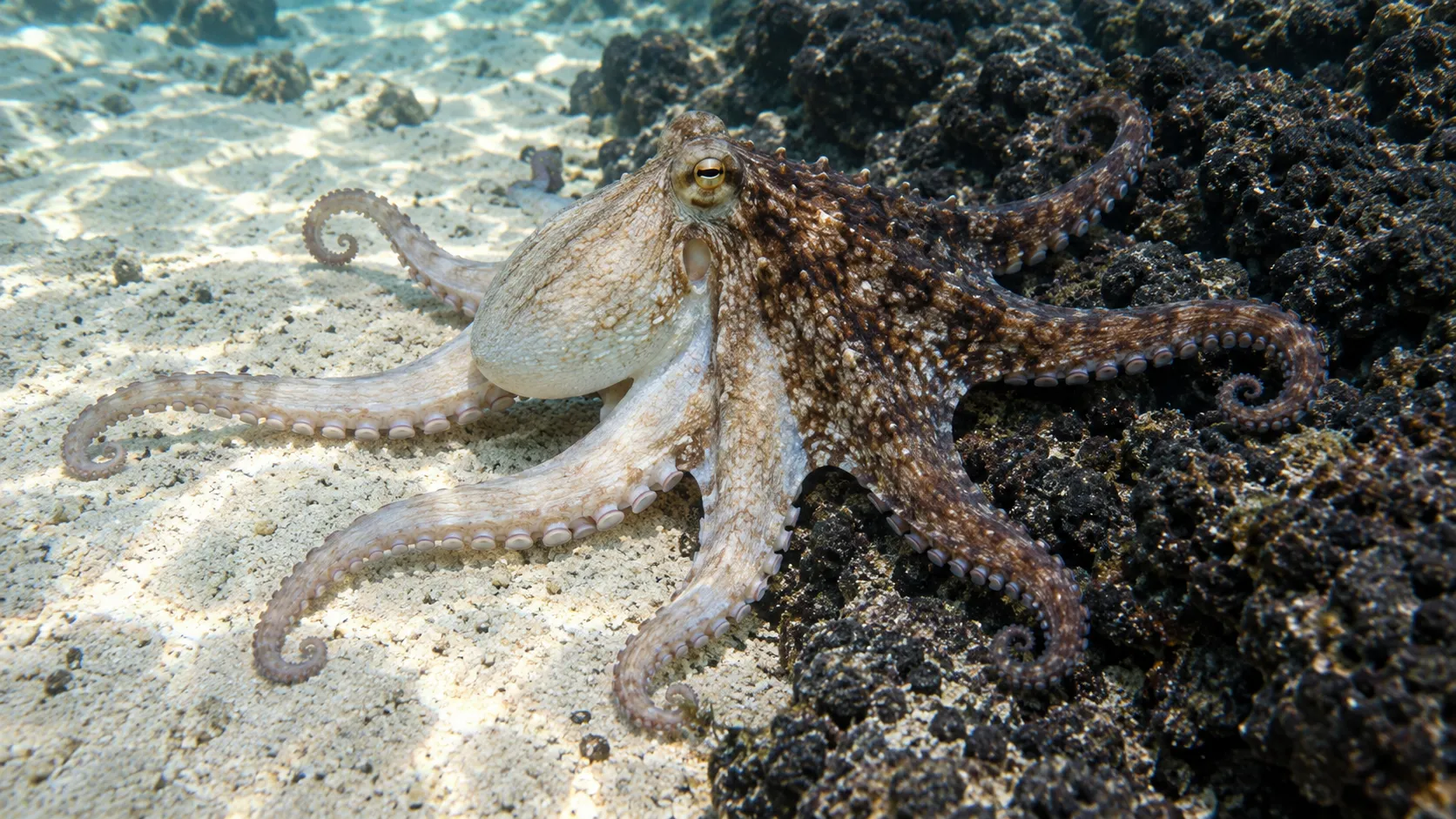
Camouflage, Color, and Texture
Color change is only part of the disguise; skin texture and posture finish the illusion.
- What pigment-containing skin cells change octopus color?
Answer: Chromatophores - What reflective cells can create iridescent colors?
Answer: Iridophores - What white-reflecting cells lie beneath other color cells?
Answer: Leucophores - What muscles control rapid chromatophore expansion?
Answer: Radial muscles - Can an octopus change color in under a second?
Answer: Yes - What skin structures can raise bumps and ridges?
Answer: Papillae - Why raise papillae?
Answer: To mimic rough surfaces such as rock or coral - What is countershading?
Answer: A color pattern darker above and lighter below - What is disruptive coloration?
Answer: Patterns that break up the body's outline - What is background matching?
Answer: Resembling the surrounding color and texture - Can octopus camouflage include body posture?
Answer: Yes - What behavior may make an octopus resemble drifting algae?
Answer: Changing posture and moving with the water - Why might an octopus suddenly become pale?
Answer: Camouflage, stress, communication, or physiological change - Are octopus color signals identical across every species?
Answer: No - Which species is famous for warning displays of bright blue rings?
Answer: Blue-ringed octopuses
Jet Propulsion, Crawling, and Escape
An octopus can glide, crawl, jet, squeeze, and occasionally surprise everyone by leaving the water briefly.
- How does an octopus use jet propulsion?
Answer: Forces water through its siphon - What does changing siphon direction control?
Answer: The direction of movement - Which is usually more energy-efficient for many octopuses: crawling or jetting?
Answer: Crawling - How does an octopus crawl?
Answer: Coordinates arms and suckers against the surface - Can an octopus swim using arm-web movements?
Answer: Yes - What is the web between the arms?
Answer: A membrane connecting arm bases - How can an octopus fit through a very small gap?
Answer: Its body lacks bones and compresses around the beak - Can some octopuses move briefly across damp land between tide pools?
Answer: Yes - What cloud can an octopus release during escape?
Answer: Ink - Where is octopus ink stored?
Answer: An ink sac - What dark pigment is prominent in cephalopod ink?
Answer: Melanin - How can ink confuse a predator?
Answer: It forms a screen or decoy and may affect senses - What is a pseudomorph in an ink defense?
Answer: A dense ink blob resembling the animal - Does every deep-sea octopus species rely on ink?
Answer: No - Why should aquarium lids be secure for octopuses?
Answer: They are skilled at finding and squeezing through openings
Hunting, Tools, and Clever Behavior
These predators use ambush, exploration, venom, and occasionally portable shelter.
- What do octopuses commonly eat?
Answer: Crabs, mollusks, shrimp, fish, and other prey - How can an octopus subdue prey?
Answer: With arms, suckers, a bite, and venom - Do all octopuses have venom?
Answer: Evidence indicates octopuses use venom, but potency varies - What enzyme-rich saliva helps some octopuses feed?
Answer: Salivary secretions that immobilize or digest prey - How can an octopus open a clam?
Answer: Pulling shells apart or drilling the shell - What leaves tiny holes in some mollusk shells eaten by octopuses?
Answer: Drilling with the radula and chemical secretions - What is denning?
Answer: Using a shelter as a home base - What clues may mark an octopus den?
Answer: Piles of discarded shells or stones - Which octopus is famous for carrying coconut-shell halves?
Answer: The veined octopus - Why is coconut carrying described as tool use?
Answer: The shells are transported for later shelter - Can octopuses distinguish individual human caretakers in experiments?
Answer: Some have shown that ability - What is habituation?
Answer: Reduced response after repeated harmless exposure - Can octopuses learn by trial and error?
Answer: Yes - Do octopuses generally live in permanent social groups?
Answer: No, most species are mainly solitary - What behavior shows play-like exploration in some captive octopuses?
Answer: Repeatedly manipulating or jetting objects without an obvious food reward
Mating, Eggs, and the Short Octopus Life
Reproduction is intense, and in many species it is the final chapter for both parents.
- What specialized male arm transfers sperm packets?
Answer: The hectocotylus - What are octopus sperm packets called?
Answer: Spermatophores - Where does a female commonly attach strings of eggs?
Answer: Inside a protected den - What does a brooding female do for her eggs?
Answer: Guards, cleans, and ventilates them - Does a brooding female usually leave to hunt?
Answer: Often no, depending on species - What happens to many females after their eggs hatch?
Answer: They die - What is semelparity?
Answer: Reproducing once before death - What happens to many male octopuses after mating?
Answer: They enter decline and die - What is the post-reproductive decline in octopuses called?
Answer: Senescence - What gland helps regulate reproductive changes and senescence?
Answer: The optic gland - What are newly hatched open-ocean young called in many species?
Answer: Paralarvae - Do all octopus hatchlings live as planktonic paralarvae?
Answer: No - Why do egg sizes differ among species?
Answer: Life histories and hatchling development differ - Which deep-sea octopus holds the known record for the longest egg-brooding period?
Answer: Graneledone boreopacifica - About how long was that observed brooding period?
Answer: Roughly 53 months
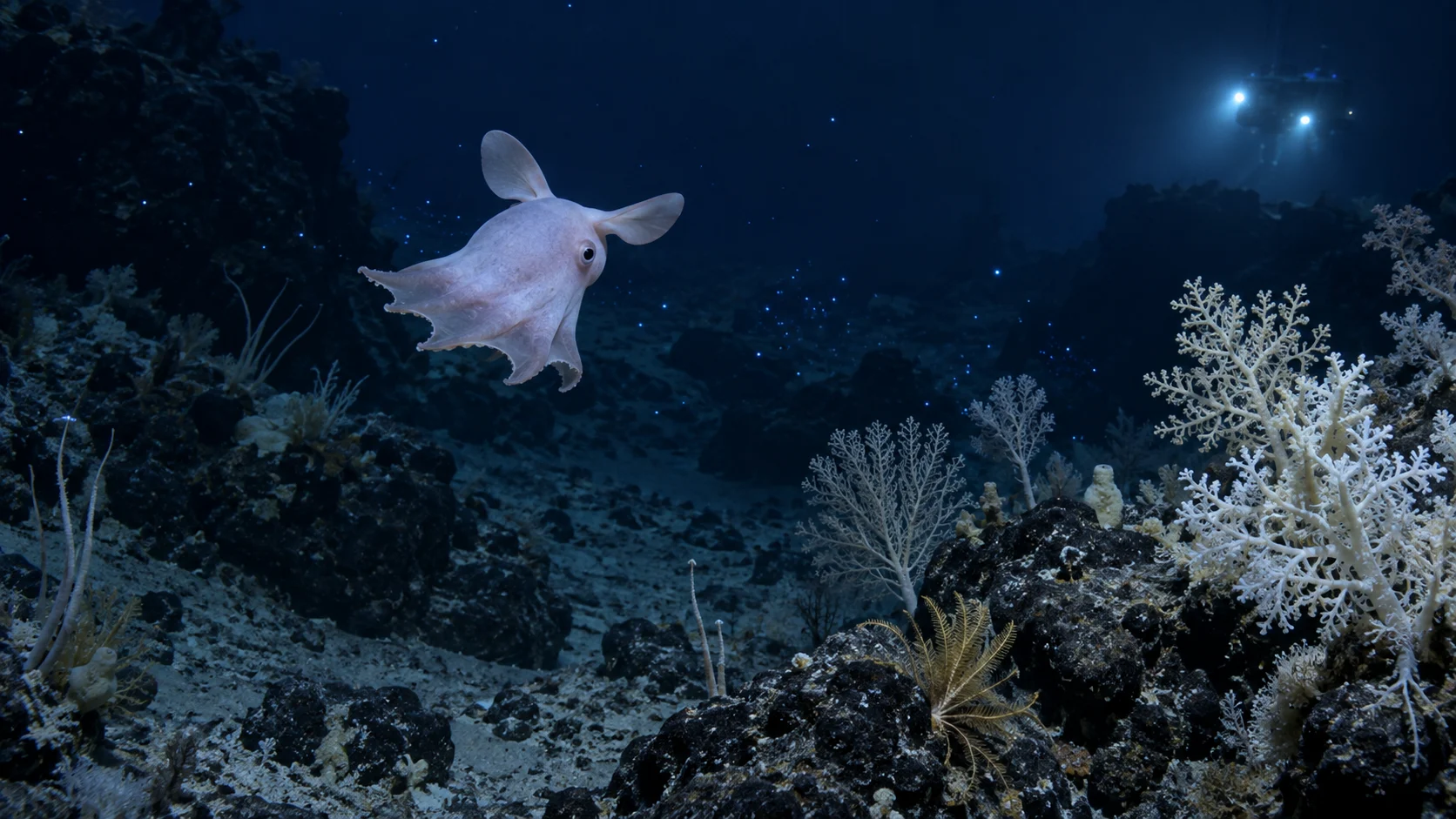
Species from Reefs to the Deep Sea
Meet octopuses with blue rings, blanket-like webs, ear-shaped fins, and habitats far below sunlight.
- What is the scientific name of the giant Pacific octopus?
Answer: Enteroctopus dofleini - Where does the giant Pacific octopus live?
Answer: The North Pacific - Which octopus group carries dangerously potent tetrodotoxin?
Answer: Blue-ringed octopuses - Are blue-ringed octopuses large animals?
Answer: No, they are small - What genus includes the mimic octopus?
Answer: Thaumoctopus - What is the mimic octopus known for?
Answer: Imitating the appearance and behavior of other animals - Where was the mimic octopus first scientifically described from?
Answer: Indonesia - What feature gives blanket octopuses their name?
Answer: A large web on females' arms - Which sex is dramatically larger in blanket octopuses?
Answer: Females - What finned deep-sea octopuses are nicknamed dumbo octopuses?
Answer: Species in the genus Grimpoteuthis and relatives - What structures resemble ears on a dumbo octopus?
Answer: Fins - What does a dumbo octopus use its fins for?
Answer: Swimming - What unusual octopus lives in a paper-thin eggcase secreted by the female?
Answer: The argonaut or paper nautilus - Is an argonaut a true nautilus?
Answer: No, it is an octopus - What deep-sea octopus lacks an ink sac and has a gelatinous body?
Answer: Many cirrate octopuses, including dumbo octopuses
Octopus Ecology, Research, and Conservation
Finish with the habitats octopuses occupy and the careful questions scientists ask about their future.
- In what habitats do octopuses live?
Answer: Marine habitats from tide pools to the deep sea - Do octopuses naturally live in freshwater?
Answer: No - What role do octopuses play in food webs?
Answer: They are both predators and prey - Which animals eat octopuses?
Answer: Fish, sharks, marine mammals, eels, seabirds, and other predators - How can warming oceans affect octopuses?
Answer: It can alter metabolism, oxygen demand, range, and prey - How can ocean acidification affect marine life?
Answer: It changes seawater chemistry and can affect physiology and food webs - Why are octopus population trends hard to generalize?
Answer: Species, regions, and data quality differ - What fishing gear commonly catches octopuses?
Answer: Pots, traps, lines, and trawls - What is bycatch?
Answer: Unintended capture in fishing operations - Why is species-level identification important in fisheries?
Answer: Different species grow and reproduce at different rates - What field studies animal behavior?
Answer: Ethology - Why are octopuses important in neuroscience?
Answer: Their large, distributed nervous systems evolved separately from vertebrates - What ethical issue has grown in cephalopod research?
Answer: Standards for welfare and humane treatment - Are cephalopods protected in some research-animal regulations?
Answer: Yes - What is a safe wildlife-viewing practice around a wild octopus?
Answer: Observe without touching, chasing, or blocking its den
Keep the game going with oceans and marine life trivia, animal trivia, shark trivia, and dolphin trivia.
Sources and Further Reading
- Smithsonian Ocean: Octopuses
- NOAA Ocean Exploration cephalopod resources
- Monterey Bay Aquarium octopus animals
- MBARI deep-sea octopus research
- Encyclopaedia Britannica: Octopus

Ellie Ewert is the founder and author of RandomTrivia.co, blending her passion for research with years of experience in content creation to deliver accurate, engaging, and well-sourced trivia. Dedicated to providing readers with trustworthy and entertaining facts, she applies meticulous fact-checking and SEO expertise to ensure every article meets the highest standards. Read more about our high standards in our Editorial Guidelines.