
From wave-tossed shores to lightless trenches, the ocean is Earth’s largest, strangest habitat.
This trivia set spans ocean geography, powerful currents, coral reefs, sharks, whales, invertebrate marvels, polar seas, plankton, and human exploration.
Questions start easy and build to brain-ticklers, perfect for quiz nights or curious ocean lovers.
Ocean Basics & Geography
Q: How much of Earth’s surface is covered by ocean?
A: Roughly 71%.
Q: What are the names of the five oceans recognized on most modern maps?
A: Pacific, Atlantic, Indian, Southern (Antarctic), and Arctic.
Q: What term describes the ocean’s saltiness, typically around 35‰?
A: Salinity (about 35 parts per thousand).
Q: Which is the largest ocean by area and volume?
A: The Pacific Ocean.
Q: What trench contains Earth’s deepest known oceanic point?
A: The Mariana Trench.
Q: What is the name of that deepest point, at ~11,000 meters?
A: The Challenger Deep.
Q: What do we call the shallow, gently sloping extension of a continent under the sea?
A: The continental shelf.
Q: About how deep is the global ocean on average?
A: Roughly 3,700 meters (3.7 km).
Q: What is the thermocline?
A: A layer where temperature drops rapidly with depth.
Q: What is a seamount?
A: An undersea mountain, often volcanic, that doesn’t reach the surface.
Q: How far does a nation’s Exclusive Economic Zone (EEZ) typically extend from its coast?
A: Up to 200 nautical miles.
Q: What are the five major ocean gyres?
A: North & South Pacific, North & South Atlantic, and the Indian Ocean gyre.
Currents, Tides & Waves
Q: What primarily causes Earth’s tides?
A: The Moon’s gravity (with the Sun as a secondary factor).
Q: What is an ocean current?
A: A persistent, directional movement of seawater.
Q: What warm current flows along the U.S. East Coast toward Europe?
A: The Gulf Stream.
Q: What is upwelling?
A: The rise of cold, nutrient-rich deep water to the surface.
Q: What climate pattern warms the central and eastern tropical Pacific and disrupts weather worldwide?
A: El Niño (part of ENSO).
Q: What is the global “conveyor belt” circulation driven by temperature and salinity differences?
A: Thermohaline circulation.
Q: Why do tsunamis have very long wavelengths and travel fast in deep water?
A: They’re generated by large seafloor displacements, so their energy spans the full water column.
Q: When are tides highest—spring or neap?
A: Spring tides (when Sun, Moon, and Earth align).
Q: What is the wave base?
A: About half a surface wave’s wavelength—the depth at which orbital motion fades.
Q: What is the Coriolis effect’s influence on currents in the Northern Hemisphere?
A: It deflects them to the right of the wind’s direction.
Q: What is Ekman transport?
A: The net movement of surface water ~90° to the wind due to friction and Coriolis effects.
Q: What is a seiche?
A: A standing wave oscillation in an enclosed or semi-enclosed basin.
Coral Reefs & Tropical Seas
Q: Are corals plants, rocks, or animals?
A: Animals (cnidarians).
Q: What microscopic partners provide many corals with much of their energy?
A: Symbiotic algae (zooxanthellae in the family Symbiodiniaceae).
Q: Where is the Great Barrier Reef found?
A: Off Australia’s northeastern coast.
Q: Name the three classic reef types.
A: Fringing, barrier, and atoll.
Q: What is coral bleaching?
A: Stress-induced loss of symbiotic algae, revealing white skeletons.
Q: Which spiny starfish is a notorious coral predator?
A: The crown-of-thorns starfish.
Q: What is a “cleaning station” on reefs?
A: A site where small fish or shrimp remove parasites from larger clients.
Q: How do parrotfish help make tropical beaches?
A: By grinding coral while feeding and excreting it as sand.
Q: What mineral do reef-building corals secrete to form skeletons?
A: Calcium carbonate (aragonite).
Q: What are mesophotic coral ecosystems?
A: Deeper, low-light reefs roughly 30–150 meters down.
Q: How can marine protected areas (MPAs) aid coral resilience?
A: By reducing local pressures like overfishing and allowing recovery.
Q: What was Darwin’s key insight about atoll formation?
A: They form as volcanic islands subside and fringing reefs keep growing upward.
Sharks, Rays & Cartilaginous Fish
Q: What is the largest fish in the ocean?
A: The whale shark.
Q: What do sharks, skates, and rays have instead of true bone?
A: Skeletons made of cartilage.
Q: What is the great white shark’s scientific name?
A: Carcharodon carcharias.
Q: What are the electroreceptive organs that help sharks detect weak fields?
A: The ampullae of Lorenzini.
Q: Do sharks have swim bladders?
A: No; they rely on oily livers and dynamic lift.
Q: Which ray has a venomous tail spine that can injure predators?
A: Many stingrays.
Q: What does “oviparous” mean for some sharks like catsharks?
A: They lay egg cases (“mermaid’s purses”).
Q: Why the hammer-shaped head in hammerheads?
A: The cephalofoil enhances sensory range and maneuverability.
Q: What is shark finning?
A: Removing fins and discarding the body—wasteful and harmful to populations.
Q: Which polar species is among the longest-lived vertebrates, reaching centuries in age?
A: The Greenland shark.
Q: How do whale sharks feed?
A: Filter-feeding on plankton and small fishes.
Q: Which small, bioluminescent shark takes round plugs from larger animals?
A: The cookiecutter shark (Isistius).
Marine Mammals (Whales, Dolphins & Seals)
Q: What is the largest animal ever known?
A: The blue whale.
Q: What group includes whales, dolphins, and porpoises?
A: Cetaceans.
Q: How do baleen whales feed compared with toothed whales?
A: Baleen whales filter small prey; toothed whales hunt individual prey.
Q: Are orcas (killer whales) dolphins or whales?
A: Dolphins—the largest species of oceanic dolphin.
Q: What deep-diving toothed whale hunts giant squid with echolocation?
A: The sperm whale.
Q: Which whale is famed for long, complex “songs”?
A: The humpback whale (sung by males).
Q: Which marine mammal uses stones as tools to crack shellfish?
A: The sea otter.
Q: How can you tell a sea lion from a “true” seal at a glance?
A: Sea lions have external ear flaps and can “walk” on large front flippers.
Q: What is the narwhal’s “tusk”?
A: An elongated, spiral upper tooth (usually in males).
Q: What gentle herbivores are sometimes called sea cows?
A: Manatees (and their relatives, dugongs).
Q: What global moratorium restricts commercial whaling?
A: The IWC moratorium, in effect since 1986.
Q: What cooperative hunting method creates a net of bubbles around prey?
A: Bubble-net feeding.
Cephalopods, Jellyfish & Invertebrate Marvels
Q: How many hearts does an octopus have?
A: Three (two branchial, one systemic).
Q: How do squids’ appendages differ from octopuses’?
A: Squids have 8 arms plus 2 longer tentacles; octopuses have 8 arms only.
Q: Which tiny, vividly patterned octopus carries potent venom—look, don’t touch?
A: The blue-ringed octopus.
Q: Which giant cephalopod has the heftiest mass: giant squid or colossal squid?
A: The colossal squid is bulkier on average.
Q: What internal structure gives cuttlefish buoyancy and support?
A: The cuttlebone.
Q: Name the two classic life stages of many jellyfish.
A: Polyp and medusa.
Q: Is the Portuguese man o’ war a single jellyfish?
A: No; it’s a colonial siphonophore.
Q: What is bioluminescence?
A: Light produced by organisms via chemical reactions (e.g., luciferin-luciferase).
Q: What crustacean is famed for a blistering, cavitation-powered punch and wild color vision?
A: The mantis shrimp.
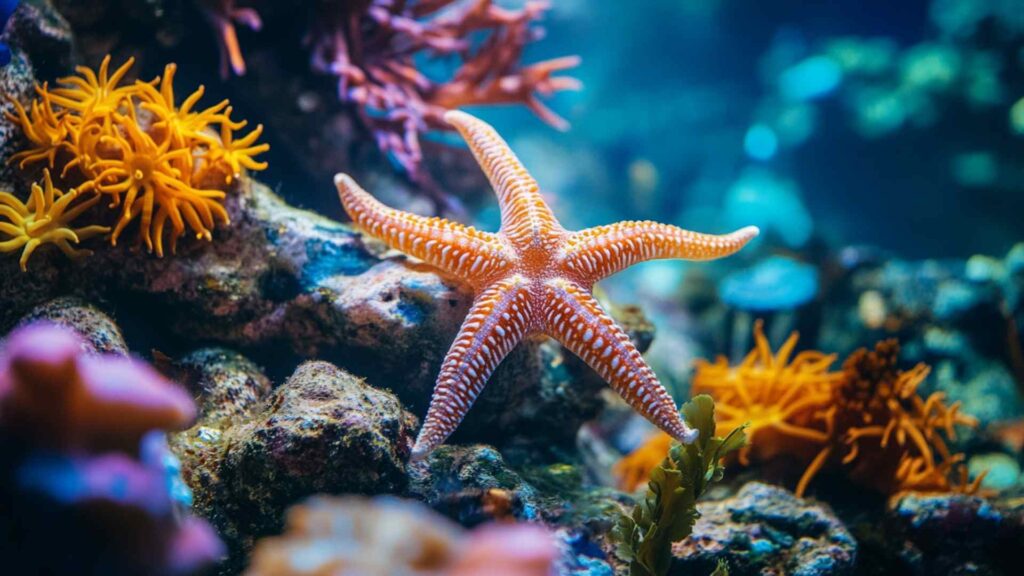
Q: How do sea stars move and feed without bones?
A: Using tube feet powered by a water vascular system.
Q: Why is horseshoe crab blood valuable to medicine?
A: It detects bacterial endotoxins (LAL test).
Q: Which tiny jelly can revert its adult form back to a juvenile polyp stage?
A: Turritopsis dohrnii, the “immortal jellyfish.”
Deep Sea & Hydrothermal Vents
Q: What depth marks the start of the ocean “twilight zone”?
A: Around 200 meters.
Q: In what year were hydrothermal vents first observed by scientists?
A: 1977.
Q: What powers life at vents instead of sunlight?
A: Chemosynthesis—bacteria use chemicals like hydrogen sulfide to fix carbon.
Q: Which giant tubeworm lacks a digestive tract and hosts symbiotic bacteria?
A: Riftia pachyptila.
Q: What do we call the deepest ocean zones in trenches below ~6,000 m?
A: Hadal zones.
Q: What are xenophyophores?
A: Giant, fragile single-celled protists of the deep sea.
Q: What compound helps deep-sea fishes stabilize proteins under pressure?
A: TMAO (trimethylamine N-oxide).
Q: What’s special about many deep-sea anglerfish’s reproduction?
A: Minute males fuse to females in some species.
Q: What are brine pools on the seafloor?
A: Dense, hypersaline lakes with sharp boundaries.
Q: What is “marine snow”?
A: A slow rain of organic particles feeding deep-sea life.
Q: How do cold seeps differ from hydrothermal vents?
A: Seeps release hydrocarbons like methane at near-ambient temperatures.
Q: What tools let us explore the abyss safely?
A: Human-occupied submersibles and ROVs (remotely operated vehicles).

Polar Oceans & Ice Worlds
Q: Which ocean circles the North Pole and is rimmed by continents?
A: The Arctic Ocean.
Q: What small crustacean underpins much of the Southern Ocean food web?
A: Antarctic krill.
Q: Where do wild penguins live naturally—Arctic or Antarctic?
A: The Antarctic and other Southern Hemisphere regions (not the Arctic).
Q: Which Arctic marine mammal relies on sea ice for hunting seals?
A: The polar bear.
Q: What are brinicles?
A: Underwater “icicles” formed by super-cold brine sinking from sea ice.
Q: What’s the difference between sea ice and glacial ice?
A: Sea ice forms from freezing seawater; glacial ice forms on land from snow.
Q: What is a polynya?
A: A natural opening of water within sea ice.
Q: What photosynthetic life thrives inside sea ice brine channels?
A: Ice algae and other microalgae.
Q: Where does much of the Atlantic’s deep water form?
A: The North Atlantic, where cold, salty water sinks.
Q: Which penguin breeds on sea ice during the Antarctic winter?
A: The emperor penguin.
Q: What circulatory trick helps polar birds and mammals retain heat in flippers and feet?
A: Countercurrent heat exchange.
Q: How does multi-year sea ice differ from first-year ice?
A: It’s thicker, stronger, and generally less salty.
Marine Plants, Plankton & Food Webs
Q: What do we call drifting, photosynthetic microbes that fuel marine food webs?
A: Phytoplankton.
Q: About how much of Earth’s oxygen do marine photosynthesizers produce?
A: A large share—often estimated around half.
Q: What are animal plankton called?
A: Zooplankton.
Q: What are diatoms’ glassy shells made of?
A: Silica, forming intricate frustules.
Q: Which plankton can cause “red tides” or harmful algal blooms?
A: Some dinoflagellates and other algae.
Q: What tiny cyanobacterium may be the most abundant photosynthetic organism on Earth?
A: Prochlorococcus.
Q: Are kelps plants?
A: No, brown algae; they build underwater forests.
Q: Are seagrasses algae?
A: No, they’re true flowering plants (e.g., eelgrass).
Q: What rule of thumb describes energy transfer between trophic levels?
A: Roughly 10% passes up each level.
Q: What gelatinous filter-feeders can suddenly dominate open water?
A: Salps and related tunicates.
Q: What is a trophic cascade?
A: Top-down changes where predators affect herbivores and, in turn, primary producers.
Q: What is the “biological pump”?
A: Processes that move carbon from surface waters to the deep ocean.
People, Exploration & Conservation
Q: What does SCUBA stand for?
A: Self-Contained Underwater Breathing Apparatus.
Q: What U.S. agency studies weather and oceans, including fisheries and satellites?
A: NOAA—the National Oceanic and Atmospheric Administration.
Q: Who co-developed the Aqua-Lung and popularized ocean documentaries?
A: Jacques-Yves Cousteau (with engineer Émile Gagnan).
Q: What does ROV stand for in ocean exploration?
A: Remotely Operated Vehicle.
Q: Who led the 1985 expedition that found the wreck of RMS Titanic?
A: Robert Ballard and team.
Q: What is a marine protected area (MPA)?
A: An ocean region with rules to conserve habitats and species.
Q: What is bycatch?
A: Non-target species accidentally caught during fishing.
Q: What is ocean acidification?
A: The drop in seawater pH as CO₂ dissolves and forms carbonic acid.
Q: Why are microplastics a persistent concern?
A: Tiny, long-lasting fragments and fibers spread widely through food webs.
Q: What recent global agreement aims to protect biodiversity on the high seas?
A: The UN High Seas Treaty (BBNJ agreement).
Q: What guides help consumers choose sustainable seafood?
A: Programs like Monterey Bay Aquarium’s Seafood Watch.
Q: What environmental issue is debated for its potential impacts on abyssal ecosystems?
A: Deep-seabed mining for polymetallic nodules.

Ellie Simons creates and edits Random Trivia. She researches trivia using primary and authoritative sources whenever possible and is currently reviewing the site's older trivia library for accuracy, clarity, and playability. Read more on the About page.
About this quiz
Site editor: Ellie Simons. Read our Trivia Methodology to learn how questions are researched and updated. Page last updated: . Report an error.