
I can remember an animal’s ridiculous-looking face forever and still forget whether it lays eggs, has a backbone, or belongs anywhere near the category I put it in.
Browse the animal trivia guide for more focused question sets.
These 100 animal trivia questions mix familiar favorites with stranger discoveries, so there is room for both the casual animal lover and the person who takes the nature-documentary remote very seriously.
Playing with a group? Choose a round, have one person read the questions without the answers, and award one point per correct response. The explanations are there for the conversation afterward, not extra points.
Mammal Trivia
Start with the furry crowd, although a few of these mammals make that description feel a little generous.
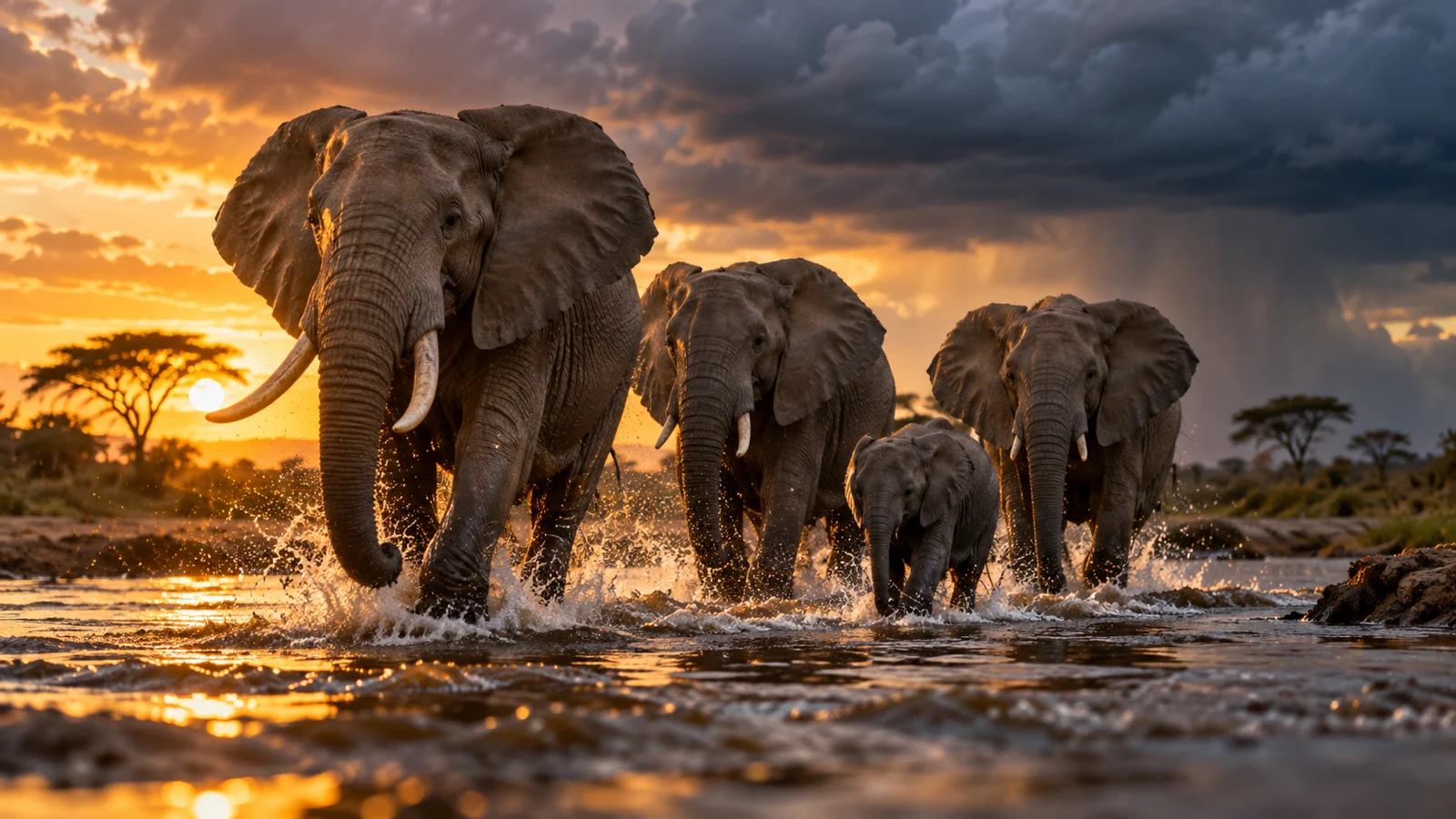
- What is the largest living land animal?
Answer: The African savanna elephant, also called the African bush elephant. - What is a social group of lions called?
Answer: A pride. - Which mammals are capable of powered flight rather than just gliding?
Answer: Bats. Flying squirrels glide, which is not the same thing. - What is a baby kangaroo called?
Answer: A joey. - What plant makes up most of a giant panda’s diet?
Answer: Bamboo. - How many neck vertebrae does a giraffe normally have?
Answer: Seven. Its neck bones are much longer than ours, not more numerous. - What are the skin-covered, hornlike structures on a giraffe’s head called?
Answer: Ossicones. - Is a koala a bear or a marsupial?
Answer: A marsupial. “Koala bear” is a nickname, not its biological classification. - What group of egg-laying mammals includes platypuses and echidnas?
Answer: Monotremes. The platypus is not the only mammal that lays eggs. - What defensive feature do male platypuses have on their hind ankles?
Answer: Venom-delivering spurs. - What are an echidna’s protective spines made of?
Answer: Keratin, the protein also found in hair and fingernails. - Does a camel store water or fat in its hump?
Answer: Fat. A hump is not a water tank. - Which broad-tailed rodent is famous for building dams?
Answer: The beaver. - What is the world’s largest living rodent?
Answer: The capybara. - Which spotted cat is the fastest land animal over short distances?
Answer: The cheetah. - Which scaly mammal curls into a ball when threatened?
Answer: The pangolin. - Which body part helps a platypus detect electrical signals from underwater prey?
Answer: Its bill. Electroreceptors help it locate food while its eyes and ears are closed underwater. - What name describes an adult male gorilla with silver-gray hair across its back?
Answer: A silverback. - Which opossum species is the only marsupial native to the United States?
Answer: The Virginia opossum. Other marsupials live farther south in North America, so the location matters. - Is a narwhal’s long tusk a horn or a tooth?
Answer: A tooth, usually an elongated upper canine in males.
Bird Trivia
Being a bird does not guarantee you can fly, and looking pink does not mean you were born that way.
- What is the largest living bird?
Answer: The ostrich. - How many toes does an ostrich have on each foot?
Answer: Two. - Which long-billed, flightless bird is a national symbol of New Zealand?
Answer: The kiwi. - What have penguin wings evolved into for underwater movement?
Answer: Flippers. - Which penguin species is the tallest and heaviest?
Answer: The emperor penguin. - Where do flamingos get the pigments that make their feathers pink?
Answer: Their food. Carotenoid pigments in algae and small animals contribute to the color. - What nutrient-rich secretion do pigeons produce to feed their chicks?
Answer: Crop milk. Despite its name, it is not mammalian milk. - What type of bird is New Zealand’s flightless kākāpō?
Answer: A parrot. - What term describes the kākāpō’s mainly nighttime activity?
Answer: Nocturnal. - What do male bowerbirds build and decorate to attract mates?
Answer: Bowers. These courtship structures are different from the nests where eggs are laid. - What do we call the compact mass of indigestible food remains an owl regurgitates?
Answer: A pellet. - Which widespread owl is known for a pale, heart-shaped face?
Answer: The barn owl. - How are a typical parrot’s four toes arranged?
Answer: Two point forward and two backward. This arrangement helps with gripping. - Which falcon is famous for its exceptionally fast hunting dive, or stoop?
Answer: The peregrine falcon. A diving-speed record is different from a level-flight record. - What protein forms much of a bird’s feathers?
Answer: Keratin.
Ocean Animal Trivia
This is my favorite round for confident wrong guesses: several creatures with “whale,” “fish,” or “crab” in their names are not what people first assume.
- What is the largest living animal on Earth?
Answer: The blue whale. - What small shrimp-like animals make up most of a blue whale’s diet?
Answer: Krill. - What structures do blue whales use instead of teeth to filter food?
Answer: Baleen plates. - Do whale calves drink milk or hatch from eggs?
Answer: They drink milk. Whales are mammals. - What material makes up most of a shark’s skeleton?
Answer: Cartilage rather than bone. - Is a whale shark a fish or a mammal?
Answer: A fish. The word “whale” refers to its impressive size, not its classification. - Orcas belong to which family of marine mammals?
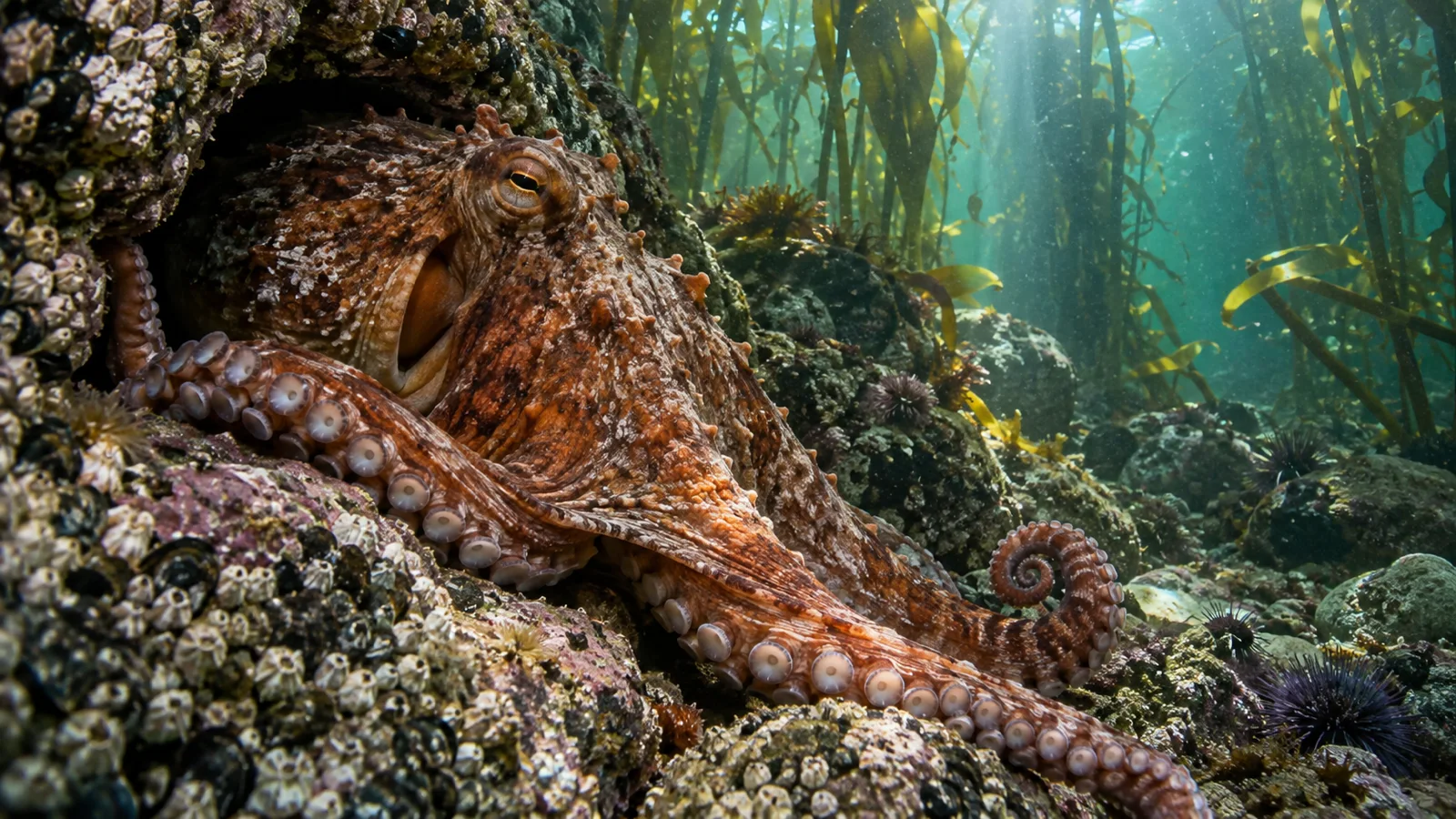
Answer: The oceanic dolphin family. - How many arms does an octopus have?
Answer: Eight. Calling them arms is more precise than calling them legs. - How many hearts does an octopus have?
Answer: Three: two supply the gills and one circulates blood around the body. - Which metal in hemocyanin helps give oxygenated octopus blood its blue color?
Answer: Copper. - What are the pigment-containing structures that help octopuses rapidly change color?
Answer: Chromatophores. - Octopuses, squid, and cuttlefish belong to which class of mollusks?
Answer: Cephalopods. - Do sea otters rely mainly on dense fur or a thick blubber layer to stay warm?
Answer: Dense fur. Keeping it clean and well groomed helps maintain its insulation. - By eating which spiny grazers can sea otters help protect kelp forests?
Answer: Sea urchins. - What hard objects do some sea otters use as tools to open shellfish?
Answer: Rocks. - In seahorses, which sex carries developing embryos in a brood pouch?
Answer: The male. - Are corals animals, plants, or rocks?
Answer: Animals. Their stationary appearance can be misleading. - What are the individual animals that make up a typical reef-building coral colony called?
Answer: Polyps. - Do jellyfish have a backbone?
Answer: No. They are invertebrates, not true fish. - Do sea turtles breathe with lungs or gills?
Answer: Lungs, so they must surface for air.
Reptile and Amphibian Trivia
Dragons, tadpoles, and an animal nicknamed a walking fish share this round, but they do not share the same family tree.
- What is the largest living lizard species?
Answer: The Komodo dragon. - Komodo dragons are native to islands in which country?
Answer: Indonesia. - What does a Komodo dragon flick out to collect chemical information from its surroundings?
Answer: Its forked tongue. - What is the larval stage of a frog commonly called?
Answer: A tadpole. - Is an axolotl a fish, lizard, or salamander?
Answer: A salamander, making it an amphibian. - What are the feathery structures extending from an axolotl’s head?
Answer: External gills. Axolotls normally retain these juvenile features as adults. - What term describes an animal that gets most of the heat needed to regulate its body temperature from its surroundings?
Answer: An ectotherm. - What is the upper part of a turtle’s shell called?
Answer: The carapace. - What is the lower part of a turtle’s shell called?
Answer: The plastron. - How many chambers does a crocodile’s heart have?
Answer: Four.
Insects and Other Small Invertebrates
The tiny animals get their turn, including a reminder that “bug” is a much looser word than “insect.”
- How many legs does a typical adult insect have?
Answer: Six. - Spiders belong to which group rather than insects?
Answer: Arachnids. - What is the name for an arthropod’s hard outer skeleton?
Answer: An exoskeleton. - What process allows an arthropod to shed its old outer covering as it grows?
Answer: Molting, also called ecdysis. - What dance do honeybees use to communicate the direction and distance of a food source?
Answer: The waggle dance. - What chemical signals do many ants use to mark trails to food?
Answer: Pheromones. - Are fireflies flies or beetles?
Answer: Beetles. - What is the production of light by a living organism called?
Answer: Bioluminescence. - What are the four stages of a butterfly’s life cycle?
Answer: Egg, larva, pupa, and adult. - Do dragonfly nymphs usually develop in water or dry soil?
Answer: Water. - What is a butterfly’s larva commonly called?
Answer: A caterpillar. - Are worker honeybees male or female?
Answer: Female. - What do bees transfer between flowers during pollination?
Answer: Pollen. - What does a praying mantis use its spiny front legs for?
Answer: Grasping prey. - What are the small external openings that lead into an insect’s breathing system called?
Answer: Spiracles.
Extinct and Prehistoric Animal Trivia
Fossils tell wonderful stories, but not every ancient reptile was a dinosaur and not every animal with “saber-toothed” in its nickname was a tiger.
- The extinct dodo was native to which Indian Ocean island?
Answer: Mauritius. - Woolly mammoths were close relatives of which living animals?
Answer: Elephants. Being related does not make mammoths the direct ancestors of modern elephants. - How many prominent facial horns did Triceratops have?
Answer: Three. - Which dinosaur is known for two rows of large plates along its back?
Answer: Stegosaurus. - Was Tyrannosaurus rex primarily a meat-eater or a plant-eater?
Answer: A meat-eater. - Were pterosaurs dinosaurs or a separate group of flying reptiles?
Answer: A separate group of flying reptiles. - Were ichthyosaurs fish or marine reptiles?
Answer: Marine reptiles, despite their fishlike or dolphinlike body shapes. - What fossilized tree material sometimes preserves ancient insects?
Answer: Amber, which forms from resin rather than ordinary tree sap. - What type of fossil records an animal’s activity, such as a footprint or burrow?
Answer: A trace fossil. - Which living group of animals belongs to the dinosaur family tree?
Answer: Birds. They evolved from theropod dinosaurs.
Wildlife Conservation Trivia
This last round focuses on habitats and conservation terms rather than population numbers that can quickly become outdated.
- What does IUCN stand for?
Answer: International Union for Conservation of Nature. - Which three IUCN Red List categories collectively describe species threatened with extinction?
Answer: Vulnerable, Endangered, and Critically Endangered. - What does it mean when a species is endemic to a place?
Answer: It occurs naturally there and nowhere else. - Is the vaquita a dolphin or a porpoise?
Answer: A porpoise. - In which Mexican gulf is the vaquita found?
Answer: The Gulf of California, specifically its northern waters. - What fishing equipment poses the main direct threat to vaquitas through entanglement?
Answer: Gillnets. - What floating habitat do polar bears rely on to hunt seals?
Answer: Sea ice. - What word describes an animal, such as a condor, that feeds on the remains of dead animals?
Answer: A scavenger. - What microscopic partners do many corals lose during bleaching?
Answer: The symbiotic algae living in their tissues. Bleaching stresses coral, but does not automatically mean it has died. - What protein makes up most of a rhinoceros horn?
Answer: Keratin. The horn is not made of ivory.
Sources and Answer Notes
For the egg-laying mammals, the Australian Museum explains platypuses and echidnas, including the platypus’s sensory bill and male venom spurs. San Diego Zoo provides the giraffe anatomy reference, while New Zealand’s Department of Conservation covers the kākāpō.
The Monterey Bay Aquarium and NOAA Fisheries support the marine-animal questions. The Natural History Museum explains the bird-dinosaur connection, and the IUCN Red List defines the conservation categories.
Found an unclear answer? Please report a correction with the question number. The editorial policy explains how corrections are handled.
Pick Your Next Round
Stay curious with science trivia, try a younger crowd with kids trivia, or hand your most competitive friend the hard trivia questions.

Ellie Simons creates and edits Random Trivia. She researches trivia using primary and authoritative sources whenever possible and is currently reviewing the site's older trivia library for accuracy, clarity, and playability. Read more on the About page.
About this quiz
Site editor: Ellie Simons. Read our Trivia Methodology to learn how questions are researched and updated. Page last updated: . Report an error.