
Pickleball borrowed a court, found a perforated ball, and somehow made the kitchen the most competitive room in sports.
These pickleball trivia questions use the 2026 USA Pickleball rulebook for rules, scoring, equipment, and terminology.
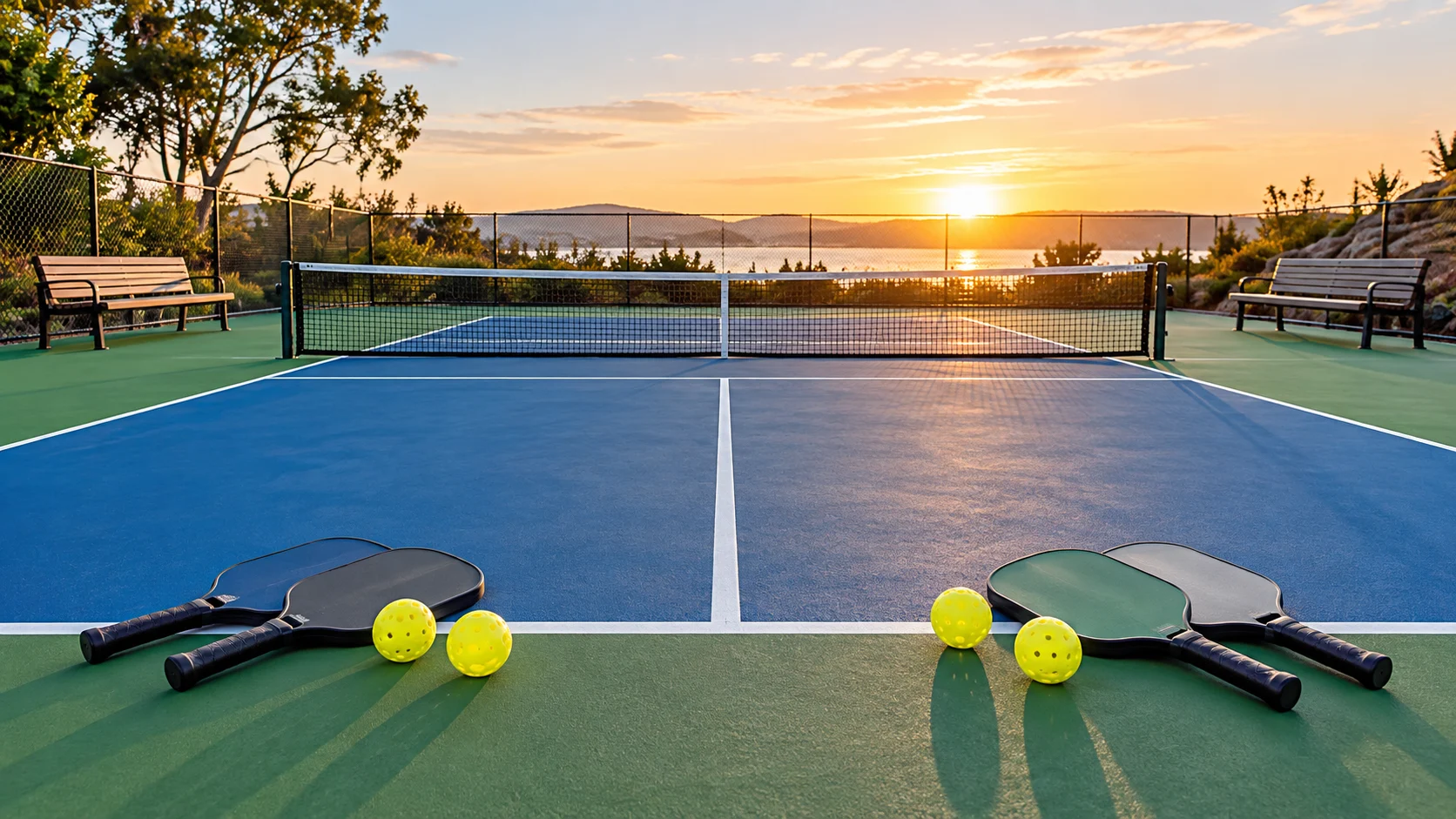
Court Lines, Nets, and Equipment
Start by measuring the court and identifying the gear before anyone calls the score.
- What are the dimensions of a regulation pickleball court?
Answer: 20 feet by 44 feet - Are singles and doubles played on the same court dimensions?
Answer: Yes - How high is the net at the sidelines?
Answer: 36 inches - How high is the net at the center?
Answer: 34 inches - What is the common nickname for the non-volley zone?
Answer: The kitchen - How far does the non-volley zone extend from the net on each side?
Answer: Seven feet - What line divides the right and left service courts?
Answer: The centerline - What line marks the back of the court?
Answer: The baseline - What lines mark the sides of the court?
Answer: The sidelines - What type of ball is used in pickleball?
Answer: A hollow perforated plastic ball - What piece of equipment strikes the ball?
Answer: A paddle - Can an approved pickleball paddle have strings like a tennis racket?
Answer: No - What materials are common in modern paddle faces?
Answer: Composite materials such as carbon fiber, fiberglass, or graphite - What organization publishes an approved paddle list for sanctioned U.S. play?
Answer: USA Pickleball - How should indoor and outdoor balls commonly differ?
Answer: They may differ in hole size, number, weight, and material for conditions
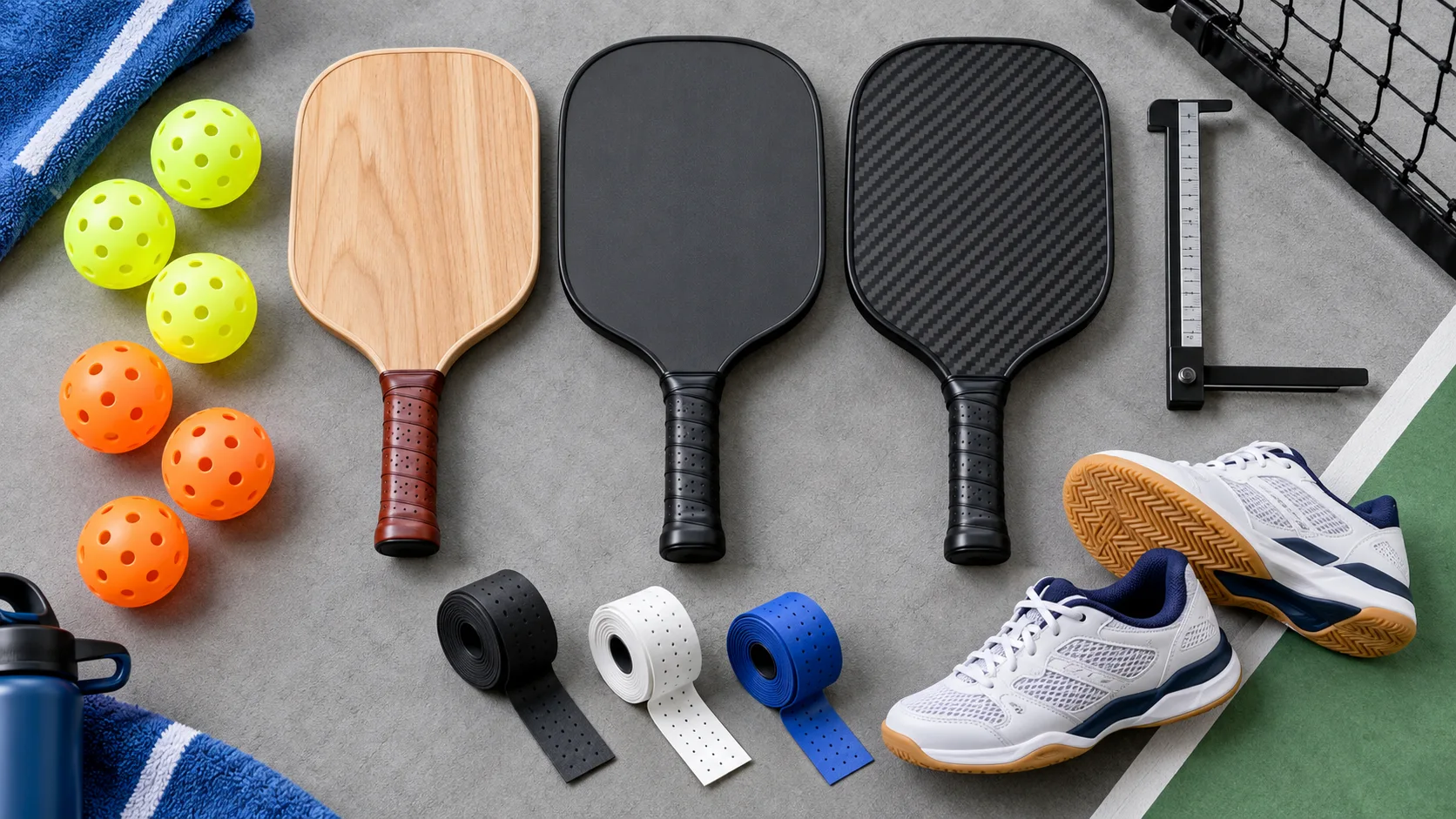
Serving Under the 2026 Rules
These answers follow USA Pickleball's 2026 rulebook, including placement, motion, and what happens when the net gets involved.
- Where must a serve land?
Answer: In the diagonally opposite service court - Must a serve clear the non-volley zone and its line?
Answer: Yes - Can a serve land on a sideline or baseline?
Answer: Yes - Is the non-volley-zone line in on a serve?
Answer: No, a serve touching it is a fault - Where must at least one server foot be when the ball is served?
Answer: On the playing surface behind the baseline - May a server foot touch the baseline at contact?
Answer: No - May a server stand beyond the imaginary extension of a sideline?
Answer: No - What are the two legal service methods?
Answer: Volley serve and drop serve - Does a drop serve require the same upward-motion rules as a volley serve?
Answer: No - May a server propel the ball downward before a drop serve bounce?
Answer: No - Must the score be called before the serve?
Answer: Yes - What happens if a serve touches the net and lands correctly?
Answer: Play continues; it is legal - Is the old service let replay still used for a net-touching legal serve?
Answer: No - Can a receiver be awarded a point for being struck by an otherwise legal serve before it bounces?
Answer: The serving side scores if the receiver or partner is hit before a fault occurs - Which player serves first in a standard doubles game?
Answer: The player starting in the right service court
Standard Scoring and Service Sequence
Keep the three-number doubles score straight and the rest of the game gets much friendlier.
- Under traditional side-out scoring, which side can score a point?
Answer: The serving side - What score is a standard game commonly played to?
Answer: 11 points - By how many points must a team win a standard game?
Answer: Two - What is the first number called in a doubles score?
Answer: The serving team's score - What is the second number in a doubles score?
Answer: The receiving team's score - What does the third number in a doubles score identify?
Answer: Whether the first or second server is serving - Why is the opening doubles score commonly called 0-0-2?
Answer: The starting team begins with only one service turn - At an even team score, from which side should the correct starting server serve?
Answer: The right side - At an odd team score, where should that starting server be?
Answer: The left side - After scoring a point, what does the server do?
Answer: Switches service courts and serves again - Do receiving partners switch sides when the serving team scores?
Answer: No - When does service pass to a doubles partner during a normal turn?
Answer: After the first server loses a rally - When does service pass to the opponents?
Answer: After both partners have lost their serves, except at the game's start - How is a singles score normally called?
Answer: Server score, receiver score - Does USA Pickleball's 2026 rulebook include a provisional rally-scoring option for specified play?
Answer: Yes
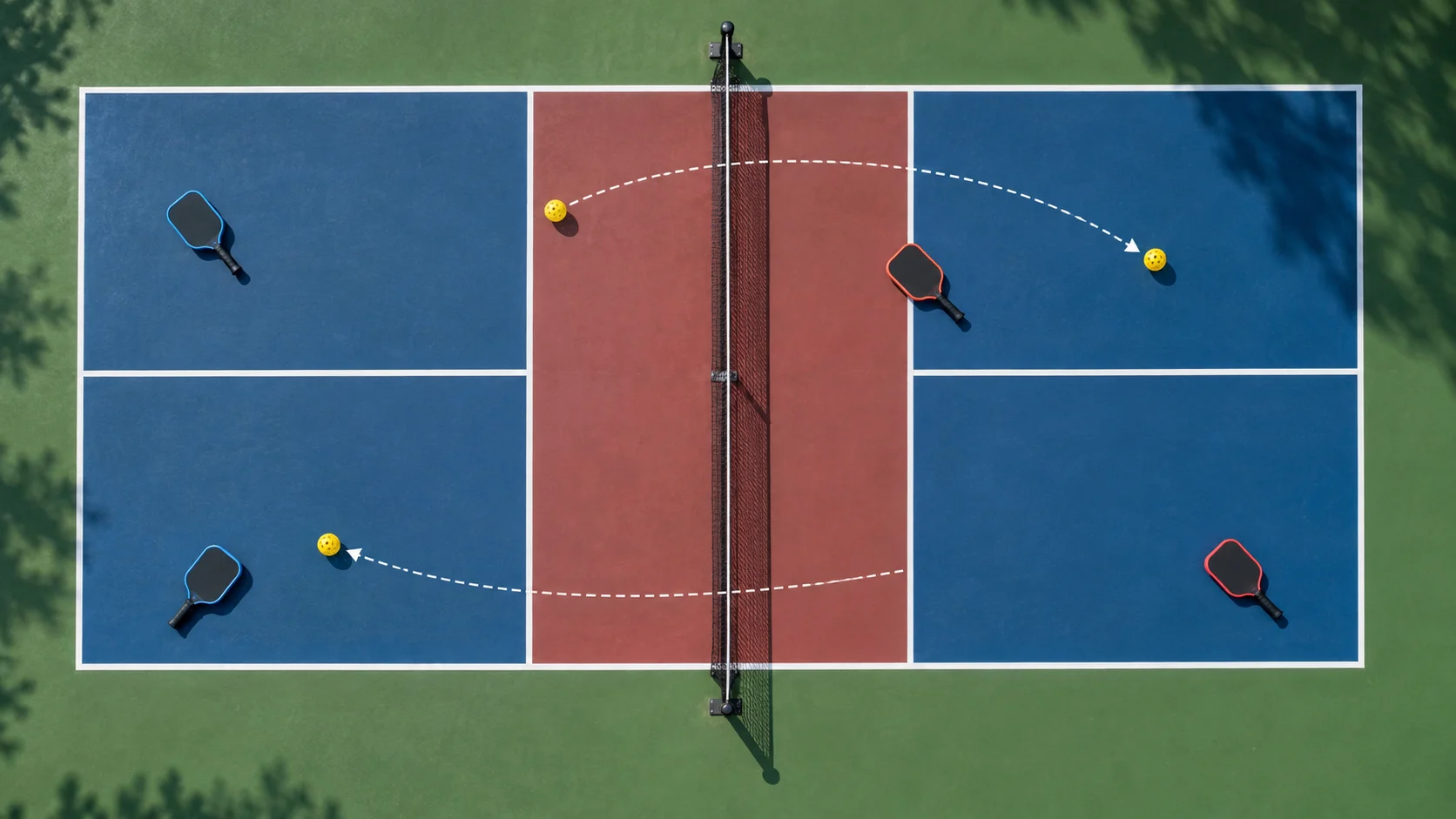
The Two-Bounce Rule and the Kitchen
This is where the sport's most famous restrictions prevent every rally from becoming a net-side smash festival.
- What is the two-bounce rule also called?
Answer: The two-bounce rule or two-bounce requirement - What must the receiving team do with the serve?
Answer: Let it bounce before returning - What must the serving team do with the return?
Answer: Let it bounce before striking it - After those two bounces, may either side volley?
Answer: Yes, if otherwise legal - What is a volley?
Answer: Striking the ball before it bounces - May a player volley while standing in the non-volley zone?
Answer: No - May a player stand in the kitchen when not volleying?
Answer: Yes - May a player enter the kitchen to play a ball that has bounced there?
Answer: Yes - What creates a non-volley-zone momentum fault?
Answer: A volley carries the player or anything connected to the player into the zone - Can momentum cause a kitchen fault even after the ball becomes dead?
Answer: Yes - May a volleying player's paddle touch the kitchen?
Answer: No - Is the non-volley-zone line part of the zone?
Answer: Yes - Can a player's partner stop the volleying player's momentum before a zone violation?
Answer: Yes, if the partner does not create another fault - What shot softly arcs into the opponent's kitchen from near the kitchen line?
Answer: A dink - What attacking shot is hit out of the air near the non-volley line?
Answer: A volley
Faults, Line Calls, and Replays
Good calls depend on clear rules, prompt judgment, and giving opponents the benefit of doubt.
- What happens when a served ball lands outside the correct service court?
Answer: A fault - What happens when a player hits the ball into the net and it fails to cross?
Answer: A fault - What happens when the ball bounces twice before being returned?
Answer: A fault - What happens when a player touches the net while the ball is live?
Answer: A fault - Who normally makes line calls on a team's side in unofficiated play?
Answer: The players on that side - If players are uncertain whether an opponent's ball was out, how should it be called?
Answer: In - What part of a ball must contact outside the line for an out call?
Answer: The part contacting the ground must be completely outside - Are balls touching a boundary line in during rallies?
Answer: Yes - What is the serve-line exception to ordinary line rules?
Answer: A serve touching the non-volley-zone line is a fault - Should an out call be made promptly?
Answer: Yes - May spectators make binding line calls?
Answer: No - What is a replay?
Answer: Playing the rally again without awarding the rally result - What outside event can justify a replay?
Answer: Outside interference such as another ball entering the court - What is a hinder?
Answer: A transient event not caused by a player that affects play - Can a cracked or broken ball lead to a replay under rulebook conditions?
Answer: Yes
Shots, Strategy, and Doubles Positioning
Once the rules are comfortable, placement and patience become every bit as important as pace.
- What is the third-shot drop?
Answer: A soft third shot intended to land in the opponent's kitchen - What is a third-shot drive?
Answer: A hard attacking shot on the serving team's third stroke - What is a dink rally?
Answer: An exchange of soft shots landing in the kitchen - What is an Erne?
Answer: A volley hit from outside the sideline near the net - What is an ATP shot?
Answer: An around-the-post shot - Does an around-the-post shot need to pass above the net?
Answer: No - What is a lob?
Answer: A high shot sent over opponents toward the baseline - What is an overhead?
Answer: A forceful shot hit above the head - What is a reset?
Answer: A soft defensive shot used to neutralize an attack - What is the transition zone's common nickname?
Answer: No man's land - What is stacking in doubles?
Answer: Starting or moving in an arranged formation to keep preferred sides - Why might partners stack?
Answer: To preserve forehand or matchup preferences - What is poaching?
Answer: Crossing into a partner's area to intercept a shot - What is a speed-up?
Answer: A sudden hard attack from a slower exchange - What does kitchen-line positioning often reduce?
Answer: Open angles and reaction time for opponents
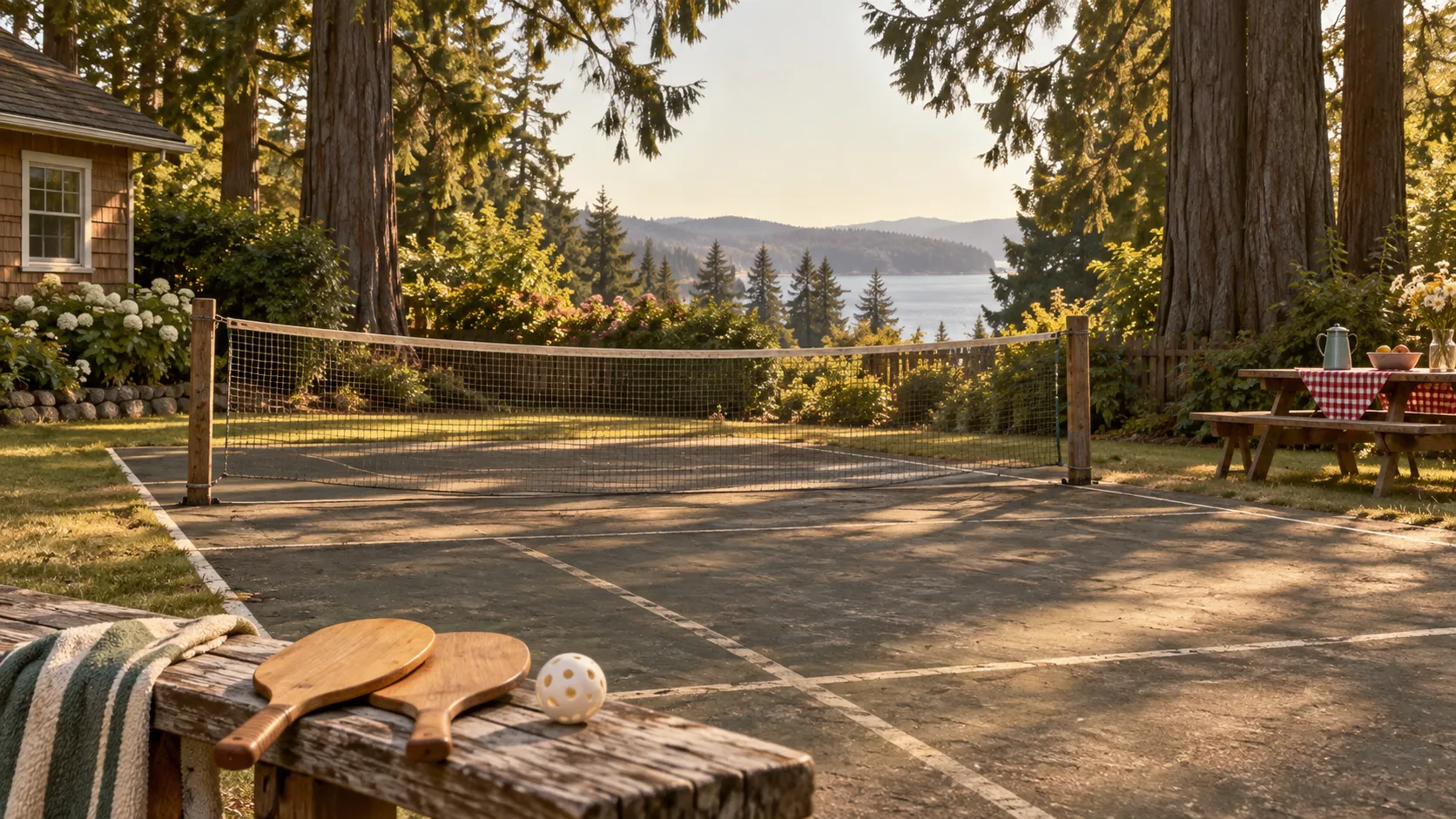
How Pickleball Began
The origin story starts on a Washington island with bored families and improvised equipment.
- In what year was pickleball invented?
Answer: 1965 - Where was pickleball invented?
Answer: Bainbridge Island, Washington - Which three men are credited as the sport's founders?
Answer: Joel Pritchard, Bill Bell, and Barney McCallum - What existing court did the founders first use?
Answer: A badminton court - What did they use as early paddles?
Answer: Ping-pong paddles - What kind of ball did they use?
Answer: A perforated plastic ball - How high was the net at first?
Answer: Badminton height, about 60 inches - To what height was the net soon lowered at the sidelines?
Answer: 36 inches - What was the founders' stated goal for the game?
Answer: A pastime the whole family could play - Which sport heavily influenced the first written rules?
Answer: Badminton - Why is the origin of the name pickleball debated?
Answer: Accounts differ between a pickle boat and the dog Pickles - Who said the mixed-sport game reminded her of a pickle boat?
Answer: Joan Pritchard - What was the Pritchard family dog's name?
Answer: Pickles - Did the dog necessarily exist before the game was first played?
Answer: Accounts indicate the dog may have arrived later - In what year was the first official pickleball rulebook published?
Answer: 1984
Organizations, Competition, and Modern Pickleball
Finish with the groups, formats, and rating terms that organize the game's fast-growing competitive side.
- What is the U.S. national governing body that maintains the official rulebook?
Answer: USA Pickleball - What abbreviation did USA Pickleball previously use?
Answer: USAPA - What does UTPR stand for?
Answer: USA Pickleball Tournament Player Rating - What does DUPR stand for?
Answer: Dynamic Universal Pickleball Rating - What format pairs one man and one woman on each doubles team?
Answer: Mixed doubles - What format uses one player on each side?
Answer: Singles - What format uses two players on each side?
Answer: Doubles - What is wheelchair pickleball?
Answer: Pickleball played with rule adaptations for wheelchair athletes - Under wheelchair rules, how many bounces may the ball take?
Answer: Two, with the second allowed anywhere - What event is governed by an organizer under a published competition format?
Answer: A tournament - What is a round-robin format?
Answer: Each entrant plays multiple scheduled opponents in a group - What is single elimination?
Answer: A format where one loss removes a player or team - What is double elimination?
Answer: A format that generally requires two losses for elimination - What document works with the rulebook to regulate paddles and balls?
Answer: The USA Pickleball Equipment Standards Manual - When did the 2026 USA Pickleball rulebook take effect?
Answer: January 1, 2026
Keep the game going with sports trivia, tennis trivia, Olympics trivia, and volleyball trivia.
Sources and Further Reading
- USA Pickleball 2026 official rulebook
- USA Pickleball equipment standards
- USA Pickleball history
- USA Pickleball referee resources
- International Federation of Pickleball

Ellie Ewert is the founder and author of RandomTrivia.co, blending her passion for research with years of experience in content creation to deliver accurate, engaging, and well-sourced trivia. Dedicated to providing readers with trustworthy and entertaining facts, she applies meticulous fact-checking and SEO expertise to ensure every article meets the highest standards. Read more about our high standards in our Editorial Guidelines.