
Look up for stars and constellations trivia filled with blazing giants, stellar nurseries, ancient sky patterns, and handy celestial signposts.
These questions travel from our own Sun to the far reaches of the Milky Way without requiring a telescope or a midnight alarm.
How Stars Shine
Q: What is a star primarily made of?
A: Hot plasma, mostly hydrogen and helium.
Q: What process powers a main-sequence star?
A: Nuclear fusion.
Q: What element do main-sequence stars fuse in their cores?
A: Hydrogen.
Q: What element is produced when hydrogen fuses in a Sun-like star?
A: Helium.
Q: What inward force tries to collapse a star?
A: Gravity.
Q: What outward effect balances gravity in a stable star?
A: Pressure from hot gas and radiation.
Q: What is the balance between inward gravity and outward pressure called?
A: Hydrostatic equilibrium.
Q: What is the visible surface of a star called?
A: The photosphere.
Q: What stellar layer lies just above the photosphere?
A: The chromosphere.
Q: What is the Sun's hot outer atmosphere called?
A: The corona.
Q: Why do stars appear to twinkle from Earth?
A: Turbulence in Earth's atmosphere bends their light.
Q: Do stars usually twinkle as much when viewed from space?
A: No.
Q: What unit measures enormous distances to stars using the distance light travels in one year?
A: A light-year.
Q: Is a light-year a unit of time or distance?
A: Distance.
Q: What unit equal to about 3.26 light-years is widely used by astronomers?
A: A parsec.

A Star Is Born and Grows Up
Q: What cloud of gas and dust can give birth to stars?
A: A nebula.
Q: What is a forming star called before sustained hydrogen fusion begins?
A: A protostar.
Q: What long, stable stage includes the Sun?
A: The main sequence.
Q: What property most strongly determines a star's life cycle?
A: Its mass.
Q: Which burns through fuel faster, a high-mass star or a low-mass star?
A: A high-mass star.
Q: Which generally lives longer, a red dwarf or a blue giant?
A: A red dwarf.
Q: What does a Sun-like star become after exhausting hydrogen in its core?
A: A red giant.
Q: What glowing shell may a Sun-like star shed late in life?
A: A planetary nebula.
Q: Does a planetary nebula contain newly formed planets?
A: No.
Q: What compact remnant does a Sun-like star leave behind?
A: A white dwarf.
Q: What supports a white dwarf against further collapse?
A: Electron degeneracy pressure.
Q: What explosive death can occur when a massive star's core collapses?
A: A supernova.
Q: What ultradense remnant may remain after a core-collapse supernova?
A: A neutron star.
Q: What can the most massive collapsing stellar cores form?
A: Black holes.
Q: Where were many elements heavier than helium forged?
A: In stars and stellar explosions.
Color, Temperature, and Starlight
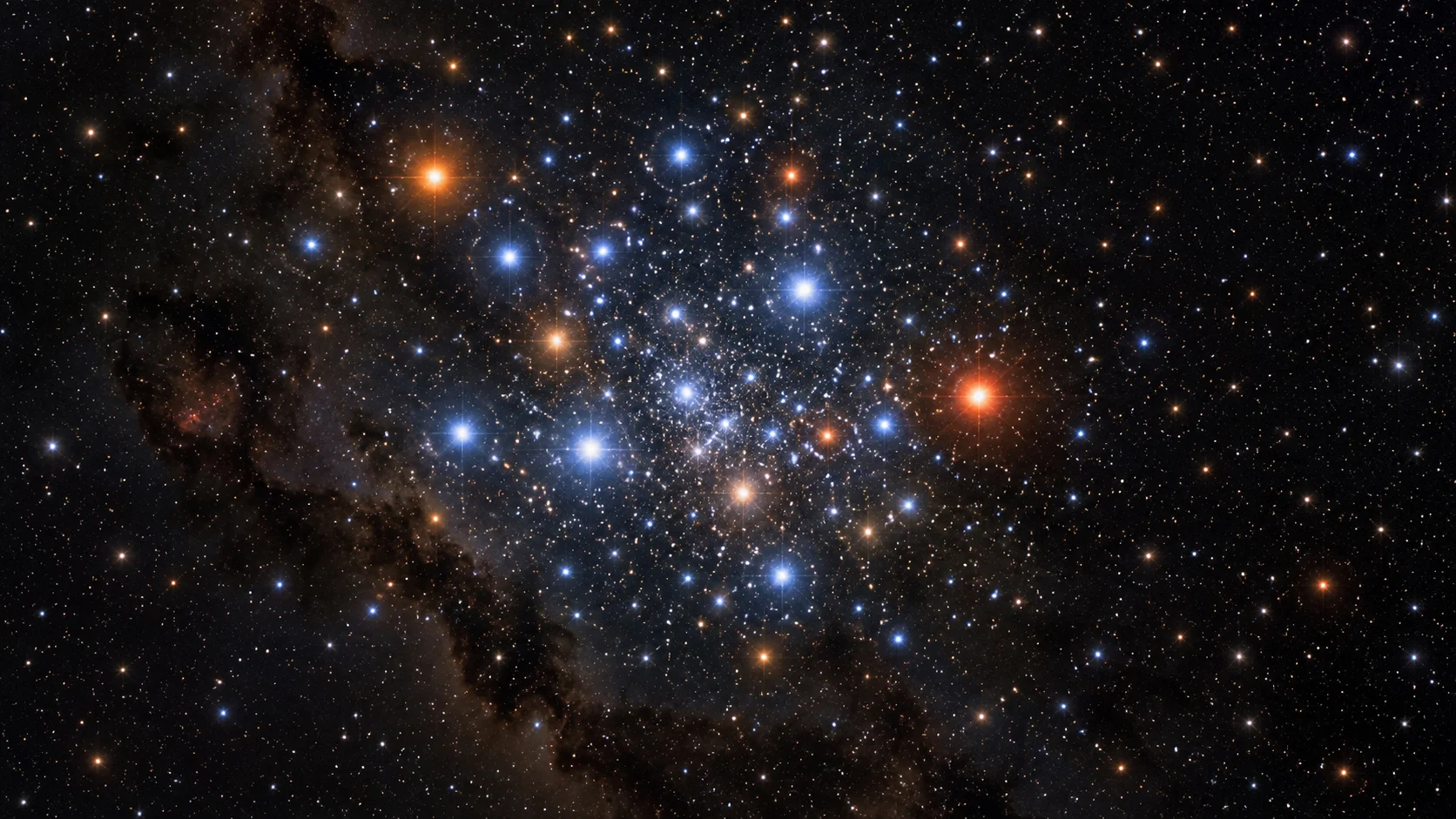
Q: Which is hotter, a blue star or a red star?
A: A blue star.
Q: What color are the coolest common stars?
A: Red.
Q: What color does the Sun appear from space?
A: White.
Q: What sequence orders stars from hottest to coolest?
A: O, B, A, F, G, K, M.
Q: What spectral class is the Sun?
A: G2 V.
Q: What does the V in the Sun's G2 V classification indicate?
A: It is a main-sequence star.
Q: What instrument spreads starlight into a spectrum?
A: A spectrograph.
Q: What dark lines in a stellar spectrum reveal elements in a star's atmosphere?
A: Absorption lines.
Q: What shift toward longer wavelengths can show that a star is moving away?
A: Redshift.
Q: What shift toward shorter wavelengths can show that a star is approaching?
A: Blueshift.
Q: What chart plots stars by luminosity and temperature?
A: The Hertzsprung-Russell diagram.
Q: Where do most stars fall on the Hertzsprung-Russell diagram?
A: Along the main sequence.
Q: What term describes a star's true energy output?
A: Luminosity.
Q: What term describes how bright a star looks from Earth?
A: Apparent brightness.
Q: On the magnitude scale, is a first-magnitude star brighter or fainter than a sixth-magnitude star?
A: Brighter.
Our Sun and Stellar Neighbors
Q: What is the closest star to Earth?
A: The Sun.
Q: About how long does sunlight take to reach Earth?
A: About eight minutes and twenty seconds.
Q: What is the closest star to the Sun?
A: Proxima Centauri.
Q: About how far away is Proxima Centauri?
A: About 4.24 light-years.
Q: What three-star system includes Proxima Centauri?
A: Alpha Centauri.
Q: What is the brightest star in Earth's night sky?
A: Sirius.
Q: In which constellation is Sirius found?
A: Canis Major.
Q: What nickname is commonly given to Sirius?
A: The Dog Star.
Q: What is the second-brightest star in the night sky?
A: Canopus.
Q: What is the closest star system visible to the naked eye after the Sun?
A: Alpha Centauri.
Q: What red supergiant marks a shoulder of Orion?
A: Betelgeuse.
Q: What blue supergiant marks one of Orion's feet?
A: Rigel.
Q: What bright red star marks the eye of Taurus?
A: Aldebaran.
Q: What bright star in Lyra is part of the Summer Triangle?
A: Vega.
Q: What bright star in Scorpius has a name meaning rival of Mars?
A: Antares.
Constellation Essentials
Q: What is a constellation in modern astronomy?
A: An officially defined region of the sky.
Q: How many official constellations are recognized by the International Astronomical Union?
A: 88.
Q: Are the stars in a constellation necessarily close together in space?
A: No.
Q: What is an informal star pattern that is not an official constellation called?
A: An asterism.
Q: Is the Big Dipper a constellation or an asterism?
A: An asterism.
Q: Which constellation contains the Big Dipper?
A: Ursa Major.
Q: What does Ursa Major mean in Latin?
A: Greater Bear.
Q: Which constellation contains the Little Dipper?
A: Ursa Minor.
Q: What star sits near the north celestial pole?
A: Polaris.
Q: Is Polaris the brightest star in the night sky?
A: No.
Q: What two Big Dipper stars point toward Polaris?
A: Merak and Dubhe.
Q: What familiar constellation is known for three stars in a straight belt?
A: Orion.
Q: What W-shaped constellation is named for a mythological queen?
A: Cassiopeia.
Q: What is the largest constellation by area?
A: Hydra.
Q: What is the smallest constellation by area?
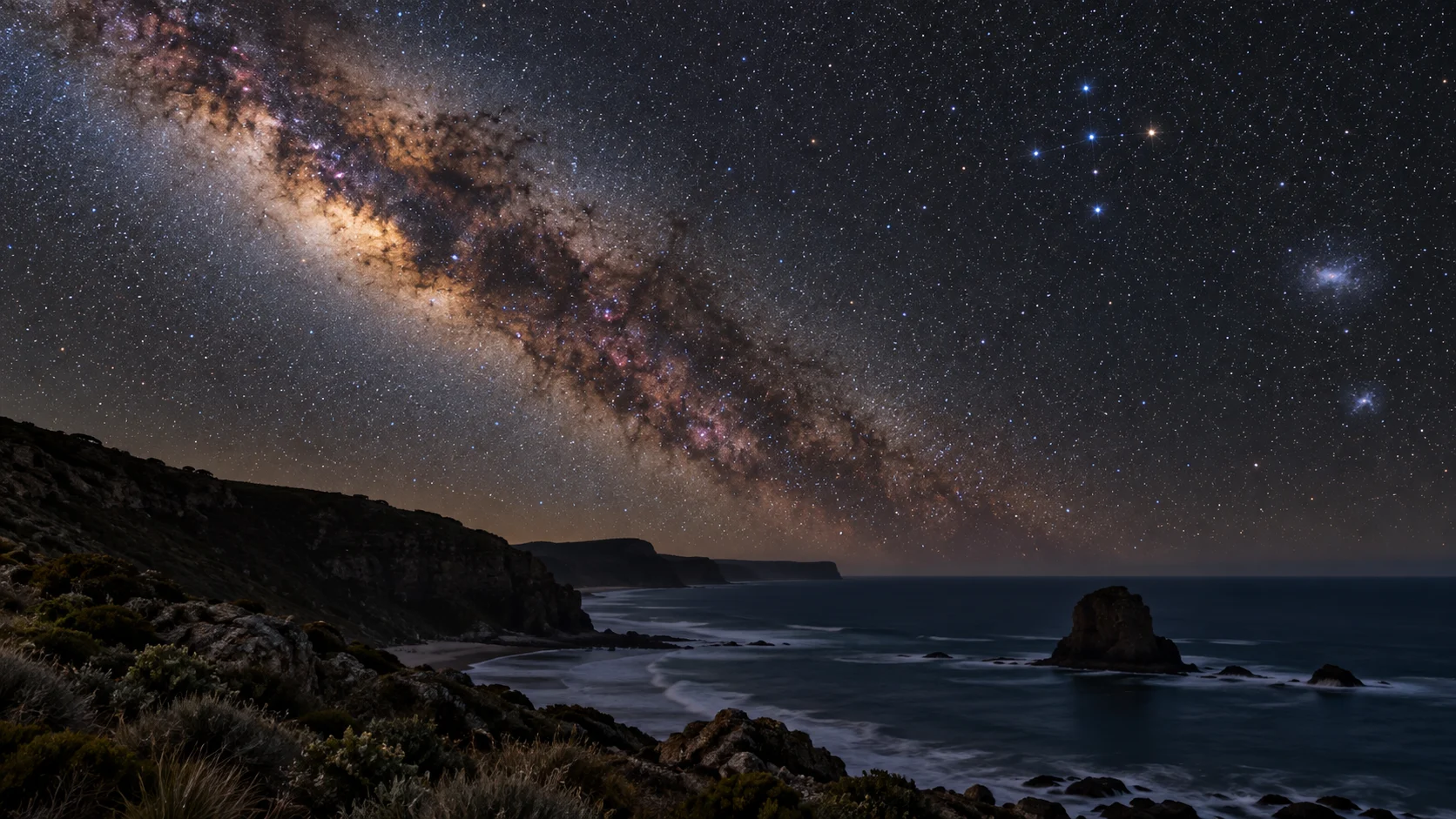
A: Crux.
Zodiac and Seasonal Skies
Q: What imaginary path does the Sun appear to follow across the sky?
A: The ecliptic.
Q: What group of constellations lies along the ecliptic?
A: The zodiac.
Q: Which zodiac constellation is represented by a ram?
A: Aries.
Q: Which zodiac constellation is represented by a bull?
A: Taurus.
Q: Which zodiac constellation represents twins?
A: Gemini.
Q: Which zodiac constellation is represented by a crab?
A: Cancer.
Q: Which zodiac constellation is represented by a lion?
A: Leo.
Q: Which zodiac constellation is often represented by a maiden?
A: Virgo.
Q: Which zodiac constellation is represented by scales?
A: Libra.
Q: Which zodiac constellation is represented by a scorpion?
A: Scorpius.
Q: Which zodiac constellation is represented by an archer?
A: Sagittarius.
Q: Which zodiac constellation is represented by a sea goat?
A: Capricornus.
Q: Which zodiac constellation is represented by a water bearer?
A: Aquarius.
Q: Which zodiac constellation is represented by two fish?
A: Pisces.
Q: Which constellation along the ecliptic is often called the zodiac's unofficial 13th member?
A: Ophiuchus.
Clusters, Multiple Stars, and Deep-Sky Sights
Q: What famous star cluster in Taurus is also called the Seven Sisters?
A: The Pleiades.
Q: What V-shaped star cluster forms the face of Taurus?
A: The Hyades.
Q: Is Aldebaran physically part of the Hyades cluster?
A: No.
Q: What kind of cluster is the Pleiades?
A: An open cluster.
Q: What kind of cluster packs old stars into a roughly spherical swarm?
A: A globular cluster.
Q: What bright globular cluster lies in Hercules?
A: Messier 13.
Q: What is a binary star system?
A: Two stars gravitationally bound in orbit around each other.
Q: What kind of binary is detected through periodic changes in brightness as its stars pass in front of each other?
A: An eclipsing binary.
Q: What famous eclipsing binary in Perseus is nicknamed the Demon Star?
A: Algol.
Q: What double star in the Big Dipper's handle pairs with Alcor?
A: Mizar.
Q: What giant stellar nursery is visible in Orion's sword?
A: The Orion Nebula.
Q: What catalog designation does the Orion Nebula have?
A: Messier 42.
Q: What expanding remnant in Taurus was created by a supernova seen in 1054?
A: The Crab Nebula.
Q: What rapidly spinning neutron star sits inside the Crab Nebula?
A: The Crab Pulsar.
Q: What fuzzy object in Andromeda is the nearest large galaxy to the Milky Way?
A: The Andromeda Galaxy.
Finding Your Way by the Stars
Q: Which direction does Polaris indicate for observers in the Northern Hemisphere?
A: North.
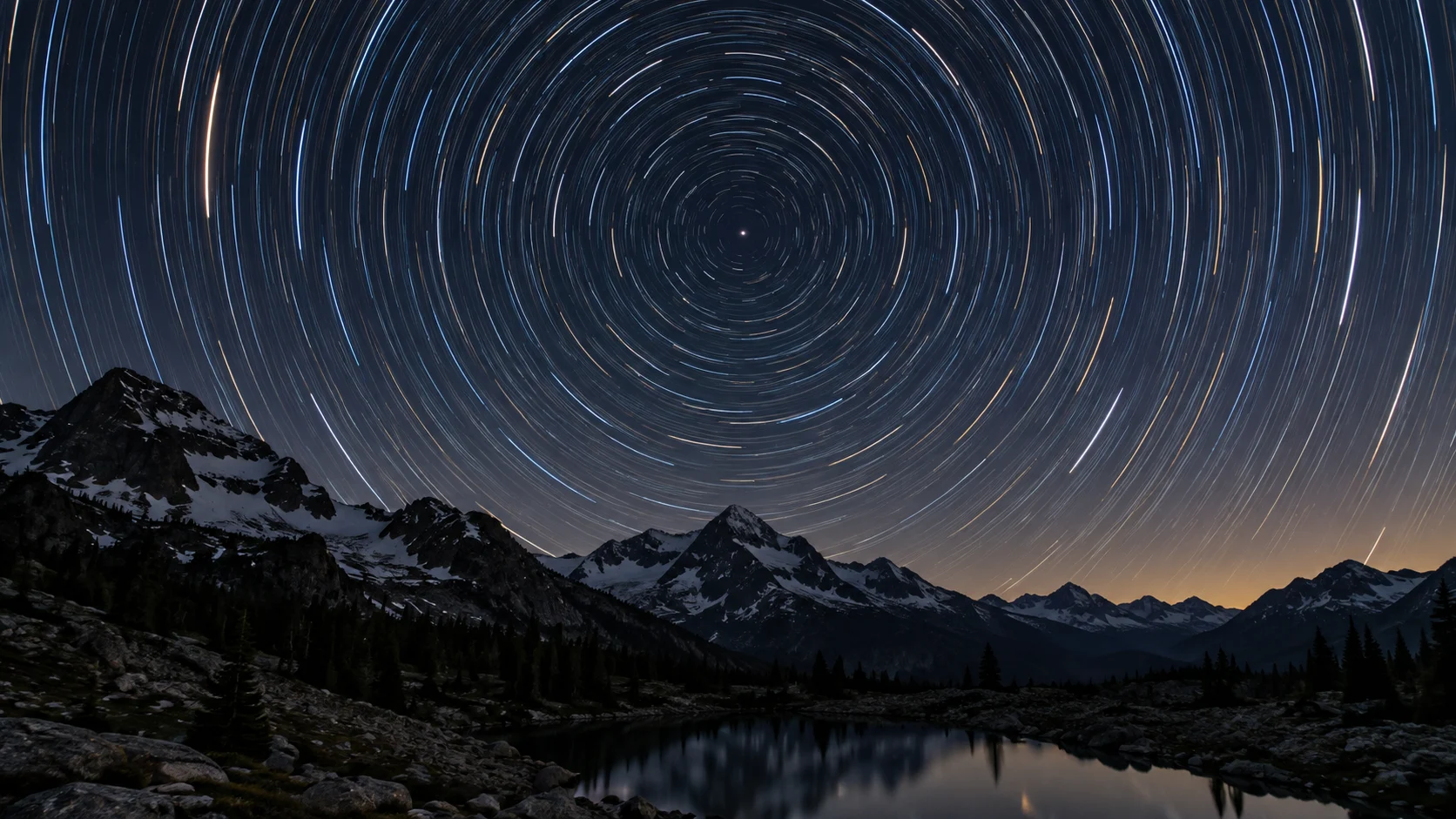
Q: Why does Polaris appear nearly fixed while other stars circle it?
A: It lies close to the north celestial pole.
Q: What constellation contains Polaris?
A: Ursa Minor.
Q: What cross-shaped constellation helps observers find south in the Southern Hemisphere?
A: Crux, the Southern Cross.
Q: What two bright stars are commonly called the Southern Pointers?
A: Alpha Centauri and Beta Centauri.
Q: What three bright stars form the Summer Triangle?
A: Vega, Deneb, and Altair.
Q: Which constellation contains Deneb?
A: Cygnus.
Q: Which constellation contains Altair?
A: Aquila.
Q: What winter asterism includes Sirius, Procyon, and Betelgeuse?
A: The Winter Triangle.
Q: What coordinate system uses right ascension and declination?
A: The celestial coordinate system.
Q: What is the point directly overhead called?
A: The zenith.
Q: What circle divides the visible sky from the part hidden by Earth?
A: The horizon.
Q: What instrument measures the altitude of a celestial object for navigation?
A: A sextant.
Q: What ancient star cataloging work by Ptolemy described 48 constellations?
A: The Almagest.
Q: What organization standardized the 88 modern constellations?
A: The International Astronomical Union.
Your Score Is Written in the Stars
If you charted all 120 questions, you have officially earned a constellation-sized brag. Follow your curiosity into more bright ideas with our famous people trivia and decades trivia.

Ellie Ewert is the founder and author of RandomTrivia.co, blending her passion for research with years of experience in content creation to deliver accurate, engaging, and well-sourced trivia. Dedicated to providing readers with trustworthy and entertaining facts, she applies meticulous fact-checking and SEO expertise to ensure every article meets the highest standards. Read more about our high standards in our Editorial Guidelines.