
Hoist the colors and mind the powder barrel, because pirate history is wilder, stranger, and far less tidy than the movies suggest.
These questions sail from ancient Mediterranean raiders to Caribbean privateers, formidable women, famous wrecks, and a treasure chest of myths worth busting.
Pirates, Privateers, and the Rules of the Sea
Q: What is piracy in its simplest legal sense?
A: Robbery or criminal violence at sea.
Q: What distinguished a privateer from a pirate?
A: A privateer raided enemy shipping with government authorization.
Q: What document authorized a privateer to attack enemy vessels?
A: A letter of marque.
Q: What name was given to Caribbean hunters who later became sea raiders?
A: Buccaneers.
Q: What did the French word boucan originally describe?
A: A wooden frame used for smoking meat.
Q: What broad term was often used for Mediterranean raiders operating from North Africa?
A: Barbary corsairs.
Q: What is a captured enemy ship or cargo called?
A: A prize.
Q: What court decided whether a privateer's captured ship was a lawful prize?
A: An admiralty or prize court.
Q: What written agreements set rules and shares for many pirate crews?
A: Articles.
Q: Did every pirate crew follow one universal pirate code?
A: No, crews made their own articles.
Q: What did it mean to give an enemy “no quarter”?
A: No mercy or surrender would be accepted.
Q: What punishment left a person stranded in an isolated place?
A: Marooning.
Q: What nickname is commonly given to a pirate flag?
A: The Jolly Roger.
Q: Were all historical pirate flags black with a skull and crossbones?
A: No, designs and colors varied.
Q: What red flag could signal that a pirate crew intended to show no mercy?
A: The bloody flag.
Ancient Raiders and Mediterranean Corsairs
Q: Which young Roman leader was captured by Cilician pirates around 75 BCE?
A: Julius Caesar.
Q: What did Caesar do to many of his former captors after his ransom was paid?
A: He captured and crucified them.
Q: Which Roman general received extraordinary powers to suppress Mediterranean piracy in 67 BCE?
A: Pompey the Great.
Q: What 67 BCE law granted Pompey his anti-piracy command?
A: The Lex Gabinia.
Q: What region on the southern coast of Anatolia became associated with ancient pirates?
A: Cilicia.
Q: What Old Norse word referred to an overseas raiding expedition?
A: Viking.
Q: Which fast, shallow-draft vessel helped Norse raiders travel by sea and river?
A: The longship.
Q: What name was given to maritime raiders who attacked the coasts of China and Korea?
A: Wokou.
Q: Were all wokou ethnically Japanese?
A: No, many later groups included Chinese and other participants.
Q: Which North African city became a major base for corsairs in the early modern Mediterranean?
A: Algiers.
Q: Which brothers became powerful corsair leaders based in Algiers?
A: Oruç and Hayreddin Barbarossa.
Q: Which Barbarossa became grand admiral of the Ottoman navy?
A: Hayreddin Barbarossa.
Q: What was the common European name for the corsair ports of Algiers, Tunis, and Tripoli?
A: The Barbary States.
Q: Which U.S. conflict included the line “to the shores of Tripoli” in Marine Corps tradition?
A: The First Barbary War.
Q: What human trade made Barbary corsair raids especially feared?
A: The capture and enslavement of people.
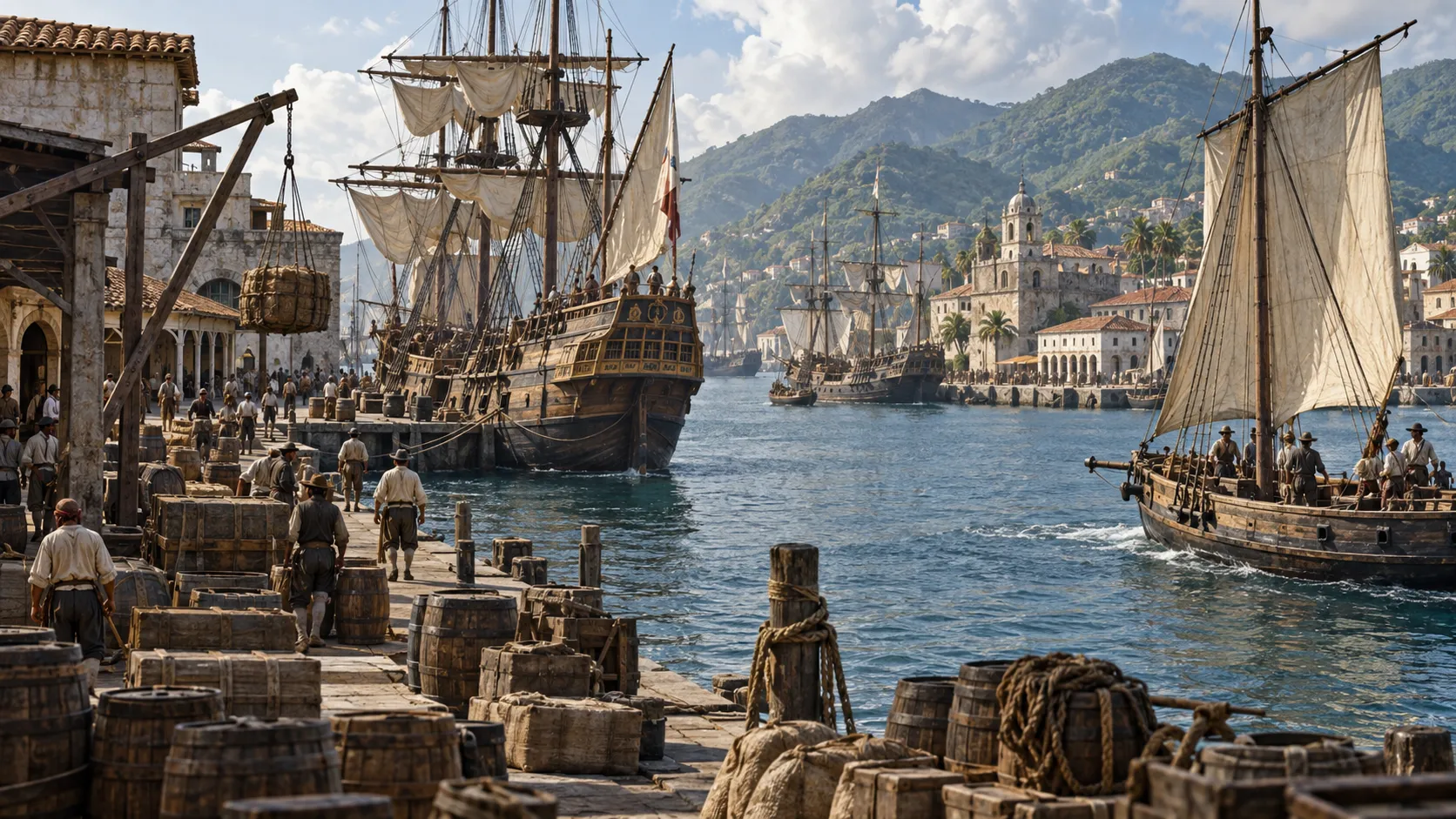
The Caribbean's Golden Age
Q: What period from roughly the late 1600s to early 1700s is called piracy's Golden Age?
A: The era of Atlantic piracy, roughly 1650 to 1730.
Q: Which Bahamian island became a major pirate base?
A: New Providence.
Q: What town on New Providence served as the center of the so-called pirate republic?
A: Nassau.
Q: Which former privateer became governor of the Bahamas and worked to suppress piracy?
A: Woodes Rogers.
Q: What royal offer did Rogers bring to pirates willing to surrender?
A: The King's Pardon.
Q: In what year did Woodes Rogers arrive in Nassau as governor?
A: 1718.
Q: Which Jamaican city was notorious for privateers and buccaneers?
A: Port Royal.
Q: What 1692 disaster destroyed much of Port Royal?
A: An earthquake and resulting tsunami.
Q: Which island off Hispaniola became a famous buccaneer base?
A: Tortuga.
Q: What fleets carried American silver and other goods to Spain?
A: The Spanish treasure fleets.
Q: Which early-18th-century war employed many sailors as privateers before peace left them unemployed?
A: The War of the Spanish Succession.
Q: What 1713 treaty helped end the War of the Spanish Succession?
A: The Treaty of Utrecht.
Q: Which African slave ship did Blackbeard capture and rename Queen Anne's Revenge?
A: La Concorde.
Q: What ship captured by Sam Bellamy became his flagship?
A: Whydah Gally.
Q: What profitable cargo made merchant ships attractive to pirates?
A: Goods such as sugar, tobacco, textiles, and precious metals.
Blackbeard, Morgan, Kidd, and Company
Q: What was Blackbeard's most commonly recorded surname?
A: Teach, also spelled Thatch.
Q: What was the name of Blackbeard's flagship?
A: Queen Anne's Revenge.
Q: Which colonial port did Blackbeard blockade in 1718?
A: Charles Town, now Charleston.
Q: Near which North Carolina island was Blackbeard killed?
A: Ocracoke Island.
Q: Which British naval officer led the force that killed Blackbeard?
A: Lieutenant Robert Maynard.
Q: Which Welsh privateer captured Panama City in 1671?
A: Henry Morgan.
Q: What honor did King Charles II grant Henry Morgan?
A: A knighthood.
Q: What senior Jamaican office did Henry Morgan later hold?
A: Lieutenant governor.
Q: Which Scottish sea captain was commissioned as a privateer before being convicted of piracy?
A: William Kidd.
Q: What valuable ship did Captain Kidd capture in 1698?
A: Quedagh Merchant.
Q: Where was Captain Kidd executed in 1701?
A: Execution Dock in London.
Q: Which pirate was nicknamed Black Bart?
A: Bartholomew Roberts.
Q: About how many ships is Bartholomew Roberts credited with capturing?
A: More than 400.
Q: Which pirate was known as the “Gentleman Pirate”?
A: Stede Bonnet.
Q: What unusual background did Stede Bonnet leave for piracy?
A: Life as a wealthy Barbados landowner.
Anne Bonny, Mary Read, and Pirates Around the World
Q: Which two women sailed with Calico Jack Rackham?
A: Anne Bonny and Mary Read.
Q: What was Calico Jack's real surname?
A: Rackham.
Q: In what year was Rackham's crew captured?
A: 1720.
Q: What plea delayed the executions of Anne Bonny and Mary Read?
A: They said they were pregnant.
Q: What happened to Mary Read while imprisoned in Jamaica?
A: She died in jail.
Q: Is Anne Bonny's final fate known with certainty?
A: No.
Q: Which Chinese pirate leader commanded a vast confederation in the early 1800s?
A: Zheng Yi Sao.
Q: What English nickname is often used for Zheng Yi Sao?
A: Ching Shih.
Q: What fleet did Zheng Yi Sao help lead?
A: The Red Flag Fleet.
Q: How did Zheng Yi Sao end her pirate career?
A: She negotiated a pardon and retired.
Q: Which 16th-century Irish maritime leader is also called Grace O'Malley?
A: Gráinne O'Malley.
Q: Which English monarch met Gráinne O'Malley in 1593?
A: Elizabeth I.
Q: Which Moroccan ruler and corsair governed Tétouan in the 1500s?
A: Sayyida al Hurra.
Q: Which French pirate earned the nickname La Buse, meaning “The Buzzard”?
A: Olivier Levasseur.
Q: What supposed clue to Levasseur's treasure remains part of pirate legend?
A: A cryptogram.
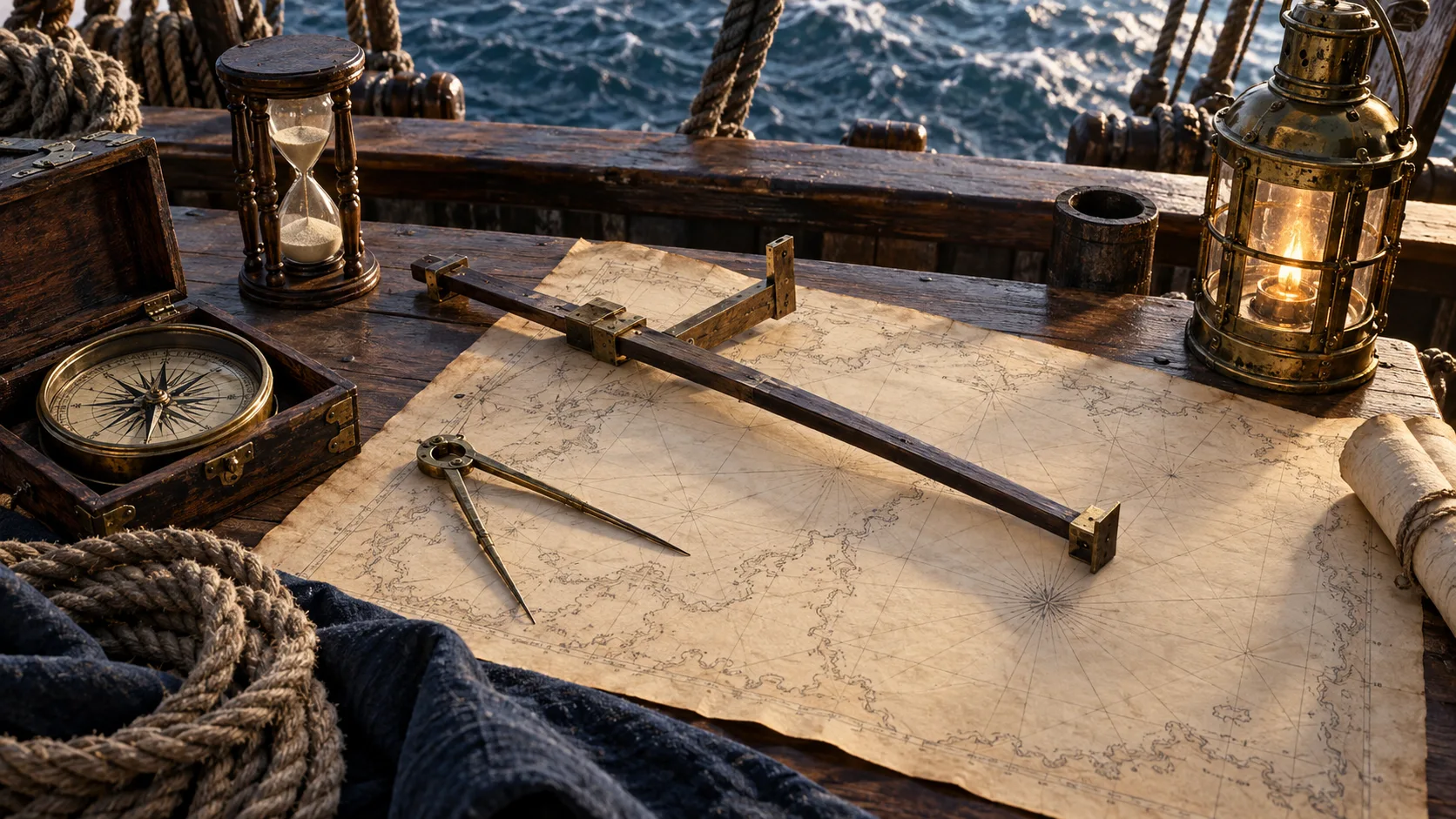
Ships, Weapons, and Navigation
Q: Why did pirates often favor sloops?
A: They were fast, maneuverable, and had shallow drafts.
Q: What two-masted vessel was another popular choice for speed?
A: A schooner.
Q: What tool helped sailors determine direction?
A: A magnetic compass.
Q: What instrument measured the angle of a celestial body above the horizon?
A: A quadrant.
Q: What method estimated position from course, speed, time, and a previous location?
A: Dead reckoning.
Q: What weighted rope measured water depth?
A: A lead line.
Q: What device measured a ship's speed by paying out a knotted line?
A: A chip log.
Q: What nautical speed unit took its name from knots in a log line?
A: The knot.
Q: What short, curved sword is closely associated with sailors and pirates?
A: The cutlass.
Q: What small firearm could be carried in a belt or sash?
A: A flintlock pistol.
Q: What small cannon mounted on a pivot could sweep a ship's deck?
A: A swivel gun.
Q: What hooks and ropes helped attackers pull ships together?
A: Grappling hooks.
Q: What was the main goal of firing chain shot at an enemy ship?
A: Damaging masts and rigging.
Q: What did it mean to careen a wooden ship?
A: Tilt it on its side to clean or repair the hull.
Q: Why might pirates fly a false national flag while approaching a target?
A: To avoid suspicion until they were close.
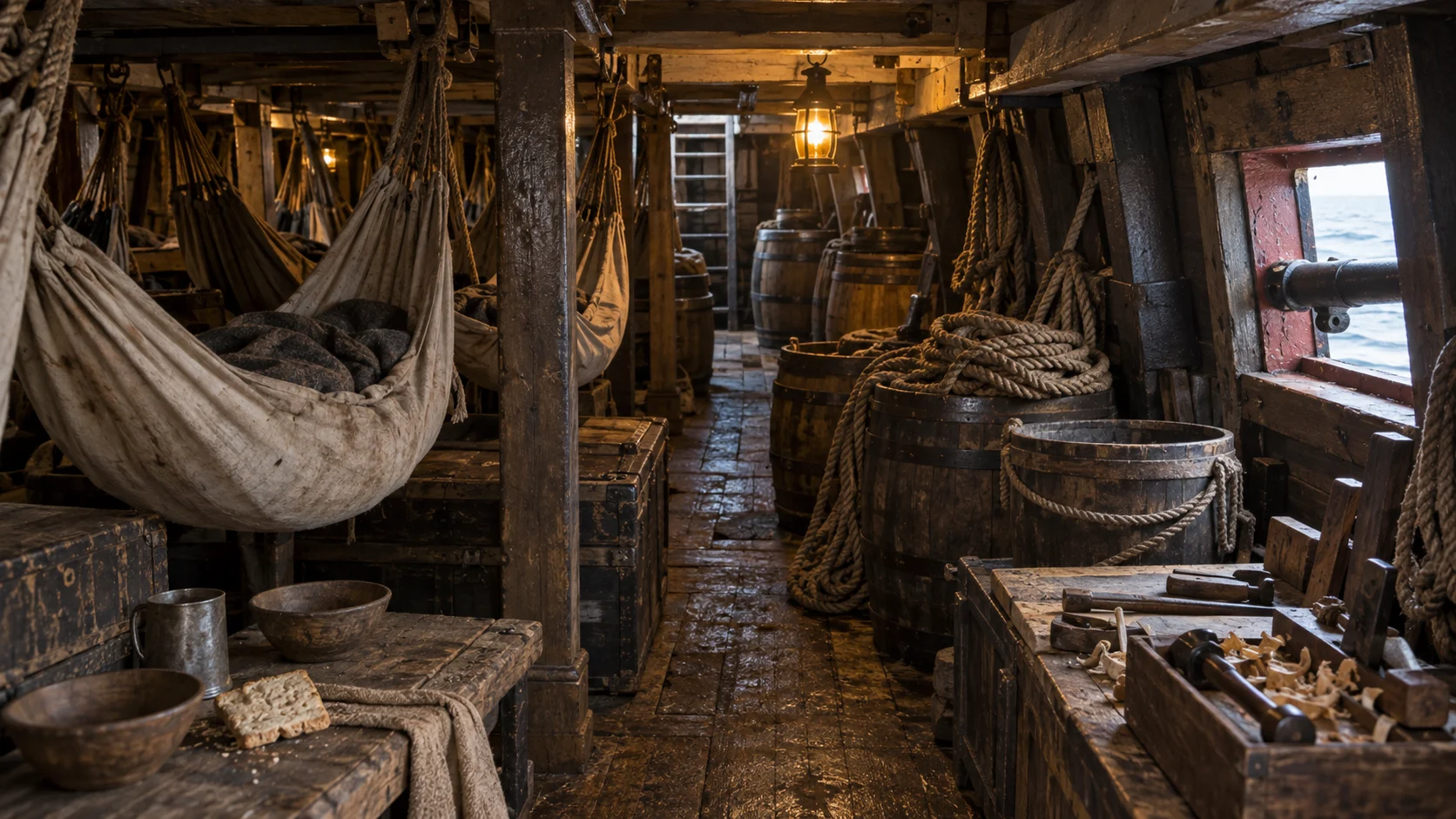
Life and Survival Aboard a Pirate Ship
Q: Who often oversaw discipline and the division of loot?
A: The quartermaster.
Q: Could some Golden Age pirate crews vote for their captain?
A: Yes.
Q: When was a pirate captain's authority usually strongest?
A: During battle or pursuit.
Q: How was captured wealth commonly divided?
A: Into agreed shares under the crew's articles.
Q: What might pirate articles promise to a crew member badly injured in battle?
A: Financial compensation.
Q: What hard biscuit was a shipboard staple?
A: Hardtack.
Q: What disease caused by vitamin C deficiency plagued sailors?
A: Scurvy.
Q: Why was fresh water a constant concern at sea?
A: Stored water could become foul or run out.
Q: What shipboard craftsperson repaired hulls, masts, and boats?
A: The carpenter.
Q: Why were skilled surgeons especially valuable aboard ships?
A: They treated battle wounds, disease, and accidents.
Q: Were Golden Age pirate crews drawn from only one nationality?
A: No, many crews were multinational.
Q: Did some Black sailors join pirate crews as free crew members?
A: Yes, although piracy also operated within a world shaped by slavery.
Q: What cramped sleeping item swung from beams aboard many ships?
A: A hammock.
Q: What maintenance task removed barnacles and growth that slowed a ship?
A: Scraping and cleaning the hull.
Q: What was a pirate's most practical reason for capturing a ship without sinking it?
A: To take its cargo, supplies, or the vessel itself.
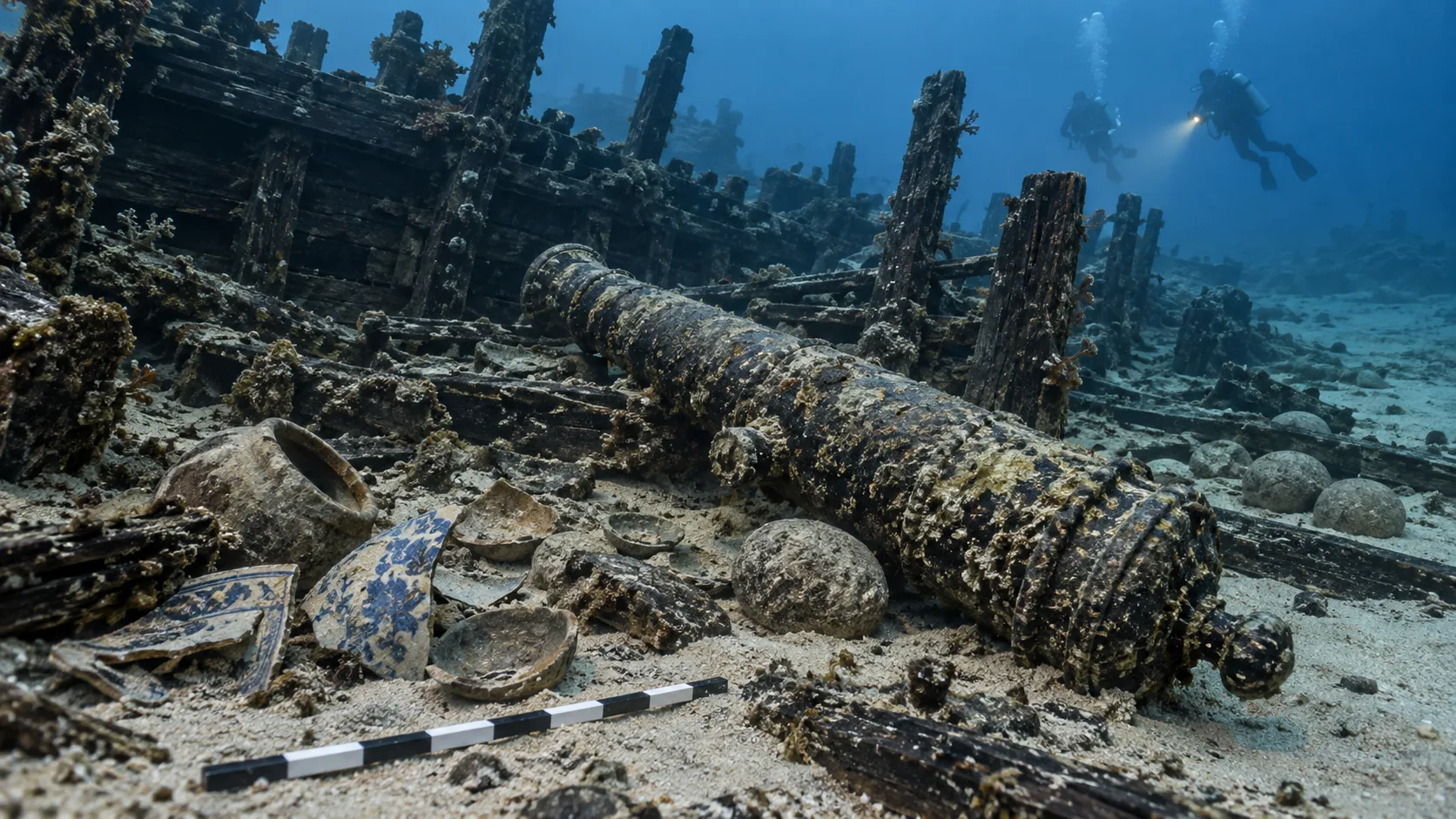
Treasure Maps, Wrecks, and Pirate Myths
Q: Did pirates commonly make prisoners walk the plank?
A: No, it is mostly a fictional trope.
Q: Did pirates routinely bury treasure in chests?
A: No, most loot was spent or divided quickly.
Q: Which pirate really did bury some treasure on Gardiners Island?
A: Captain Kidd.
Q: Which 1883 novel popularized treasure maps, X marks, and Long John Silver?
A: Treasure Island.
Q: Who wrote Treasure Island?
A: Robert Louis Stevenson.
Q: What fictional ship carries Jim Hawkins toward Treasure Island?
A: Hispaniola.
Q: Which fictional pirate captain is Peter Pan's enemy?
A: Captain Hook.
Q: What comic opera features a famously duty-bound band of pirates?
A: The Pirates of Penzance.
Q: Who wrote The Pirates of Penzance?
A: Gilbert and Sullivan.
Q: What shipwreck off Cape Cod is the first fully authenticated Golden Age pirate wreck found in North America?
A: Whydah Gally.
Q: What inscribed object helped identify the Whydah wreck?
A: The ship's bell.
Q: Which underwater explorer found the Whydah wreck in 1984?
A: Barry Clifford.
Q: Where was the wreck believed to be Queen Anne's Revenge found in 1996?
A: Beaufort Inlet, North Carolina.
Q: What animal could realistically appear aboard ship because sailors traded exotic creatures?
A: A parrot.
Q: Is there solid evidence that pirates wore eye patches to preserve night vision below deck?
A: No, that popular explanation is unproven.
Your Pirate Voyage Is in the Logbook
If you sailed through all 120 without losing your bearings, claim the captain's share of the bragging rights. Keep exploring bold characters with our famous people trivia or chart another era in decades trivia.

Ellie Ewert is the founder and author of RandomTrivia.co, blending her passion for research with years of experience in content creation to deliver accurate, engaging, and well-sourced trivia. Dedicated to providing readers with trustworthy and entertaining facts, she applies meticulous fact-checking and SEO expertise to ensure every article meets the highest standards. Read more about our high standards in our Editorial Guidelines.