
Blast off into exoplanet trivia, where alien sunsets, hot Jupiters, rocky worlds, and clever telescopes fill the itinerary.
These questions explore real discoveries and big cosmic possibilities without drifting into science fiction.
Worlds Beyond Our Solar System
Q: What is an exoplanet?
A: A planet outside our solar system.
Q: What star does Earth orbit?
A: The Sun.
Q: In which galaxy have nearly all confirmed exoplanets been found?
A: The Milky Way.
Q: What is a planet that orbits two stars called?
A: A circumbinary planet.
Q: What is a planet that travels through space without orbiting a star called?
A: A rogue planet.
Q: What is a star with planets orbiting it called?
A: A host star.
Q: What force keeps a planet in orbit around its star?
A: Gravity.
Q: What is the time a planet takes to complete one orbit called?
A: Its orbital period.
Q: What is an oval-shaped orbit called?
A: An ellipse.
Q: What point in an orbit lies closest to a star?
A: Periastron.
Q: What is the name for a planet's greatest orbital distance from its star?
A: Apastron.
Q: What is the plane of a planet's orbit called?
A: The orbital plane.
Q: What measurement describes how stretched an orbit is?
A: Eccentricity.
Q: What term describes a planet's average distance from its star in an elliptical orbit?
A: The semimajor axis.
Q: What unit equals the average Earth-Sun distance?
A: The astronomical unit.
How Astronomers Find Exoplanets
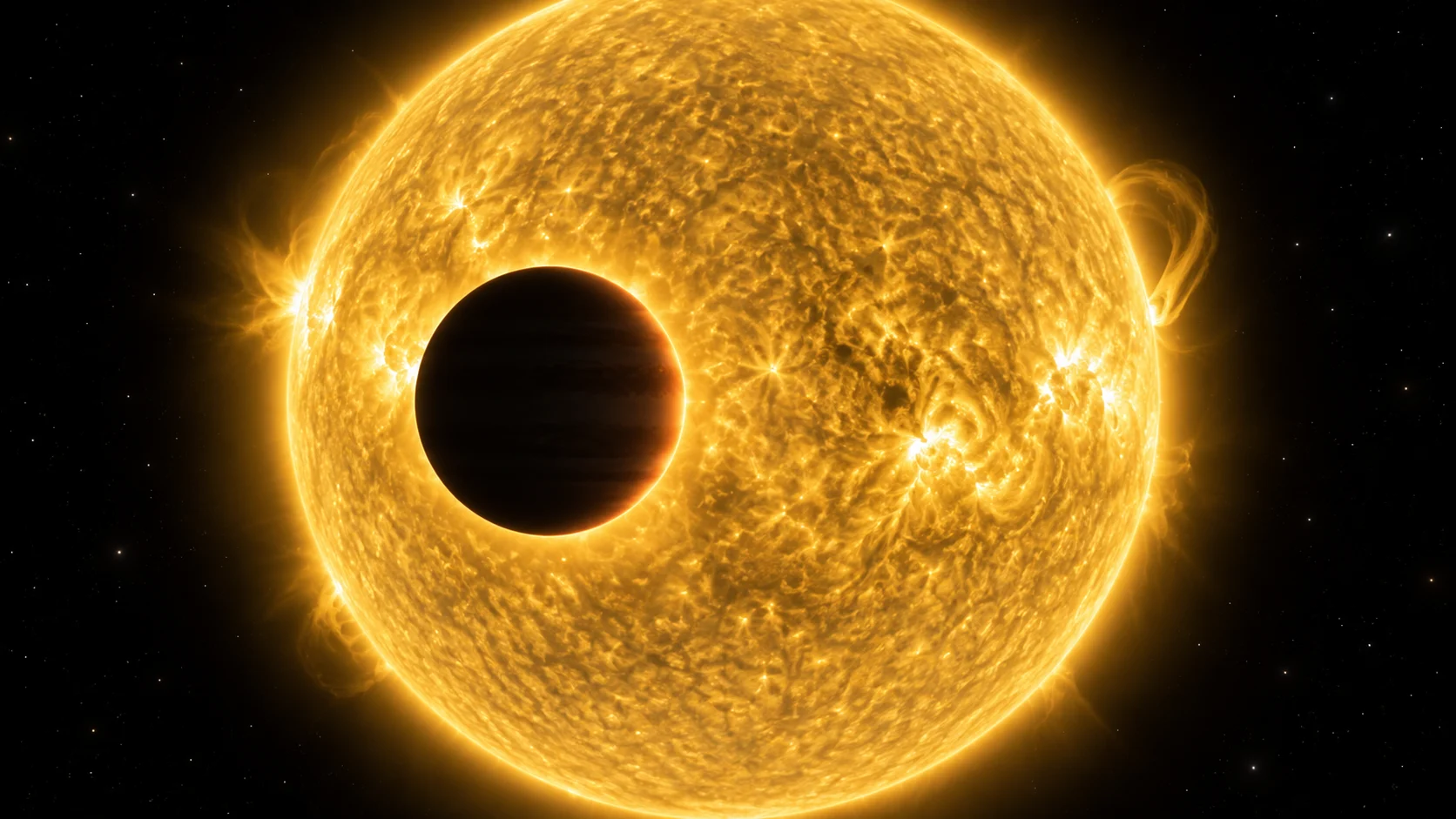
Q: What detection method watches a star dim as a planet crosses it?
A: The transit method.
Q: What graph shows a star's brightness over time?
A: A light curve.
Q: What planet property can transit depth reveal?
A: The planet's size.
Q: Astronomers can time recurring transits to calculate what?
A: The planet's orbital period.
Q: What detection method measures a star's gravitational wobble?
A: The radial velocity method.
Q: What light shift shows that a star is moving toward Earth?
A: Blueshift.
Q: Which Doppler shift lengthens wavelengths as a star recedes?
A: Redshift.
Q: What planet property does radial velocity help estimate?
A: Mass.
Q: What method uses a foreground star's gravity to magnify background light?
A: Gravitational microlensing.
Q: What method photographs a planet separately from its star?
A: Direct imaging.
Q: What device blocks a star's glare inside a telescope?
A: A coronagraph.
Q: What method tracks tiny changes in a star's position on the sky?
A: Astrometry.
Q: What timing method can reveal planets around pulsars?
A: Pulsar timing.
Q: What technique splits light into wavelengths to study composition?
A: Spectroscopy.
Q: Why must many transit candidates receive follow-up observations?
A: To rule out false positives.
Planet Types and Strange Worlds
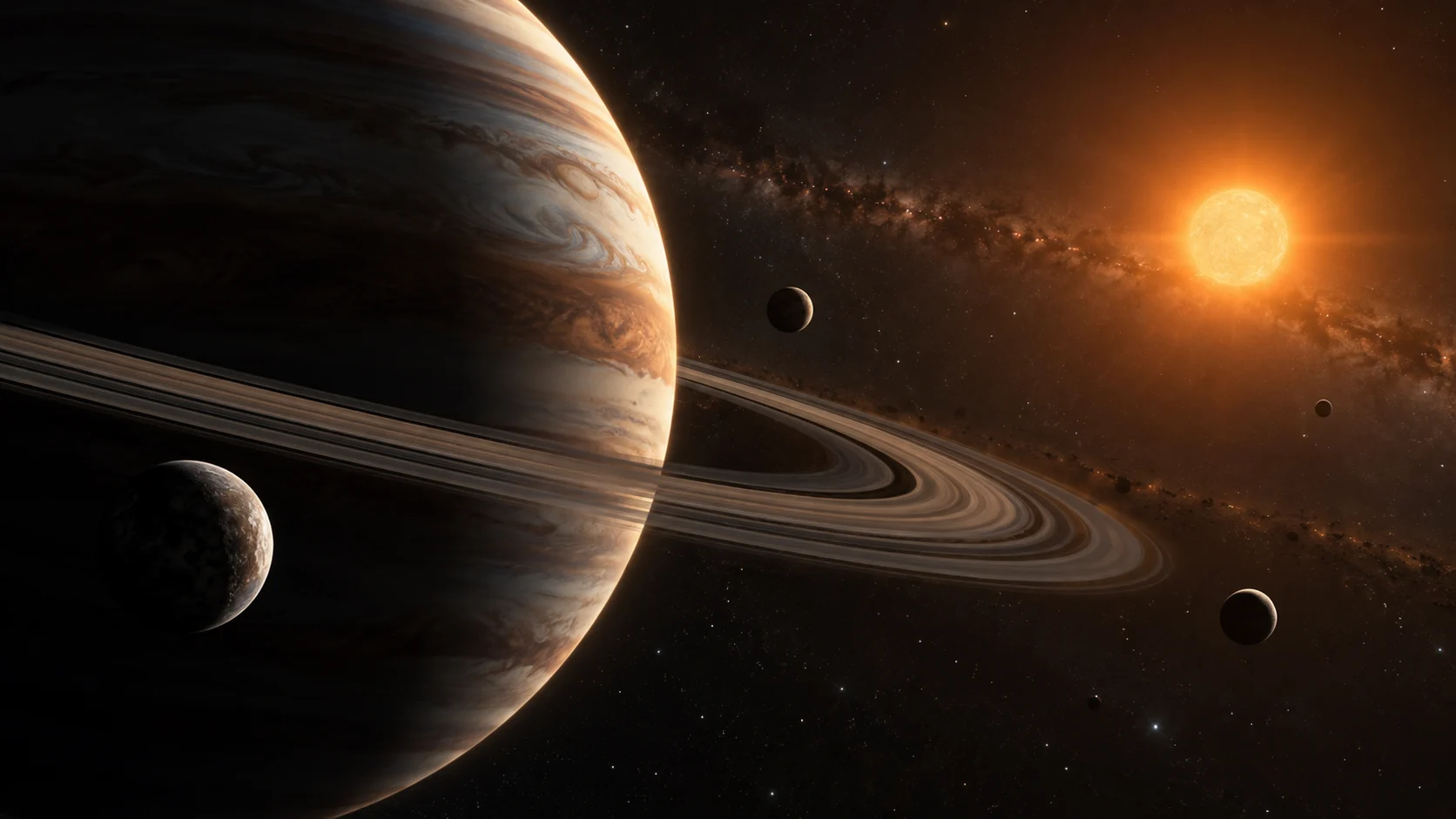
Q: What kind of exoplanet is similar in size to Jupiter or Saturn?
A: A gas giant.
Q: What is a hot Jupiter?
A: A gas giant orbiting very close to its star.
Q: What class includes planets larger than Earth but lighter than Neptune?
A: Super-Earths.
Q: Does the term super-Earth guarantee Earth-like conditions?
A: No.
Q: What is a mini-Neptune?
A: A planet smaller than Neptune with a substantial atmosphere.
Q: What broad type describes Earth-sized rocky worlds?
A: Terrestrial planets.
Q: What may cover the surface of a lava world?
A: Molten rock.
Q: What is an ocean world?
A: A planet thought to contain a large amount of water.
Q: What is an ultra-short-period planet?
A: A planet completing an orbit in less than a day.
Q: Which nickname describes a Neptune-sized world in a moderately close orbit?
A: Warm Neptune.
Q: What does a planet's equilibrium temperature estimate?
A: Temperature based on received starlight and reflectivity.
Q: What term describes a world always showing one face to its star?
A: Tidally locked.
Q: What boundary may separate a tidally locked planet's day and night sides?
A: The terminator.
Q: What is a planet's reflective power called?
A: Albedo.
Q: What internal property can be estimated from mass and radius together?
A: Density.
Firsts and Famous Discoveries
Q: What were the first confirmed exoplanets found orbiting in 1992?
A: Planets around the pulsar PSR B1257+12.
Q: Who discovered the first confirmed pulsar planets?
A: Aleksander Wolszczan and Dale Frail.
Q: What was the first exoplanet found around a Sun-like star?
A: 51 Pegasi b.
Q: In what year was 51 Pegasi b announced?
A: 1995.
Q: Who discovered 51 Pegasi b?
A: Michel Mayor and Didier Queloz.
Q: What type of planet is 51 Pegasi b?
A: A hot Jupiter.
Q: Which nearby red dwarf hosts Proxima Centauri b?
A: Proxima Centauri.
Q: What is the nearest known exoplanet to our solar system?
A: Proxima Centauri b.
Q: About how far away is Proxima Centauri?
A: About 4.2 light-years.
Q: Which system contains seven roughly Earth-sized known planets?
A: TRAPPIST-1.
Q: What kind of star is TRAPPIST-1?
A: An ultracool red dwarf.
Q: Which directly imaged planetary-mass companion orbits 1RXS J160929.1-210524?
A: 1RXS J160929.1-210524 b.
Q: Which multi-planet system became famous for four directly imaged giant planets?
A: HR 8799.
Q: Which planet was found orbiting the two stars of Kepler-16?
A: Kepler-16b.
Q: What informal nickname connects Kepler-16b to Star Wars?
A: Tatooine.
Kepler, TESS, and Planet Hunters
Q: Which NASA telescope launched in 2009 to hunt for transiting planets?
A: Kepler.
Q: In which constellation-rich region did Kepler conduct its original survey?
A: A fixed field near Cygnus and Lyra.
Q: What was Kepler designed to measure about stars like the Sun?
A: How commonly they host planets.
Q: What spacecraft problem ended Kepler's original pointing mode?
A: Failure of two reaction wheels.
Q: What was Kepler's extended mission called?
A: K2.
Q: In what year was Kepler retired?
A: 2018.
Q: What does TESS stand for?
A: Transiting Exoplanet Survey Satellite.
Q: In what year did TESS launch?
A: 2018.
Q: What kinds of stars does TESS emphasize?
A: Bright, nearby stars.
Q: How does TESS divide most of the sky for observation?
A: Into sectors.
Q: What does TOI stand for in TESS science?
A: TESS Object of Interest.
Q: Which NASA telescope uses infrared light to study exoplanet atmospheres?
A: The James Webb Space Telescope.
Q: Which retired NASA infrared telescope helped characterize the TRAPPIST-1 system?
A: Spitzer.
Q: What citizen-science project lets volunteers search stellar light curves?
A: Planet Hunters.
Q: Has NASA's confirmed exoplanet count passed 6,000?
A: Yes.
Atmospheres and Alien Weather
Q: What happens during transmission spectroscopy?
A: Starlight filters through a planet's atmosphere.
Q: What can molecules in an atmosphere leave in a spectrum?
A: Absorption signatures.
Q: What is a secondary eclipse?
A: A planet passing behind its star.
Q: What can a secondary eclipse help measure?
A: The planet's emitted and reflected light.
Q: What graph maps brightness changes through a planet's orbit?
A: A phase curve.
Q: What scattering process helps make Earth's sky look blue?
A: Rayleigh scattering.
Q: Is oxygen by itself definitive proof of life on an exoplanet?
A: No.
Q: What is a biosignature?
A: Evidence that may indicate biological activity.
Q: What is a false-positive biosignature?
A: A nonliving process that mimics evidence of life.
Q: What atmospheric gas is a major greenhouse gas on Earth?
A: Carbon dioxide.
Q: What molecule has been detected in several exoplanet atmospheres?
A: Water vapor.
Q: What clouds may form on extremely hot rocky planets?
A: Mineral clouds.
Q: Why can hot Jupiters have powerful winds?
A: Their day and night sides have strong temperature contrasts.
Q: What effect can make a close planet's atmosphere escape into space?
A: Intense stellar radiation.
Q: What extended feature can escaping gas form behind a planet?
A: A comet-like tail.
Habitable Zones and the Search for Life
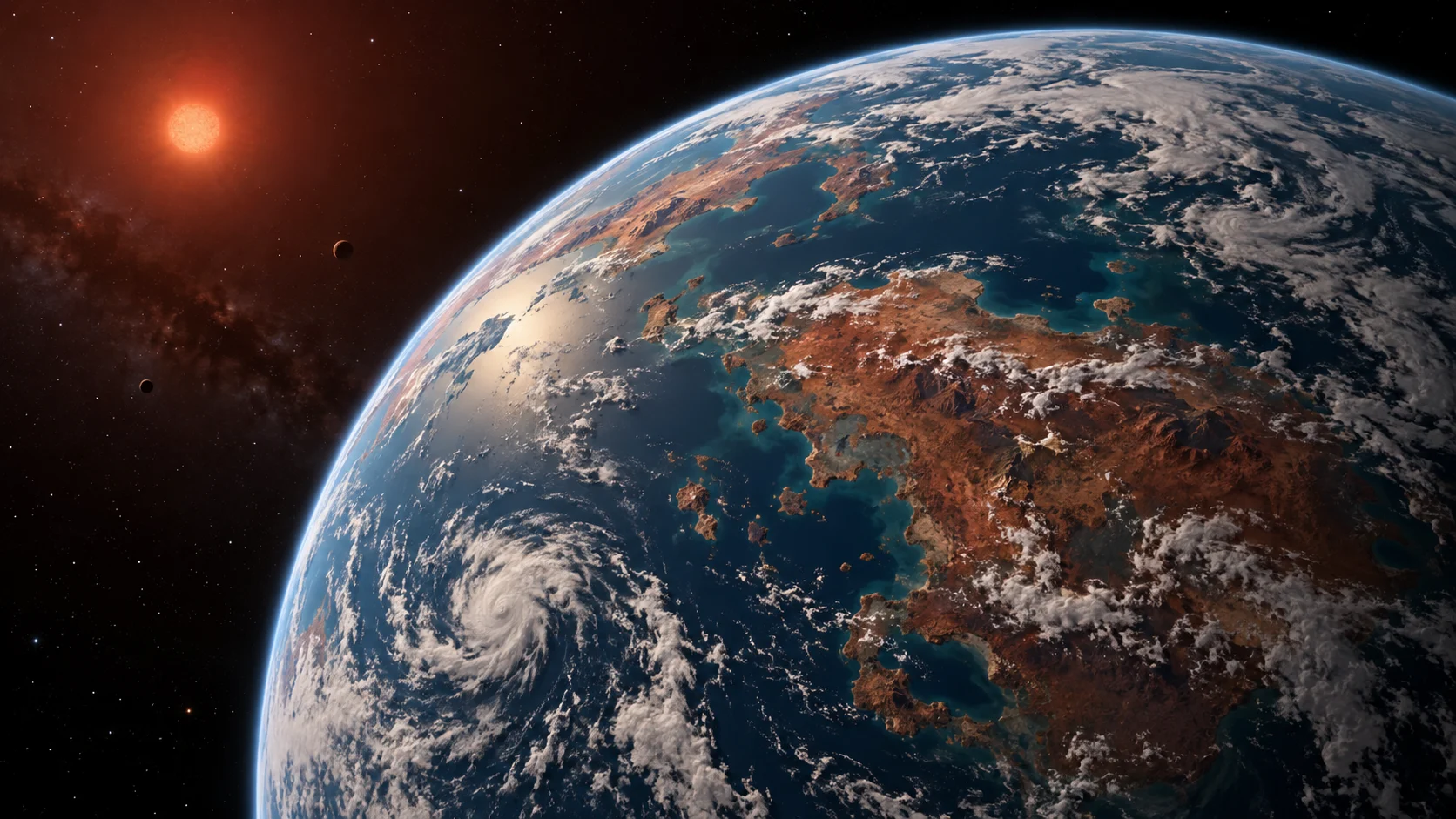
Q: What is the habitable zone?
A: The region where surface liquid water could be possible.
Q: What playful nickname is used for the habitable zone?
A: The Goldilocks zone.
Q: Does orbiting in the habitable zone prove a planet is inhabited?
A: No.
Q: What star property strongly affects the location of its habitable zone?
A: Luminosity.
Q: Is the habitable zone closer to a cool red dwarf than to a Sun-like star?
A: Yes.
Q: What liquid is central to the traditional habitable-zone definition?
A: Water.
Q: Why does atmosphere matter for habitability?
A: It influences temperature and surface conditions.
Q: What stellar outbursts can threaten atmospheres around red dwarfs?
A: Flares.
Q: What is astrobiology?
A: The study of life's origins, evolution, and cosmic distribution.
Q: What term describes the conditions that allow life to exist?
A: Habitability.
Q: What Earth organisms survive in extreme environments?
A: Extremophiles.
Q: Why do extremophiles interest astrobiologists?
A: They expand ideas about where life might survive.
Q: What equation frames a discussion of communicative civilizations in our galaxy?
A: The Drake equation.
Q: What paradox asks why we have not found clear evidence of extraterrestrial civilizations?
A: The Fermi paradox.
Q: Has life been confirmed on an exoplanet?
A: No.
Remarkable Systems and Cosmic Comparisons
Q: Which exoplanet is famous for appearing deep blue?
A: HD 189733 b.
Q: What may blow sideways in HD 189733 b's extreme atmosphere?
A: Silicate particles, often described as glass rain.
Q: Which ultra-hot Jupiter has an atmosphere containing vaporized metals?
A: WASP-121 b.
Q: Which dark hot Jupiter absorbs most visible light that reaches it?
A: WASP-12 b.
Q: Which planet orbits the star 55 Cancri A and may have a lava-covered surface?
A: 55 Cancri e.
Q: Which small exoplanet is gradually disintegrating as it orbits its star?
A: KIC 12557548 b.
Q: Which famous super-Earth orbits in the habitable zone of Kepler-186?
A: Kepler-186f.
Q: Which planet was the first near-Earth-size world found in a Sun-like star's habitable zone?
A: Kepler-452b.
Q: What nickname was given to Kepler-452b in popular coverage?
A: Earth's cousin.
Q: Which nearby system contains the potentially rocky planet LHS 1140 b?
A: The LHS 1140 system.
Q: Which directly imaged planet orbits the bright star Beta Pictoris?
A: Beta Pictoris b.
Q: Which system includes planets named Osiris and HD 209458 b?
A: They are the same planet.
Q: What was HD 209458 b the first exoplanet seen doing?
A: Transiting its star.
Q: Which orange giant hosts the planet Pollux b?
A: Pollux.
Q: Are any known exoplanets close enough for present-day human travel?
A: No.
Your Cosmic Passport Is Stamped
If you cleared all 120, your exoplanet expertise is officially out of this world. Come back to Earth with our famous people trivia or time-travel through decades trivia.

Ellie Ewert is the founder and author of RandomTrivia.co, blending her passion for research with years of experience in content creation to deliver accurate, engaging, and well-sourced trivia. Dedicated to providing readers with trustworthy and entertaining facts, she applies meticulous fact-checking and SEO expertise to ensure every article meets the highest standards. Read more about our high standards in our Editorial Guidelines.