
Ready to time-travel?
This packed guide explores the Renaissance from Florence’s workshops and Venetian print shops to observatories, courts, and theaters across Europe.
Expect a smart mix of art, architecture, science, humanism, exploration, music, and daily life. Questions rise in difficulty so you can warm up, then level up.
Origins & Big Picture
Q: What does the word “Renaissance” literally mean?
A: Rebirth.
Q: Which country is widely considered the cradle of the Renaissance?
A: Italy.
Q: Which city is often cited as the Renaissance’s birthplace?
A: Florence.
Q: Which centuries broadly frame the Renaissance?
A: Fourteenth to seventeenth centuries.
Q: Which banking family famously patronized the arts in Florence?
A: The Medici.
Q: What intellectual movement centered on classical texts and civic virtue?
A: Humanism.
Q: “Studia humanitatis” traditionally included which subjects?
A: Grammar, rhetoric, history, poetry, moral philosophy.
Q: Which 1453 event sent Greek scholars and manuscripts westward?
A: The Fall of Constantinople.
Q: Which mid-fifteenth-century invention rapidly spread ideas?
A: The printing press.
Q: Who introduced movable type printing in Europe?
A: Johannes Gutenberg.
Q: What 1494 conflict drew France into Italy and disrupted the peninsula?
A: The French invasions of Italy.
Q: What 1527 disaster shook Italy’s art world and politics?
A: The Sack of Rome.
Q: What label describes peak Italian art c. 1490–1530?
A: The High Renaissance.
Q: What later style favored elegance and elongated forms?
A: Mannerism.
Q: Which Dominican friar led a puritanical regime and a “Bonfire of the Vanities”?
A: Girolamo Savonarola.
Q: What’s the term for wealthy sponsorship of art and learning?
A: Patronage.
Q: Which maritime republic built a commercial empire influencing Renaissance trade?
A: Venice.
Q: Which colossal Roman project drew top artists and architects to the papal court?
A: The rebuilding of St. Peter’s Basilica.
Q: Who wrote Lives of the Artists (1550), shaping art history?
A: Giorgio Vasari.
Q: Which 1545–1563 gathering launched Catholic reforms affecting art?
A: The Council of Trent.
Q: Historians debate whether the Renaissance was a sharp break or what?
A: A gradual transition/continuity with the Middle Ages.
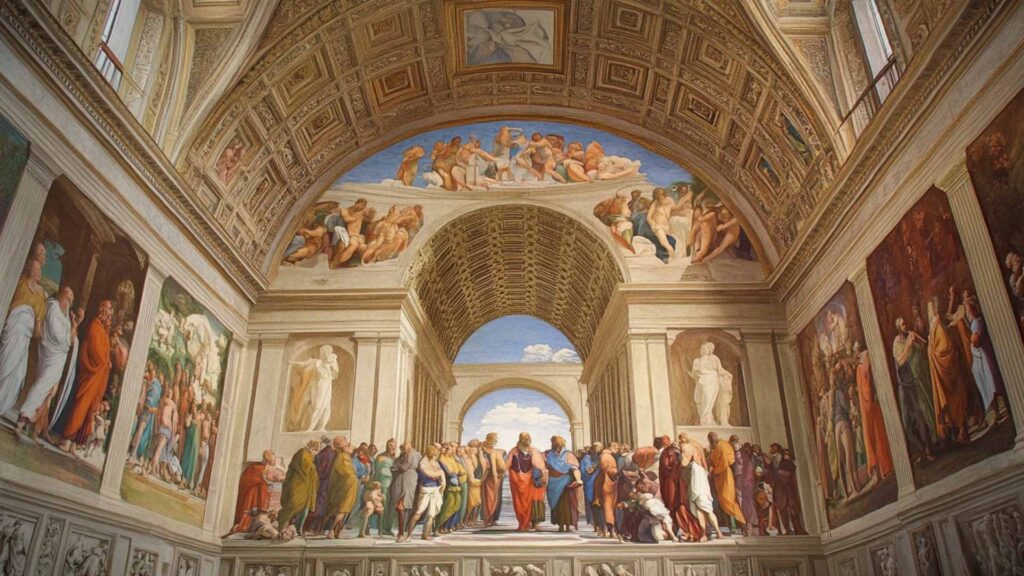
Italian Art Icons
Q: Who painted the Mona Lisa?
A: Leonardo da Vinci.
Q: Who sculpted the marble David (1501–1504)?
A: Michelangelo.
Q: Who painted The Last Supper in Milan?
A: Leonardo da Vinci.
Q: What technique gives the Mona Lisa its smoky transitions?
A: Sfumato.
Q: Who painted The Birth of Venus?
A: Sandro Botticelli.
Q: Who painted The School of Athens?
A: Raphael.
Q: Why did The Last Supper deteriorate so quickly?
A: Leonardo used experimental tempera/oil on dry wall, not true fresco.
Q: Which Venetian master is renowned for luminous color and paint handling?
A: Titian.
Q: What is chiaroscuro?
A: Modeling form with strong light–dark contrasts.
Q: Who sculpted the earlier bronze David?
A: Donatello.
Q: Which northern-perfected medium helped Italians achieve new depth and sheen?
A: Oil painting with glazing.
Q: Which pope commissioned the Sistine Chapel ceiling?
A: Julius II.
Q: When was the Sistine ceiling painted?
A: 1508–1512.
Q: Which Botticelli allegory features the Three Graces and Zephyrus?
A: Primavera.
Q: Which figures stand at the center of The School of Athens?
A: Plato and Aristotle.
Q: What mathematical method maps depth onto a flat surface?
A: Linear perspective.
Q: Who codified perspective in a 1435 treatise?
A: Leon Battista Alberti.
Q: Whose dynamic compositions and color foreshadowed the Baroque?
A: Titian.
Q: Which Leonardo panel in the Uffizi famously remains unfinished?
A: Adoration of the Magi.
Q: Which style after 1520 favored elegant elongation (e.g., Parmigianino)?
A: Mannerism.
Q: Which Mantuan court employed Andrea Mantegna, master of foreshortening?
A: The Gonzaga court.

Architecture & Engineering
Q: Who engineered the dome of Florence’s Santa Maria del Fiore?
A: Filippo Brunelleschi.
Q: What lifting device did Brunelleschi invent for the dome?
A: A reversible-gear, ox-driven hoist.
Q: What structural form characterizes the Florence dome?
A: A double-shell dome with eight visible ribs.
Q: Which ancient author’s treatise inspired Renaissance architects?
A: Vitruvius.
Q: Who wrote De re aedificatoria (c. 1452)?
A: Leon Battista Alberti.
Q: What do we call the triangular crown above a classical portico?
A: A pediment.
Q: What small shrine did Bramante build, modeling ancient Rome?
A: The Tempietto (San Pietro in Montorio).
Q: Which vast church involved Bramante, Michelangelo, Maderno, and Bernini?
A: St. Peter’s Basilica.
Q: Which Palladian treatise standardized the classical orders?
A: I Quattro Libri dell’Architettura.
Q: Which Palladian villa is also called Villa Capra?
A: Villa Rotonda.
Q: What is rustication in stonework?
A: Rough-textured masonry, often on lower stories.
Q: Which Florentine palace exemplifies rusticated design?
A: Palazzo Medici Riccardi.
Q: What fortification form countered cannon warfare?
A: Star forts (trace italienne).
Q: Which bridge in Florence carries shops across the Arno?
A: Ponte Vecchio.
Q: What early Renaissance hospital showcases harmonious arcades?
A: Ospedale degli Innocenti.
Q: Who designed the façade of Santa Maria Novella?
A: Leon Battista Alberti.
Q: What is a “serliana” or Palladian window?
A: A central arch flanked by two rectangular openings.
Q: Which artist-engineer sketched flying machines and war devices?
A: Leonardo da Vinci.
Q: Which Florentine church interior shows Brunelleschi’s modular clarity?
A: San Lorenzo.
Q: Who redesigned Rome’s Capitoline Hill with a new piazza scheme?
A: Michelangelo.
Q: Which Venetian architect created scenographic churches like Il Redentore?
A: Andrea Palladio.
Science & Innovation
Q: Who proposed heliocentrism in 1543?
A: Nicolaus Copernicus.
Q: Who published the landmark anatomy De humani corporis fabrica (1543)?
A: Andreas Vesalius.
Q: What was Europe’s first major book printed with movable type?
A: The Gutenberg Bible.
Q: Which printing innovation is linked to Aldus Manutius?
A: Italic type (and compact formats).
Q: Who introduced the 1569 world map with a new navigational projection?
A: Gerardus Mercator.
Q: What instrument measured celestial altitudes at sea?
A: The astrolabe.
Q: Which polymath published solutions to cubic equations in Ars Magna (1545)?
A: Gerolamo Cardano.
Q: Who used a telescope in 1609–1610 to challenge Aristotelian cosmology?
A: Galileo Galilei.
Q: Whose meticulous observations let Kepler derive planetary laws?
A: Tycho Brahe.
Q: What 1582 reform corrected calendar drift?
A: The Gregorian calendar.
Q: Who wrote De revolutionibus orbium coelestium?
A: Nicolaus Copernicus.
Q: Who described double-entry bookkeeping in 1494?
A: Luca Pacioli.
Q: Which paint medium, layered with glazes, created luminous effects?
A: Oil paint.
Q: Which Swiss physician advanced chemical medicine over Galenism?
A: Paracelsus.
Q: What is a camera obscura?
A: A light-tight box projecting an external image for drawing.
Q: Who wrote De pictura (1435), theorizing perspective?
A: Leon Battista Alberti.
Q: Which 1609 work announced elliptical orbits?
A: Kepler’s Astronomia Nova.
Q: What chart with rhumb lines guided Mediterranean mariners?
A: The portolan chart.
Q: Which university became famous for an anatomy theater by 1594?
A: The University of Padua.
Q: Who authored Magia Naturalis (1558) on natural philosophy and experiment?
A: Giambattista della Porta.
Q: Which French mathematician advanced symbolic algebra in the 1590s?
A: François Viète.

Literature & Humanism
Q: Who is often called the “Father of Humanism”?
A: Petrarch.
Q: Which Tuscan poet wrote The Divine Comedy?
A: Dante Alighieri.
Q: Who wrote the story cycle Decameron?
A: Giovanni Boccaccio.
Q: Who penned the satire In Praise of Folly?
A: Desiderius Erasmus.
Q: Who authored Utopia (1516)?
A: Thomas More.
Q: Which Florentine diplomat wrote The Prince?
A: Niccolò Machiavelli.
Q: Which court manual defined ideal conduct (1528)?
A: Castiglione’s The Book of the Courtier.
Q: Who founded the Aldine Press in Venice?
A: Aldus Manutius.
Q: Which compact book format did Aldus popularize?
A: The octavo.
Q: Which English playwright’s era overlaps the Renaissance?
A: William Shakespeare.
Q: Who was Shakespeare’s great patron queen?
A: Elizabeth I.
Q: Who wrote Don Quixote?
A: Miguel de Cervantes.
Q: Which French writer pioneered the personal essay?
A: Michel de Montaigne.
Q: Who authored the chivalric epic Orlando Furioso?
A: Ludovico Ariosto.
Q: Which poet wrote Jerusalem Delivered (Gerusalemme liberata)?
A: Torquato Tasso.
Q: What poetic form perfected by Petrarch spread across Europe?
A: The sonnet.
Q: Which two poets adapted the sonnet into English?
A: Sir Thomas Wyatt and Henry Howard, Earl of Surrey.
Q: Which Florentine circle revived Plato for the Medici?
A: The Platonic Academy of Florence.
Q: Which humanist translated and interpreted Plato for that circle?
A: Marsilio Ficino.
Q: Which Italian scholar codified Tuscan as a literary standard (1525)?
A: Pietro Bembo.
Q: Which printer popularized the semicolon in Italian printing?
A: Aldus Manutius.
Northern Renaissance & the Reformation
Q: Which Low Countries painter helped pioneer realistic oil technique?
A: Jan van Eyck.
Q: Who painted the Arnolfini Portrait?
A: Jan van Eyck.
Q: Which German master is renowned for woodcuts like The Four Horsemen?
A: Albrecht Dürer.
Q: Who painted the fantastical triptych The Garden of Earthly Delights?
A: Hieronymus Bosch.
Q: Who depicted peasant life in works like Hunters in the Snow?
A: Pieter Bruegel the Elder.
Q: Which portraitist served Henry VIII’s court?
A: Hans Holbein the Younger.
Q: What printmaking media drove mass image circulation?
A: Woodcuts and engravings.
Q: What 1517 act ignited the Protestant Reformation?
A: Martin Luther’s Ninety-Five Theses.
Q: Which artist near Luther produced powerful propaganda prints?
A: Lucas Cranach the Elder.
Q: What 1530 document summarized Lutheran doctrines?
A: The Augsburg Confession.
Q: Which 1555 settlement let princes choose their realm’s religion?
A: The Peace of Augsburg.
Q: What practice destroyed church images in some Reformation centers?
A: Iconoclasm.
Q: Which humanist urged a return to simple piety, influencing reformers?
A: Erasmus of Rotterdam.
Q: Which translation shaped modern standard German?
A: Luther’s German Bible.
Q: Which English law made the monarch head of the Church of England?
A: The Act of Supremacy (1534).
Q: Which English queen briefly restored Catholicism?
A: Mary I (Mary Tudor).
Q: Which 1563 catechism became a Reformed standard?
A: The Heidelberg Catechism.
Q: Which order founded in 1540 became influential educators and missionaries?
A: The Society of Jesus (Jesuits).
Q: Which Antwerp enterprise dominated late-sixteenth-century publishing?
A: The Plantin Press (Christophe Plantin).
Q: Which conflicts wracked France from 1562 to 1598?
A: The French Wars of Religion.
Q: Which 1598 decree granted limited toleration to Huguenots?
A: The Edict of Nantes.

Exploration, Trade & Global Encounters
Q: Who reached the Americas in 1492 under the Spanish flag?
A: Christopher Columbus.
Q: Which Portuguese navigator reached India by sea in 1498?
A: Vasco da Gama.
Q: Whose expedition completed the first circumnavigation (1522)?
A: Ferdinand Magellan’s fleet under Juan Sebastián Elcano.
Q: Which 1494 treaty split new lands between Spain and Portugal?
A: The Treaty of Tordesillas.
Q: Which 1507 map first applied the name “America”?
A: Martin Waldseemüller’s world map.
Q: Which conquistador toppled the Aztec Empire?
A: Hernán Cortés.
Q: Which conquistador overthrew the Inca Empire?
A: Francisco Pizarro.
Q: What commodity moved from the Americas to Asia via Manila?
A: Silver.
Q: Which Bolivian mountain became a colossal silver source after 1545?
A: Potosí (Cerro Rico).
Q: Which Portuguese stronghold dominated Indian Ocean spice routes?
A: Goa.
Q: Which Jesuit mapped China and engaged with Confucian scholars?
A: Matteo Ricci.
Q: What Japanese term describes European-influenced “Southern Barbarian” art?
A: Nanban art.
Q: What nimble ship type underpinned early Portuguese exploration?
A: The caravel.
Q: Which handheld tool measured star altitude by a sliding arm?
A: The cross-staff.
Q: What was Spain’s Casa de Contratación (1503)?
A: Seville’s House of Trade regulating New World commerce.
Q: Who published the first modern atlas in 1570?
A: Abraham Ortelius.
Q: Which 1588 naval clash reshaped European sea power?
A: The defeat of the Spanish Armada.
Q: Name two American foods that reached Europe in the 1500s.
A: Maize, tomatoes (also potatoes, cacao).
Q: What devastating exchange accompanied conquest and contact?
A: Old World diseases (e.g., smallpox).
Q: Which Portuguese commander first sighted Brazil in 1500?
A: Pedro Álvares Cabral.
Q: Which 1571 battle checked Ottoman naval dominance?
A: The Battle of Lepanto.
Music, Theater & Daily Life
Q: What texture defines much Renaissance choral writing?
A: Polyphony.
Q: Which Franco-Flemish composer was revered across Europe?
A: Josquin des Prez.
Q: Who epitomized Counter-Reformation sacred style in Rome?
A: Giovanni Pierluigi da Palestrina.
Q: What 1501 collection marked a revolution in printed music?
A: Petrucci’s Harmonice Musices Odhecaton.
Q: What secular vocal genre blossomed in Italy and England?
A: The madrigal.
Q: Which English composers enriched sacred music under Elizabeth I?
A: Thomas Tallis and William Byrd.
Q: Which plucked instrument dominated domestic music-making?
A: The lute.
Q: What courtly dance often paired with the pavane?
A: The galliard.
Q: What improvised theater used stock characters like Harlequin?
A: Commedia dell’arte.
Q: Which public playhouse opened in London in 1599?
A: The Globe Theatre.
Q: Which playwright of Doctor Faustus rivaled Shakespeare?
A: Christopher Marlowe.
Q: In England, plays often circulated in small printed what?
A: Quarto editions.
Q: Which city was famous for strict sumptuary laws on dress?
A: Venice.
Q: What eating utensil spread from Italy before northern uptake?
A: The fork.
Q: Which Venetian poet-courtesan published letters and verse?
A: Veronica Franco.
Q: Which Mantuan noblewoman became a leading art patron?
A: Isabella d’Este.
Q: Which woman painter earned fame at the Spanish court?
A: Sofonisba Anguissola.
Q: What 1576 event closed London theaters temporarily?
A: A plague outbreak.
Q: What core emphasis marked humanist schooling?
A: Classical languages and rhetoric.
Q: Which city established Europe’s first ghetto in 1516?
A: Venice.
Q: Which composer bridged late Renaissance style to early opera?
A: Claudio Monteverdi.

Ellie Simons creates and edits Random Trivia. She researches trivia using primary and authoritative sources whenever possible and is currently reviewing the site's older trivia library for accuracy, clarity, and playability. Read more on the About page.
About this quiz
Site editor: Ellie Simons. Read our Trivia Methodology to learn how questions are researched and updated. Page last updated: . Report an error.