
From ancient crowns and civil wars to televised coronations and diplomatic tours, Britain’s monarchy spans more than a millennium.
This mega-set mixes easy starters with brain-ticklers: dynasties, laws, palaces, symbols, and global connections.
Warm up your history muscles and see how deep your royal knowledge goes.
Royal Basics & Succession Rules
Q: What type of monarchy does the United Kingdom have today?
A: A constitutional monarchy, with the sovereign as head of state and ministers governing.
Q: Who succeeded Queen Elizabeth II as monarch in 2022?
A: Charles III.
Q: What phrase captures immediate succession at a monarch’s death?
A: “The king is dead, long live the king.”
Q: What is the monarch’s weekly meeting with the Prime Minister called?
A: An audience.
Q: Which document formally enacts laws after Parliament passes a bill?
A: Royal Assent.
Q: What title is traditionally granted to the heir apparent to the British throne?
A: Prince of Wales (not automatic; granted by the monarch).
Q: What 2013 law modernized succession by ending male-preference primogeniture?
A: The Succession to the Crown Act 2013.
Q: Under that Act, how many people must seek the sovereign’s consent to marry?
A: The first six in line to the throne.
Q: Can a Roman Catholic become the British monarch?
A: No; the monarch must be in communion with the Church of England.
Q: What role does the monarch hold in the Church of England?
A: Supreme Governor.
Q: Which 1701 law originally restricted succession to Protestant heirs of Sophia of Hanover?
A: The Act of Settlement 1701.
Q: What is the formal body that proclaims a new sovereign in London?
A: The Accession Council.
Q: Which Scottish title does the heir apparent use when in Scotland?
A: Duke of Rothesay.
Q: What style is used by most close royal family members?
A: His/Her Royal Highness (HRH).
Q: What legal term describes the Crown as a continuing institution beyond any one person?
A: “The Crown” as a corporation sole (linked to the “king’s two bodies” doctrine).
Q: Which act re-affirmed the monarch’s role after the Glorious Revolution, limiting powers?
A: The Bill of Rights 1689.
Q: What is the monarch’s speech at the State Opening of Parliament commonly called?
A: The King’s (or Queen’s) Speech.
Q: When was the last time Royal Assent was withheld from a bill?
A: 1708, by Queen Anne (Scottish Militia Bill).
Q: What is the difference between a queen regnant and a queen consort?
A: A queen regnant rules in her own right; a queen consort is the king’s spouse.
Q: What title did Prince Albert receive in 1857 clarifying his status?
A: Prince Consort.
Q: What funding mechanism replaced the Civil List in 2012?
A: The Sovereign Grant, derived from Crown Estate profits.

Medieval Foundations: From Alfred to the Plantagenets
Q: Which king is often called the first “King of the English”?
A: Æthelstan (reigned 924–939).
Q: Which 1066 battle brought the Normans to the English throne?
A: The Battle of Hastings.
Q: Who became king after Hastings?
A: William I (William the Conqueror).
Q: What great survey did William I commission in 1086?
A: The Domesday Book.
Q: Where have most English and later British coronations been held since 1066?
A: Westminster Abbey.
Q: Which 12th-century ruler founded the Plantagenet dynasty?
A: Henry II.
Q: Henry II’s son Richard I is famously known by what epithet?
A: “The Lionheart.”
Q: Which king sealed Magna Carta at Runnymede in 1215?
A: King John.
Q: What did Magna Carta primarily seek to limit?
A: The king’s arbitrary power, affirming baronial and legal constraints.
Q: Which Plantagenet reigned for 50 years and saw the Model Parliament of 1295?
A: Edward I.
Q: What conflict beginning in 1337 pitted England against France for over a century?
A: The Hundred Years’ War.
Q: Which English victory in 1415 is linked with longbowmen and muddy fields?
A: Agincourt under Henry V.
Q: The rival houses in the Wars of the Roses were which two dynasties?
A: Lancaster and York.
Q: Which 1485 battle ended the Wars of the Roses?
A: Bosworth Field.
Q: Who founded the Tudor dynasty after Bosworth?
A: Henry VII.
Q: What’s the usual term for the merging of Yorkist and Lancastrian claims under Henry VII?
A: The union through his marriage to Elizabeth of York.
Q: Which two princes disappeared from the Tower of London in 1483?
A: Edward V and his brother Richard, Duke of York (fate uncertain).
Q: Which medieval charter, reissued in 1216 and 1217, became a symbol of liberties?
A: Magna Carta.
Q: Which 12th-century conflict saw Thomas Becket clash with Henry II?
A: The struggle over church courts and clerical privilege, ending in Becket’s martyrdom.
Q: What name is given to the royal council that evolved into Parliament?
A: The king’s council (Curia Regis), later the Model Parliament.
Q: Which English king was deposed in 1327 after baronial revolt and invasion?
A: Edward II.
Tudor Turbulence: Power, Politics & Religion
Q: Which Tudor king had six wives?
A: Henry VIII.
Q: Name Henry VIII’s six wives in order.
A: Catherine of Aragon, Anne Boleyn, Jane Seymour, Anne of Cleves, Catherine Howard, Catherine Parr.
Q: What 1534 act declared Henry VIII Supreme Head of the Church of England?
A: The Act of Supremacy.
Q: Which queen ruled immediately after Edward VI?
A: Mary I.
Q: What religious policy is Elizabeth I best known for establishing?
A: The Elizabethan Religious Settlement (1559).
Q: Which 1588 event secured England against invasion?
A: The defeat of the Spanish Armada.
Q: Who was the last Tudor monarch?
A: Elizabeth I.
Q: What famed royal ship of Henry VIII sank in 1545?
A: The Mary Rose.
Q: Which minister masterminded much of Henry VIII’s early Reformation policy?
A: Thomas Cromwell.
Q: Which queen of Scots was executed by Elizabeth I in 1587?
A: Mary, Queen of Scots.
Q: What grand palace did Henry VIII expand that still hosts tennis today?
A: Hampton Court Palace.
Q: Which short-reigned queen preceded Mary I for nine days in 1553?
A: Lady Jane Grey.
Q: Which marriage of Henry VIII was annulled after a diplomatic fiasco?
A: His marriage to Anne of Cleves.
Q: Which two of Henry VIII’s wives were executed?
A: Anne Boleyn and Catherine Howard.
Q: Which book commissioned under Edward VI shaped Anglican worship?
A: The Book of Common Prayer (1549/1552).
Q: What 1563 document summarized Anglican doctrine under Elizabeth I?
A: The Thirty-Nine Articles.
Q: Who was Elizabeth I’s long-serving statesman nicknamed her “Spirit”?
A: William Cecil, Lord Burghley (later his son Robert Cecil).
Q: Which 1601 rising challenged Elizabeth I late in her reign?
A: The Essex Rebellion.
Q: Which law in 1536–1541 dissolved monasteries across England and Wales?
A: The Dissolution of the Monasteries.
Q: What authorized English Bible translation appeared in 1611 under James I, Elizabeth’s successor?
A: The King James Version (Authorized Version).
Q: Which playwright’s career flowered under Elizabeth I’s patronage era?
A: William Shakespeare.
The Stuarts: Civil War, Commonwealth & Revolution
Q: Which Scottish king became James I of England in 1603?
A: James VI of Scotland.
Q: What 1605 conspiracy tried to blow up King and Parliament?
A: The Gunpowder Plot.
Q: Which Stuart king was executed in 1649 after the Civil War?
A: Charles I.
Q: What name is given to the period without a king (1649–1660)?
A: The Interregnum (Commonwealth/Protectorate).
Q: Who led the New Model Army to victory and ruled as Lord Protector?
A: Oliver Cromwell.
Q: Which 1660 event restored the monarchy under Charles II?
A: The Restoration.
Q: Which two disasters struck London in the 1660s during Charles II’s reign?
A: The Great Plague (1665) and Great Fire (1666).
Q: Which Catholic king was deposed in the Glorious Revolution of 1688?
A: James II.
Q: Who replaced him as joint sovereigns?
A: William III and Mary II.
Q: What 1689 document limited royal power and affirmed parliamentary rights?
A: The Bill of Rights.
Q: What 1701 statute settled succession on Sophia of Hanover’s Protestant heirs?
A: The Act of Settlement.
Q: Which 1690 battle in Ireland pitted William III against James II?
A: The Battle of the Boyne.
Q: What uprising sought to restore the Stuarts in 1715 and 1745?
A: The Jacobite risings.
Q: Who was the “Young Pretender” in the 1745 rising?
A: Charles Edward Stuart (“Bonnie Prince Charlie”).
Q: Which 1746 battle ended the Jacobite cause decisively?
A: Culloden.
Q: What doctrine described the sacred authority of kings favored by early Stuarts?
A: The divine right of kings.
Q: What tax dispute symbolized Charles I’s absolutist tendencies before war?
A: Ship Money.
Q: Which petition of 1628 challenged royal taxation without consent?
A: The Petition of Right.
Q: What was the “Rump Parliament”?
A: The reduced Long Parliament left after Pride’s Purge (1648).
Q: What was the Clarendon Code?
A: Restoration laws enforcing Anglican conformity.
Q: Which queen consort of Charles I influenced royal Catholic ties?
A: Henrietta Maria of France.
Georgians & Hanoverians: Empire and Enlightenment
Q: Which German-born elector became King of Great Britain in 1714?
A: George I of Hanover.
Q: What 1707 union created the Kingdom of Great Britain?
A: The Acts of Union between England (and Wales) and Scotland.
Q: Who is often called Britain’s first “prime minister,” serving George I/II?
A: Sir Robert Walpole.
Q: Which war for American independence unfolded during George III’s reign?
A: The American War of Independence (1775–1783).
Q: What 1801 change created the United Kingdom of Great Britain and Ireland?
A: The Acts of Union with Ireland.
Q: Which royal period saw a prince ruling for his incapacitated father (1811–1820)?
A: The Regency (future George IV as Prince Regent).
Q: Which naval hero’s death at Trafalgar (1805) shaped royal-naval myth?
A: Admiral Horatio Nelson.
Q: What 1716–1788 dynasty nickname refers to George I–III’s era?
A: The Georgian era (continuing through George IV).
Q: Which 1745 conflict’s end at Culloden secured Hanoverian rule?
A: The Jacobite rising of 1745.
Q: Which 1760-1820 king suffered periods of mental illness?
A: George III.
Q: Which 1832 law, on the cusp of Victoria’s era, reformed Parliament’s representation?
A: The Great Reform Act.
Q: What 1763 proclamation affected colonial settlement after the Seven Years’ War?
A: The Proclamation of 1763.
Q: Which palace became a royal favorite under George III and IV, later rebuilt grandly?
A: Buckingham Palace.
Q: What order of chivalry, revived in 1725, honored military and civil service?
A: The Order of the Bath.
Q: Which 1715 financial crisis shook the early Hanoverian regime?
A: The South Sea Bubble.
Q: Which queen consort of George III was an ardent patron of Kew Gardens?
A: Queen Charlotte.
Q: Which cultural moment—coffeehouses, satire, the Spectator—flourished under early Georgians?
A: The Enlightenment public sphere.
Q: What colonial rebellion chant targeted taxation policy?
A: “No taxation without representation.”
Q: Which legal milestone in 1707 kept distinct Scottish law under a shared Crown?
A: The union preserved Scotland’s separate legal system.
Q: What Hanoverian king had an infamous court scandal surrounding Queen Caroline of Brunswick?
A: George IV.
Q: Which 1830 king preceded Victoria and gave his name to the “Sailor King”?
A: William IV.
Victorians to Windsors: Modern Monarchy
Q: Which monarch reigned from 1837 to 1901?
A: Queen Victoria.
Q: Whom did Victoria marry in 1840?
A: Prince Albert of Saxe-Coburg and Gotha.
Q: What imperial title did Victoria adopt in 1876?
A: Empress of India.
Q: Which 1917 decision renamed the dynasty “Windsor”?
A: George V changed it from Saxe-Coburg and Gotha during World War I.
Q: Which 1936 king abdicated to marry Wallis Simpson?
A: Edward VIII.
Q: Who succeeded Edward VIII in 1936?
A: George VI.
Q: Which queen served from 1952 to 2022, Britain’s longest-reigning monarch?
A: Elizabeth II.
Q: What 1949 declaration enabled republics to remain in the Commonwealth?
A: The London Declaration.
Q: What term names the monarch’s constitutional reserve authority exercised by ministers?
A: The royal prerogative.
Q: What 1969 event invested a new Prince of Wales at Caernarfon?
A: The investiture of Charles (later Charles III).
Q: Which 1992 Latin term did Elizabeth II use for her difficult year?
A: Annus horribilis.
Q: What 2011 law (effective 2013) updated marriage and succession rules?
A: The Succession to the Crown Act 2013.
Q: In 2022, who became King after Elizabeth II?
A: Charles III.
Q: Where was the 2023 Coronation held?
A: Westminster Abbey.
Q: What crown is traditionally used for the act of crowning a sovereign?
A: St Edward’s Crown.
Q: Which crown is often worn for the State Opening of Parliament?
A: The Imperial State Crown.
Q: What jewel set in the Sovereign’s Sceptre is nicknamed the Great Star of Africa?
A: Cullinan I diamond.
Q: What funding arrangement now supports official duties of the monarch?
A: The Sovereign Grant from Crown Estate profits.
Q: What act in 2022 restored the monarch’s power to dissolve Parliament on advice?
A: The Dissolution and Calling of Parliament Act 2022 (repealing Fixed-term Parliaments Act).
Q: Which royal residence in Scotland is the monarch’s official Edinburgh home?
A: The Palace of Holyroodhouse.
Q: Which queen consort modernized royal charity work and became “Queen Mother” in 1952?
A: Queen Elizabeth (the Queen Mother), wife of George VI.
Palaces, Ceremonies & Symbols of the Crown
Q: What London palace is the monarch’s administrative headquarters?
A: Buckingham Palace.
Q: Which castle is the oldest and largest occupied castle in the world?
A: Windsor Castle.
Q: What Scottish estate is a private royal residence beloved for summer stays?
A: Balmoral Castle.
Q: What Norfolk estate is a private royal home used at Christmas?
A: Sandringham House.
Q: Where are the Crown Jewels kept?
A: The Tower of London.
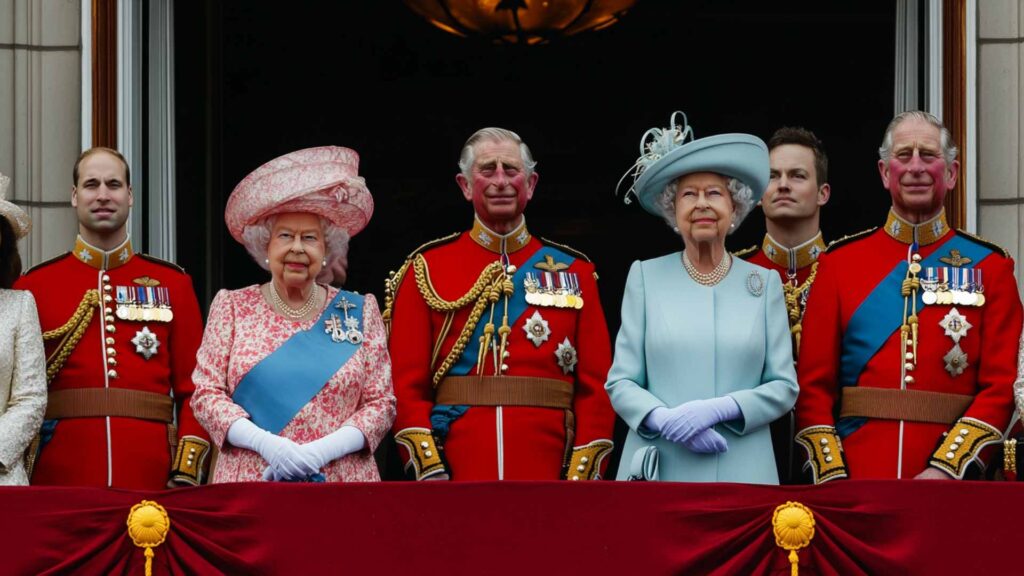
Q: What annual parade marks the sovereign’s official birthday?
A: Trooping the Colour.
Q: Where is the Order of the Garter service held?
A: St George’s Chapel, Windsor Castle.
Q: What flag flies when the monarch is in residence?
A: The Royal Standard.
Q: What is the coronation anointing oil ceremony called?
A: The anointing, symbolizing sacred kingship.
Q: What medieval coronation chair houses the Stone of Destiny beneath it?
A: King Edward’s Chair in Westminster Abbey.
Q: Which diamond, long debated, has been mounted in various crowns of British queens?
A: The Koh-i-Noor (its modern use is sensitive and contested).
Q: What ceremony opens each new session of Parliament?
A: The State Opening of Parliament.
Q: What is the monarch’s Great Seal used for?
A: To signify formal approval of state documents.
Q: Which royal residence in London sits beside St James’s Park?
A: St James’s Palace.
Q: What is the Maundy Service?
A: A Holy Week ceremony where the monarch distributes Maundy money.
Q: What title is reserved for the sovereign’s eldest daughter?
A: Princess Royal (granted, not automatic).
Q: Which order of chivalry is Scotland’s premier order?
A: The Order of the Thistle.
Q: What is the Ceremony of the Keys in London?
A: Nightly locking of the Tower of London.
Q: Which crown incorporates the Black Prince’s Ruby (actually a spinel)?
A: The Imperial State Crown.
Q: Which heraldic arms feature the lion and the unicorn supporters?
A: The Royal Arms of the United Kingdom.
Q: What coin inscription initials—F.D.—stand for?
A: Fidei Defensor (“Defender of the Faith”).
Law, Charters & the Constitution
Q: What 1215 charter is a cornerstone of constitutional tradition?
A: Magna Carta.
Q: What 1689 document limited sovereign power and affirmed parliamentary supremacy?
A: The Bill of Rights.
Q: Which 1707 acts united England (and Wales) with Scotland under one Parliament?
A: The Acts of Union 1707.
Q: Which 1800/1801 acts united Great Britain with Ireland?
A: The Acts of Union 1800/1801.
Q: What 1931 statute recognized dominion legislative independence?
A: The Statute of Westminster.
Q: What legal doctrine means the Crown never dies?
A: Demise of the Crown—the institution continues instantly.
Q: Which council advises the sovereign, including for Orders in Council?
A: The Privy Council.
Q: What is royal prerogative of mercy commonly called?
A: The royal pardon.
Q: Which 1701 statute originally barred those married to Catholics from succession (since amended)?
A: The Act of Settlement (amended by 2013 Act).
Q: What is the difference between the Crown Estate and the monarch’s private estates?
A: Crown Estate is public; Balmoral/Sandringham are private.
Q: Which law replaced the Civil List with the Sovereign Grant?
A: The Sovereign Grant Act 2011 (effective 2012).
Q: Which 1708 event is the last refusal of Royal Assent?
A: Queen Anne’s veto of the Scottish Militia Bill.
Q: What is a regency?
A: A period when a regent exercises royal functions for a minor/incapacitated monarch.
Q: Who can serve as Counsellors of State?
A: Certain adults in the line of succession, including the consort.
Q: What’s the constitutional status of the monarch’s political neutrality?
A: A convention: the sovereign remains neutral.
Q: What’s the monarch’s role in appointing a Prime Minister?
A: Appoints the person most likely to command Commons confidence.
Q: Which case debated regnal numbering for Elizabeth II in Scotland?
A: MacCormick v. Lord Advocate (1953).
Q: What are Letters Patent?
A: Open documents under the Great Seal granting offices, peerages, or styles.
Q: What’s the royal assent formula used in the Lords?
A: The Norman French “La Reyne/le Roi le veult” (“The Queen/King wills it”).
Q: What is the “Queen’s (King’s) peace”?
A: The general peace and protection of the realm under the Crown’s authority.
Q: Which 1707 guarantee preserved the Church of Scotland’s status?
A: The union settlement safeguarded the Presbyterian Church of Scotland.
Queens, Consorts & Powerful Royal Women
Q: Who was England’s first queen regnant?
A: Mary I (reigned 1553–1558).
Q: Which queen’s long rule is dubbed the Elizabethan era?
A: Elizabeth I.
Q: Which queen regnant restored Protestantism after Mary I?
A: Elizabeth I.
Q: Which medieval empress contested Stephen for the throne in the 12th century?
A: Empress Matilda (Maud).
Q: Which queen consort influenced arts and philanthropy in the Victorian age?
A: Queen Victoria herself as queen regnant; consort Prince Albert drove many initiatives.
Q: Which queen consort to Charles I was a French Catholic?
A: Henrietta Maria.
Q: Which queen mother guided a wartime king in the 1940s?
A: Queen Elizabeth (later the Queen Mother).
Q: Which 16th-century queen’s marriage to Philip II tied England to Spain?
A: Mary I.
Q: Which Tudor queen survived Henry VIII and later married Thomas Seymour?
A: Catherine Parr.
Q: Which Scottish queen’s tumultuous life ended on Elizabeth I’s order?
A: Mary, Queen of Scots.
Q: Which Georgian queen gave her name to city names, cake, and a flower?
A: Queen Charlotte.
Q: Which queen consort strongly shaped late Victorian court after Albert’s death?
A: Queen Victoria maintained strict mourning; Princess of Wales Alexandra influenced fashion.
Q: Which 20th-century princess became a global humanitarian icon?
A: Diana, Princess of Wales (not a queen, but transformative).
Q: Which title is held by the reigning monarch’s wife today?
A: Queen (styled as queen consort in formal contexts).
Q: Which title can the eldest daughter of the sovereign receive?
A: Princess Royal.
Q: Which queen regnant’s navy defeated the Armada?
A: Elizabeth I.
Q: Which queen’s Golden Jubilee in 2002 marked 50 years on the throne?
A: Elizabeth II.
Q: Which queen’s Platinum Jubilee in 2022 marked 70 years?
A: Elizabeth II.
Q: Which medieval queen was famed for political acumen and the “Lady with the Lamp” is not royal—careful—
A: Eleanor of Aquitaine was famed for political acumen (not the nurse).
Q: Which queen’s coronation in 1953 was the first televised?
A: Elizabeth II.
Q: Which queen consort’s crown formerly featured the Koh-i-Noor in the 20th century?
A: Queen Elizabeth (the Queen Mother)’s Crown (its use is now sensitive).
Wars, Rebellions & Turning Points
Q: What 1215 baronial revolt produced a foundational charter?
A: The revolt against King John leading to Magna Carta.
Q: Which 1455–1487 conflict ended with Tudor rule?
A: The Wars of the Roses.
Q: What 1588 event foiled an invasion of England?
A: Defeat of the Spanish Armada.
Q: Which 1642–1651 conflict led to a king’s execution?
A: The English Civil Wars.
Q: What 1688 change brought a Protestant succession and parliamentary supremacy?
A: The Glorious Revolution.
Q: Which 1715 and 1745 uprisings aimed to restore the Stuarts?
A: The Jacobite risings.
Q: Which 1805 battle cemented British naval dominance?
A: Trafalgar.
Q: Which 1815 battle ended Napoleon’s rule?
A: Waterloo.
Q: Which 1914–1918 war saw George V rebrand the dynasty?
A: World War I (to Windsor).
Q: What 1939–1945 conflict tested George VI’s wartime leadership?
A: World War II.
Q: Which 1936 constitutional crisis forced Parliament to choose between crown and marriage?
A: The Abdication Crisis.
Q: Which 1916 Irish event challenged British rule and later politics?
A: The Easter Rising (with major constitutional repercussions).
Q: Which 1707 event realigned sovereignty and Parliament on the island of Great Britain?
A: The Acts of Union.
Q: Which 1801 change joined Ireland to a new United Kingdom?
A: The Acts of Union with Ireland.
Q: Which 1922 development reshaped the UK’s name and borders?
A: Irish Free State’s creation; the UK became “of Great Britain and Northern Ireland.”
Q: Which 1931 statute recognized self-governing dominions’ equality with Britain?
A: The Statute of Westminster.
Q: Which 1998 accords, while political, carried royal symbolism of reconciliation?
A: The Good Friday Agreement (royal visits later reinforced reconciliation).
Q: Which 1999 change altered the House of Lords composition?
A: Removal of most hereditary peers (House of Lords Act 1999).
Q: Which 2011 (effective 2013) change updated succession fairness?
A: Ended male-preference primogeniture.
Q: Which 2022 law restored classic dissolution powers?
A: The Dissolution and Calling of Parliament Act 2022.
Q: Which 2023 event marked a new reign’s formal consecration?
A: The Coronation of Charles III.
Empire, Commonwealth & Global Connections
Q: What loose association succeeded the British Empire?
A: The Commonwealth of Nations.
Q: What role does the British monarch hold within the Commonwealth?
A: Head of the Commonwealth (symbolic, not hereditary by law but chosen).
Q: What 1949 declaration allowed republics to remain members?
A: The London Declaration.
Q: What are countries that share the monarch as head of state called?
A: Commonwealth realms.
Q: Name one large Commonwealth realm outside the UK.
A: Canada, Australia, or New Zealand (among others).
Q: What 1931 act affirmed dominion legislative independence?
A: The Statute of Westminster.
Q: Which jewel debates highlight imperial legacies in the Crown Jewels?
A: The Koh-i-Noor and Cullinan diamonds.
Q: Which royal tour element often emphasizes reconciliation and remembrance?
A: Wreath-laying and meetings with communities tied to historic events.
Q: What is the monarch’s role in appointing governors-general in realms?
A: Appoints on the advice of each realm’s prime minister.
Q: Which Caribbean nation became a republic in 2021, ending the monarch’s role there?
A: Barbados.
Q: What is a realm referendum sometimes used to decide?
A: Whether to retain the monarch as head of state.
Q: What is the collective term for the UK’s remaining overseas territories?
A: British Overseas Territories.
Q: Which charter modernized the Commonwealth’s values in 2013?
A: The Commonwealth Charter.
Q: What is the Commonwealth Games’ informal nickname?
A: The “Friendly Games.”
Q: Which 1953–1954 royal tour famously circled the globe?
A: Queen Elizabeth II’s first Commonwealth tour.
Q: Which Canadian constitutional milestone in 1982 fully “patriated” its constitution?
A: The Constitution Act 1982 (with the Charter of Rights and Freedoms).
Q: Which Australian 1999 vote concerned the monarchy?
A: A referendum on becoming a republic (it failed).
Q: Which New Zealand honor did the Crown re-establish in 1996 reflecting local identity?
A: The New Zealand Order of Merit.
Q: Which realm’s 1986 Constitutional Act affirmed local control over symbols like the royal title?
A: Australia (Australia Acts also in 1986).
Q: What is the diplomatic term for royal visits building soft power?
A: Royal diplomacy or “soft power” tours.
Q: What body of prime ministers meets biennially, often with the monarch attending opening?
A: The Commonwealth Heads of Government Meeting (CHOGM).

Ellie Simons creates and edits Random Trivia. She researches trivia using primary and authoritative sources whenever possible and is currently reviewing the site's older trivia library for accuracy, clarity, and playability. Read more on the About page.
Explore more questions in our history trivia guide.
About this quiz
Site editor: Ellie Simons. Read our Trivia Methodology to learn how questions are researched and updated. Page last updated: . Report an error.