
Your brain uses billions of cells to read this sentence, ignore your socks, regulate breathing, and possibly suggest a snack. These 120 human brain trivia questions cover anatomy, neurons, senses, movement, memory, sleep, research, and myths worth retiring.
Think through our human anatomy trivia, biology trivia, and science trivia.
Human Brain Anatomy and Major Structures
The brain weighs roughly three pounds and somehow uses that modest luggage allowance to run language, balance, memory, temperature, and my habit of forgetting why I entered a room. Its neighborhoods specialize, but none works alone.
Q: What is the largest part of the human brain?
A: The cerebrum.
Q: How many major hemispheres does the cerebrum have?
A: Two.
Q: What thick band of fibers connects the cerebral hemispheres?
A: The corpus callosum.
Q: What is the wrinkled outer layer of the cerebrum called?
A: The cerebral cortex.
Q: What are the raised folds of the cerebral cortex called?
A: Gyri.
Q: What are the grooves between cortical folds called?
A: Sulci.
Q: Why does the cerebral cortex have folds?
A: Folding increases surface area within the skull.
Q: What tissue forms much of the outer cerebral cortex?
A: Gray matter.
Q: What tissue contains many myelinated axons beneath the cortex?
A: White matter.
Q: Which lobe is strongly involved in planning, decision-making, and voluntary movement?
A: The frontal lobe.
Q: Which lobe processes much touch and body-position information?
A: The parietal lobe.
Q: Which lobe contains the primary visual cortex?
A: The occipital lobe.
Q: Which lobe contains the primary auditory cortex?
A: The temporal lobe.
Q: Which structure is essential for forming many new declarative memories?
A: The hippocampus.
Q: Which structure helps process emotional significance, especially threat and fear?
A: The amygdala.
Q: Which relay center sends much sensory information to the cerebral cortex?
A: The thalamus.
Q: Which small region helps regulate hunger, thirst, temperature, and hormones?
A: The hypothalamus.
Q: Which gland attached to the hypothalamus is often called the master endocrine gland?
A: The pituitary gland.
Q: Which group of structures helps select and coordinate movement?
A: The basal ganglia.
Q: Which brain region fine-tunes balance, timing, and coordination?
A: The cerebellum.
Q: Which structure connects the brain with the spinal cord?
A: The brainstem.
Q: What are the three main parts of the brainstem?
A: The midbrain, pons, and medulla oblongata.
Q: Which brainstem region helps control breathing and heart rate?
A: The medulla oblongata.
Q: What are the three protective membrane layers around the brain?
A: The dura mater, arachnoid mater, and pia mater.
Q: What fluid cushions the brain and spinal cord?
A: Cerebrospinal fluid.
Q: What connected spaces inside the brain contain cerebrospinal fluid?
A: The ventricles.
Q: What selective boundary limits substances moving from blood into brain tissue?
A: The blood-brain barrier.
Q: Which bony structure protects the brain?
A: The skull or cranium.
Q: How much does an average adult human brain weigh?
A: About three pounds.
Q: What share of the body’s resting energy does the brain use?
A: Roughly 20 percent.
Neurons, Glia, and Brain Signaling
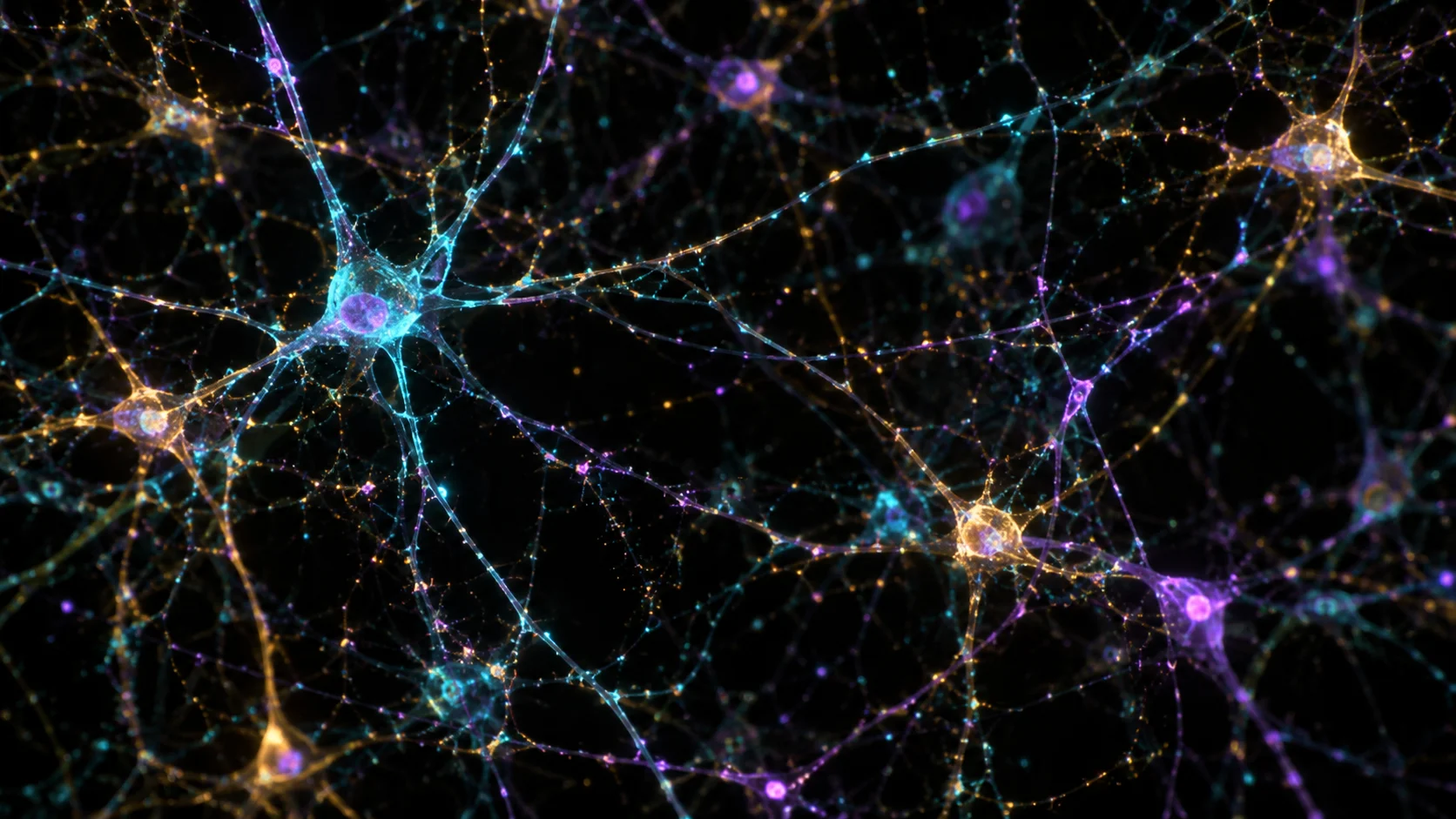
A neuron can send an electrical pulse down a long axon, convert it to a chemical message, and hand it across a microscopic gap. My group chats have accomplished less with vastly more punctuation.
Q: What cell is specialized to transmit information in the nervous system?
A: A neuron.
Q: How many neurons are estimated to be in the human brain?
A: Roughly 86 billion.
Q: What branched parts of a neuron usually receive incoming signals?
A: Dendrites.
Q: What long neuron extension carries signals away from the cell body?
A: The axon.
Q: What fatty insulation speeds signals along many axons?
A: Myelin.
Q: Which cells make myelin in the brain and spinal cord?
A: Oligodendrocytes.
Q: Which cells make myelin in peripheral nerves?
A: Schwann cells.
Q: What is the junction where one neuron communicates with another cell?
A: A synapse.
Q: What tiny gap separates cells at a chemical synapse?
A: The synaptic cleft.
Q: What chemical messenger crosses many synapses?
A: A neurotransmitter.
Q: What rapid electrical signal travels along an axon?
A: An action potential.
Q: What membrane change begins an action potential?
A: Depolarization.
Q: Which ion rushes into many neurons during depolarization?
A: Sodium.
Q: Which ion moves out during much of repolarization?
A: Potassium.
Q: What does the all-or-none principle mean for an action potential?
A: Once threshold is reached, the action potential fires at full size.
Q: Which neurotransmitter is the brain’s main excitatory messenger?
A: Glutamate.
Q: Which neurotransmitter is the brain’s main inhibitory messenger?
A: GABA.
Q: Which neurotransmitter is involved in movement, motivation, and reward learning?
A: Dopamine.
Q: Which neurotransmitter helps regulate mood, sleep, and other functions?
A: Serotonin.
Q: Which neurotransmitter supports muscle activation, attention, and memory?
A: Acetylcholine.
Q: What process removes neurotransmitter by taking it back into the releasing cell?
A: Reuptake.
Q: What enzyme-driven process can end a neurotransmitter’s signal?
A: Enzymatic breakdown.
Q: What are glial cells?
A: Nervous-system cells that support, protect, nourish, and regulate neurons.
Q: Which star-shaped glial cells support neurons and help maintain the brain environment?
A: Astrocytes.
Q: Which immune-like cells patrol the brain and remove debris?
A: Microglia.
Q: Which cells line the brain’s ventricles?
A: Ependymal cells.
Q: What is neuroplasticity?
A: The nervous system’s ability to change its connections and function with experience.
Q: What repeated cellular process can strengthen a synapse for learning?
A: Long-term potentiation.
Q: What happens when a frequently unused connection weakens?
A: Synaptic depression or pruning may reduce its influence.
Q: Why is the old idea that glia are merely “glue” inaccurate?
A: Glia actively regulate signaling, immunity, metabolism, and neural support.
Senses, Movement, Language, and Automatic Control
Your brain turns pressure waves into speech, light into faces, and muscle feedback into a staircase you can descend without calculating every joint angle. That last trick becomes especially impressive when the lights go out.
Q: Where is the primary motor cortex located?
A: In the precentral gyrus of the frontal lobe.
Q: Where is the primary somatosensory cortex located?
A: In the postcentral gyrus of the parietal lobe.
Q: What does the motor cortex control?
A: Voluntary movement.
Q: What does the somatosensory cortex process?
A: Touch, pressure, pain, temperature, and body-position information.
Q: Which body map shows how much cortex represents each body part?
A: The cortical homunculus.
Q: Why do hands and lips occupy large areas on the cortical homunculus?
A: They require especially detailed sensation or motor control.
Q: Which lobe first receives most visual information from the eyes?
A: The occipital lobe.
Q: Which cranial nerve carries visual signals?
A: The optic nerve.
Q: Which cranial nerve carries smell information?
A: The olfactory nerve.
Q: How many pairs of cranial nerves do humans have?
A: Twelve pairs.
Q: Which cranial nerve extends widely to the heart, lungs, and digestive organs?
A: The vagus nerve.
Q: Which brain region is classically linked to speech production?
A: Broca’s area.
Q: Where is Broca’s area usually located?
A: In the left frontal lobe.
Q: Which region is classically linked to understanding language?
A: Wernicke’s area.
Q: Why is language not controlled by only two isolated spots?
A: Language depends on distributed networks connecting many brain regions.
Q: Which hemisphere handles language in most people?
A: The left hemisphere.
Q: Why is the “logical left brain versus creative right brain” idea misleading?
A: Complex tasks use interacting networks across both hemispheres.
Q: What pathway carries movement commands from cortex toward the spinal cord?
A: The corticospinal tract.
Q: Where do many corticospinal fibers cross to the opposite side?
A: In the lower medulla.
Q: Why does the left hemisphere control much of the right side of the body?
A: Many major motor pathways cross in the brainstem.
Q: Which system controls involuntary functions such as heart rate and digestion?
A: The autonomic nervous system.
Q: Which autonomic division prepares the body for action?
A: The sympathetic division.
Q: Which autonomic division supports rest and digestion?
A: The parasympathetic division.
Q: What brainstem network helps regulate alertness and wakefulness?
A: The reticular formation.
Q: Which inner-ear structures detect head rotation?
A: The semicircular canals.
Q: Which sense tells the brain where body parts are without looking?
A: Proprioception.
Q: Which sensory system contributes strongly to balance alongside vision?
A: The vestibular system.
Q: What reflex causes the pupils to constrict in bright light?
A: The pupillary light reflex.
Q: Which brain structure coordinates learned movement timing and error correction?
A: The cerebellum.
Q: How does the brain identify an object by touch alone?
A: Somatosensory and association areas combine texture, shape, and position information.
Memory, Sleep, Brain Research, and Persistent Myths
Brains sleep, forget, reorganize, predict, and confidently invent missing details. Mine is excellent at remembering one embarrassing sentence from 2009 and less committed to grocery lists, which feels like questionable resource allocation.
Q: What type of memory briefly holds and manipulates information?
A: Working memory.
Q: Which frontal region is important for working memory and planning?
A: The prefrontal cortex.
Q: What type of memory stores facts and personal events?
A: Declarative or explicit memory.
Q: What type of memory supports learned skills such as riding a bicycle?
A: Procedural memory.
Q: Which structures contribute strongly to procedural learning?
A: The basal ganglia and cerebellum.
Q: What role does the hippocampus play in memory?
A: It helps organize and consolidate many new declarative memories.
Q: Which emotion-related structure can strengthen memory for significant events?
A: The amygdala.
Q: What is memory consolidation?
A: The stabilization and reorganization of a memory after learning.
Q: Why is remembering not like replaying a perfect recording?
A: Memory is reconstructive and can change during recall.
Q: What is forgetting sometimes useful for?
A: It reduces interference and helps prioritize relevant information.
Q: What two broad sleep states cycle during the night?
A: Non-REM and REM sleep.
Q: How many stages are in the modern non-REM sleep classification?
A: Three.
Q: Which sleep stage contains slow delta waves and deep sleep?
A: N3 sleep.
Q: Which sleep stage features rapid eye movements and vivid dreaming?
A: REM sleep.
Q: How long is a typical adult sleep cycle?
A: Roughly 90 minutes, with substantial variation.
Q: Which brain clock coordinates daily rhythms?
A: The suprachiasmatic nucleus.
Q: Where is the suprachiasmatic nucleus located?
A: In the hypothalamus.
Q: Which hormone helps signal biological night?
A: Melatonin.
Q: Which gland releases melatonin?
A: The pineal gland.
Q: What brain-cleaning system becomes especially active during sleep?
A: The glymphatic system.
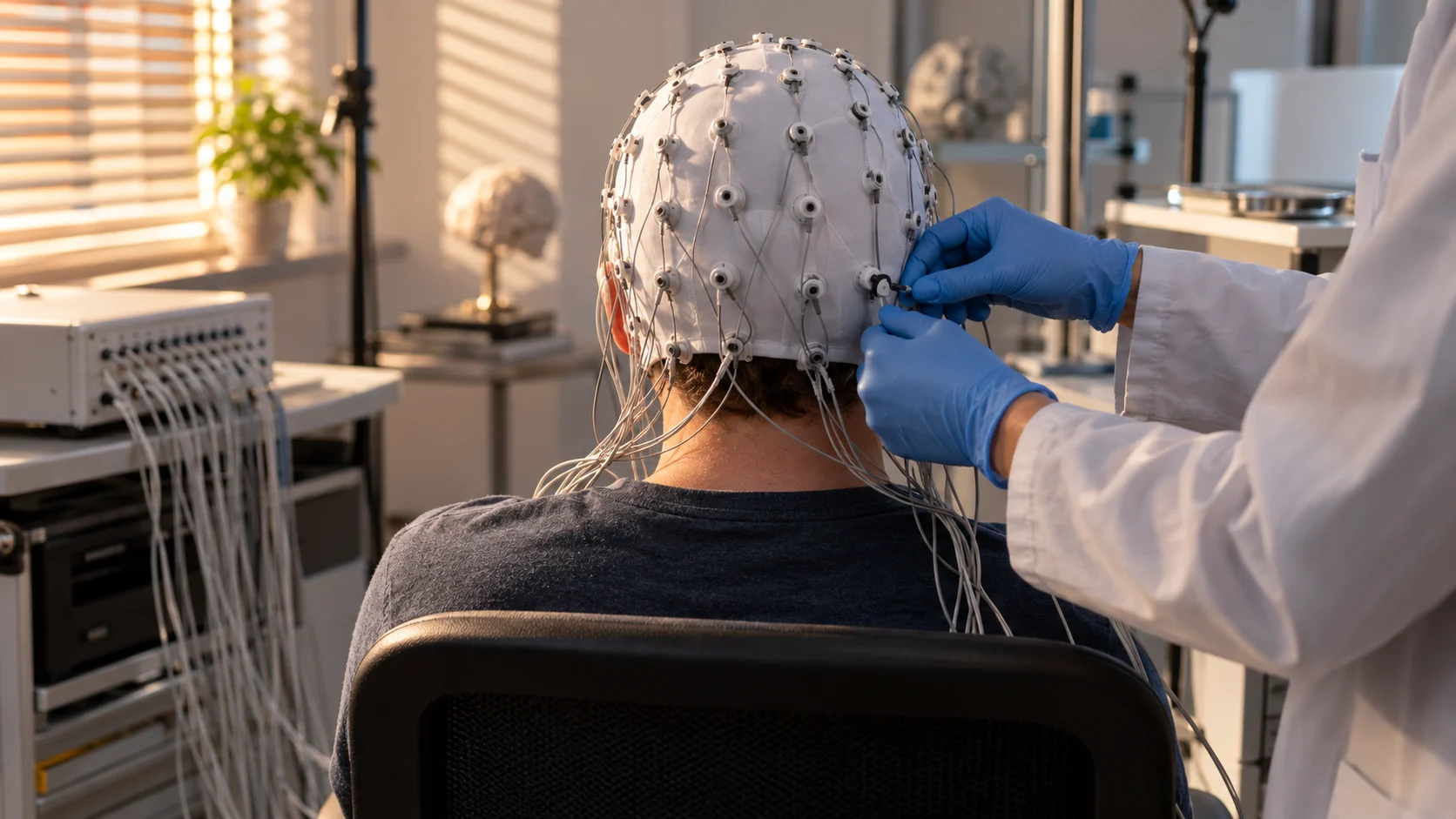
Q: What electrical recording measures activity from electrodes on the scalp?
A: An electroencephalogram, or EEG.
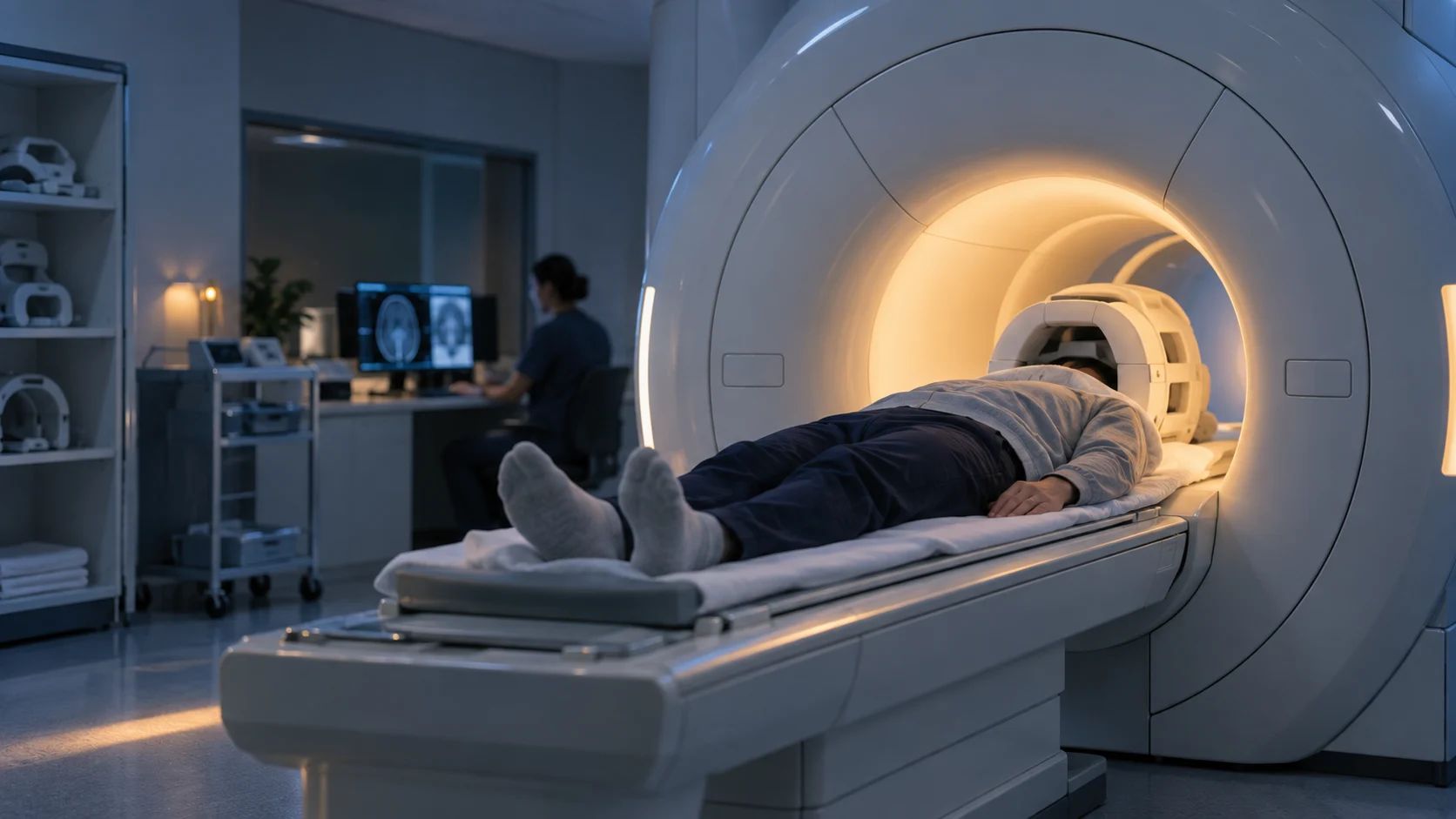
Q: What imaging method uses magnetic fields to show brain structure?
A: Magnetic resonance imaging, or MRI.
Q: What does functional MRI track indirectly?
A: Changes in blood oxygenation associated with neural activity.
Q: What scan uses radioactive tracers to measure metabolism or molecular targets?
A: A PET scan.
Q: Which physician linked speech production to a left frontal region through patient Leborgne?
A: Paul Broca.
Q: Which railroad worker became famous after surviving a tamping-iron injury?
A: Phineas Gage.
Q: Which scientist used silver staining to reveal individual neurons?
A: Camillo Golgi.
Q: Which scientist championed the neuron doctrine using detailed nerve-cell drawings?
A: Santiago Ramón y Cajal.
Q: What popular claim about using only 10 percent of the brain is false?
A: Healthy people use networks throughout the brain over the course of ordinary life.
Q: Why can brain surgery sometimes occur while a patient is awake?
A: Brain tissue itself lacks pain receptors, while the scalp and surrounding tissues are carefully numbed.
How Did You Score?
If you found the postcentral gyrus, separated glia from neurons, and retired the 10-percent myth, your brain trivia score is fully awake. Mine misplaced one fact in working memory and found it beside the grocery list.

Ellie Simons creates and edits Random Trivia. She researches trivia using primary and authoritative sources whenever possible and is currently reviewing the site's older trivia library for accuracy, clarity, and playability. Read more on the About page.
About this quiz
Site editor: Ellie Simons. Read our Trivia Methodology to learn how questions are researched and updated. Page last updated: . Report an error.