
Mars has blue sunsets, continent-sized dust storms, the solar system’s tallest volcano, and a growing population of retired robots. These 120 Mars trivia questions cover the planet’s orbit, geology, weather, missions, search for life, and persistent hold on human imagination.
Launch into our space trivia, solar system trivia, and Moon trivia.
Mars Basics, Orbit, Atmosphere, and Moons
Mars is close enough to tempt explorers and far enough to make every trip a major engineering argument. It has familiar seasons and days, then ruins the resemblance with carbon dioxide air, global dust, and two potato-shaped moons.
Q: Which planet is known as the Red Planet?
A: Mars.
Q: What gives Mars its reddish color?
A: Iron minerals in its soil oxidize, producing rust-like compounds.
Q: Which planet is Mars from the Sun?
A: The fourth planet.
Q: How wide is Mars?
A: About 4,220 miles in diameter.
Q: How does Mars compare with Earth in diameter?
A: Mars is a little more than half as wide as Earth.
Q: How long is a Martian day?
A: About 24 hours and 39 minutes.
Q: What word describes a Martian solar day?
A: A sol.
Q: How long is a Martian year?
A: About 687 Earth days.
Q: How strong is gravity on Mars compared with Earth?
A: About 38 percent as strong.
Q: What is Mars’s average distance from the Sun?
A: About 142 million miles.
Q: What shape is Mars’s orbit compared with Earth’s?
A: It is more elliptical.
Q: What is the tilt of Mars’s rotational axis?
A: About 25 degrees.
Q: Why does Mars have seasons?
A: Its axis is tilted as it orbits the Sun.
Q: Why are Martian seasons unequal in length?
A: Mars moves at different speeds along its elliptical orbit.
Q: What gas makes up most of Mars’s atmosphere?
A: Carbon dioxide.
Q: How dense is the Martian atmosphere compared with Earth’s?
A: Surface pressure averages less than 1 percent of Earth’s.
Q: Which gas is the second most abundant in Mars’s atmosphere?
A: Nitrogen.
Q: Why can liquid water not remain stable on most of the Martian surface today?
A: Low pressure and cold temperatures make it freeze or boil away quickly.
Q: What average temperature is often given for Mars?
A: About minus 80 degrees Fahrenheit.
Q: Why can Martian temperatures vary widely?
A: The thin atmosphere stores and redistributes little heat.
Q: How many natural moons does Mars have?
A: Two.
Q: What are Mars’s moons called?
A: Phobos and Deimos.
Q: Which Martian moon is larger and closer?
A: Phobos.
Q: Which Martian moon orbits Mars faster than Mars rotates?
A: Phobos.
Q: What is gradually happening to Phobos’s orbit?
A: It is spiraling inward toward Mars.
Q: Which Martian moon is smaller and farther away?
A: Deimos.
Q: What shapes do Phobos and Deimos have?
A: Irregular, potato-like shapes.
Q: Who discovered Phobos and Deimos in 1877?
A: Asaph Hall.
Q: What do the names Phobos and Deimos mean?
A: Fear and terror.
Q: Which Roman god gave Mars its name?
A: The god of war.
Martian Mountains, Canyons, Ice, and Weather
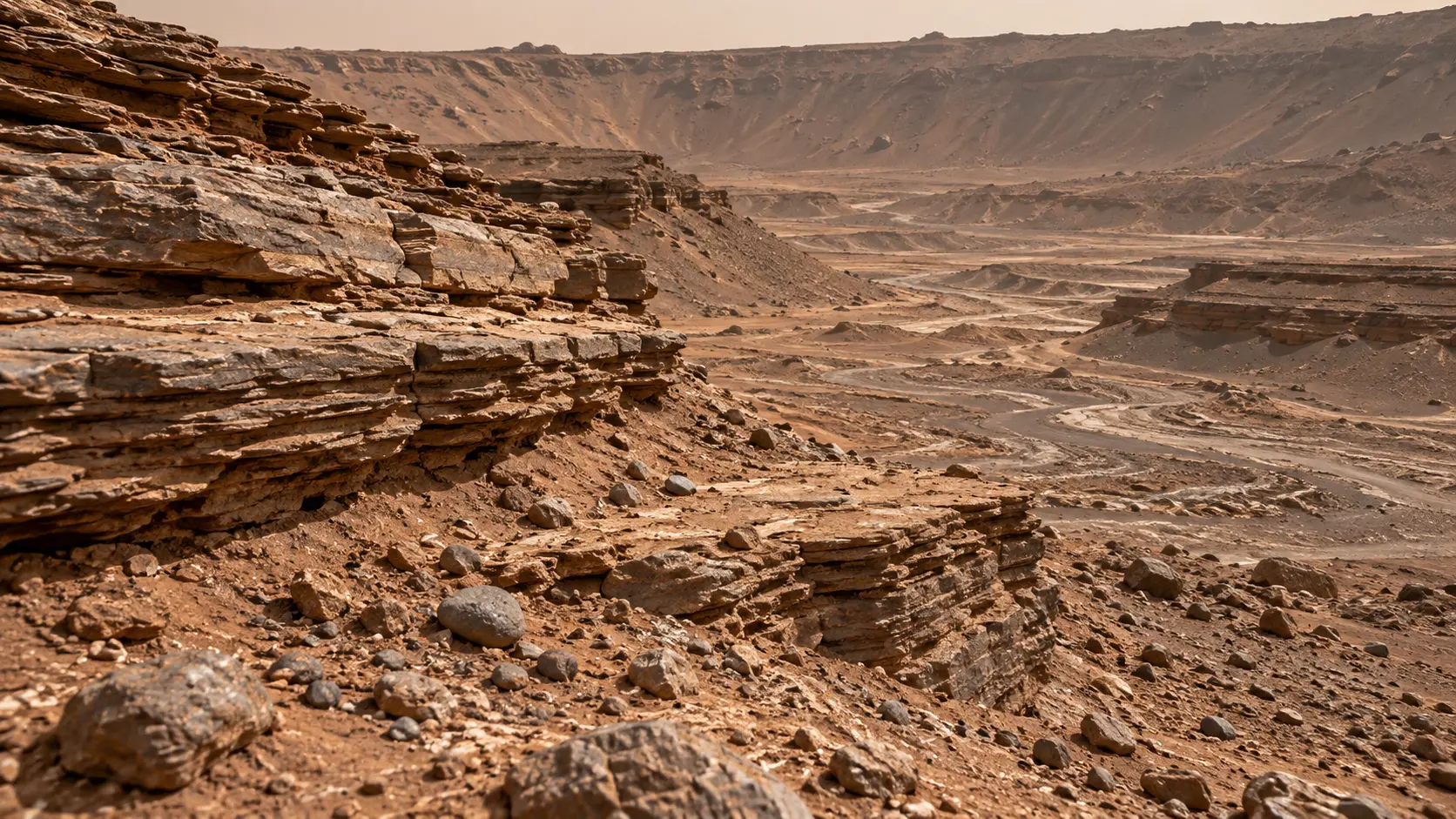
Mars took familiar geology and turned the scale knob all the way up. Its tallest volcano and biggest canyon make Earth landmarks look restrained, while its sunsets chose blue just to keep the postcards interesting.
Q: What is the largest known volcano in the solar system?
A: Olympus Mons.
Q: What type of volcano is Olympus Mons?
A: A shield volcano.
Q: How tall is Olympus Mons above the surrounding plains?
A: Roughly 13 miles.
Q: Which volcanic region contains several giant Martian volcanoes?
A: Tharsis.
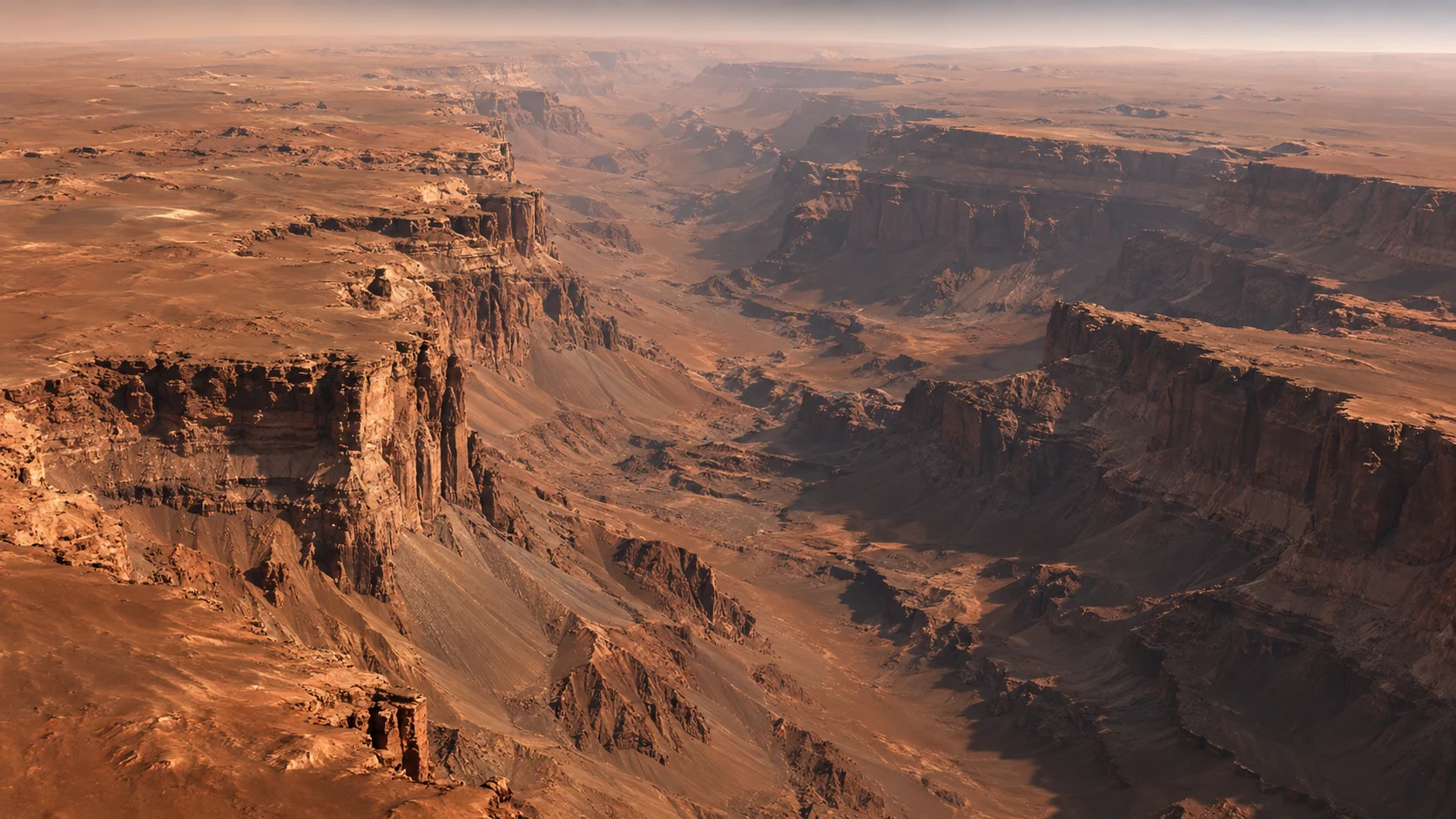
Q: What is the vast canyon system near the Martian equator called?
A: Valles Marineris.
Q: How long is Valles Marineris?
A: More than 2,500 miles.
Q: Which spacecraft inspired the name Valles Marineris?
A: Mariner 9.
Q: What is the largest clearly visible impact basin on Mars?
A: Hellas Planitia.
Q: Which northern lowland may contain sediments from an ancient ocean?
A: Vastitas Borealis.
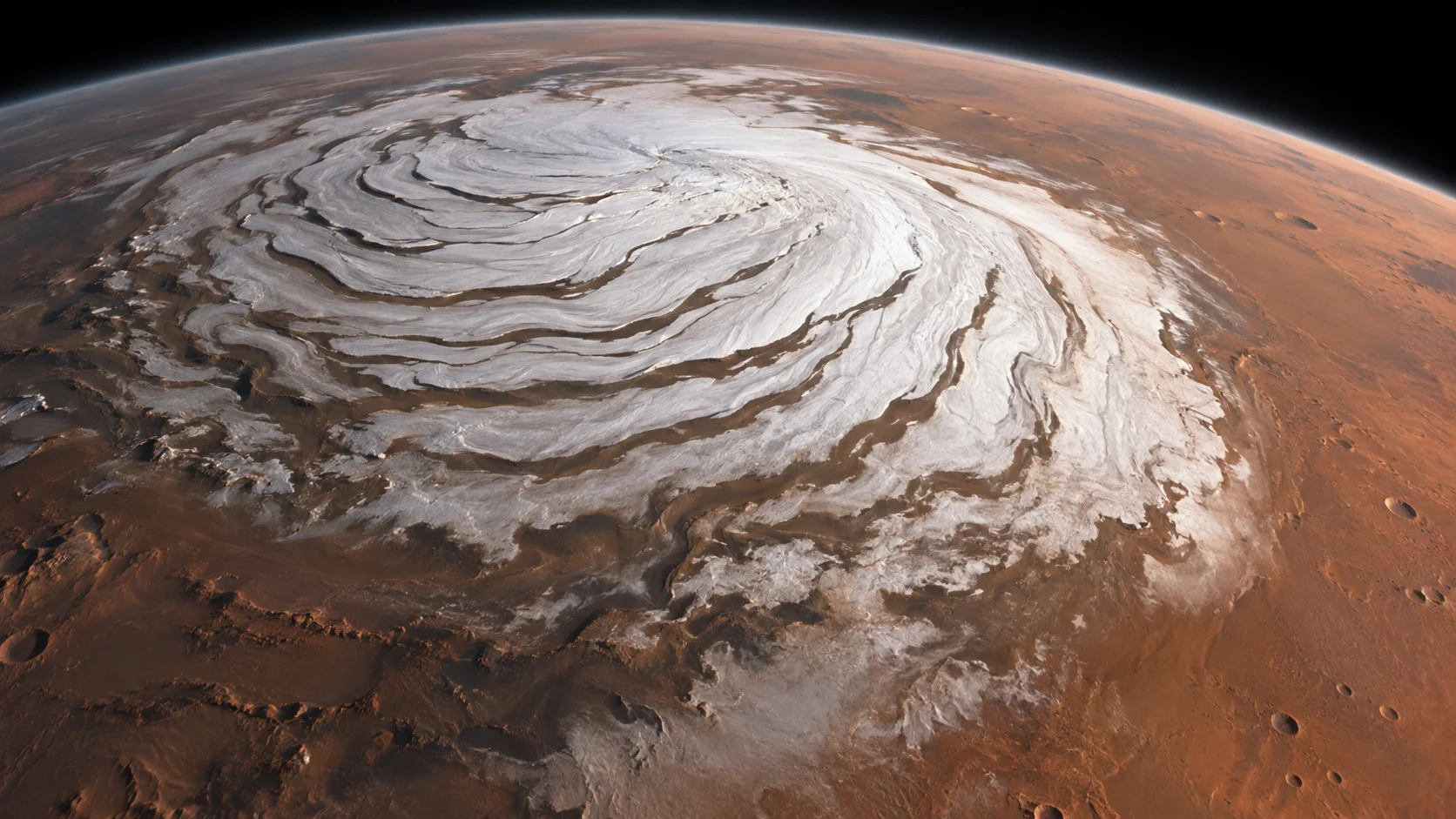
Q: What materials form Mars’s polar caps?
A: Water ice and seasonal carbon dioxide ice.
Q: What do both permanent Martian polar caps contain?
A: Water ice.
Q: What are recurring dark and light layers near the poles called?
A: Polar layered deposits.
Q: What process causes carbon dioxide frost to change directly into gas?
A: Sublimation.
Q: What weather event can sometimes spread around most of Mars?
A: A planet-encircling dust storm.
Q: Why does Martian dust stay airborne for long periods?
A: Fine particles settle slowly in low gravity and thin air.
Q: What color can sunsets appear on Mars?
A: Bluish near the Sun.
Q: Why can Martian sunsets look blue?
A: Fine dust scatters blue light forward near the Sun.
Q: What are dust devils?
A: Rotating columns of heated air that lift dust.
Q: Which rover photographed many dust devils inside Gale Crater?
A: Curiosity.
Q: What small seasonal features form when carbon dioxide gas erupts through polar ice?
A: Dark fans and spider-like channels.
Q: What is Gale Crater’s central mountain called?
A: Mount Sharp, officially Aeolis Mons.
Q: Which rover is climbing the layers of Mount Sharp?
A: Curiosity.
Q: Which crater contains an ancient river delta explored by Perseverance?
A: Jezero Crater.
Q: What does Jezero’s delta show about ancient Mars?
A: A river once carried sediment into a crater lake.
Q: Which mineral deposits can preserve evidence of ancient water?
A: Clays, sulfates, carbonates, and hydrated salts.
Q: What rounded objects found by Opportunity were nicknamed blueberries?
A: Hematite-rich mineral concretions.
Q: Which landform suggests glaciers once flowed on Mars?
A: Lobate debris aprons and lineated valley fill.
Q: Where is much of Mars’s accessible water found today?
A: In polar ice and subsurface ice.
Q: What causes many Martian craters to have layered ejecta?
A: Impacts into ground containing ice or volatile-rich material.
Q: Why does Mars lack an Earth-like global magnetic field?
A: Its internal dynamo shut down early in the planet’s history.
Robots, Orbiters, Rovers, and Mars Missions
Mars exploration includes silent landers, marathon rovers, a helicopter, and several spacecraft that arrived only to become expensive craters. The success rate improved, but Mars never stopped charging tuition.
Q: Which spacecraft made the first successful Mars flyby?
A: Mariner 4.
Q: When did Mariner 4 return the first close-up Mars images?
A: 1965.
Q: Which spacecraft became the first to orbit another planet?
A: Mariner 9 at Mars in 1971.
Q: Which Soviet lander made the first soft landing on Mars but transmitted only briefly?
A: Mars 3.
Q: Which two U.S. missions landed on Mars in 1976?
A: Viking 1 and Viking 2.
Q: Which Viking lander was the first successful U.S. Mars landing?
A: Viking 1.
Q: What did the Viking landers test directly in Martian soil?
A: They conducted experiments designed to detect signs of microbial activity.
Q: Which 1997 mission delivered the Sojourner rover?
A: Mars Pathfinder.
Q: What distinction did Sojourner hold?
A: It was the first rover to operate on Mars.
Q: Which twin rovers landed on Mars in 2004?
A: Spirit and Opportunity.
Q: Which rover became stuck in soft soil and ended its mission in 2010?
A: Spirit.
Q: Which rover operated for nearly 15 years before a dust storm ended contact?
A: Opportunity.
Q: What conditions ended Opportunity’s mission?
A: A planet-encircling dust storm reduced sunlight until the rover lost power and contact.
Q: Which 2008 lander exposed water ice in Martian soil?
A: Phoenix.
Q: Which rover landed in Gale Crater in 2012?
A: Curiosity.
Q: What landing system lowered Curiosity on cables?
A: The sky crane.
Q: Which mission studied Mars’s upper atmosphere and its loss to space?
A: MAVEN.
Q: Which lander detected hundreds of marsquakes?
A: InSight.
Q: What instrument did InSight place on the surface?
A: A sensitive seismometer.
Q: Which mission reached Mars orbit for the United Arab Emirates in 2021?
A: The Hope probe.
Q: Which Chinese mission delivered an orbiter, lander, and rover in 2021?
A: Tianwen-1.
Q: What was China’s first Mars rover called?
A: Zhurong.
Q: Which NASA rover landed in Jezero Crater in 2021?
A: Perseverance.
Q: What helicopter traveled to Mars with Perseverance?
A: Ingenuity.
Q: When did Ingenuity make the first powered controlled flight on another planet?
A: April 19, 2021.
Q: How many flights did Ingenuity complete before its mission ended?
A: Seventy-two.
Q: What is Perseverance storing in sealed tubes?
A: Samples of Martian rock and soil for possible future return.
Q: Which instrument on Perseverance produced oxygen from Martian carbon dioxide?
A: MOXIE.
Q: What does MOXIE stand for?
A: Mars Oxygen In-Situ Resource Utilization Experiment.
Q: Why do orbiters relay data for surface missions?
A: They provide efficient communication links between Mars and Earth.
Searching for Life, Human Plans, and Mars in Culture
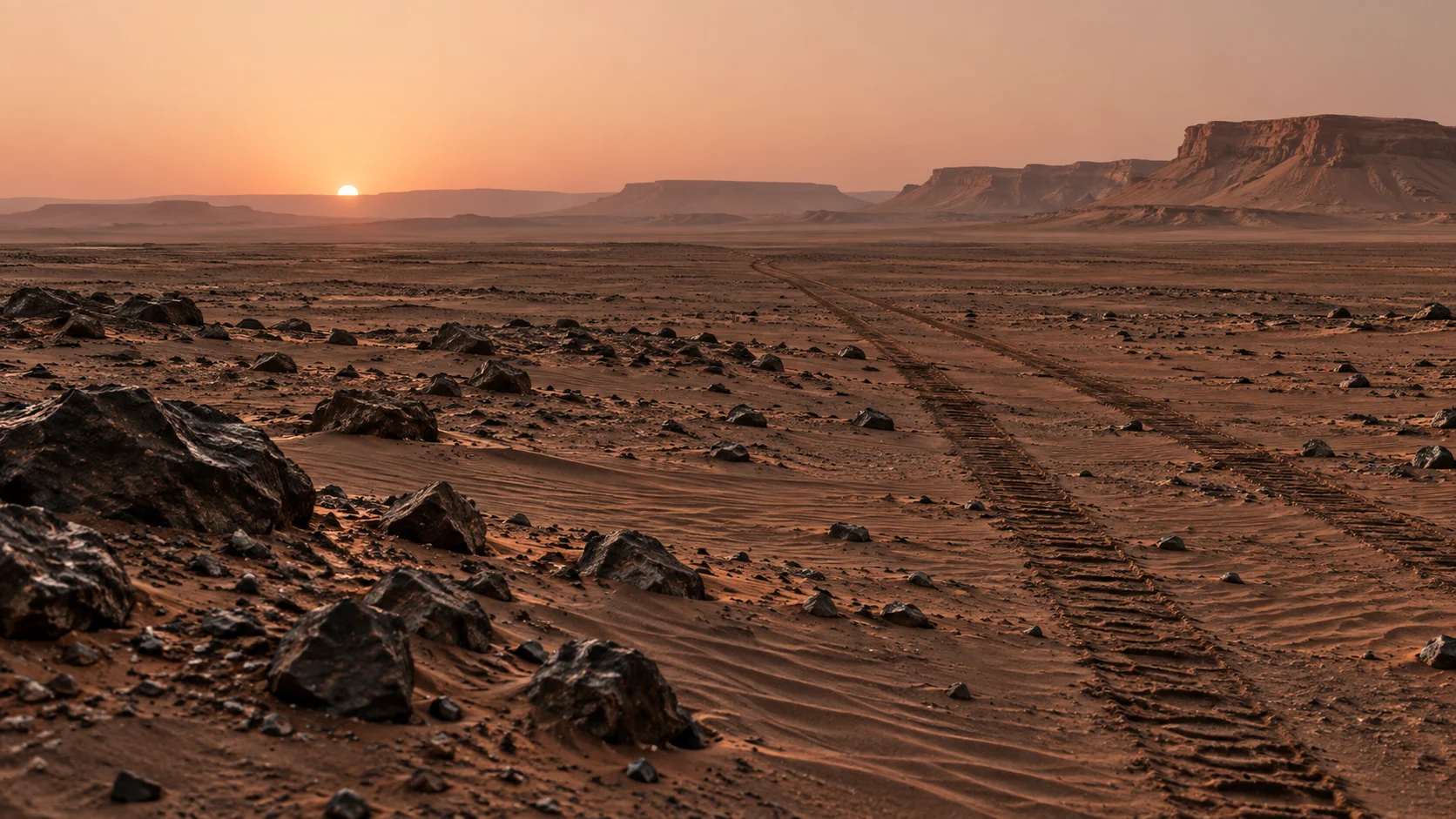
Mars has hosted imaginary canals, tripod invaders, stranded astronauts, and serious debates about ancient habitability. The planet does not owe us Martians, but it keeps offering enough clues to justify another mission.
Q: What does astrobiology study?
A: The origin, evolution, distribution, and future of life in the universe.
Q: Why was ancient Mars potentially more habitable than modern Mars?
A: It had rivers, lakes, a thicker atmosphere, and a milder surface environment.
Q: What evidence shows that ancient Mars had flowing water?
A: Valley networks, deltas, lake sediments, and water-altered minerals.
Q: What kind of life would Mars missions most plausibly seek evidence of?
A: Past or present microbial life.
Q: Why are organic molecules not automatic proof of life?
A: They can form through nonbiological chemistry.
Q: Which Martian meteorite sparked debate about possible microscopic fossils in 1996?
A: ALH 84001.
Q: Where was ALH 84001 found?
A: Antarctica.
Q: What is planetary protection?
A: Practices that limit biological contamination between Earth and other worlds.
Q: Why are some Martian locations considered special regions?
A: Conditions there might allow terrestrial microbes to survive or replicate.
Q: What is a biosignature?
A: A substance, structure, or pattern that may indicate life.
Q: Why would several independent biosignatures be stronger than one?
A: Different evidence can rule out nonbiological explanations.
Q: What are the dark seasonal streaks called recurring slope lineae?
A: Narrow features that appear and fade on steep warm slopes.
Q: What is the leading caution about recurring slope lineae?
A: Many may result from dry granular flows rather than liquid water.
Q: How often do favorable Earth-to-Mars launch windows occur?
A: About every 26 months.
Q: How long does a typical one-way trip to Mars take with current methods?
A: Roughly seven to nine months.
Q: What is solar conjunction for Mars missions?
A: A period when the Sun lies between Earth and Mars and disrupts communication.
Q: Why is radiation a major concern for Mars travelers?
A: Mars-bound crews lack Earth’s thick atmosphere and global magnetic shielding.
Q: Why is Martian dust a concern for humans and machinery?
A: It is fine, abrasive, electrostatic, and potentially harmful if inhaled.
Q: What resource could astronauts extract from Martian ice?
A: Water for drinking, oxygen, and rocket fuel ingredients.
Q: What does in-situ resource utilization mean?
A: Using local materials instead of bringing everything from Earth.
Q: What is terraforming Mars?
A: The hypothetical large-scale alteration of Mars to make it more Earth-like.
Q: Why is terraforming far beyond current capability?
A: It would require enormous energy, materials, time, and planetary-scale engineering.
Q: Who observed linear features on Mars and called them canali?
A: Giovanni Schiaparelli.
Q: How was the Italian word canali often mistranslated in English?
A: As canals rather than channels.
Q: Who promoted the idea of engineered Martian canals?
A: Percival Lowell.
Q: Which H. G. Wells novel features Martian invaders?
A: The War of the Worlds.
Q: What name did Edgar Rice Burroughs use for Mars in his planetary romances?
A: Barsoom.
Q: Which novel follows astronaut Mark Watney surviving on Mars?
A: The Martian.
Q: Which month is named after the Roman god Mars?
A: March.
Q: What makes Mars science more interesting than simply asking whether aliens exist?
A: Its geology, climate history, atmosphere, water, and habitability form a connected planetary story.
How Did You Score?
If you knew a sol, found Valles Marineris, and remembered Ingenuity’s 72 flights, your Mars score is mission-ready. Mine needed a software patch after the recurring slope lineae, but contact has been restored.

Ellie Simons creates and edits Random Trivia. She researches trivia using primary and authoritative sources whenever possible and is currently reviewing the site's older trivia library for accuracy, clarity, and playability. Read more on the About page.
About this quiz
Site editor: Ellie Simons. Read our Trivia Methodology to learn how questions are researched and updated. Page last updated: . Report an error.