
Sharpen your history pencil, because this round follows a decade that tested families, governments, and economies around the world.
These Great Depression trivia questions focus mainly on the United States while adding the global context, major policies, culture, and personal stories that make the era easier to understand.
The Crash and the Economic Slide
Q: In what year did the U.S. stock market crash associated with the start of the Great Depression?
A: 1929.
Q: What date is known as Black Tuesday?
A: October 29, 1929.
Q: What major New York financial marketplace crashed in 1929?
A: The New York Stock Exchange.
Q: Did the 1929 crash alone cause the Great Depression?
A: No. It was one factor in a broader economic collapse.
Q: What practice allowed investors to buy stocks with borrowed money?
A: Buying on margin.
Q: What happens when a bank run occurs?
A: Many depositors try to withdraw their money at once.
Q: What general economic term describes a sustained fall in prices?
A: Deflation.
Q: What happened to U.S. unemployment as the Depression deepened?
A: It rose dramatically.
Q: About what share of the U.S. workforce was unemployed at the 1933 peak?
A: Roughly one-quarter.
Q: What economic problem results when factories can produce more goods than consumers can afford to buy?
A: Overproduction.
Q: What imbalance left many Americans without enough income to sustain consumer demand?
A: Unequal distribution of wealth and income.
Q: What international monetary system limited countries' flexibility during the crisis?
A: The gold standard.
Q: What 1930 U.S. tariff raised duties on thousands of imports?
A: The Smoot-Hawley Tariff.
Q: How did many trading partners respond to the Smoot-Hawley Tariff?
A: They imposed retaliatory tariffs.
Q: What broad measure of national output fell sharply during the Depression?
A: Gross domestic product, or GDP.
Hard Times at Home
Q: What nickname was given to makeshift shantytowns during the Depression?
A: Hoovervilles.
Q: Why were shantytowns called Hoovervilles?
A: Critics blamed President Herbert Hoover for the crisis.
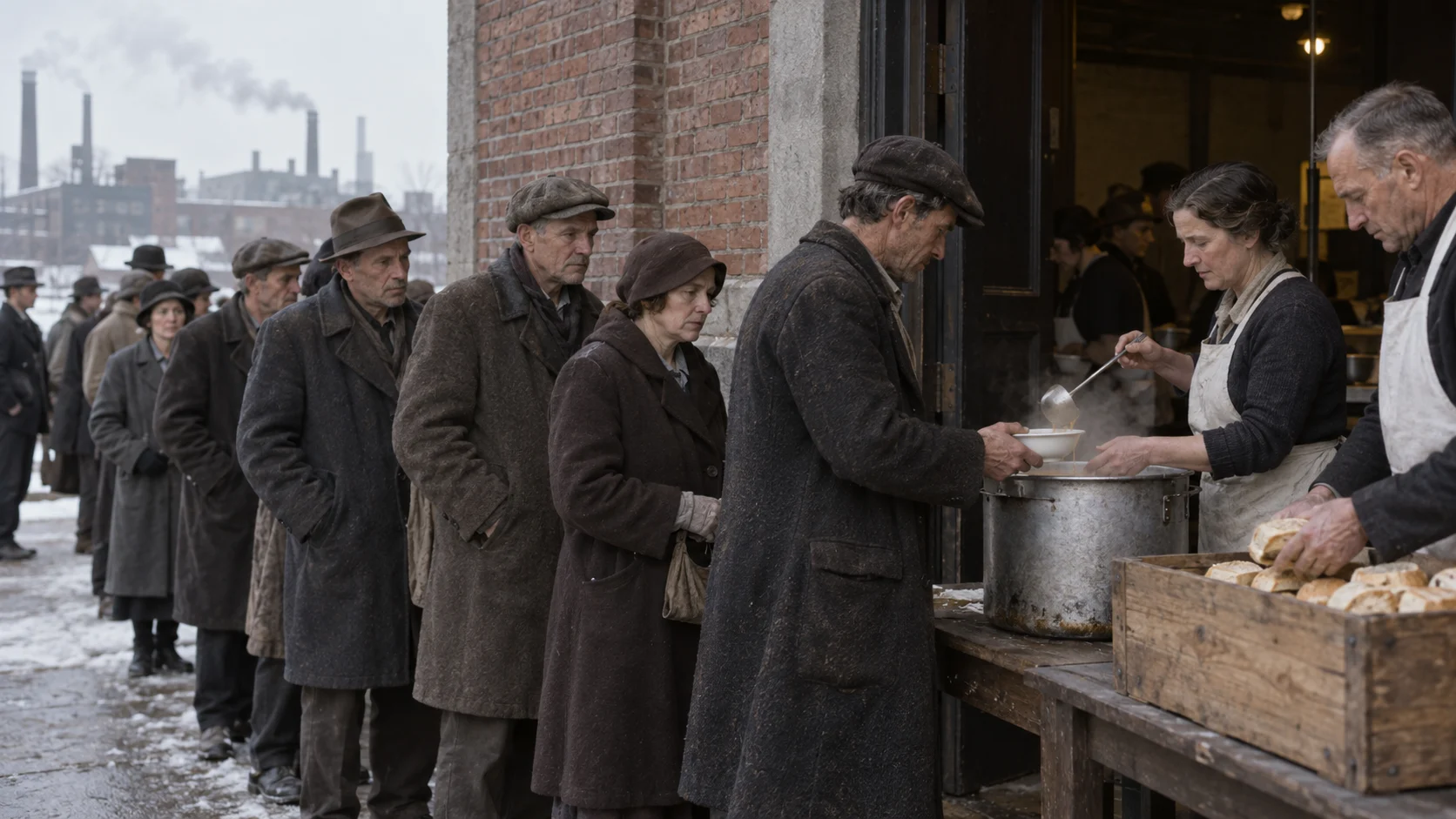
Q: What were breadlines?
A: Lines of people waiting for free or low-cost food.
Q: What were soup kitchens?
A: Places that served free meals to people in need.
Q: What happened to many families who could no longer pay mortgages or rent?
A: They lost their homes.
Q: What informal exchange system became useful when cash was scarce?
A: Bartering.
Q: What happened to many young people who left home looking for work?
A: They traveled as migrants or transient workers.
Q: What freight-train practice did some job seekers use despite its dangers and illegality?
A: Riding the rails.
Q: What happened to marriage and birth rates during much of the Depression?
A: They generally declined.
Q: What household habit became a necessity for many families during the Depression?
A: Repairing and reusing goods.
Q: What low-cost medium brought news, comedy, drama, and music into homes?
A: Radio.
Q: Which board game became a major commercial hit during the Depression?
A: Monopoly.
Q: What inexpensive movie feature offered audiences an escape from daily hardship?
A: Double features.
Q: Which groups often faced especially severe job discrimination during the Depression?
A: Black Americans, immigrants, and women, among others.
Q: What term described the forced or pressured removal of many people of Mexican descent from the United States?
A: Mexican Repatriation.
Hoover, Relief, and Protest
Q: Who was U.S. president when the stock market crashed in 1929?
A: Herbert Hoover.
Q: What approach led Hoover to prefer voluntary cooperation over direct federal relief at first?
A: His belief in limited federal intervention and voluntary action.
Q: What federal agency created in 1932 loaned money to banks, railroads, and other institutions?
A: The Reconstruction Finance Corporation.
Q: What massive dam project begun under Hoover was later named for him?
A: Hoover Dam.
Q: What group of World War I veterans marched on Washington in 1932?
A: The Bonus Army.
Q: What did the Bonus Army demand?
A: Early payment of veterans' bonus certificates.
Q: Who commanded the troops that cleared the Bonus Army camps?
A: General Douglas MacArthur.
Q: Which future president served under MacArthur during the Bonus Army removal?
A: Dwight D. Eisenhower.
Q: What political damage did the Bonus Army episode do to Hoover?
A: It reinforced his image as unsympathetic to suffering Americans.
Q: Who defeated Hoover in the 1932 presidential election?
A: Franklin D. Roosevelt.
Q: What phrase did Roosevelt use for his program of economic action?
A: The New Deal.
Q: What did Roosevelt promise the American people in his 1932 nomination speech?
A: A new deal.
Q: Which political party gained lasting support from many urban workers during the Depression?
A: The Democratic Party.
Q: What term describes direct aid to people in immediate need?
A: Relief.
Q: What three words often summarize New Deal goals?
A: Relief, recovery, and reform.

FDR and the First New Deal
Q: When did Franklin D. Roosevelt take office as president?
A: March 4, 1933.
Q: What did Roosevelt declare immediately to stabilize the banking system?
A: A national bank holiday.
Q: What law allowed federal inspection before banks reopened?
A: The Emergency Banking Act.
Q: What were Roosevelt's radio addresses to the public called?
A: Fireside chats.
Q: What agency insures deposits in participating U.S. banks?
A: The Federal Deposit Insurance Corporation, or FDIC.
Q: Which law created the FDIC?
A: The Banking Act of 1933, also called Glass-Steagall.
Q: What agency regulates the U.S. securities markets?
A: The Securities and Exchange Commission, or SEC.
Q: Which New Deal program employed young men in conservation work?
A: The Civilian Conservation Corps, or CCC.
Q: What kinds of projects did CCC workers complete?
A: Conservation, forestry, park, and soil projects.
Q: Which agency paid farmers to reduce production in an effort to raise prices?
A: The Agricultural Adjustment Administration, or AAA.
Q: Which regional program built dams and brought electricity to parts of the South?
A: The Tennessee Valley Authority, or TVA.
Q: What industrial program used codes to coordinate wages, hours, and prices?
A: The National Recovery Administration, or NRA.
Q: What symbol represented the NRA?
A: A blue eagle.
Q: What agency provided grants to states for direct relief and work programs?
A: The Federal Emergency Relief Administration, or FERA.
Q: What term describes Roosevelt's burst of legislation early in his presidency?
A: The First Hundred Days.
The Second New Deal and Its Programs
Q: What large work-relief agency employed millions beginning in 1935?
A: The Works Progress Administration, or WPA.
Q: What did the WPA build besides roads and public buildings?
A: Parks, bridges, schools, airports, and other public works.
Q: What WPA project employed writers to document American life?
A: The Federal Writers' Project.
Q: What WPA project employed actors, directors, and theater workers?
A: The Federal Theatre Project.
Q: What 1935 law created old-age pensions and unemployment insurance?
A: The Social Security Act.
Q: What labor law guaranteed many private-sector workers the right to organize?
A: The Wagner Act.
Q: What federal board enforces key provisions of the Wagner Act?
A: The National Labor Relations Board.
Q: What 1938 law established a federal minimum wage and overtime rules?
A: The Fair Labor Standards Act.
Q: Which program brought electricity to many rural homes and farms?
A: The Rural Electrification Administration.
Q: What agency helped refinance troubled home mortgages?
A: The Home Owners' Loan Corporation.
Q: Which housing agency insured private mortgages and promoted longer repayment terms?
A: The Federal Housing Administration, or FHA.
Q: What major flaw marked many federal housing policies of the era?
A: They reinforced racial segregation and redlining.
Q: What 1937 economic downturn interrupted the recovery?
A: The Roosevelt Recession.
Q: What controversial 1937 plan sought to add justices to the Supreme Court?
A: Roosevelt's court-packing plan.
Q: Did Congress approve Roosevelt's court-expansion proposal?
A: No.
Dust Bowl and Migration
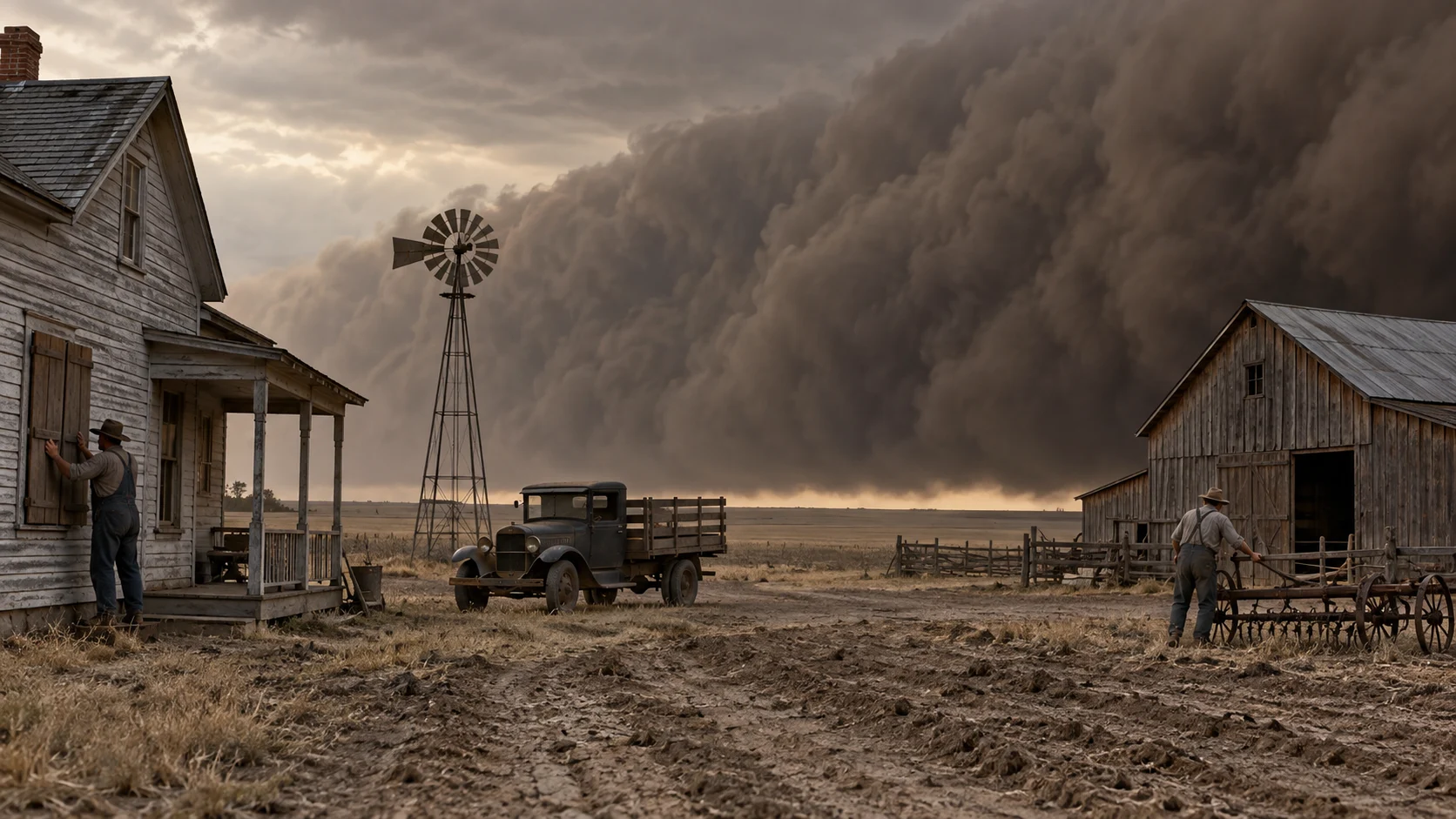
Q: What environmental disaster struck the Great Plains during the 1930s?
A: The Dust Bowl.
Q: What combination helped cause the Dust Bowl?
A: Severe drought, high winds, and damaging farming practices.
Q: Which part of the United States was hit hardest by Dust Bowl storms?
A: The southern Great Plains.
Q: What name was given to towering dust storms?
A: Black blizzards.
Q: What date became known as Black Sunday in the Dust Bowl?
A: April 14, 1935.
Q: Which state became especially associated with Dust Bowl migration?
A: Oklahoma.
Q: What broad nickname was applied to many Dust Bowl migrants?
A: Okies.
Q: To which state did many displaced Plains families migrate?
A: California.
Q: What highway became a major westward route for migrants?
A: U.S. Route 66.
Q: Which federal agency documented migrant life in famous photographs?
A: The Farm Security Administration.
Q: Who took the photograph Migrant Mother?
A: Dorothea Lange.
Q: Who was the woman pictured in Migrant Mother?
A: Florence Owens Thompson.
Q: What federal conservation agency taught farmers methods to reduce erosion?
A: The Soil Conservation Service.
Q: What tree-planting project created windbreaks across the Great Plains?
A: The Shelterbelt Project.
Q: Which John Steinbeck novel follows the Joad family's westward migration?
A: The Grapes of Wrath.
Voices, Images, and Popular Culture
Q: Which first lady became an influential advocate for civil rights and New Deal causes?
A: Eleanor Roosevelt.
Q: Which photographer documented sharecroppers for Let Us Now Praise Famous Men?
A: Walker Evans.
Q: Which writer collaborated with Walker Evans on that book?
A: James Agee.
Q: Which folk singer wrote “This Land Is Your Land”?
A: Woody Guthrie.
Q: What phrase appeared on Woody Guthrie's guitar?
A: “This machine kills fascists.”
Q: Which dance band leader became known as the King of Swing?
A: Benny Goodman.
Q: What 1939 film offered a vivid escape in Technicolor?
A: The Wizard of Oz.
Q: Which 1933 musical film featured choreography by Busby Berkeley?
A: 42nd Street.
Q: What comic-strip orphan became a symbol of cheerful perseverance?
A: Little Orphan Annie.
Q: Which superhero debuted in Action Comics in 1938?
A: Superman.
Q: Which radio broadcast caused alarm among some listeners in 1938?
A: Orson Welles's The War of the Worlds.
Q: Which artist painted American Gothic in 1930?
A: Grant Wood.
Q: Which muralist painted New Deal-era public art celebrating workers and industry?
A: Diego Rivera.
Q: What oral-history collection recorded the memories of formerly enslaved people?
A: The WPA Slave Narratives.
Q: Which 1936 Charlie Chaplin film satirized industrial work?
A: Modern Times.
A Global Crisis and Its Legacy
Q: Was the Great Depression limited to the United States?
A: No, it became a global economic crisis.
Q: Which Weimar-era European country was hit especially hard after U.S. loans dried up?
A: Germany.
Q: Which extremist party gained support amid Germany's economic and political crisis?
A: The Nazi Party.
Q: Which country abandoned the gold standard in September 1931?
A: The United Kingdom.
Q: What happened to world trade during the early 1930s?
A: It contracted sharply.
Q: Which economist argued that governments could use spending to support demand?
A: John Maynard Keynes.
Q: What was Keynes's influential 1936 book called?
A: The General Theory of Employment, Interest and Money.
Q: Which U.S. economic mobilization finally brought unemployment down to very low levels?
A: World War II mobilization.
Q: What lasting bank protection emerged from New Deal reform?
A: Federal deposit insurance.
Q: What lasting retirement program emerged from the Depression?
A: Social Security.
Q: How did the Depression change expectations of the U.S. federal government?
A: Many Americans came to expect a larger federal role in economic security.
Q: What political coalition helped Democrats dominate national politics for decades?
A: The New Deal coalition.
Q: Did New Deal programs eliminate racial and gender inequality?
A: No.
Q: What international organization was created after World War II to promote monetary cooperation?
A: The International Monetary Fund.
Q: What central lesson did many policymakers draw from the Depression?
A: Financial systems and severe downturns may require active public safeguards.
You Made It Through the Hard Times
That was a demanding decade, and your score deserves the good china. Keep the timeline moving with our decades trivia, or revisit the people who shaped history in famous people trivia.

Ellie Ewert is the founder and author of RandomTrivia.co, blending her passion for research with years of experience in content creation to deliver accurate, engaging, and well-sourced trivia. Dedicated to providing readers with trustworthy and entertaining facts, she applies meticulous fact-checking and SEO expertise to ensure every article meets the highest standards. Read more about our high standards in our Editorial Guidelines.