
Butterflies manage to be delicate-looking, continent-crossing, chemically defended, and dressed like living stained glass.
These butterfly trivia questions explore life cycles, identification, behavior, adaptations, and habitats without treating every species as a monarch.
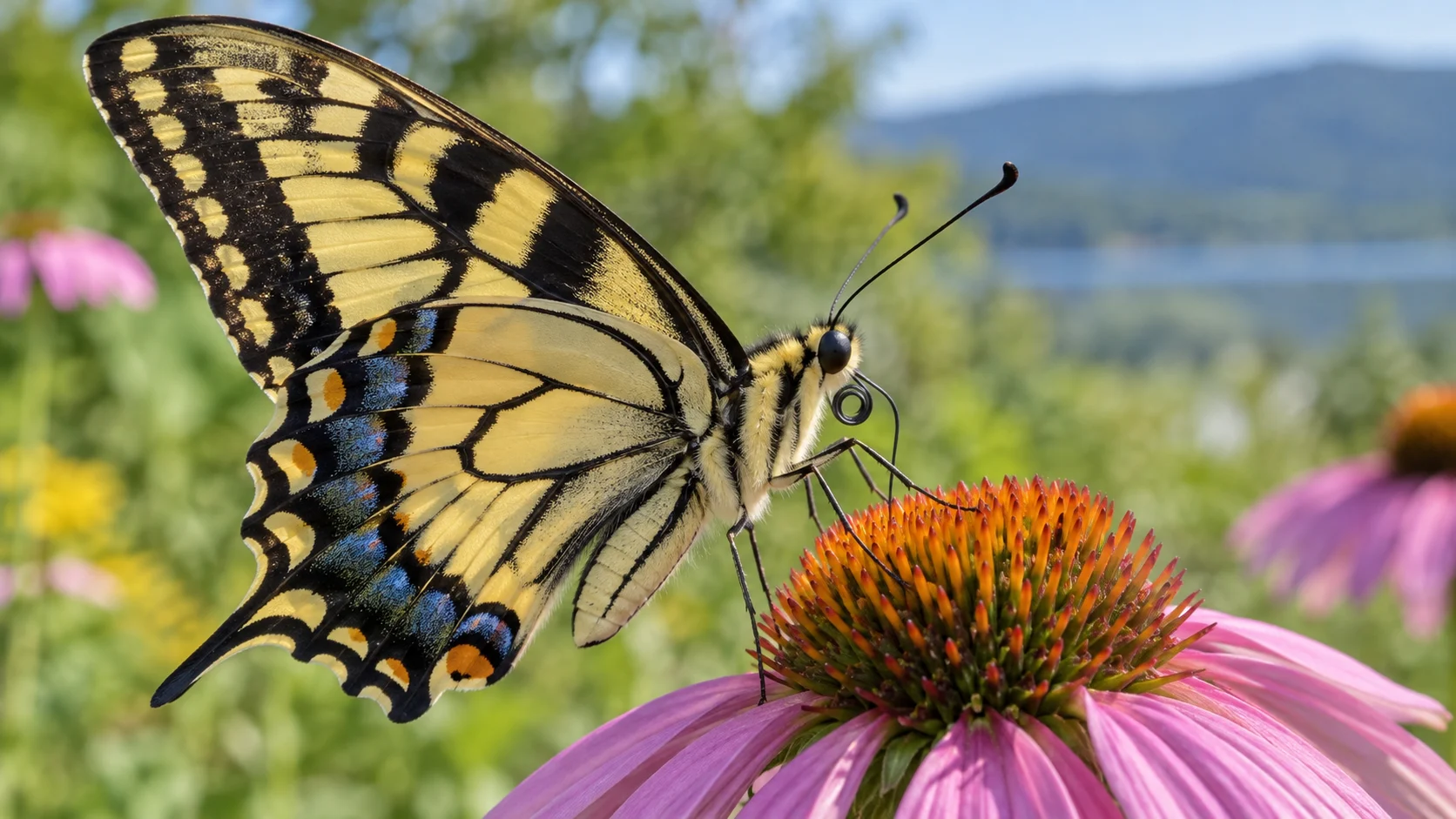
Butterfly Anatomy Up Close
Begin with scales, spiracles, antennae, and the structures hidden inside those bright wings.
- How many main body sections does an adult butterfly have?
Answer: Three - What are the three main body sections of a butterfly?
Answer: Head, thorax, and abdomen - How many legs does an adult butterfly have?
Answer: Six - How many wings does an adult butterfly have?
Answer: Four - What covers butterfly wings?
Answer: Tiny overlapping scales - What gives many butterfly wings structural color?
Answer: Microscopic scale structures that reflect light - What feeding tube does an adult butterfly uncoil?
Answer: The proboscis - Where are a butterfly's wings and legs attached?
Answer: The thorax - What type of eyes do adult butterflies have?
Answer: Compound eyes - What sensory structures end in clubs on most butterfly antennae?
Answer: Clubbed antennae - What openings along the body deliver air to the tracheal system?
Answer: Spiracles - Do butterflies have lungs?
Answer: No - What circulatory fluid do insects have instead of vertebrate blood?
Answer: Hemolymph - What do butterfly feet help them detect on plants?
Answer: Chemical cues or taste - What stiff veins support a butterfly wing?
Answer: Wing veins
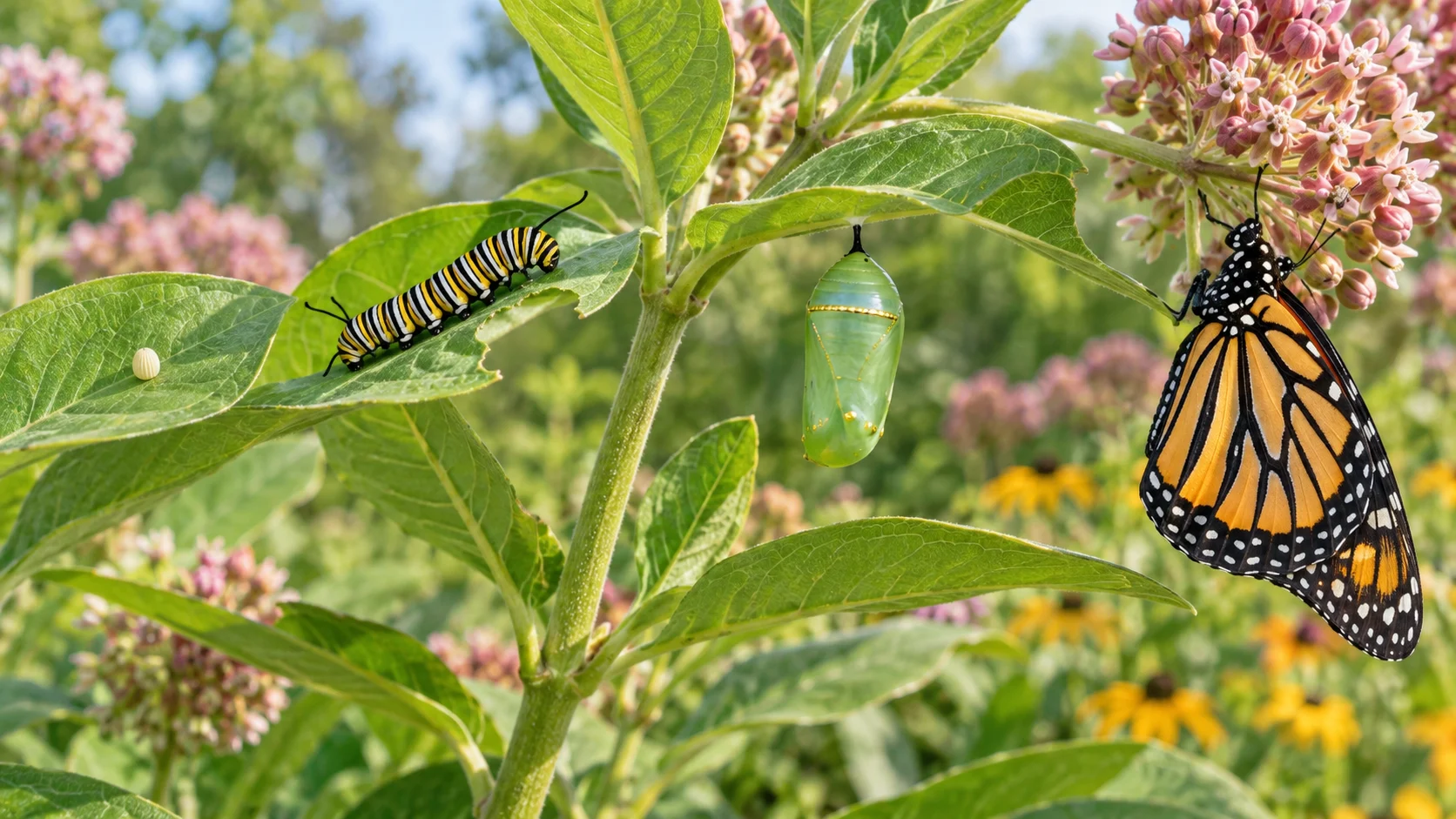
Egg, Caterpillar, Chrysalis, Butterfly
Follow complete metamorphosis through four stages that look almost unrelated to one another.
- What are the four butterfly life stages?
Answer: Egg, larva, pupa, adult - What is a butterfly larva commonly called?
Answer: A caterpillar - What is a butterfly pupa commonly called?
Answer: A chrysalis - What process transforms larva into adult?
Answer: Metamorphosis - What does a caterpillar primarily do?
Answer: Eat and grow - What is an instar?
Answer: A developmental stage between molts - Why must caterpillars molt?
Answer: Their outer skeleton cannot expand indefinitely - What is the shed outer skin called?
Answer: An exuvia - What does a caterpillar attach before pupating?
Answer: A silk pad, girdle, or shelter depending on species - Is a chrysalis the same thing as a cocoon?
Answer: No - What is a cocoon?
Answer: A silk casing spun around a pupa by some insects, especially many moths - What emerges from a chrysalis?
Answer: An adult butterfly - What must a newly emerged butterfly do before flying?
Answer: Expand and dry its wings - What fluid helps expand the wings after emergence?
Answer: Hemolymph - What is eclosion?
Answer: The adult's emergence from the pupa
Butterfly Families and Identification
Wing shape, antennae, posture, and pattern can help place a butterfly in the right family.
- What butterfly family includes monarchs, admirals, and fritillaries?
Answer: Nymphalidae - Why are nymphalids called brush-footed butterflies?
Answer: Their front pair of legs is reduced and hairy - What family includes swallowtails?
Answer: Papilionidae - What wing feature gives many swallowtails their common name?
Answer: Tail-like hindwing extensions - What family includes whites, sulphurs, and orangetips?
Answer: Pieridae - What family includes blues, coppers, and hairstreaks?
Answer: Lycaenidae - What family includes skippers?
Answer: Hesperiidae - How do skipper antennae often differ from other butterfly antennae?
Answer: The clubs may end in small hooks - What family includes metalmarks?
Answer: Riodinidae - What feature should be checked before identifying a butterfly from a photo?
Answer: Both upperwing and underwing patterns if possible - Why can fresh and worn individuals look different?
Answer: Scales fade or rub off - What is sexual dimorphism?
Answer: Visible differences between males and females - What is seasonal polyphenism?
Answer: Different adult forms produced in different seasons - What is a field mark?
Answer: A visible feature used for identification - Why is location useful in identification?
Answer: Species ranges and habitats differ
Host Plants, Nectar, and Pollination
Caterpillars and adults often need different plants, so a good habitat supplies more than flowers.
- What is a larval host plant?
Answer: A plant eaten by a species' caterpillars - What plant family hosts monarch caterpillars?
Answer: Milkweeds - What compound from milkweed helps defend monarchs?
Answer: Cardenolides - What do many adult butterflies drink from flowers?
Answer: Nectar - Do all adult butterflies feed only on nectar?
Answer: No - What is puddling?
Answer: Drinking moisture and dissolved minerals from damp ground - Which sex often puddles more frequently in many species?
Answer: Males - Why may males seek sodium while puddling?
Answer: It can support reproduction and be transferred during mating - What rotting foods attract some adult butterflies?
Answer: Fruit or tree sap - Can butterflies pollinate flowers?
Answer: Yes - How does butterfly pollination differ from bee pollination?
Answer: Butterflies often carry less pollen but can move it over distance - What flower shape is accessible to a butterfly's proboscis?
Answer: Tubular or deep flowers can be accessible - Why plant groups of the same flower species?
Answer: They make forage easier to locate - Why avoid insecticides on host plants?
Answer: They can kill caterpillars and adults - What two plant resources does a butterfly garden need?
Answer: Adult nectar plants and larval host plants
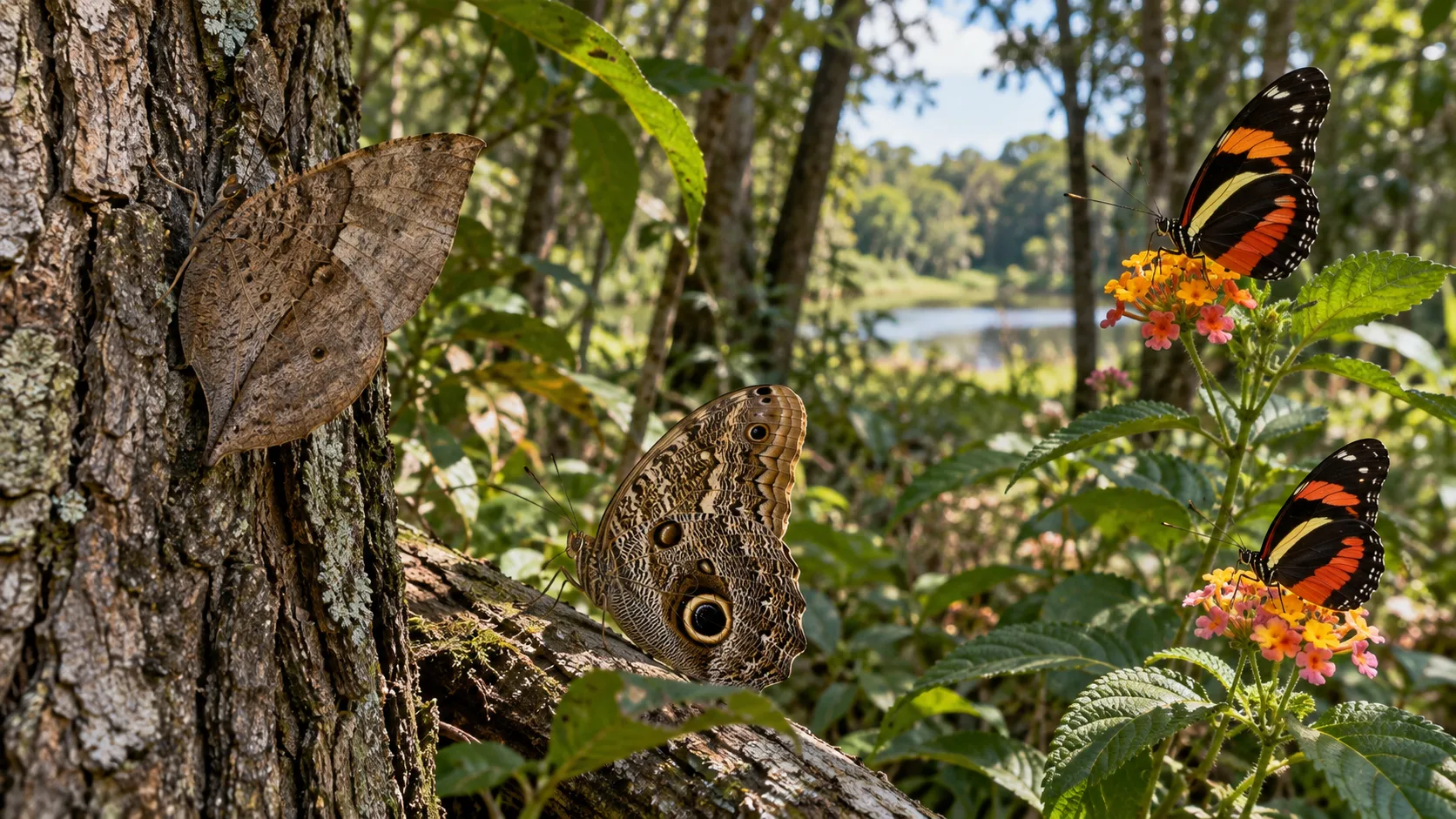
Camouflage, Mimicry, and Survival
Patterns can hide a butterfly, startle a predator, or advertise a meal best left uneaten.
- What is camouflage?
Answer: Color or form that helps an organism blend in - What is masquerade?
Answer: Resembling an inedible object such as a leaf or twig - What are eyespots?
Answer: Wing markings resembling eyes - How can eyespots help a butterfly?
Answer: Startle predators or redirect attacks - What is aposematic coloration?
Answer: Warning coloration advertising defense - What is Batesian mimicry?
Answer: A harmless species resembling a defended species - What is Müllerian mimicry?
Answer: Defended species sharing similar warning patterns - What famous butterfly pair illustrates debated mimicry?
Answer: Monarch and viceroy - Are viceroys now considered simply harmless monarch mimics?
Answer: No, viceroys also have defenses - What is crypsis?
Answer: Avoiding detection through camouflage - Why do some butterflies close their wings while resting?
Answer: To conceal bright upperwings and show camouflaged undersides - What is flash coloration?
Answer: Bright color revealed in flight then hidden at rest - How can hindwing tails misdirect predators?
Answer: They create a false head near the rear - What defense do some caterpillars use besides camouflage?
Answer: Spines, toxins, odors, or startle displays - What is thanatosis?
Answer: Feigning death
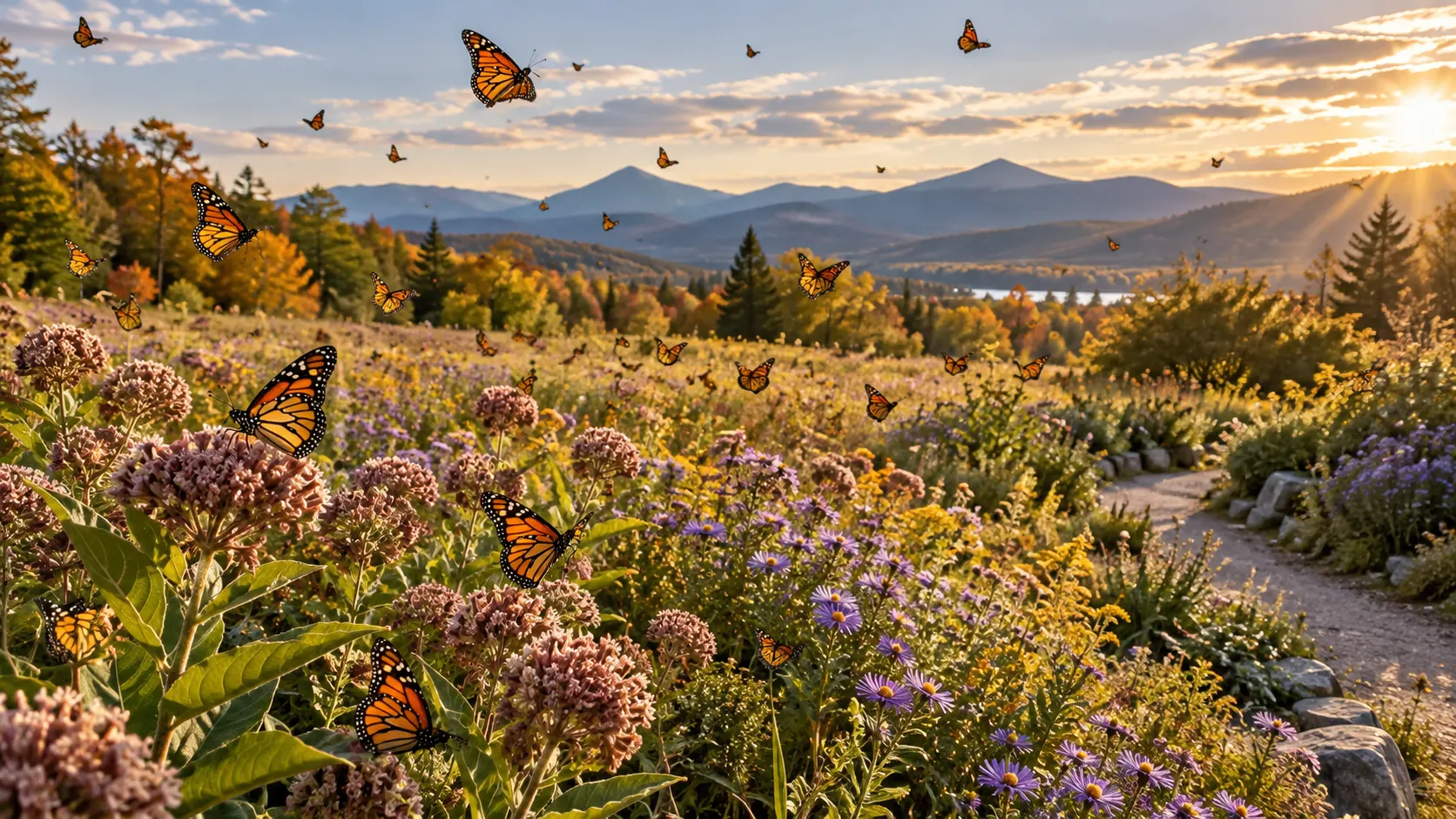
Migration, Flight, and Seasonal Behavior
Some butterflies remain near one meadow, while others turn migration into a multigenerational relay.
- Which North American butterfly is famous for long-distance migration?
Answer: The monarch - Do individual eastern monarchs complete the entire annual round trip?
Answer: No - Where do many eastern North American monarchs overwinter?
Answer: Central Mexico - Where do many western monarchs overwinter?
Answer: Coastal California, though patterns vary - What generation lives much longer during fall migration?
Answer: The migratory or super generation - What cues help monarchs orient?
Answer: The sun compass and Earth's magnetic field among other cues - Which butterfly is known for migrations between Europe and Africa?
Answer: The painted lady - Can painted lady migrations involve several generations?
Answer: Yes - What term describes a hormonally controlled pause in butterfly development or reproduction?
Answer: Diapause - How do many temperate butterflies survive winter?
Answer: As eggs, larvae, pupae, or adults depending on species - What does basking do?
Answer: Raises body temperature for flight - Why do butterflies angle their wings toward the sun?
Answer: To absorb or regulate heat - Can butterflies fly efficiently when their muscles are too cold?
Answer: No - What is hilltopping?
Answer: Adults gathering on high points to find mates - What is territorial behavior in butterflies?
Answer: Defending an area from rivals
Habitats and Butterflies Around the World
Butterflies live from tropical forests to tundra, provided their climate and host plants line up.
- Which biome supports exceptionally high butterfly diversity?
Answer: Tropical rainforest - What is a meadow butterfly likely to need besides flowers?
Answer: Host plants and shelter - Why are forest edges often good butterfly habitat?
Answer: They combine sun, shelter, and varied plants - What are canopy butterflies?
Answer: Species living mainly high in forests - What butterfly is one of Europe's largest and has swallowtail-like wings?
Answer: The scarce swallowtail or Old World swallowtail - Which giant birdwing genus includes some of the world's largest butterflies?
Answer: Ornithoptera - Where are birdwing butterflies native?
Answer: South and Southeast Asia and Australasia - What blue butterfly genus is famous in Central and South American forests?
Answer: Morpho - Why do morpho wings appear brilliant blue?
Answer: Structural coloration - Which butterfly is the state insect of several U.S. states including Alabama?
Answer: The monarch is state insect of several states, while Alabama's is the monarch - What British butterfly reintroduced after extinction is tied to thyme and ants?
Answer: The large blue - What unusual partners do large blue caterpillars depend on?
Answer: Myrmica ants - What is an endemic species?
Answer: A species native to and restricted to a place - Why can island butterflies be vulnerable?
Answer: They may have small ranges and specialized habitats - What determines whether a host plant supports a local butterfly?
Answer: The correct plant species, chemistry, timing, and accessibility
Butterfly Conservation and Smart Observation
Finish with practical ways to observe butterflies without harming the plants and habitats they depend on.
- What major pressure comes from converting habitat to development or intensive agriculture?
Answer: Habitat loss - How can climate change affect butterflies?
Answer: It can shift ranges, timing, drought, and host-plant availability - Why are connected habitats valuable?
Answer: They let populations move and exchange genes - What is a pollinator corridor?
Answer: Linked habitat providing food and shelter across a landscape - Why should gardens bloom from spring through fall?
Answer: Different species fly at different times - Why leave some leaf litter and stems?
Answer: They may shelter overwintering insects - What is citizen science?
Answer: Public participation in scientific data collection - What should a butterfly observer record?
Answer: Date, location, species, count, and habitat - Why photograph both sides of the wings?
Answer: Different field marks appear above and below - Why avoid handling butterfly wings?
Answer: Scales and delicate structures can be damaged - Does touching a wing automatically doom a butterfly?
Answer: No, but unnecessary handling can harm it - Why use regional field guides?
Answer: Ranges and look-alike species differ by location - What is captive rearing's conservation limitation?
Answer: It cannot replace healthy wild habitat and may spread disease if poorly managed - Why buy pesticide-free host plants?
Answer: Nursery residues can harm larvae - What is the simplest butterfly-friendly rule?
Answer: Provide diverse native plants and minimize pesticide use
Keep the game going with insect trivia, animal trivia, plants trivia, and environmental science trivia.
Sources and Further Reading
- Smithsonian butterfly and moth resources
- U.S. Forest Service monarch resources
- U.S. Fish and Wildlife Service pollinator conservation
- Xerces Society butterfly conservation
- Encyclopaedia Britannica: Butterfly

Ellie Simons creates and edits Random Trivia. She researches trivia using primary and authoritative sources whenever possible and is currently reviewing the site's older trivia library for accuracy, clarity, and playability. Read more on the About page.
Explore more rounds in our Animal trivia collection.
About this quiz
Site editor: Ellie Simons. Read our Trivia Methodology to learn how questions are researched and updated. Page last updated: . Report an error.