
Ancient China stretches across thousands of years, so this quiz has plenty of room to roam. These 117 questions travel from Neolithic cultures and Shang oracle bones through the Zhou, Confucius, the First Emperor, the Terracotta Army, the Han dynasty, Silk Road trade, writing, bronze art, inventions, and everyday life.
The first questions are approachable. The last ones belong in the imperial archives.
Why Ancient China Makes Great Trivia
Ancient Chinese history combines archaeology, dynasties, philosophy, technology, warfare, trade, ritual, art, and one of the world's longest continuous written traditions. The Smithsonian's National Museum of Asian Art dates the Shang to roughly 1600 to 1050 BCE, the Zhou to roughly 1050 to 221 BCE, the Qin to 221 to 206 BCE, and the Han to 206 BCE to 220 CE.
Those museum chronologies anchor this quiz. For more ancient history, try our Ancient Egypt trivia, Ancient Greece trivia, and world history trivia.
Dynasties, Rivers & Ancient China Basics
Q: What river valley was especially important to early states in northern China?
A: The Yellow River, or Huang He, valley.
Q: What dynasty is the earliest Chinese dynasty verified securely by written and archaeological evidence?
A: The Shang dynasty.
Q: What earlier dynasty is traditionally said to have preceded the Shang?
A: The Xia dynasty, although its exact relationship to archaeological cultures remains debated.
Q: Which dynasty overthrew the Shang?
A: The Zhou dynasty.
Q: Which dynasty unified the major warring states in 221 BCE?
A: The Qin dynasty.
Q: Which dynasty followed the Qin and ruled for roughly four centuries with an interruption?
A: The Han dynasty.
Q: What period came between the Western and Eastern Han dynasties?
A: The short-lived Xin dynasty under Wang Mang.
Q: What two broad eras make up the Zhou dynasty?
A: Western Zhou and Eastern Zhou.
Q: What two famous periods make up the Eastern Zhou era?
A: The Spring and Autumn period and the Warring States period.
Q: What state eventually defeated the other major Warring States?
A: Qin.
Q: What was the first unified imperial dynasty of China?
A: Qin.
Q: What dynasty's name became the source of the English word China according to a common explanation?
A: Qin is often cited as one possible source, although the word's linguistic history is complex.
Q: What major river flows through central and southern China and later became crucial to agriculture and transport?
A: The Yangtze River, or Chang Jiang.
Q: What does the word dynasty mean in historical usage?
A: A succession of rulers from the same family or ruling house.
Q: Why do historians use dynasty names to organize ancient Chinese history?
A: They provide a useful political chronology, even though culture, technology, and regional life did not change instantly when ruling houses changed.
The Shang Dynasty, Oracle Bones & Bronze
Q: Around when did the Shang dynasty rule according to the Smithsonian chronology?
A: Roughly 1600 to 1050 BCE.
Q: What late Shang capital has been excavated near modern Anyang?
A: Yin, associated with the archaeological site of Yinxu.
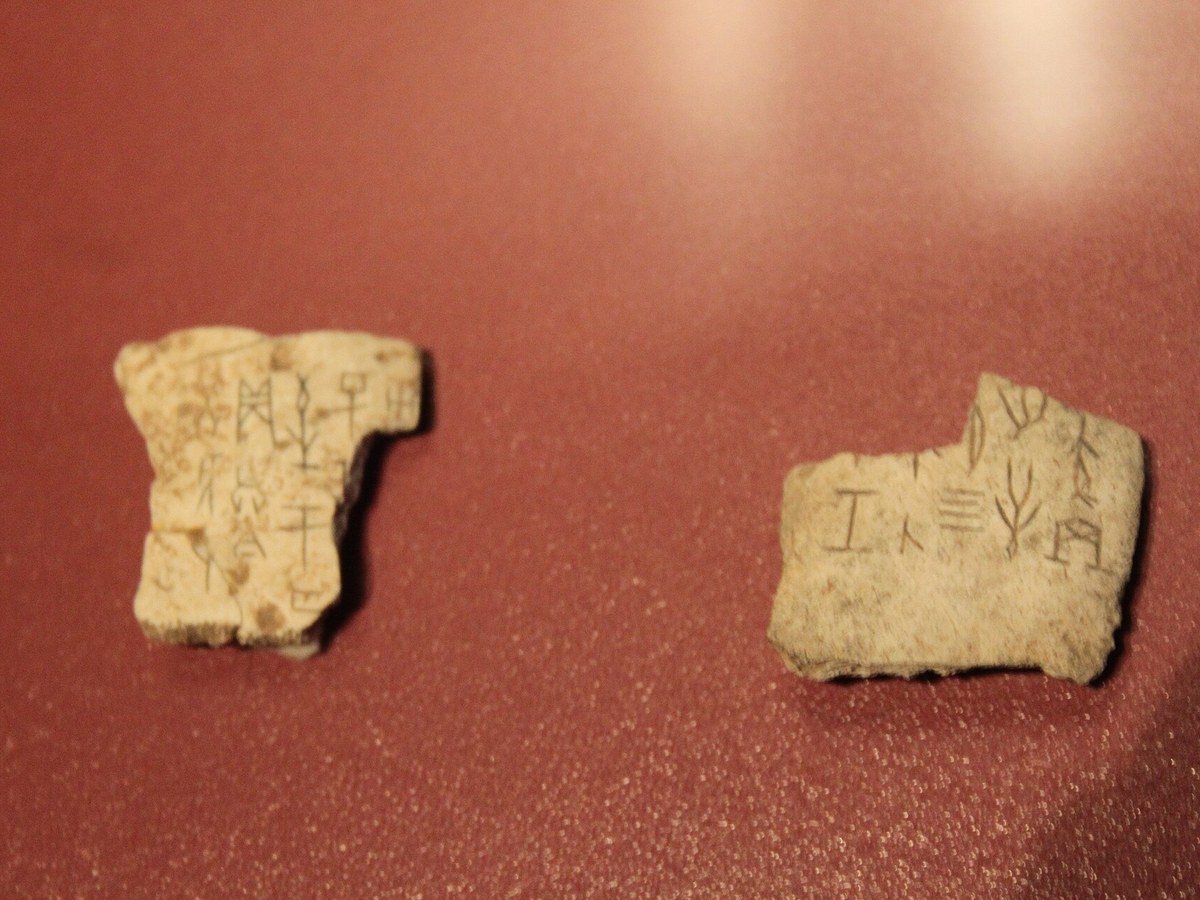
Q: What are oracle bones?
A: Animal bones or turtle shells inscribed for royal divination.
Q: What animal part was commonly used alongside cattle shoulder blades for oracle-bone divination?
A: Turtle plastrons, the lower shell.
Q: Why are oracle bones important to historians?
A: Their inscriptions preserve some of the earliest securely dated examples of Chinese writing.
Q: What kinds of questions did Shang rulers ask through divination?
A: Questions about warfare, harvests, weather, childbirth, hunting, ritual, illness, and royal affairs.
Q: What material were Shang craftspeople especially famous for casting into ritual vessels?
A: Bronze.
Q: What were many bronze vessels used for?
A: Ritual offerings of food and wine to ancestors and deities.
Q: What stylized animal-mask motif appears frequently on ancient Chinese bronzes?
A: The taotie motif.
Q: What does the sophistication of Shang bronze casting reveal?
A: Highly organized labor, mining, craft specialization, elite ritual culture, and advanced metalworking.
Q: What role did ancestors play in Shang royal religion?
A: Royal ancestors were believed to influence the living and were honored through ritual and divination.
Q: What social group controlled Shang political and ritual power?
A: The king and an elite aristocratic class.
Q: What military technology became increasingly important during the Shang period?
A: Horse-drawn chariots.
Q: What precious stone-like material was carved for ritual and elite objects in ancient China?
A: Jade.
Q: What major source combination lets scholars reconstruct Shang history?
A: Archaeology, oracle-bone inscriptions, tombs, bronze inscriptions, and later historical texts.
The Zhou, Mandate of Heaven & Great Thinkers
Q: What political idea did Zhou rulers use to justify overthrowing the Shang?
A: The Mandate of Heaven.
Q: What did the Mandate of Heaven claim in broad terms?
A: A ruler's right to govern depended on moral and effective rule, and the mandate could be lost.
Q: Could the Mandate of Heaven theoretically pass to a different ruling house?
A: Yes.
Q: What event in 771 BCE helped mark the end of Western Zhou rule?
A: The royal capital was attacked, and the court moved east.
Q: What city became the Eastern Zhou capital?
A: Luoyang.
Q: What philosopher traditionally lived from 551 to 479 BCE?
A: Confucius, or Kongzi.
Q: What did Confucius emphasize in social life?
A: Ethical conduct, education, ritual propriety, family relationships, and responsible government.
Q: What collection preserves sayings attributed to Confucius and his disciples?
A: The Analects.
Q: What philosophical tradition is associated with Laozi and the Dao?
A: Daoism.
Q: What does Dao roughly mean?
A: The Way.
Q: What school of thought argued for strong laws and strict state authority?
A: Legalism.
Q: What philosopher is strongly associated with Legalist political theory?
A: Han Feizi is one of its best-known thinkers.
Q: What period saw intense competition among states such as Qin, Chu, Qi, Zhao, Wei, Han, and Yan?
A: The Warring States period.
Q: Why did the Warring States period encourage military and administrative innovation?
A: Rival states needed larger armies, stronger taxation, improved weapons, and more effective bureaucracies to survive.
Q: What broad intellectual label is often applied to the many competing schools of thought of the late Zhou era?
A: The Hundred Schools of Thought.
Qin Shi Huang, Unification & the Terracotta Army
Q: Who became the first emperor of a unified China in 221 BCE?
A: Qin Shi Huang.
Q: What title did Qin Shi Huang adopt?
A: First Emperor.
Q: What was Qin Shi Huang's personal name before becoming emperor?
A: Ying Zheng.
Q: What political philosophy strongly influenced the Qin state?
A: Legalism.
Q: What important standards did the Qin government impose across the empire?
A: Standardized systems for writing, weights, measures, coinage, and administrative practices.
Q: Why did standardizing writing matter?
A: It made government communication across different regions more consistent.
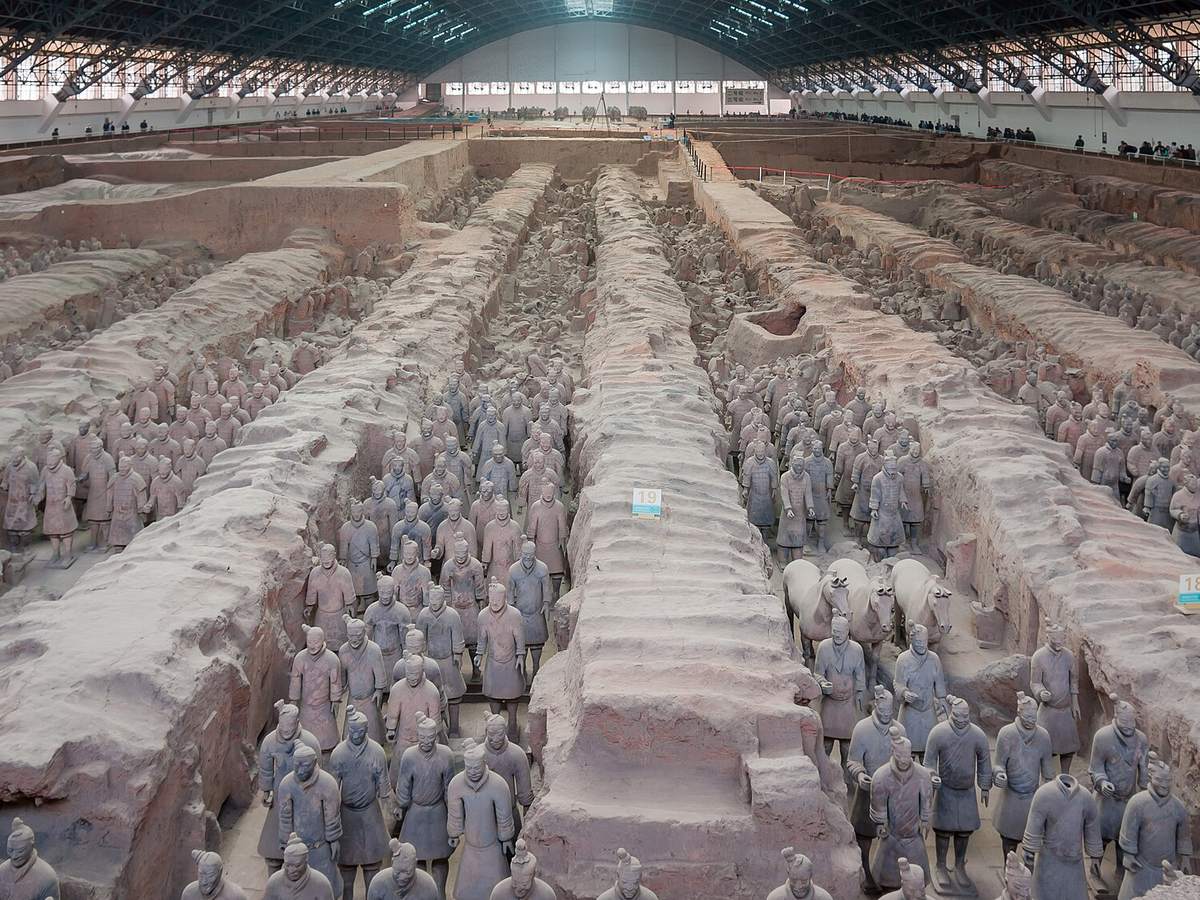
Q: What famous underground army guards Qin Shi Huang's mausoleum complex?
A: The Terracotta Army.
Q: Near what modern Chinese city is the Terracotta Army located?
A: Xi'an.
Q: What are the Terracotta Army figures made from?
A: Fired clay, or terracotta.
Q: Do the terracotta soldiers all have one identical face?
A: No. They were produced from component types and individually finished to create extensive variation.
Q: What kinds of figures appear besides infantry soldiers?
A: Archers, cavalry, charioteers, officers, horses, and other figures.
Q: What defensive structures did Qin rulers connect and expand along northern frontiers?
A: Earlier walls that contributed to the long history of what later became known as the Great Wall.
Q: Did Qin Shi Huang build the entire Great Wall seen by tourists today?
A: No. Many surviving famous sections date from much later, especially the Ming dynasty.
Q: How long did the Qin dynasty last?
A: About fifteen years, from 221 to 206 BCE.
Q: Why was the Qin dynasty historically important despite its short duration?
A: Its centralized imperial system and standardization profoundly influenced Chinese government for the next two millennia.
The Han Dynasty, Silk Road & Imperial Expansion
Q: What dynasty replaced the Qin?
A: The Han dynasty.
Q: What are the traditional dates of the Han dynasty including both major phases?
A: 206 BCE to 220 CE, with a short interruption by the Xin dynasty.
Q: Who founded the Han dynasty?
A: Liu Bang, later Emperor Gaozu.
Q: What major capital served the Western Han?
A: Chang'an, near modern Xi'an.
Q: What city became the capital of the Eastern Han?
A: Luoyang.
Q: Which Han emperor greatly expanded imperial power and territory?
A: Emperor Wu, or Han Wudi.
Q: What nomadic confederation fought repeatedly with the Han along the northern frontier?
A: The Xiongnu.
Q: What diplomat and explorer's missions helped open connections toward Central Asia?
A: Zhang Qian.
Q: What trade network developed across Eurasia and became especially important during the Han era?
A: The Silk Road.
Q: Was the Silk Road one single paved road?
A: No. It was a network of land and sea routes linking many regions and traders.
Q: What Chinese luxury product gave the Silk Road its modern name?
A: Silk.
Q: What religion entered China from India and Central Asia along trade networks during the Han era?
A: Buddhism.
Q: What philosophical tradition became deeply integrated into Han state ideology?
A: Confucianism.
Q: What invention associated with Cai Lun was improved and officially reported during the Eastern Han?
A: Papermaking.
Q: Why is the name Han still culturally important?
A: Han became the name used for China's majority ethnic group and remains central to Chinese cultural identity.
Writing, Art, Belief & Ancient Technology
Q: What ancient writing medium provides evidence for Shang royal questions and rituals?
A: Oracle bones.
Q: Did ancient Chinese writing develop into an alphabet?
A: No. Chinese writing developed as a character-based system.
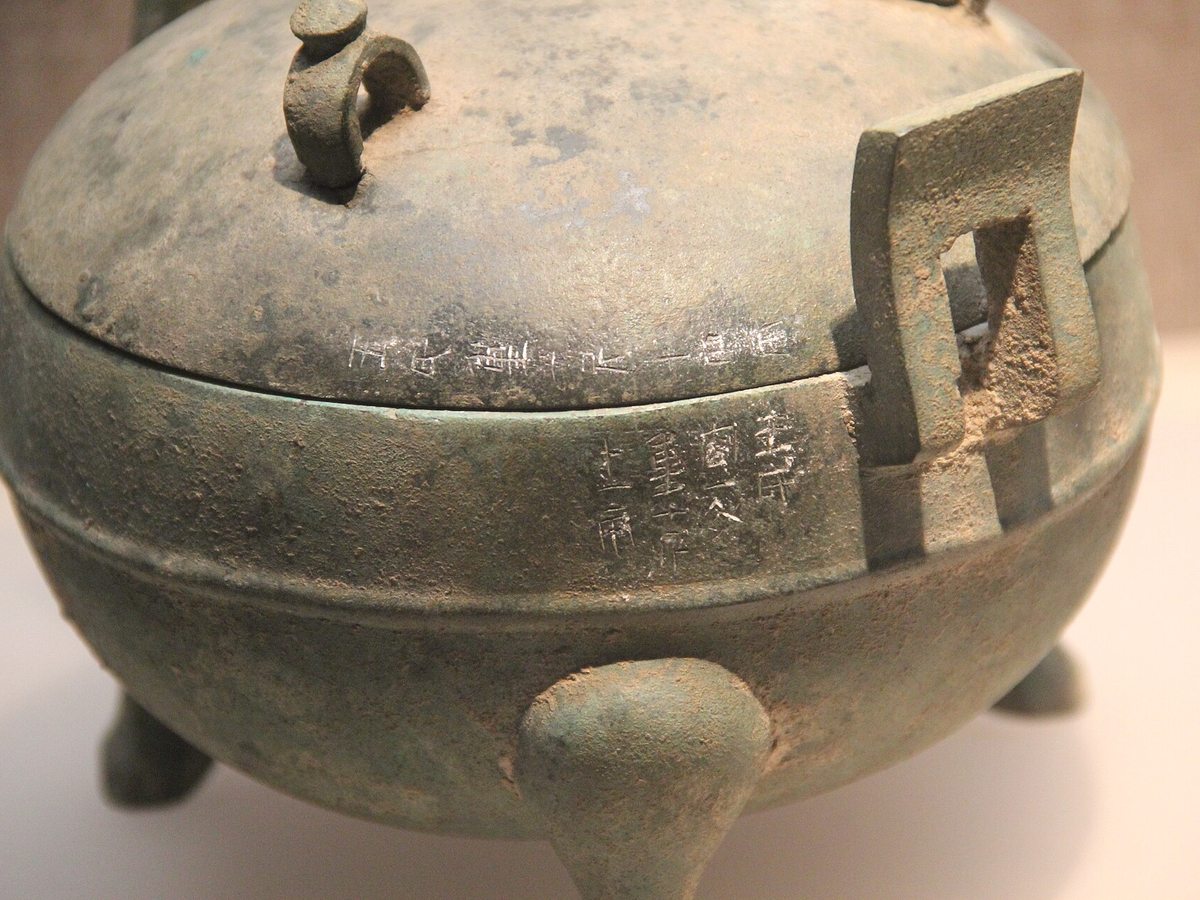
Q: What material besides oracle bones preserves many elite inscriptions from the Shang and Zhou periods?
A: Bronze vessels.
Q: What is jade's importance in ancient Chinese culture?
A: It was prized for ritual, status, burial, beauty, and symbolic associations with virtue and immortality.
Q: What is lacquer?
A: A durable coating made from tree sap that can be layered and polished on wood and other materials.
Q: What ancient Chinese instrument is a plucked zither associated with scholars and moral cultivation?
A: The qin, now commonly called the guqin.
Q: What metallurgical technology was China especially advanced in by the late Zhou and Han periods?
A: Iron casting and iron production.
Q: What weapon using a mechanical trigger became widespread in ancient Chinese warfare?
A: The crossbow.
Q: What does ancestor veneration mean?
A: Honoring deceased family members through ritual and maintaining relationships between living and ancestral generations.
Q: What was a common purpose of elite tomb goods?
A: To express status and provide or symbolize necessities, protection, and ritual support for the afterlife.
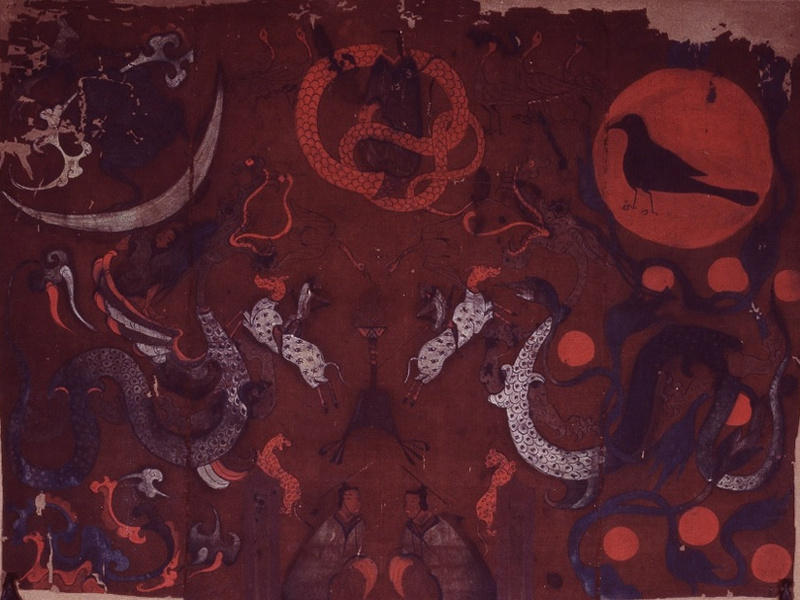
Q: What miniature objects became common in Han tombs?
A: Models of houses, towers, animals, servants, granaries, and other parts of daily life.
Q: What does the abundance of Han tomb models reveal to archaeologists?
A: Information about architecture, agriculture, clothing, animals, occupations, and beliefs about the afterlife.
Q: What Chinese invention made durable written records cheaper than silk or bamboo strips over time?
A: Paper.
Q: What early compass-related technology used magnetized lodestone?
A: Lodestone devices were known in ancient China, though the navigation compass developed more fully in later centuries.
Daily Life, Farming, Warfare & Society
Q: What crop was especially important in northern China?
A: Millet, with wheat also becoming important.
Q: What crop became central to agriculture in southern China?
A: Rice.
Q: What animals pulled chariots in Shang and Zhou warfare?
A: Horses.
Q: What military development gradually reduced the chariot's dominance?
A: Larger infantry armies, cavalry, and widespread crossbow use.
Q: Why did irrigation matter to ancient Chinese states?
A: Water control increased agricultural productivity and supported larger populations and armies.
Q: What did many ordinary ancient Chinese households produce besides food?
A: Textiles, tools, pottery, and household goods varied by region and status.
Q: What fiber-producing insect supported China's famous silk industry?
A: The silkworm.
Q: What process turns silkworm cocoons into silk thread?
A: Sericulture includes raising silkworms and reeling silk from their cocoons.
Q: Was ancient Chinese society socially equal?
A: No. Kings, nobles, officials, farmers, artisans, merchants, soldiers, servants, and enslaved people occupied very different positions.
Q: What group became increasingly important in running large imperial governments?
A: Educated officials and bureaucrats.
Q: Did the fully developed imperial examination system already dominate government recruitment during the early Han?
A: No. Recommendation and state education mattered, while the famous examination system developed more fully in later dynasties.
Q: What does filial piety mean in Confucian ethics?
A: Respectful duty toward parents and ancestors.
Q: What major source of state revenue came from agriculture?
A: Taxes and labor obligations imposed on farming households.
Q: What made ancient Chinese cities important beyond royal palaces?
A: They served as administrative, military, ritual, manufacturing, and market centers.
Hard Ancient China Challenge
Q: Which dynasty is securely linked with oracle-bone writing?
A: Shang.
Q: Which dynasty promoted the Mandate of Heaven after overthrowing the Shang?
A: Zhou.
Q: Which period is divided into Spring and Autumn and Warring States eras?
A: Eastern Zhou.
Q: Which state defeated the six other major Warring States and unified China?
A: Qin.
Q: What was Qin Shi Huang called before taking the imperial title?
A: Ying Zheng, king of Qin.
Q: What famous archaeological army belongs to the First Emperor's burial complex?
A: The Terracotta Army.
Q: What city was the Western Han capital and an eastern terminus of Silk Road networks?
A: Chang'an.
Q: What city served as the Eastern Han capital?
A: Luoyang.
Q: What nomadic confederation was a major Han rival?
A: The Xiongnu.
Q: What traveler helped the Han court learn more about Central Asia?
A: Zhang Qian.
Q: What philosophical school advocated strict law and state power and influenced Qin rule?
A: Legalism.
Q: What philosophical tradition emphasizes ritual, education, moral example, and family duty?
A: Confucianism.
Q: What philosophical tradition centers on harmony with the Dao?
A: Daoism.
Q: Which dynasty's fall in 220 CE conventionally closes the period usually called ancient imperial China in many survey timelines?
A: Han.
How Did You Score?
If taotie, Yinxu, the Mandate of Heaven, Ying Zheng, Chang'an, Zhang Qian, the Xiongnu, and the difference between Qin walls and surviving Ming Great Wall sections all came easily, your ancient Chinese history is in imperial shape.
Keep exploring with our Ancient Egypt trivia, Ancient Greece trivia, and world history trivia.

Ellie Simons creates and edits Random Trivia. She researches trivia using primary and authoritative sources whenever possible and is currently reviewing the site's older trivia library for accuracy, clarity, and playability. Read more on the About page.
About this quiz
Site editor: Ellie Simons. Read our Trivia Methodology to learn how questions are researched and updated. Page last updated: . Report an error.