
Ready to time-travel to marble temples, bustling agoras, and epic battlefields?
This Ancient Greece trivia set spans city-states and gods, thinkers and playwrights, art and everyday life, starting simple and ramping up.
Perfect for quiz nights, classrooms, or solo brain gains. Grab a laurel wreath and dive in!
Why Ancient Greece Makes Great Trivia
From democracy to drama, geometry to gymnasiums, Ancient Greece shaped how we govern, think, and compete.
Its stories are vivid, well-documented, and endlessly referenced in modern culture.
The period also invites nuance: rival city-states, shifting alliances, and a chorus of philosophical schools.
That blend of familiar icons and deeper layers is catnip for trivia lovers, approachable at first, challenging upon exploration.

Greek Geography & City-States
Q: Which city-state is famous for pioneering democracy?
A: Athens.
Q: Which city-state was renowned for strict military training?
A: Sparta.
Q: What term names a city’s fortified hilltop?
A: Acropolis.
Q: What was the public square and marketplace called?
A: Agora.
Q: In which sanctuary did the Pythia speak for Apollo?
A: Delphi.
Q: In which city were the ancient Olympic Games held?
A: Olympia.
Q: Which sea lies between Greece and the Anatolian coast?
A: The Aegean Sea.
Q: Which large island was home to the Minoan civilization?
A: Crete.
Q: Which narrow land bridge did Corinth control?
A: The Isthmus of Corinth.
Q: Which alliance was led by Athens after the Persian Wars?
A: The Delian League.
Q: Which rival alliance was led by Sparta?
A: The Peloponnesian League.
Q: Athens’ Long Walls linked the city to which port?
A: Piraeus.
Q: Thebes belonged to which region of Greece?
A: Boeotia.
Q: Alexander the Great came from which northern kingdom?
A: Macedon (Macedonia).
Q: Which city houses the Parthenon?
A: Athens.
Q: Which Attic plain gave its name to the 490 BCE battle?
A: Marathon.
Q: The poet Sappho lived on which Aegean island?
A: Lesbos.
Q: Which island was famed for the Colossus?
A: Rhodes.
Q: Ephesus—famous for a great temple—stood in which region?
A: Ionia (on the Anatolian coast).
Q: What geographic feature encouraged the independence of poleis?
A: Rugged mountains and valleys.
Q: Which region did Sparta conquer to secure helot labor?
A: Messenia.

Mythology & Religion
Q: Who was king of the Olympian gods?
A: Zeus.
Q: Which goddess of wisdom was Athens’ patron?
A: Athena.
Q: Who ruled the seas with a trident?
A: Poseidon.
Q: Which god served as messenger and guide of travelers?
A: Hermes.
Q: Who ruled the underworld?
A: Hades.
Q: The inspirational goddesses of arts and learning were the…
A: Muses.
Q: Which god of wine was central to theater festivals?
A: Dionysus.
Q: Apollo was the god of prophecy, music, and which sacred site?
A: Delphi.
Q: What was the priestess at Delphi called?
A: The Pythia.
Q: Which hero slew the Gorgon Medusa?
A: Perseus.
Q: Which hero is famed for completing twelve labors?
A: Heracles (Hercules).
Q: Who crafted wings of wax and feathers to escape Crete?
A: Daedalus.
Q: Which epic centers on the wrath of Achilles?
A: The Iliad.
Q: Who wrote the Theogony about the origins of the gods?
A: Hesiod.
Q: What Greek code of guest-friendship was sacred to Zeus?
A: Xenia.
Q: Odysseus’ long journey home is told in which epic?
A: The Odyssey.
Q: Who was the goddess of agriculture and grain?
A: Demeter.
Q: What fire-breathing creature had lion, goat, and serpent parts?
A: The Chimera.
Q: What deadly singers lured sailors to shipwreck?
A: The Sirens.
Q: Which Titan stole fire to give to humans?
A: Prometheus.
Q: Which Athenian festival presented Athena with a new peplos?
A: The Panathenaic Festival.
Warfare & Military
Q: What was the heavily armed citizen-soldier called?
A: A hoplite.
Q: What tight infantry formation did hoplites use?
A: The phalanx.
Q: What fast Athenian warship had three banks of oars?
A: The trireme.
Q: In 480 BCE, 300 Spartans died at which pass?
A: Thermopylae.
Q: Which 480 BCE naval battle checked Persia near Athens?
A: Salamis.
Q: Legend says who ran from Marathon to Athens with news?
A: Pheidippides.
Q: What long conflict pitted Athens against Sparta, 431–404 BCE?
A: The Peloponnesian War.
Q: What rigorous Spartan education system trained boys for war?
A: The agoge.
Q: Which soldier-philosopher wrote Anabasis about the “Ten Thousand”?
A: Xenophon.
Q: What extra-long pike armed Macedonian infantry?
A: The sarissa.
Q: What was Alexander’s elite heavy cavalry called?
A: The Companions (Hetairoi).
Q: Who reformed the Macedonian army before Alexander?
A: Philip II.
Q: Which 479 BCE battle ended the Persian invasion on land?
A: Plataea.
Q: What were Sparta’s unfree agricultural laborers called?
A: Helots.
Q: Which Hellenistic king earned the epithet “Poliorcetes” (the Besieger)?
A: Demetrius I.
Q: Which alliance’s treasury moved from Delos to Athens in 454 BCE?
A: The Delian League.
Q: Who led the Athenians to victory at Marathon?
A: Miltiades.
Q: Which Spartan king commanded at Thermopylae?
A: Leonidas I.
Q: Which Athenian statesman championed building a fleet before Salamis?
A: Themistocles.
Q: What name was given to the Greek mercenary army in Anabasis?
A: The Ten Thousand.
Q: Who authored one of the earliest surviving works on tactics?
A: Aeneas Tacticus.

Philosophy & Science
Q: Which Athenian thinker is often called the father of philosophy?
A: Socrates.
Q: Which student of Socrates founded the Academy?
A: Plato.
Q: Which philosopher taught at the Lyceum?
A: Aristotle.
Q: Who wrote The Republic?
A: Plato.
Q: Who tutored Alexander the Great?
A: Aristotle.
Q: What Delphic maxim urging self-knowledge is linked to Socrates?
A: “Know thyself.”
Q: Who founded Stoicism?
A: Zeno of Citium.
Q: Who founded Epicureanism?
A: Epicurus.
Q: Which pre-Socratic said “everything flows”?
A: Heraclitus.
Q: Which theorem bears the name of a Samian mathematician?
A: The Pythagorean theorem.
Q: Who wrote Elements, the classic of geometry?
A: Euclid.
Q: Which mathematician shouted “Eureka!” after a discovery on buoyancy?
A: Archimedes.
Q: Who’s called the “father of medicine”?
A: Hippocrates of Kos.
Q: Who measured Earth’s circumference with remarkable accuracy?
A: Eratosthenes.
Q: Which philosopher advanced an early atomic theory?
A: Democritus.
Q: Who proposed a heliocentric model centuries before Copernicus?
A: Aristarchus of Samos.
Q: Who formalized syllogistic logic?
A: Aristotle.
Q: Whose paradoxes questioned motion and plurality?
A: Zeno of Elea.
Q: Who proposed the four roots: earth, air, fire, water?
A: Empedocles.
Q: Who wrote History of Animals based on observation?
A: Aristotle.
Q: Which engineer described a steam-powered device (aeolipile)?
A: Hero (Heron) of Alexandria.
Literature & Drama
Q: Who authored the Iliad and the Odyssey (traditionally)?
A: Homer.
Q: Which early poet wrote Works and Days?
A: Hesiod.
Q: Which tragedian wrote Oedipus Rex?
A: Sophocles.
Q: Which tragedian penned Medea?
A: Euripides.
Q: Who wrote the Oresteia trilogy?
A: Aeschylus.
Q: Which comic playwright wrote Lysistrata and The Clouds?
A: Aristophanes.
Q: What choral hymn to Dionysus nourished early drama?
A: The dithyramb.
Q: Which Athenian festival hosted major drama competitions?
A: The City Dionysia.
Q: Classical tragedy eventually used how many principal actors onstage?
A: Three.
Q: What short, bawdy play followed a tragic trilogy?
A: A satyr play.
Q: Who is called the “father of history”?
A: Herodotus.
Q: Who wrote the rigorous History of the Peloponnesian War?
A: Thucydides.
Q: Who authored Anabasis, a prose adventure of retreat?
A: Xenophon.
Q: Which lyric poet from Lesbos wrote intimate love poems?
A: Sappho.
Q: What meter shapes Homeric epic?
A: Dactylic hexameter.
Q: What Greek term means “homecoming,” key to the Odyssey?
A: Nostos.
Q: Which Hellenistic city housed a legendary library and scribes?
A: Alexandria.
Q: Who wrote bucolic Idylls of herdsmen and countryside?
A: Theocritus.
Q: Who analyzed tragedy in the Poetics?
A: Aristotle.
Q: What is the opening section that provides background action?
A: The prologue.
Q: What term names a character’s moment of recognition?
A: Anagnorisis.
Art & Architecture
Q: Name the three classical architectural orders.
A: Doric, Ionic, Corinthian.
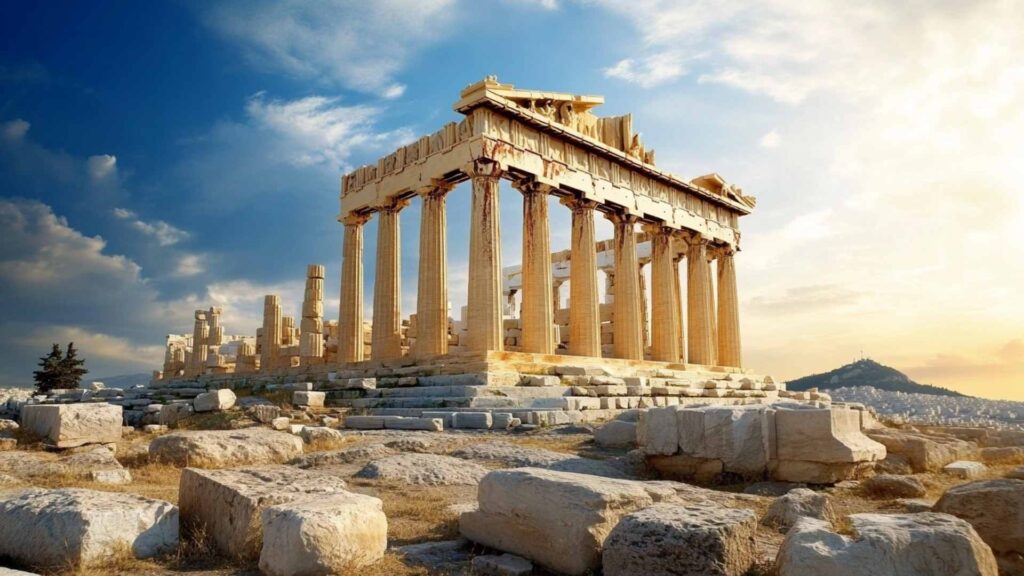
Q: What temple crowns the Athenian Acropolis?
A: The Parthenon.
Q: Which sculptor oversaw Parthenon statuary?
A: Phidias.
Q: What slight column swelling corrects optical illusion?
A: Entasis.
Q: What two main vase-painting styles dominate classical pottery?
A: Black-figure and red-figure.
Q: What method cast large bronze statues in Greece?
A: Lost-wax casting.
Q: What is a kouros statue?
A: An archaic standing nude youth.
Q: What do we call a sculpted female column?
A: A caryatid.
Q: Name one architect of the Parthenon.
A: Ictinus or Callicrates.
Q: What council hall served the Athenian boule?
A: The bouleuterion.
Q: Which small building at Delphi displayed Athenian spoils?
A: The Athenian Treasury.
Q: Which Acropolis temple features the Porch of the Maidens?
A: The Erechtheion.
Q: What chryselephantine statue stood inside the Parthenon?
A: Athena Parthenos.
Q: What is the top platform on which columns rest?
A: The stylobate.
Q: What is the inner room of a Greek temple called?
A: The cella (naos).
Q: What vessel mixed wine with water at symposia?
A: A krater.
Q: What storage jar with two handles was ubiquitous in trade?
A: An amphora.
Q: What name is given to the seating area of a theater?
A: The theatron.
Q: What was the circular performance space for the chorus?
A: The orchestra.
Q: Which Hellenistic masterpiece shows a winged goddess on a prow?
A: The Nike of Samothrace.
Q: Where were the Riace Bronzes discovered in 1972?
A: Off Riace, Calabria (Italy).
Daily Life, Society & Politics
Q: What Greek word means an independent city-state?
A: Polis.
Q: In classical Athens, who held full political rights?
A: Adult male citizens.
Q: Which Athenian lawgiver eased debt burdens c. 594 BCE?
A: Solon.
Q: Who reorganized Athenian tribes and expanded democracy c. 508 BCE?
A: Cleisthenes.
Q: What vote-based exile lasted ten years?
A: Ostracism.
Q: What were long-term resident foreigners in Athens called?
A: Metics (metoikoi).
Q: Which coin, marked by an owl, was widely used in trade?
A: The Athenian tetradrachm.
Q: What light tunic was common daily wear?
A: The chiton.
Q: What athletic-religious festival inspired a modern revival?
A: The Olympic Games.
Q: What social drinking-and-debate party did elites attend?
A: The symposium.
Q: What was the women’s quarter of the Greek house called?
A: The gynaikeion.
Q: What was the 500-member Athenian council called?
A: The boule.
Q: What professional speechwriter composed court orations?
A: A logographer.
Q: Which early lawgiver’s harsh codes gave us “draconian”?
A: Draco.
Q: Which grain was the staple in many Greek diets?
A: Barley.
Q: What dual purpose did the gymnasium serve?
A: Exercise and education.
Q: What device randomized selection for large juries?
A: The kleroterion.
Q: How many obols equaled one drachma?
A: Six.
Q: At what age did Spartan boys enter the agoge?
A: Seven.
Q: What state-owned force policed Athens?
A: Scythian archers (public slaves).
Q: What timekeeper measured speeches in Athenian courts?
A: A clepsydra (water clock).
Hellenistic World & Legacy
Q: Who conquered the Persian Empire in the 330s BCE?
A: Alexander the Great.
Q: Which Egyptian city became a scholarly powerhouse?
A: Alexandria.
Q: What was Alexander’s famous horse called?
A: Bucephalus.
Q: In which city did Alexander die in 323 BCE?
A: Babylon.
Q: Which Macedonian Greek queen allied with Julius Caesar?
A: Cleopatra VII.
Q: Which lighthouse was a Wonder of the Ancient World?
A: The Pharos of Alexandria.
Q: Which city boasted a major rival library to Alexandria’s?
A: Pergamon.
Q: What writing material’s name derives from Pergamon?
A: Parchment.
Q: Which dynasty ruled Egypt after Alexander?
A: The Ptolemies.
Q: The Rosetta Stone used Greek and which two Egyptian scripts?
A: Hieroglyphic and Demotic.
Q: The Colossus of Rhodes celebrated victory over which besieger?
A: Demetrius Poliorcetes.
Q: Which Seleucid capital on the Orontes became a metropolis?
A: Antioch.
Q: What Athenian “Garden” was a school of philosophy?
A: Epicurus’ Garden (Kepos).
Q: Who wrote Conics, advancing the study of curves?
A: Apollonius of Perga.
Q: Which astronomer discovered precession of the equinoxes?
A: Hipparchus.
Q: What spiral device lifts water for irrigation?
A: The Archimedes’ screw.
Q: Which Hellenistic epic retells Jason’s voyage?
A: The Argonautica (Apollonius of Rhodes).
Q: Teaching at the Stoa Poikile gave which school its name?
A: Stoicism.
Q: What common dialect spread across the eastern Mediterranean?
A: Koine Greek.
Q: In what language were many early Christian texts written?
A: Koine Greek.
Q: Which modern event, revived in 1896, honors Greek athletic tradition?
A: The modern Olympic Games.
Whether you aced the easy bits or wrestled with the deep cuts, you’ve now toured the breadth of Ancient Greece.
Keep this set handy for your next quiz night or keep exploring, one myth, theorem, or hoplite at a time.

Ellie Simons creates and edits Random Trivia. She researches trivia using primary and authoritative sources whenever possible and is currently reviewing the site's older trivia library for accuracy, clarity, and playability. Read more on the About page.
About this quiz
Site editor: Ellie Simons. Read our Trivia Methodology to learn how questions are researched and updated. Page last updated: . Report an error.