
Butterflies manage to be delicate-looking, continent-crossing, chemically defended, and dressed like living stained glass.
These butterfly trivia questions explore life cycles, identification, behavior, adaptations, and habitats without treating every species as a monarch.
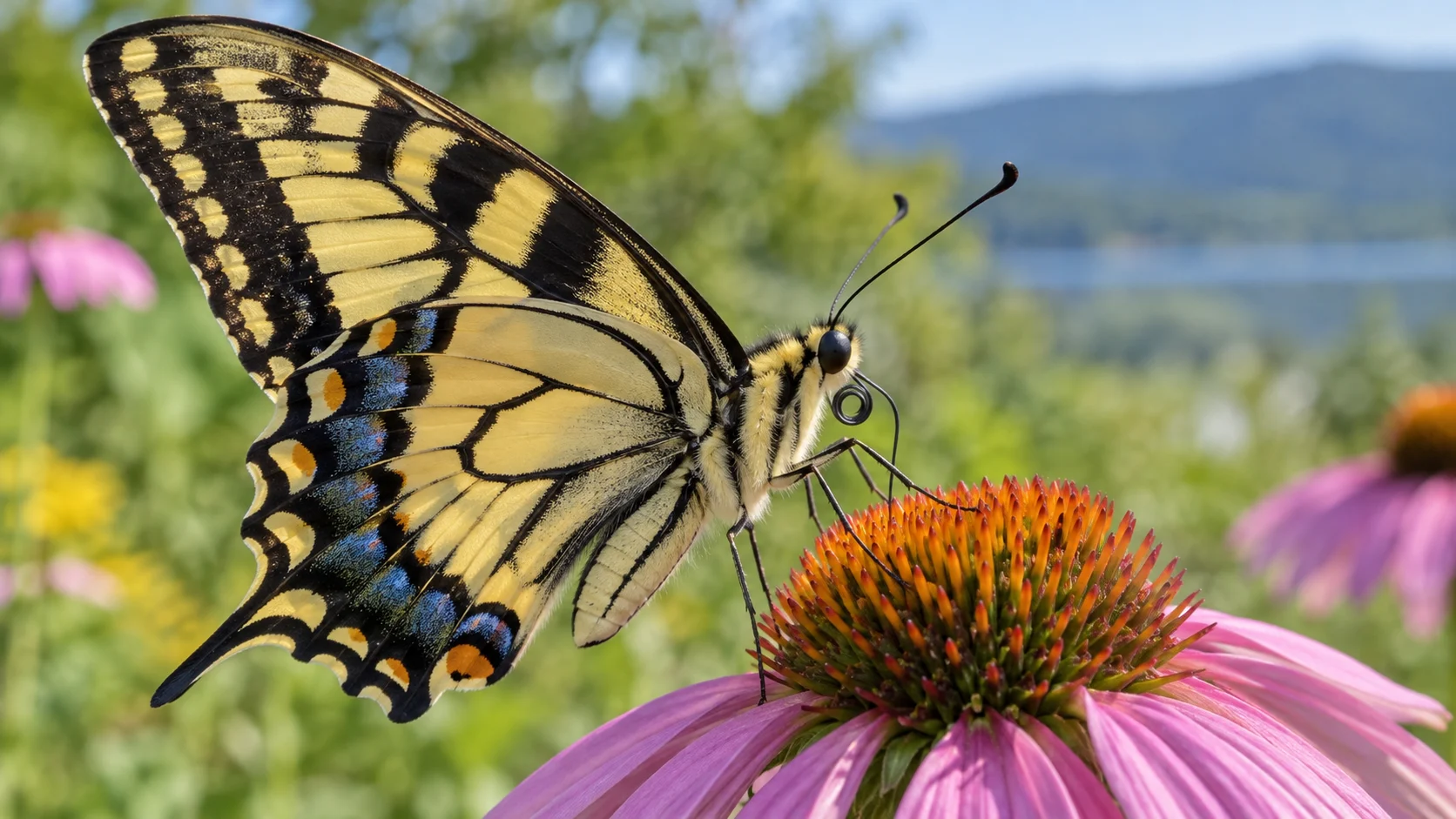
Butterfly Anatomy Up Close
Begin with scales, spiracles, antennae, and the structures hidden inside those bright wings.
- How many main body sections does an adult butterfly have?
Answer: Three - What are the three main body sections of a butterfly?
Answer: Head, thorax, and abdomen - How many legs does an adult butterfly have?
Answer: Six - How many wings does an adult butterfly have?
Answer: Four - What covers butterfly wings?
Answer: Tiny overlapping scales - What gives many butterfly wings structural color?
Answer: Microscopic scale structures that reflect light - What feeding tube does an adult butterfly uncoil?
Answer: The proboscis - Where are a butterfly's wings and legs attached?
Answer: The thorax - What type of eyes do adult butterflies have?
Answer: Compound eyes - What sensory structures end in clubs on most butterfly antennae?
Answer: Clubbed antennae - What openings along the body deliver air to the tracheal system?
Answer: Spiracles - Do butterflies have lungs?
Answer: No - What circulatory fluid do insects have instead of vertebrate blood?
Answer: Hemolymph - What do butterfly feet help them detect on plants?
Answer: Chemical cues or taste - What stiff veins support a butterfly wing?
Answer: Wing veins
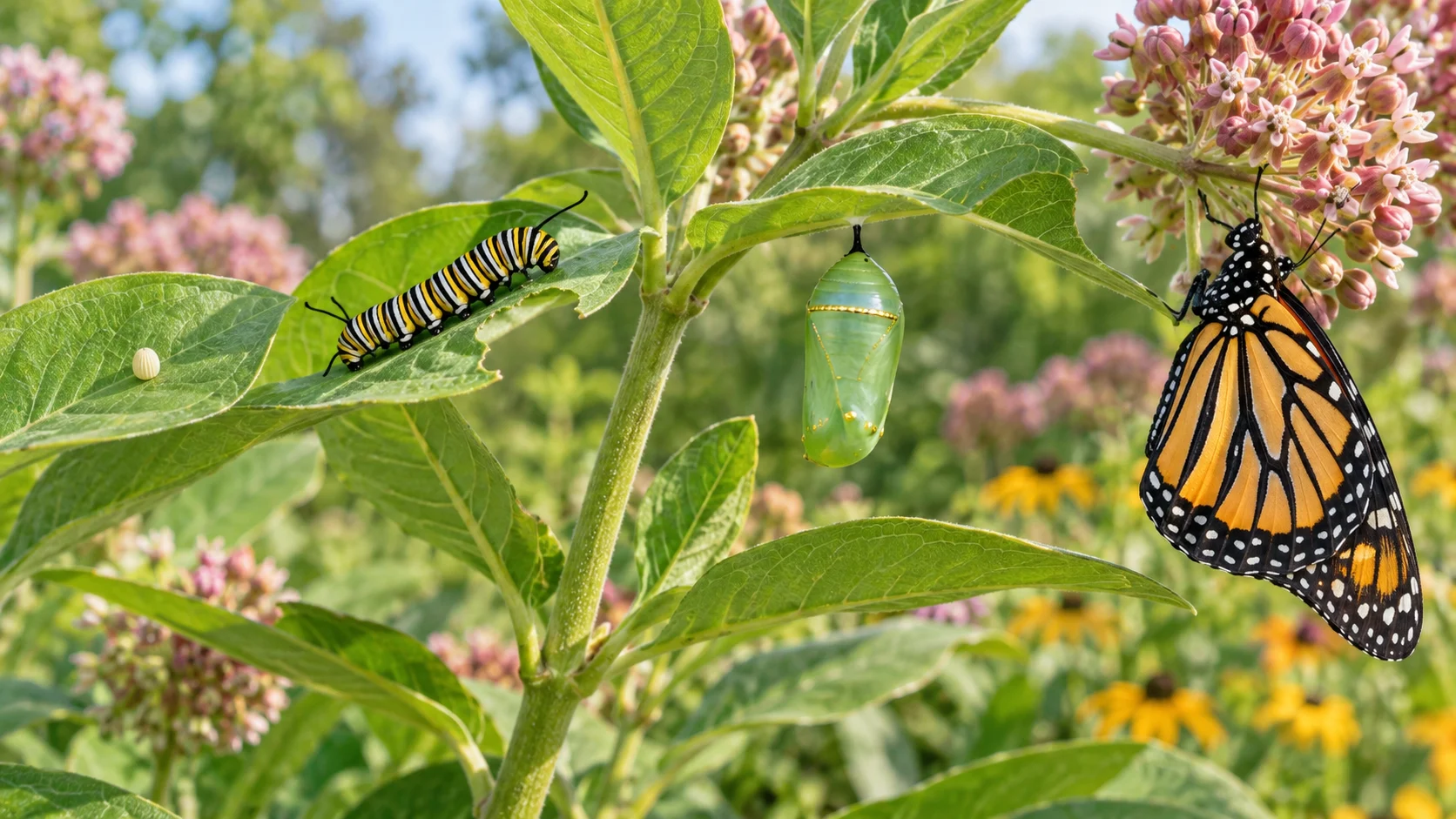
Egg, Caterpillar, Chrysalis, Butterfly
Follow complete metamorphosis through four stages that look almost unrelated to one another.
- What are the four butterfly life stages?
Answer: Egg, larva, pupa, adult - What is a butterfly larva commonly called?
Answer: A caterpillar - What is a butterfly pupa commonly called?
Answer: A chrysalis - What process transforms larva into adult?
Answer: Metamorphosis - What does a caterpillar primarily do?
Answer: Eat and grow - What is an instar?
Answer: A developmental stage between molts - Why must caterpillars molt?
Answer: Their outer skeleton cannot expand indefinitely - What is the shed outer skin called?
Answer: An exuvia - What does a caterpillar attach before pupating?
Answer: A silk pad, girdle, or shelter depending on species - Is a chrysalis the same thing as a cocoon?
Answer: No - What is a cocoon?
Answer: A silk casing spun around a pupa by some insects, especially many moths - What emerges from a chrysalis?
Answer: An adult butterfly - What must a newly emerged butterfly do before flying?
Answer: Expand and dry its wings - What fluid helps expand the wings after emergence?
Answer: Hemolymph - What is eclosion?
Answer: The adult's emergence from the pupa
Butterfly Families and Identification
Wing shape, antennae, posture, and pattern can help place a butterfly in the right family.
- What butterfly family includes monarchs, admirals, and fritillaries?
Answer: Nymphalidae - Why are nymphalids called brush-footed butterflies?
Answer: Their front pair of legs is reduced and hairy - What family includes swallowtails?
Answer: Papilionidae - What wing feature gives many swallowtails their common name?
Answer: Tail-like hindwing extensions - What family includes whites, sulphurs, and orangetips?
Answer: Pieridae - What family includes blues, coppers, and hairstreaks?
Answer: Lycaenidae - What family includes skippers?
Answer: Hesperiidae - How do skipper antennae often differ from other butterfly antennae?
Answer: The clubs may end in small hooks - What family includes metalmarks?
Answer: Riodinidae - What feature should be checked before identifying a butterfly from a photo?
Answer: Both upperwing and underwing patterns if possible - Why can fresh and worn individuals look different?
Answer: Scales fade or rub off - What is sexual dimorphism?
Answer: Visible differences between males and females - What is seasonal polyphenism?
Answer: Different adult forms produced in different seasons - What is a field mark?
Answer: A visible feature used for identification - Why is location useful in identification?
Answer: Species ranges and habitats differ
Host Plants, Nectar, and Pollination
Caterpillars and adults often need different plants, so a good habitat supplies more than flowers.
- What is a larval host plant?
Answer: A plant eaten by a species' caterpillars - What plant family hosts monarch caterpillars?
Answer: Milkweeds - What compound from milkweed helps defend monarchs?
Answer: Cardenolides - What do many adult butterflies drink from flowers?
Answer: Nectar - Do all adult butterflies feed only on nectar?
Answer: No - What is puddling?
Answer: Drinking moisture and dissolved minerals from damp ground - Which sex often puddles more frequently in many species?
Answer: Males - Why may males seek sodium while puddling?
Answer: It can support reproduction and be transferred during mating - What rotting foods attract some adult butterflies?
Answer: Fruit or tree sap - Can butterflies pollinate flowers?
Answer: Yes - How does butterfly pollination differ from bee pollination?
Answer: Butterflies often carry less pollen but can move it over distance - What flower shape is accessible to a butterfly's proboscis?
Answer: Tubular or deep flowers can be accessible - Why plant groups of the same flower species?
Answer: They make forage easier to locate - Why avoid insecticides on host plants?
Answer: They can kill caterpillars and adults - What two plant resources does a butterfly garden need?
Answer: Adult nectar plants and larval host plants
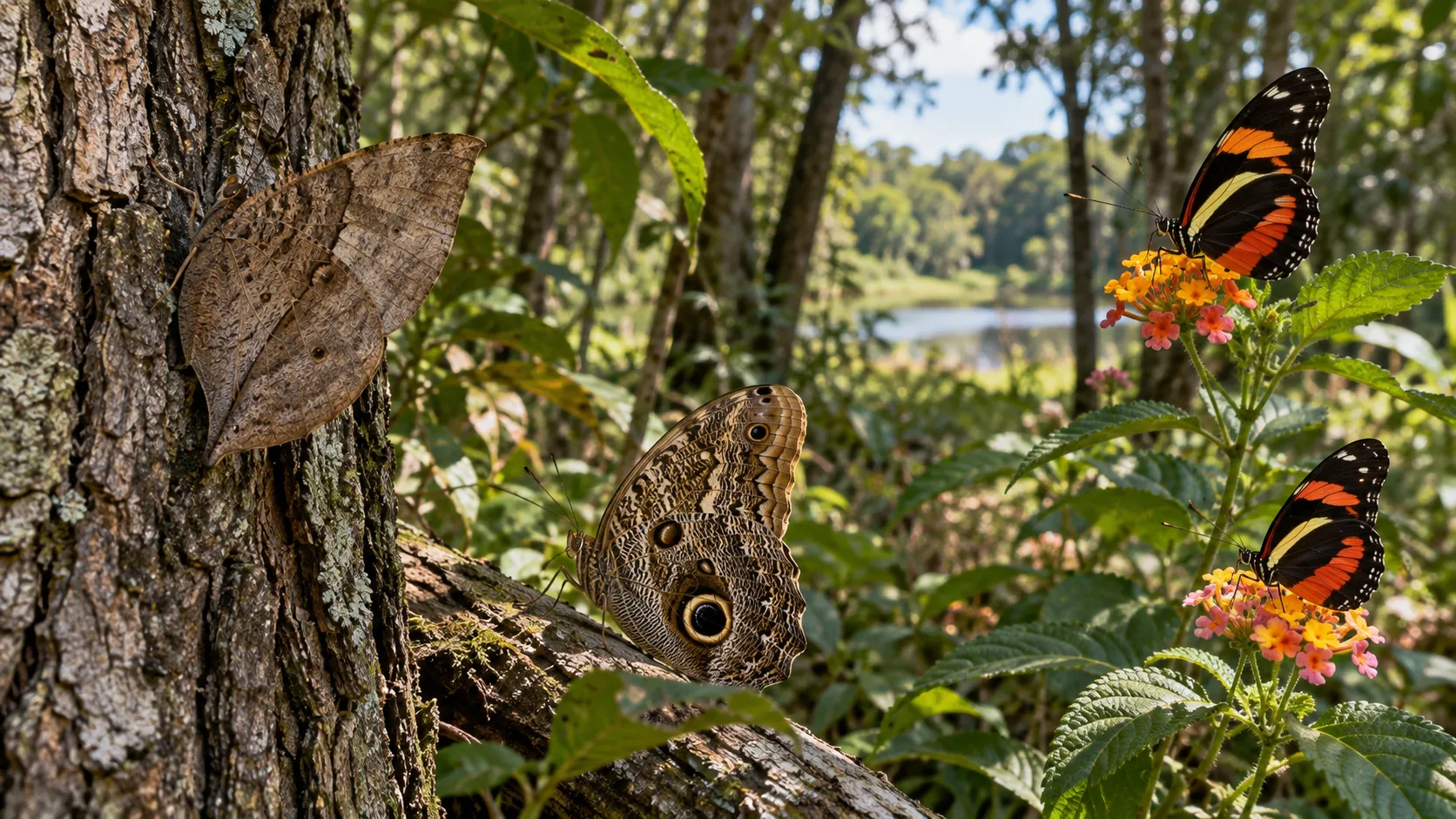
Camouflage, Mimicry, and Survival
Patterns can hide a butterfly, startle a predator, or advertise a meal best left uneaten.
- What is camouflage?
Answer: Color or form that helps an organism blend in - What is masquerade?
Answer: Resembling an inedible object such as a leaf or twig - What are eyespots?
Answer: Wing markings resembling eyes - How can eyespots help a butterfly?
Answer: Startle predators or redirect attacks - What is aposematic coloration?
Answer: Warning coloration advertising defense - What is Batesian mimicry?
Answer: A harmless species resembling a defended species - What is Müllerian mimicry?
Answer: Defended species sharing similar warning patterns - What famous butterfly pair illustrates debated mimicry?
Answer: Monarch and viceroy - Are viceroys now considered simply harmless monarch mimics?
Answer: No, viceroys also have defenses - What is crypsis?
Answer: Avoiding detection through camouflage - Why do some butterflies close their wings while resting?
Answer: To conceal bright upperwings and show camouflaged undersides - What is flash coloration?
Answer: Bright color revealed in flight then hidden at rest - How can hindwing tails misdirect predators?
Answer: They create a false head near the rear - What defense do some caterpillars use besides camouflage?
Answer: Spines, toxins, odors, or startle displays - What is thanatosis?
Answer: Feigning death
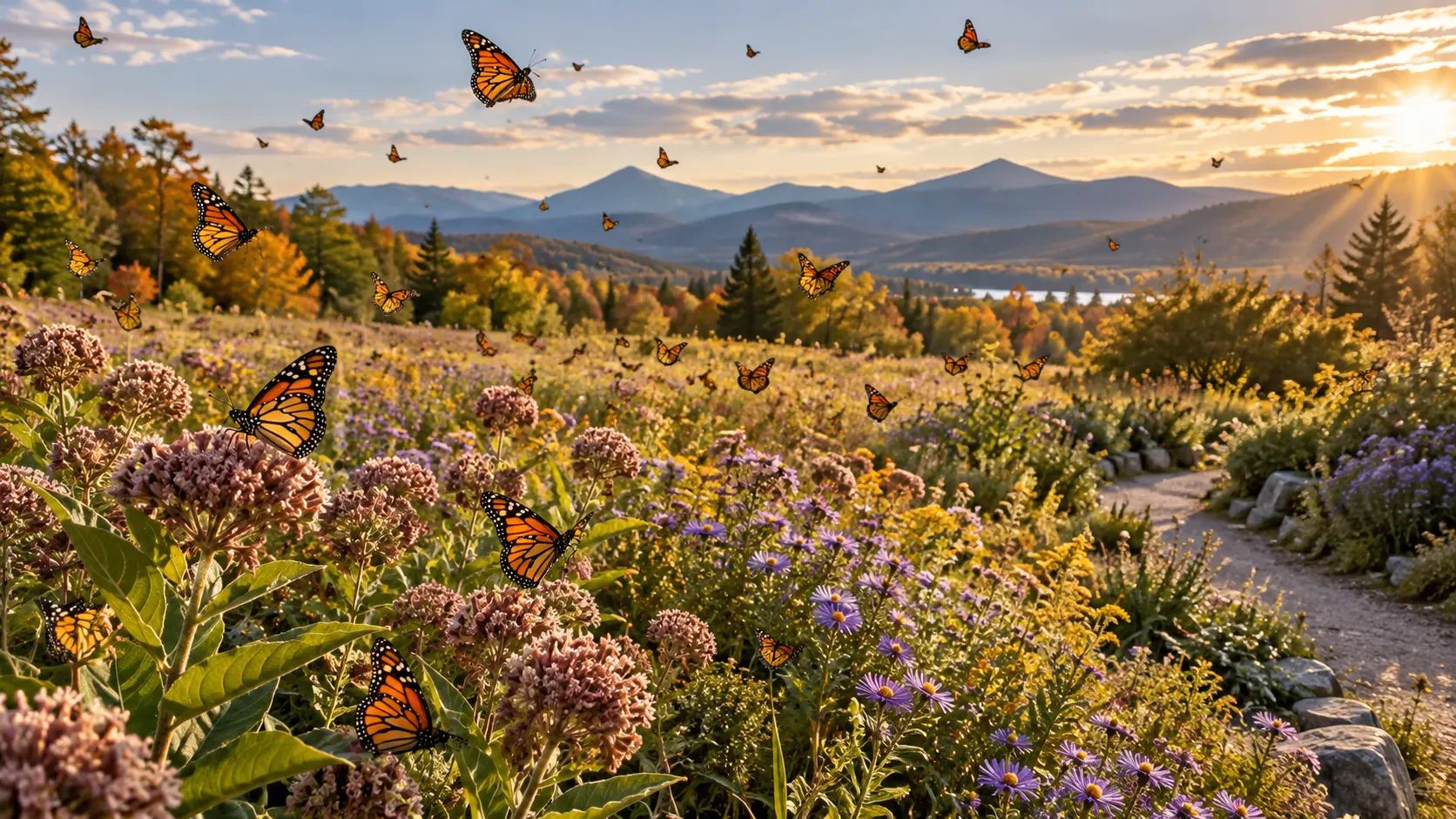
Migration, Flight, and Seasonal Behavior
Some butterflies remain near one meadow, while others turn migration into a multigenerational relay.
- Which North American butterfly is famous for long-distance migration?
Answer: The monarch - Do individual eastern monarchs complete the entire annual round trip?
Answer: No - Where do many eastern North American monarchs overwinter?
Answer: Central Mexico - Where do many western monarchs overwinter?
Answer: Coastal California, though patterns vary - What generation lives much longer during fall migration?
Answer: The migratory or super generation - What cues help monarchs orient?
Answer: The sun compass and Earth's magnetic field among other cues - Which butterfly is known for migrations between Europe and Africa?
Answer: The painted lady - Can painted lady migrations involve several generations?
Answer: Yes - What term describes a hormonally controlled pause in butterfly development or reproduction?
Answer: Diapause - How do many temperate butterflies survive winter?
Answer: As eggs, larvae, pupae, or adults depending on species - What does basking do?
Answer: Raises body temperature for flight - Why do butterflies angle their wings toward the sun?
Answer: To absorb or regulate heat - Can butterflies fly efficiently when their muscles are too cold?
Answer: No - What is hilltopping?
Answer: Adults gathering on high points to find mates - What is territorial behavior in butterflies?
Answer: Defending an area from rivals
Habitats and Butterflies Around the World
Butterflies live from tropical forests to tundra, provided their climate and host plants line up.
- Which biome supports exceptionally high butterfly diversity?
Answer: Tropical rainforest - What is a meadow butterfly likely to need besides flowers?
Answer: Host plants and shelter - Why are forest edges often good butterfly habitat?
Answer: They combine sun, shelter, and varied plants - What are canopy butterflies?
Answer: Species living mainly high in forests - What butterfly is one of Europe's largest and has swallowtail-like wings?
Answer: The scarce swallowtail or Old World swallowtail - Which giant birdwing genus includes some of the world's largest butterflies?
Answer: Ornithoptera - Where are birdwing butterflies native?
Answer: South and Southeast Asia and Australasia - What blue butterfly genus is famous in Central and South American forests?
Answer: Morpho - Why do morpho wings appear brilliant blue?
Answer: Structural coloration - Which butterfly is the state insect of several U.S. states including Alabama?
Answer: The monarch is state insect of several states, while Alabama's is the monarch - What British butterfly reintroduced after extinction is tied to thyme and ants?
Answer: The large blue - What unusual partners do large blue caterpillars depend on?
Answer: Myrmica ants - What is an endemic species?
Answer: A species native to and restricted to a place - Why can island butterflies be vulnerable?
Answer: They may have small ranges and specialized habitats - What determines whether a host plant supports a local butterfly?
Answer: The correct plant species, chemistry, timing, and accessibility
Butterfly Conservation and Smart Observation
Finish with practical ways to observe butterflies without harming the plants and habitats they depend on.
- What major pressure comes from converting habitat to development or intensive agriculture?
Answer: Habitat loss - How can climate change affect butterflies?
Answer: It can shift ranges, timing, drought, and host-plant availability - Why are connected habitats valuable?
Answer: They let populations move and exchange genes - What is a pollinator corridor?
Answer: Linked habitat providing food and shelter across a landscape - Why should gardens bloom from spring through fall?
Answer: Different species fly at different times - Why leave some leaf litter and stems?
Answer: They may shelter overwintering insects - What is citizen science?
Answer: Public participation in scientific data collection - What should a butterfly observer record?
Answer: Date, location, species, count, and habitat - Why photograph both sides of the wings?
Answer: Different field marks appear above and below - Why avoid handling butterfly wings?
Answer: Scales and delicate structures can be damaged - Does touching a wing automatically doom a butterfly?
Answer: No, but unnecessary handling can harm it - Why use regional field guides?
Answer: Ranges and look-alike species differ by location - What is captive rearing's conservation limitation?
Answer: It cannot replace healthy wild habitat and may spread disease if poorly managed - Why buy pesticide-free host plants?
Answer: Nursery residues can harm larvae - What is the simplest butterfly-friendly rule?
Answer: Provide diverse native plants and minimize pesticide use
Keep the game going with insect trivia, animal trivia, plants trivia, and environmental science trivia.
Sources and Further Reading
- Smithsonian butterfly and moth resources
- U.S. Forest Service monarch resources
- U.S. Fish and Wildlife Service pollinator conservation
- Xerces Society butterfly conservation
- Encyclopaedia Britannica: Butterfly

Ellie Ewert is the founder and author of RandomTrivia.co, blending her passion for research with years of experience in content creation to deliver accurate, engaging, and well-sourced trivia. Dedicated to providing readers with trustworthy and entertaining facts, she applies meticulous fact-checking and SEO expertise to ensure every article meets the highest standards. Read more about our high standards in our Editorial Guidelines.