
Brace yourself for black hole trivia that dives past cosmic myths and into some of the strangest physics in the universe.
From event horizons and warped time to stellar collisions and landmark images, these questions make the darkness wonderfully illuminating.
Black Hole Basics
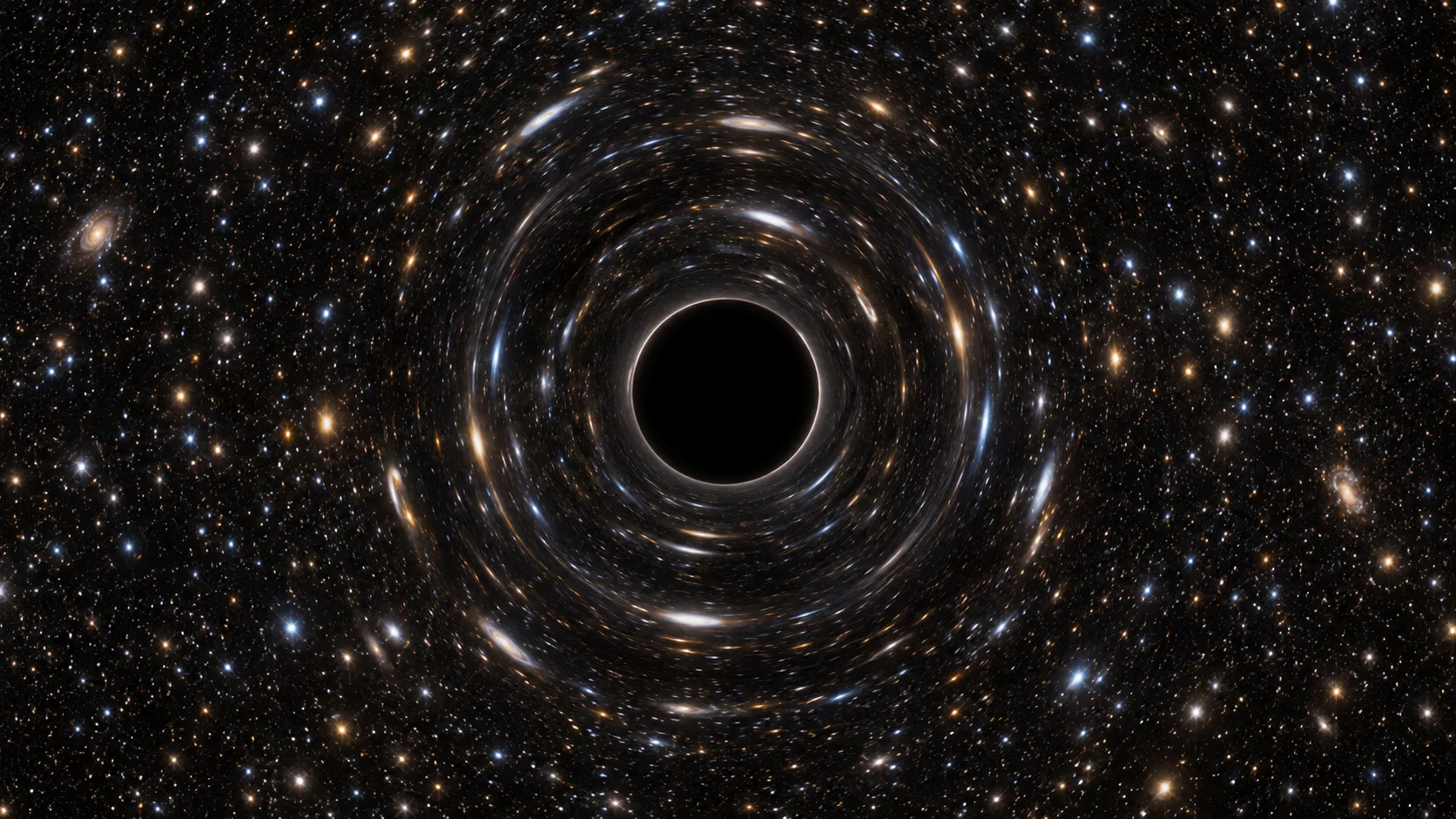
Q: What is a black hole?
A: A region where gravity is so strong that nothing, including light, can escape from within its boundary.
Q: What boundary marks the point beyond which escape from a black hole is impossible?
A: The event horizon.
Q: Why do black holes appear black?
A: Light from inside the event horizon cannot escape.
Q: What force dominates the behavior of a black hole?
A: Gravity.
Q: Which theory describes gravity as the curvature of spacetime?
A: General relativity.
Q: Who published the theory of general relativity in 1915?
A: Albert Einstein.
Q: What does a black hole's mass determine about the size of its event horizon?
A: More mass produces a larger event horizon.
Q: What name is given to the radius of a nonrotating black hole's event horizon?
A: The Schwarzschild radius.
Q: Can a distant black hole pull harder than another object of the same mass at the same distance?
A: No.
Q: If the Sun were replaced by a black hole of equal mass, would Earth's orbit immediately change?
A: No.
Q: Would Earth receive sunlight if the Sun became an equal-mass black hole?
A: No.
Q: What unit equal to the Sun's mass is often used for black holes?
A: A solar mass.
Q: Do black holes act like cosmic vacuum cleaners that automatically swallow everything nearby?
A: No.
Q: Can matter orbit a black hole without falling in?
A: Yes.
Q: What three measurable properties describe an isolated astrophysical black hole in the simplest classical model?
A: Mass, spin, and electric charge.
Anatomy of the Darkness
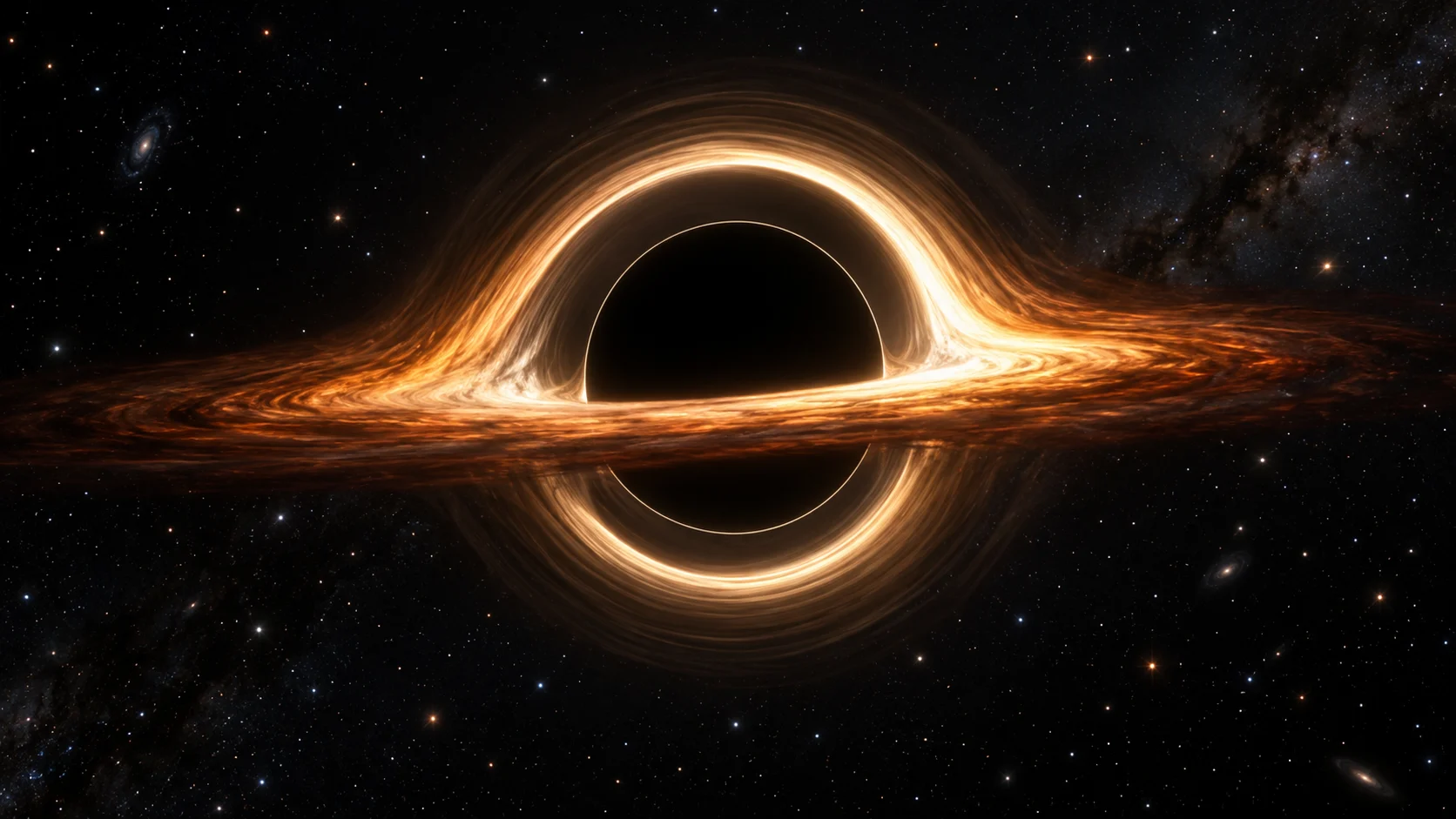
Q: What disk of hot material can form around a feeding black hole?
A: An accretion disk.
Q: Why can an accretion disk shine brightly?
A: Friction and compression heat its orbiting material.
Q: What dark central feature appears in an image of glowing material around a black hole?
A: The black hole's shadow.
Q: Is a black hole's shadow the same size as its event horizon?
A: No, the shadow appears larger because gravity bends light.
Q: What region surrounds a rotating black hole outside its event horizon?
A: The ergosphere.
Q: What happens to spacetime in the ergosphere?
A: It is dragged around by the black hole's rotation.
Q: What is the name for the dragging of spacetime by a rotating mass?
A: Frame dragging.
Q: What theoretical central region is predicted to have extreme spacetime curvature?
A: A singularity.
Q: Does current physics provide a complete description of a black hole singularity?
A: No.
Q: What is the innermost stable circular orbit often abbreviated as?
A: ISCO.
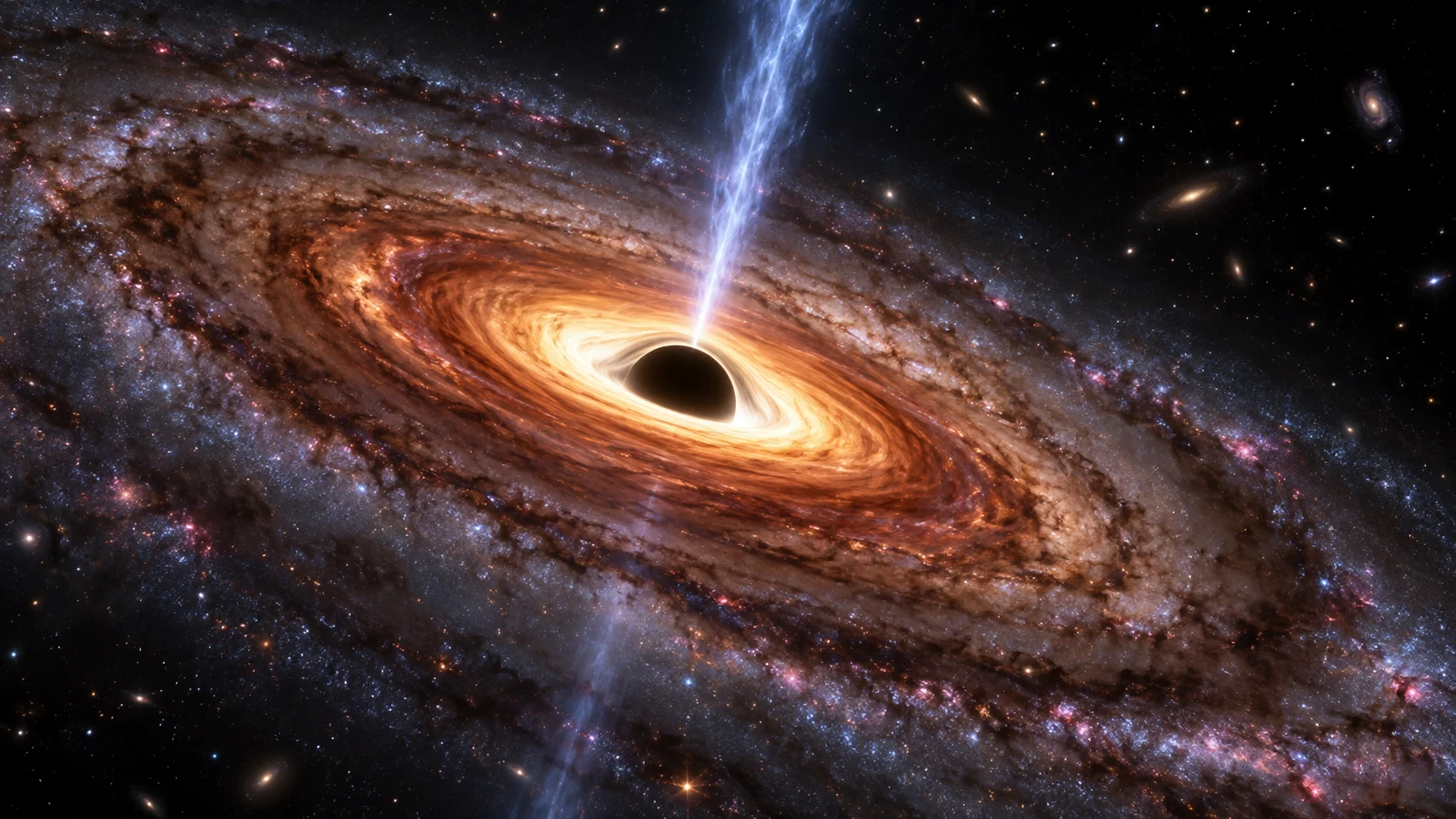
Q: What narrow beams can be launched from the surroundings of some feeding black holes?
A: Relativistic jets.
Q: Do relativistic jets emerge from inside the event horizon?
A: No.
Q: What two ingredients help power and shape black hole jets?
A: Accreting matter and magnetic fields.
Q: What is the photon sphere?
A: A region where gravity can force light onto unstable circular paths.
Q: What term describes matter spiraling onto a black hole?
A: Accretion.
Sizes and Species
Q: What kind of black hole typically has several to dozens of solar masses?
A: A stellar-mass black hole.
Q: What kind of black hole contains hundreds to hundreds of thousands of solar masses?
A: An intermediate-mass black hole.
Q: What kind of black hole commonly sits at the center of a large galaxy?
A: A supermassive black hole.
Q: How massive can a supermassive black hole be?
A: Millions or billions of times the Sun's mass.
Q: What hypothetical black holes may have formed in the early universe?
A: Primordial black holes.
Q: Have primordial black holes been confirmed?
A: No.
Q: What simple solution describes a nonrotating, uncharged black hole?
A: The Schwarzschild black hole.
Q: What solution describes a rotating, uncharged black hole?
A: The Kerr black hole.
Q: What solution describes a nonrotating black hole with electric charge?
A: The Reissner-Nordström black hole.
Q: What solution describes a rotating, electrically charged black hole?
A: The Kerr-Newman black hole.
Q: Which type, Schwarzschild or Kerr, better represents most astrophysical black holes?
A: Kerr, because real black holes are expected to rotate.
Q: Are astrophysical black holes expected to retain large electric charges?
A: No, surrounding matter would tend to neutralize them.
Q: Which black hole class remains the least firmly established observationally: stellar-mass, intermediate-mass, or supermassive?
A: Intermediate-mass black holes.
Q: Does a more massive black hole necessarily have a higher average density inside its event horizon?
A: No.
Q: Which has the larger event horizon, a ten-solar-mass black hole or a billion-solar-mass black hole?
A: The billion-solar-mass black hole.
How Black Holes Form and Grow
Q: What can happen when the core of a massive star collapses?
A: It can form a black hole.
Q: What stellar explosion may accompany the birth of a black hole?
A: A supernova.
Q: Can some massive stars collapse into black holes with little visible explosion?
A: Yes.
Q: What compact object can become a black hole if it gains enough mass?
A: A neutron star.
Q: What happens when two black holes merge?
A: They form a larger black hole and release gravitational waves.
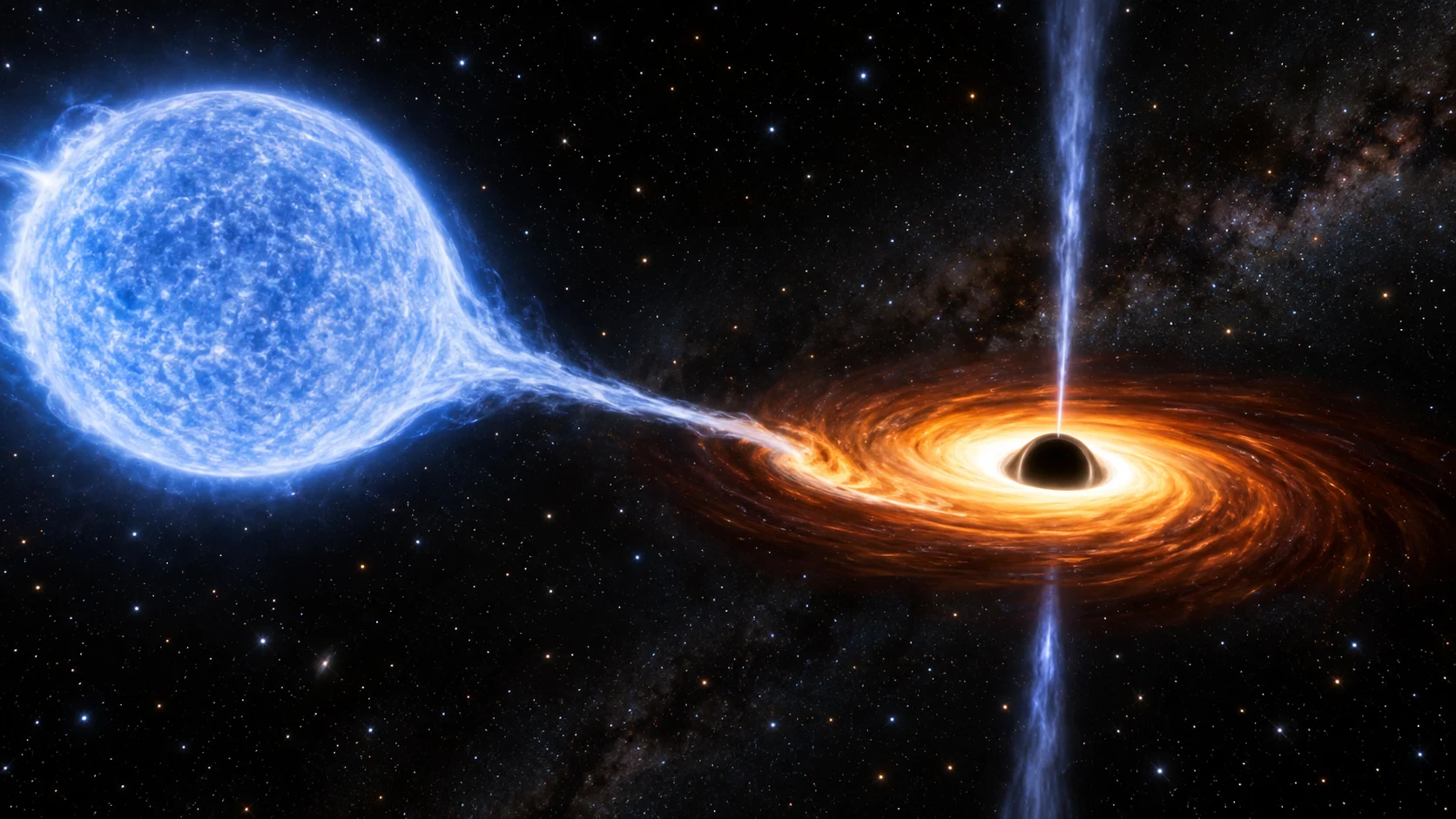
Q: How can a black hole gain mass besides merging?
A: By accreting gas, dust, stars, or other matter.
Q: What event occurs when a star is torn apart by a black hole's gravity?
A: A tidal disruption event.
Q: What limit describes the maximum steady brightness of spherical accretion when radiation pressure balances gravity?
A: The Eddington limit.
Q: What extremely bright galactic nucleus is powered by rapid accretion onto a supermassive black hole?
A: A quasar.
Q: What does AGN stand for in black hole astronomy?
A: Active galactic nucleus.
Q: Is every supermassive black hole currently an active galactic nucleus?
A: No.
Q: Why can a galactic nucleus become quiet?
A: Its central black hole is not accreting much matter.
Q: What merger can bring two supermassive black holes into the same galaxy?
A: A merger between galaxies.
Q: What ancient objects may have helped grow the first supermassive black holes?
A: Massive black hole seeds.
Q: Is the exact origin of the earliest supermassive black holes fully settled?
A: No.
Finding What Cannot Be Seen
Q: How can astronomers detect an invisible black hole in a binary system?
A: By observing its effects on a companion star and surrounding matter.
Q: What high-energy light often comes from hot gas near a stellar-mass black hole?
A: X-rays.
Q: What kind of observatory detects X-rays from space?
A: An X-ray telescope.
Q: Why must most cosmic X-ray observations be made above Earth's atmosphere?
A: The atmosphere absorbs most X-rays.
Q: What motion can reveal an unseen black hole orbiting with a star?
A: The star's orbital wobble.
Q: What effect allows gravity to magnify light from a more distant star?
A: Gravitational microlensing.
Q: What ripples in spacetime can reveal merging black holes?
A: Gravitational waves.
Q: Which observatory made the first direct detection of gravitational waves?
A: LIGO.
Q: In what year were gravitational waves first directly detected?
A: 2015.
Q: What event produced that first direct gravitational-wave detection?
A: The merger of two stellar-mass black holes.
Q: What was the designation of the first detected gravitational-wave event?
A: GW150914.
Q: What technique combines widely separated radio telescopes into an Earth-sized virtual telescope?
A: Very-long-baseline interferometry.
Q: What global collaboration produced the first image of a black hole's shadow?
A: The Event Horizon Telescope.
Q: What does the Event Horizon Telescope primarily observe?
A: Radio waves.
Q: Can astronomers infer a black hole's mass from the orbits of nearby stars?
A: Yes.
Famous Black Holes
Q: What supermassive black hole lies at the center of the Milky Way?
A: Sagittarius A*.
Q: In which constellation is Sagittarius A* located?
A: Sagittarius.
Q: About how massive is Sagittarius A*?
A: About four million solar masses.
Q: What star's short orbit helped reveal the mass of Sagittarius A*?
A: S2.
Q: Which galaxy contains the black hole first imaged by the Event Horizon Telescope?
A: Messier 87.
Q: What shorthand name is used for Messier 87's central black hole?
A: M87*.
Q: In what year was the first image of M87* released?
A: 2019.
Q: In what year was the first image of Sagittarius A* released?
A: 2022.
Q: Which stellar system contains one of the first widely accepted black hole candidates?
A: Cygnus X-1.
Q: What kind of object orbits the black hole in Cygnus X-1?
A: A massive blue supergiant star.
Q: Which nearby galaxy contains the powerful X-ray source LMC X-1?
A: The Large Magellanic Cloud.
Q: What supermassive black hole powers a famous jet in the galaxy M87?
A: M87*.
Q: What quasar was the first object identified as a quasar in 1963?
A: 3C 273.
Q: Which astronomer measured stellar orbits near Sagittarius A* and shared the 2020 Nobel Prize in Physics?
A: Andrea Ghez.
Q: Which other astronomer shared that Nobel recognition for studying the Milky Way's central black hole?
A: Reinhard Genzel.
Spacetime Gets Strange
Q: What happens to clocks deeper in a strong gravitational field relative to distant clocks?
A: They run more slowly.
Q: What is this difference in the passage of time called?
A: Gravitational time dilation.
Q: What happens to light climbing away from strong gravity?
A: It is gravitationally redshifted.
Q: How would a distant observer see an infalling object's light near the event horizon?
A: Increasingly redshifted and faint.
Q: Would an astronaut crossing a large event horizon necessarily notice a solid surface?
A: No.
Q: What playful term describes stretching caused by extreme tidal forces?
A: Spaghettification.
Q: What causes spaghettification?
A: A strong difference in gravity across an object.
Q: Where are tidal forces generally gentler at the horizon, around a stellar-mass or supermassive black hole?
A: Around a supermassive black hole.
Q: Can information or signals sent from inside an event horizon reach a distant observer?
A: No, according to classical general relativity.
Q: What hypothetical shortcut through spacetime is sometimes confused with a black hole?
A: A wormhole.
Q: Have traversable wormholes been observed?
A: No.
Q: What boundary hides a black hole's interior from outside observers?
A: The event horizon.
Q: What idea says physical laws prevent a naked singularity from being visible to distant observers?
A: The cosmic censorship conjecture.
Q: Has the cosmic censorship conjecture been proven in general?
A: No.
Q: What maximum speed still applies near a black hole?
A: The speed of light.
Quantum Questions and Cosmic History
Q: Which physicist proposed that black holes can emit thermal radiation?
A: Stephen Hawking.
Q: What is that predicted emission called?
A: Hawking radiation.
Q: What would Hawking radiation cause a black hole to do over immense time spans?
A: Lose mass and eventually evaporate.
Q: Have astronomers directly detected Hawking radiation from an astrophysical black hole?
A: No.
Q: Which emits a higher Hawking temperature, a smaller or larger black hole?
A: A smaller black hole.
Q: What puzzle asks how information is preserved when a black hole evaporates?
A: The black hole information paradox.
Q: Which 18th-century English scientist imagined a star whose gravity would trap light?
A: John Michell.
Q: What historical phrase did John Michell use for such an object?
A: A dark star.
Q: Which physicist found the first exact black hole solution to Einstein's field equations?
A: Karl Schwarzschild.
Q: In what year did Schwarzschild publish his solution?
A: 1916.
Q: Which physicist showed that sufficiently massive stars could undergo continued gravitational collapse?
A: J. Robert Oppenheimer, working with Hartland Snyder.
Q: Who popularized the term black hole in the late 1960s?
A: John Wheeler.
Q: Which mathematician found the rotating black hole solution in 1963?
A: Roy Kerr.
Q: What 2020 Nobel laureate proved that black hole formation is a robust prediction of general relativity?
A: Roger Penrose.
Q: What famous 2014 science-fiction film consulted physicist Kip Thorne on its black hole visuals?
A: Interstellar.
You Escaped the Event Horizon
If you made it through all 120 without getting spaghettified, your cosmic credentials are shining brightly. Keep your orbit going with our famous people trivia and decades trivia.

Ellie Ewert is the founder and author of RandomTrivia.co, blending her passion for research with years of experience in content creation to deliver accurate, engaging, and well-sourced trivia. Dedicated to providing readers with trustworthy and entertaining facts, she applies meticulous fact-checking and SEO expertise to ensure every article meets the highest standards. Read more about our high standards in our Editorial Guidelines.