
Fasten your white mantle, because Knights Templar history has crusader castles, coded seals, royal money, courtroom drama, and centuries of very creative rumors.
These questions follow the real medieval order from Jerusalem to its suppression, carefully separating surviving evidence from Grail-sized legend.
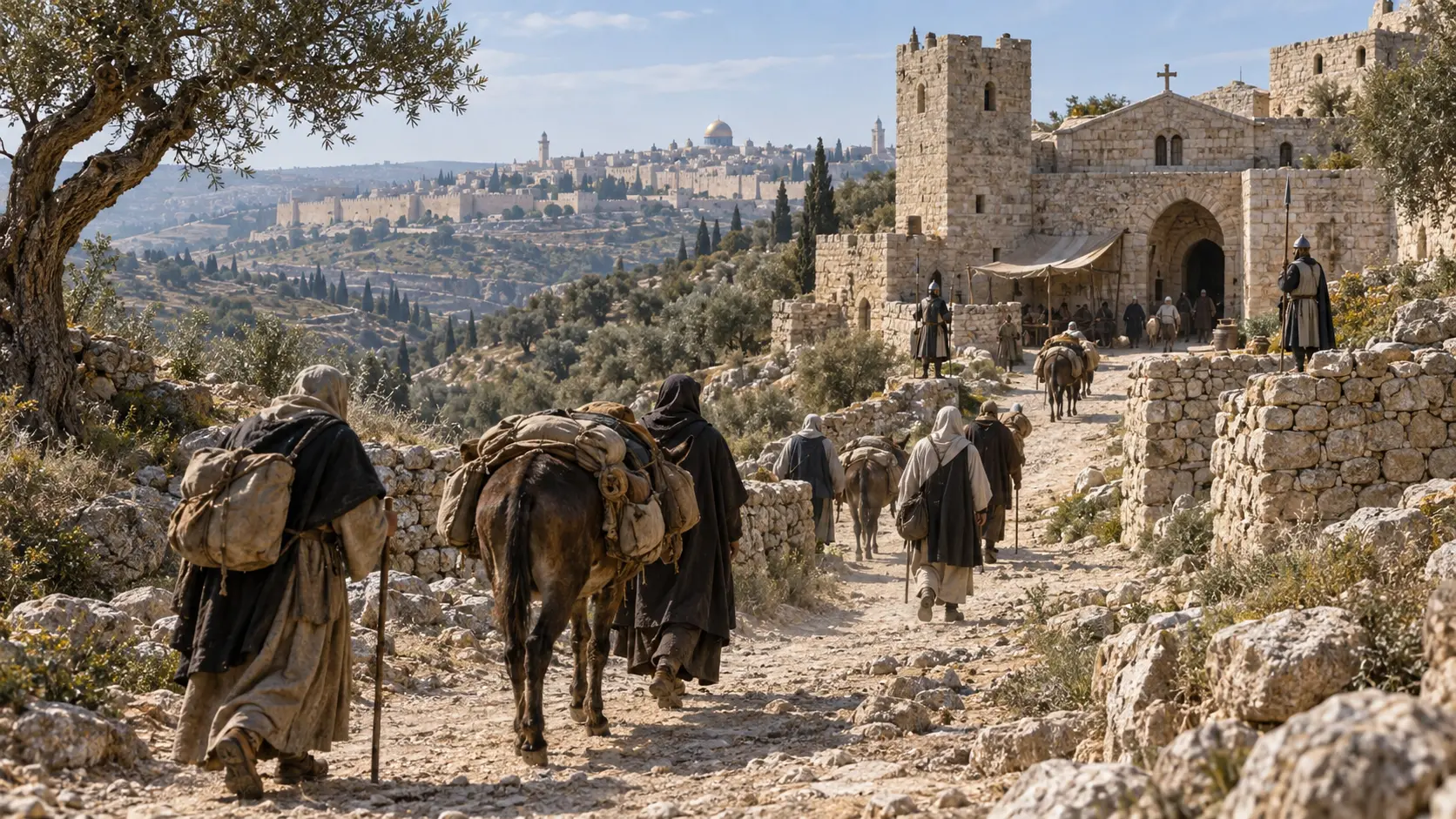
From Pilgrim Roads to the Temple Mount
Q: Around what year was the Knights Templar founded?
A: Around 1119.
Q: Who is traditionally named as the order's founding leader?
A: Hugh de Payns.
Q: What was the order's full early name?
A: The Poor Fellow-Soldiers of Christ and of the Temple of Solomon.
Q: What was the Templars' original stated mission?
A: Protecting Christian pilgrims traveling to Jerusalem.
Q: Which crusader kingdom gave the Templars their first base?
A: The Kingdom of Jerusalem.
Q: Which king provided the Templars lodging on the Temple Mount?
A: Baldwin II of Jerusalem.
Q: Which building served as the order's early headquarters in Jerusalem?
A: The al-Aqsa Mosque, then called the Temple of Solomon by the crusaders.
Q: Which biblical king gave the Templars the “Temple” in their name?
A: Solomon.
Q: At what 1129 church council was the order formally recognized?
A: The Council of Troyes.
Q: Which influential abbot supported the Templars and praised their mission?
A: Bernard of Clairvaux.
Q: What work did Bernard write in praise of the order?
A: In Praise of the New Knighthood.
Q: Which pope's 1139 bull gave the Templars major privileges and papal protection?
A: Pope Innocent II.
Q: What was that important papal bull called?
A: Omne datum optimum.
Q: To whom was the Templar order directly accountable under its papal privileges?
A: The pope.
Q: In what modern country is Troyes located?
A: France.
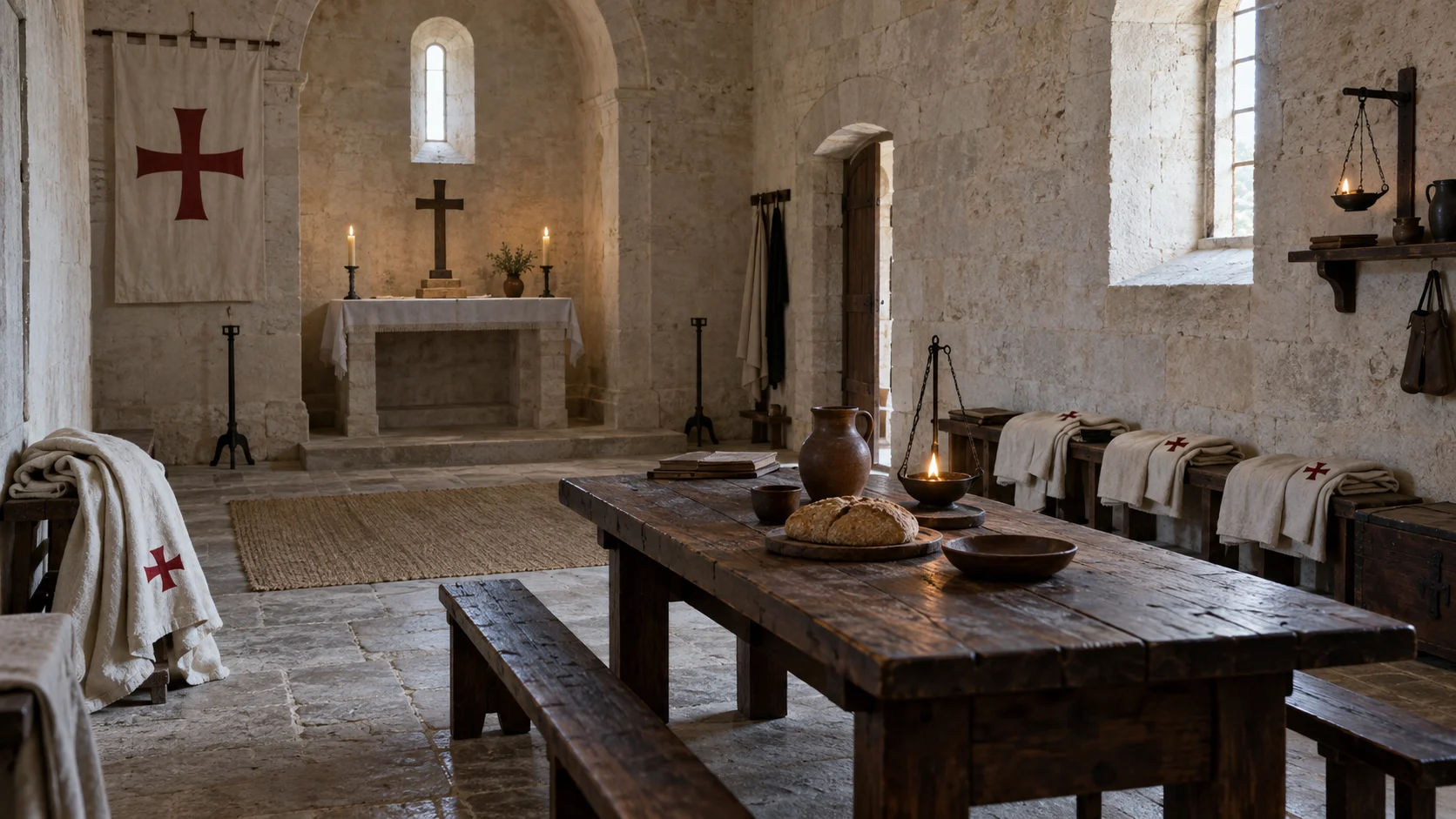
White Mantles, Vows, and a Strict Rule
Q: What three traditional monastic vows did Templars take?
A: Poverty, chastity, and obedience.
Q: What color mantle distinguished Templar knights?
A: White.
Q: What symbol was added to Templar mantles in the 12th century?
A: A red cross.
Q: Which pope granted the Templars the right to wear the red cross in 1147?
A: Pope Eugene III.
Q: What was the order's highest-ranking official called?
A: The Grand Master.
Q: What non-knightly fighting members of the order were called?
A: Sergeants.
Q: Which members performed religious services for the order?
A: Templar chaplains.
Q: Could every Templar brother claim noble birth?
A: No, sergeants and other members came from varied backgrounds.
Q: What text governed the order's discipline and daily conduct?
A: The Templar Rule.
Q: In what language was the earliest version of the Templar Rule written?
A: Latin.
Q: What was a regional Templar estate or headquarters often called?
A: A commandery, or preceptory.
Q: What farming, rental, and craft income supported Templar military work?
A: Revenue from their European estates.
Q: What did the famous Templar seal show sharing one horse?
A: Two riders.
Q: Is the exact meaning of the two-riders seal known with certainty?
A: No.
Q: What black-and-white banner was associated with the order?
A: The Beauséant.
Crusader Battles and Hard-Fought Frontiers
Q: Which 1177 battle brought a major crusader victory over Saladin?
A: The Battle of Montgisard.
Q: Which Muslim ruler defeated the crusader army at Hattin in 1187?
A: Saladin.
Q: What sacred object did the crusader army lose at Hattin?
A: The relic of the True Cross.
Q: Which Templar Grand Master survived Hattin but was later killed during the Siege of Acre?
A: Gérard de Ridefort.
Q: What city fell to Saladin soon after the Battle of Hattin?
A: Jerusalem.
Q: Which coastal city became the Templars' principal headquarters after Jerusalem was lost?
A: Acre.
Q: Which crusade recaptured Acre in 1191?
A: The Third Crusade.
Q: Which English king fought alongside crusader forces during the Third Crusade?
A: Richard I, the Lionheart.
Q: What 1244 battle was a catastrophic defeat for the military orders and crusader states?
A: The Battle of La Forbie.
Q: Which French king led the Seventh Crusade?
A: Louis IX.
Q: At which Egyptian battle in 1250 did Templar Grand Master William of Sonnac lose an eye?
A: The Battle of Mansurah.
Q: Which Mamluk sultan captured the Templar castle of Safed in 1266?
A: Baybars.
Q: In what year did Acre fall to the Mamluks?
A: 1291.
Q: Which Templar Grand Master died during the defense of Acre?
A: William of Beaujeu.
Q: What island kingdom became the Templars' main base after Acre fell?
A: Cyprus.
Castles, Commanderies, and Sacred Sites
Q: What huge coastal fortress did the Templars begin building in 1218?
A: Château Pèlerin, or Atlit Castle.
Q: On the coast of which modern country are the ruins of Atlit Castle?
A: Israel.
Q: Which fortress overlooking the Jordan Valley was rebuilt by the Templars?
A: Safed.
Q: Which Syrian coastal fortress was known to the crusaders as Tortosa?
A: Tartus.
Q: Which fortress near the Amanus Mountains was also called Gaston?
A: Baghras Castle.
Q: What castle on the Jordan was destroyed by Saladin before construction was complete?
A: Chastellet at Jacob's Ford.
Q: Which Jerusalem shrine did crusaders call the Temple of the Lord?
A: The Dome of the Rock.
Q: Did the Dome of the Rock serve as the Templars' main residence?
A: No, their headquarters was in al-Aqsa.
Q: What large London church was consecrated for the Templars in 1185?
A: Temple Church.
Q: What distinctive shape does Temple Church's original nave have?
A: It is round.
Q: Which Paris complex served as a major Templar headquarters and treasury?
A: The Temple.
Q: What Portuguese castle became an important Templar stronghold?
A: Tomar Castle.
Q: Who founded Tomar Castle in 1160?
A: Gualdim Pais.
Q: What round Templar church stands inside the Tomar complex?
A: The Charola.
Q: What island fortress was the order's last important outpost in the eastern Mediterranean?
A: Ruad.
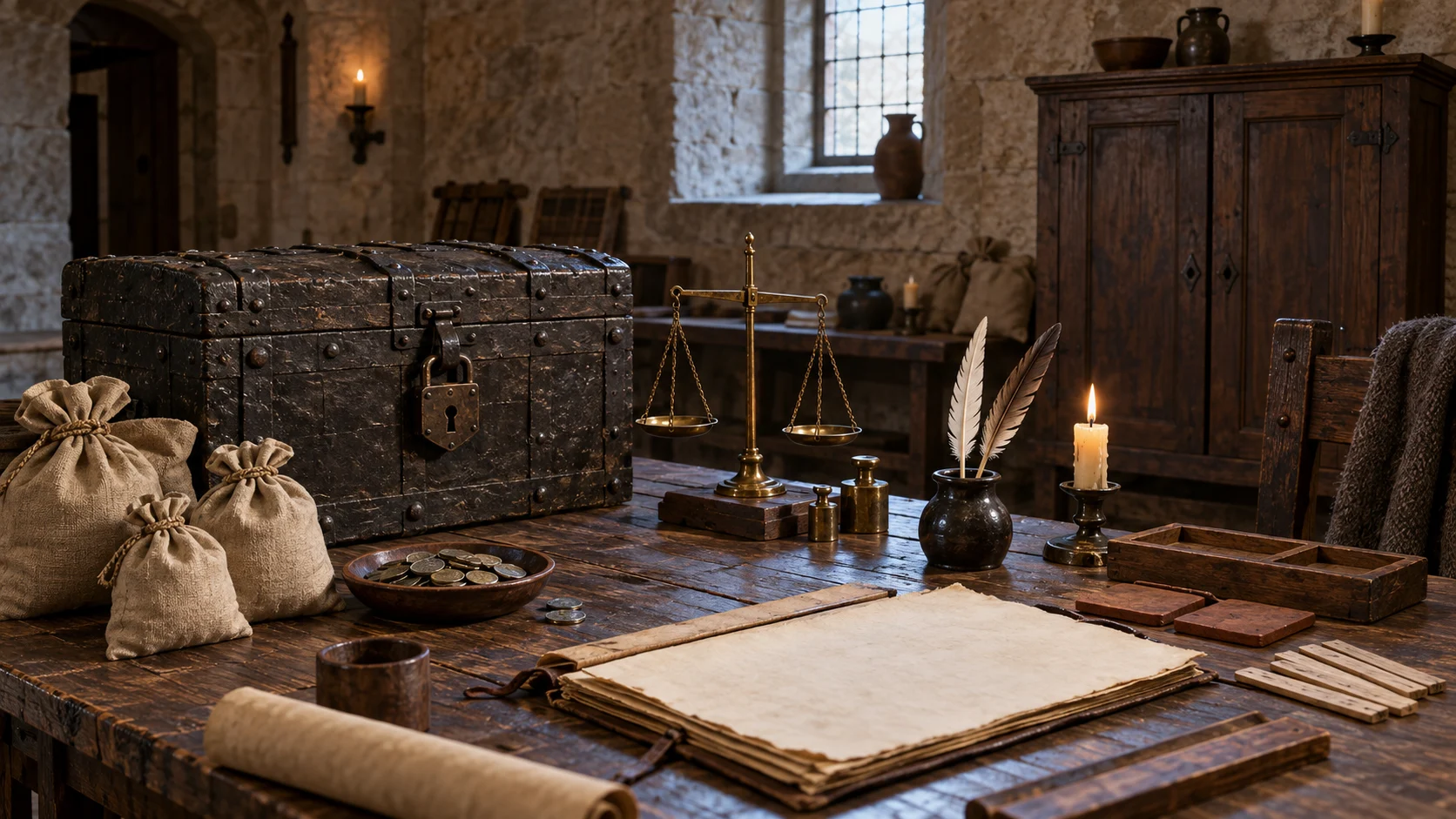
Land, Credit, and Medieval Logistics
Q: How did the Templars acquire much of their European property?
A: Through donations and purchases.
Q: What did Templar farms produce to support the order?
A: Food, animals, wine, wool, and income.
Q: What financial service let some travelers deposit value in one place and withdraw it elsewhere?
A: Transfer by written account.
Q: Is it accurate to call the Templars the inventors of banking?
A: No, banking practices existed long before them.
Q: Which French king placed his royal treasury in Templar hands before turning against them?
A: Philip IV.
Q: What did the Templars sometimes safeguard for monarchs and nobles?
A: Money, documents, and valuables.
Q: What made the order useful for moving funds across regions?
A: Its international network of houses.
Q: What military expense consumed much of the order's European income?
A: Supplying people, horses, fortresses, and ships in the East.
Q: Did individual Templar brothers personally own the order's riches?
A: No, property belonged to the institution.
Q: What profession did many Templar estates practice far from any battlefield?
A: Agriculture.
Q: What animals were especially costly and important to Templar knights?
A: Warhorses.
Q: What broad medieval movement made gifts to religious military orders spiritually attractive to donors?
A: Crusading devotion.
Q: Which English king granted the Templars land for their New Temple complex in London?
A: Henry II.
Q: What practical service did Templar houses offer travelers besides finance?
A: Lodging, contacts, and logistical support.
Q: Why could the Templars lend large sums despite individual vows of poverty?
A: The order collectively controlled extensive assets.
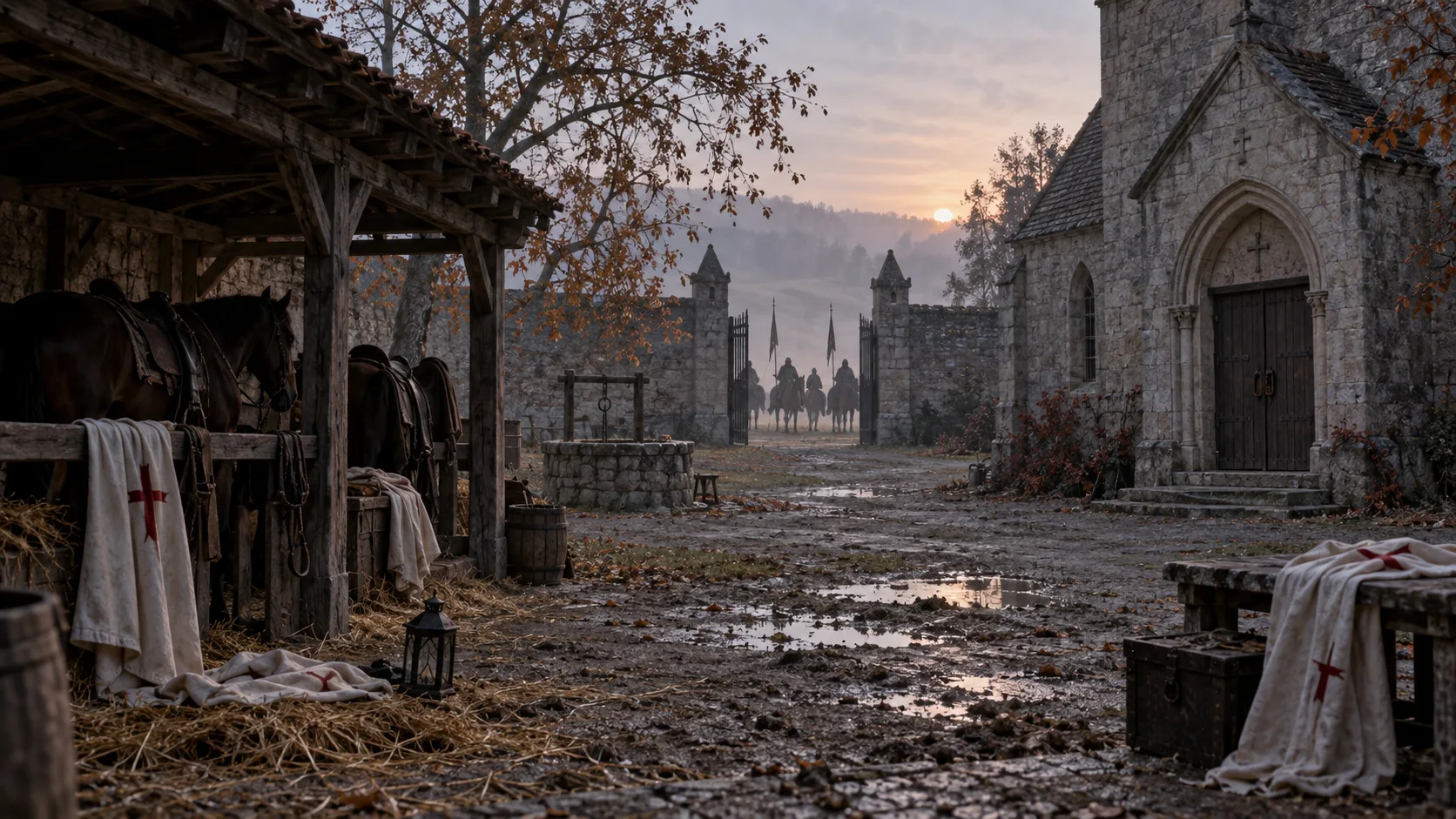
Friday the Thirteenth and the Great Arrest
Q: Which French king ordered the mass arrest of the Templars?
A: Philip IV.
Q: On what date did the arrests in France begin?
A: Friday, October 13, 1307.
Q: Which pope was pressured during the Templar proceedings?
A: Clement V.
Q: What serious religious charge was brought against the order?
A: Heresy.
Q: What coercive method produced many Templar confessions?
A: Torture.
Q: Did Templars consistently maintain those confessions?
A: No, many later retracted them.
Q: What mysterious name appeared in some accusations about an idol?
A: Baphomet.
Q: Has evidence confirmed that the Templars secretly worshipped Baphomet?
A: No.
Q: What document records papal envoys absolving leading Templars after private hearings?
A: The Chinon Parchment.
Q: At what 1311 to 1312 council was the order's fate decided?
A: The Council of Vienne.
Q: What papal bull suppressed the Templar order in 1312?
A: Vox in excelso.
Q: Was the order formally condemned by a final judicial verdict of heresy?
A: No, it was suppressed by papal provision.
Q: Which order received much of the Templars' property?
A: The Knights Hospitaller.
Q: Who was the last Templar Grand Master?
A: Jacques de Molay.
Q: In what year was Jacques de Molay executed?
A: 1314.
After the Order: Portugal, Memory, and Survival
Q: How was Jacques de Molay executed?
A: He was burned at the stake.
Q: On what Paris island was Jacques de Molay executed?
A: Île aux Juifs.
Q: What story says de Molay cursed Philip IV and Clement V from the flames?
A: A later legend.
Q: Which Portuguese order inherited many Templar people and properties?
A: The Order of Christ.
Q: In what year was the Order of Christ established?
A: 1319.
Q: Which Portuguese prince later governed the Order of Christ and supported exploration?
A: Henry the Navigator.
Q: What red emblem appeared on sails connected with the Portuguese Order of Christ?
A: The cross of the Order of Christ.
Q: What happened to many Templar properties in England after suppression?
A: They were transferred to the Hospitallers.
Q: Did every European monarch arrest Templars as quickly as Philip IV did?
A: No.
Q: What battle is sometimes said to have featured hidden Templars aiding Robert the Bruce?
A: Bannockburn.
Q: Is there reliable evidence that a Templar force fought at Bannockburn?
A: No.
Q: Did a documented Templar fleet vanish with a secret treasure from La Rochelle?
A: No, that is a modern legend.
Q: Which existing Catholic order is often confused with the Templars but remained separate?
A: The Knights Hospitaller.
Q: What modern organization claims symbolic Templar inspiration without proven institutional continuity?
A: Freemasonry.
Q: What was the most important reason the medieval Templars ceased to exist?
A: Papal suppression backed by royal pressure.
Holy Grails and Other Templar Legends
Q: Is there medieval evidence that the Templars possessed the Holy Grail?
A: No.
Q: Is there proof that the Templars found the Ark of the Covenant?
A: No.
Q: Is the modern fear of Friday the 13th proven to come from the 1307 arrests?
A: No, that connection is not historically established.
Q: Which medieval romance tradition helped attach mysterious relics to crusading knights?
A: Arthurian Grail literature.
Q: Which 1988 novel by Umberto Eco plays with Templar conspiracy theories?
A: Foucault's Pendulum.
Q: Which Dan Brown novel turned Templar and Grail theories into a global bestseller?
A: The Da Vinci Code.
Q: Which adventure film sends Indiana Jones after the Holy Grail?
A: Indiana Jones and the Last Crusade.
Q: What video game series prominently features fictional Templars and Assassins?
A: Assassin's Creed.
Q: Which television drama follows Templars including a fictional knight named Landry?
A: Knightfall.
Q: Which 19th-century novel includes a proud Templar knight named Brian de Bois-Guilbert?
A: Ivanhoe.
Q: Who wrote Ivanhoe?
A: Sir Walter Scott.
Q: What architectural feature makes many Templar churches look especially mysterious to modern visitors?
A: A round nave inspired by Jerusalem's holy sites.
Q: Were all Templar churches round?
A: No.
Q: Why do Templar conspiracy theories often thrive?
A: The order's secrecy, wealth, sudden fall, and incomplete records invite speculation.
Q: Which surviving records require special caution because many statements were extracted under torture?
A: The Templar trial records.
Your Quest Is Complete
If you made it through every siege, seal, and conspiracy claim, your score is fit for a grand master. Keep meeting history's biggest personalities with our famous people trivia or travel through later eras in decades trivia.

Ellie Ewert is the founder and author of RandomTrivia.co, blending her passion for research with years of experience in content creation to deliver accurate, engaging, and well-sourced trivia. Dedicated to providing readers with trustworthy and entertaining facts, she applies meticulous fact-checking and SEO expertise to ensure every article meets the highest standards. Read more about our high standards in our Editorial Guidelines.