
Rainforests recycle water, store carbon, shelter astonishing wildlife, and make “just one more plant” a dangerous promise for botanists. These 120 rainforest trivia questions climb from soil and understory to canopy science and forests around the world.
Branch out with our geography trivia, animal trivia, and Earth science trivia.
Rainforest Layers, Climate, and Ecology
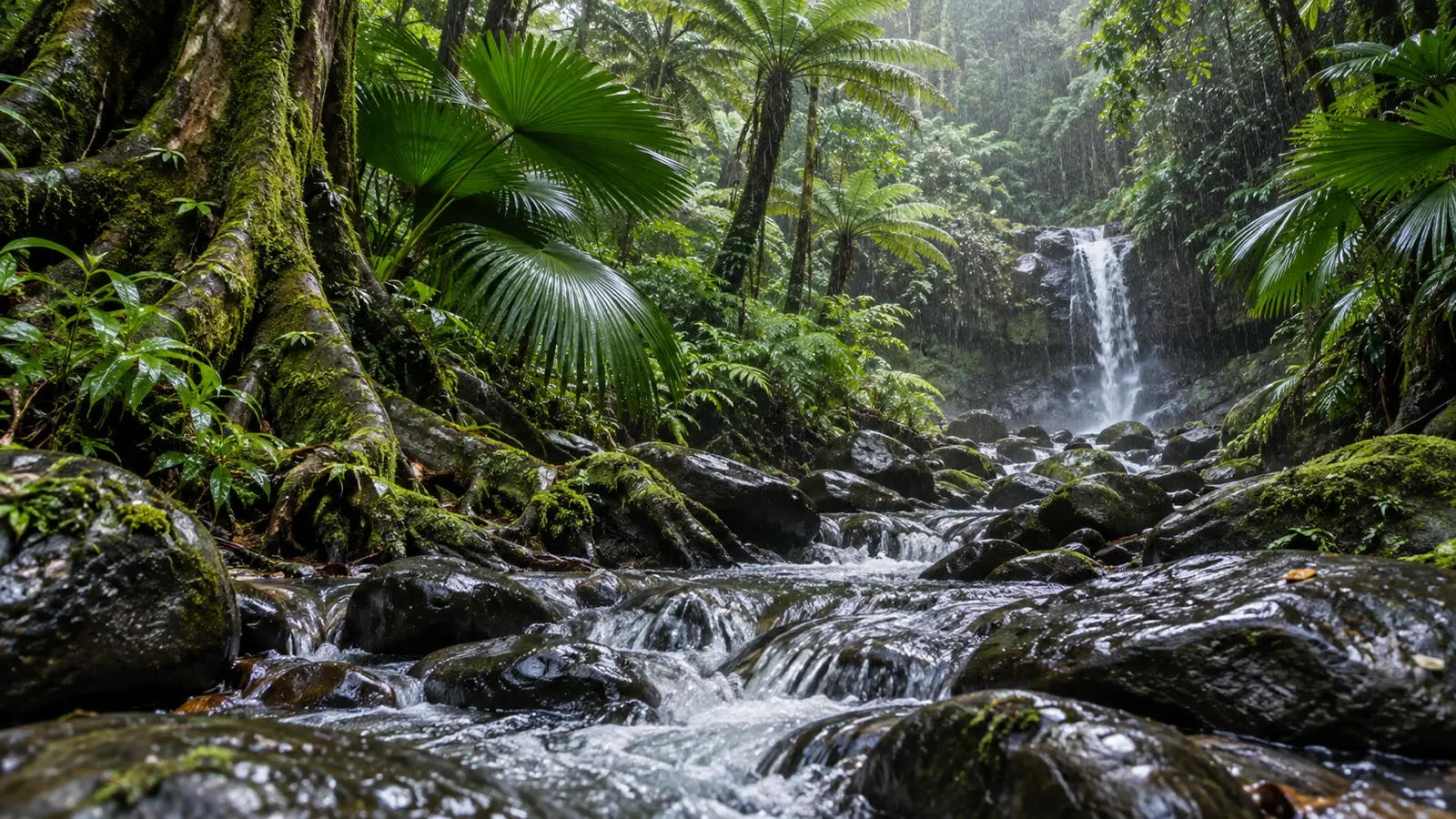
A rainforest is less a wall of green than a crowded apartment building with roots in the lobby and eagles on the roof. Every layer has different light, wind, food, and tenants who rarely agree on quiet hours.
Q: What climate feature defines a rainforest?
A: High rainfall that supports dense, moisture-loving vegetation.
Q: What are the four commonly described layers of a tropical rainforest?
A: The emergent layer, canopy, understory, and forest floor.
Q: Which rainforest layer forms a nearly continuous roof of leaves?
A: The canopy.
Q: Which layer contains the tallest trees rising above the canopy?
A: The emergent layer.
Q: Which rainforest layer receives the least direct sunlight?
A: The forest floor.
Q: Why is tropical rainforest soil often less fertile than expected?
A: Heavy rain leaches nutrients, while many nutrients are held in living plants.
Q: What process returns nutrients quickly from dead matter to rainforest plants?
A: Rapid decomposition and nutrient cycling.
Q: What plant grows on another plant without taking nutrients from it?
A: An epiphyte.
Q: Which familiar rainforest plants often grow as epiphytes?
A: Orchids, bromeliads, mosses, and ferns.
Q: What woody vine climbs trees to reach sunlight?
A: A liana.
Q: What wide root structure helps support many shallow-rooted rainforest trees?
A: A buttress root.
Q: Why do many rainforest leaves have pointed drip tips?
A: They shed water quickly and reduce lingering moisture.
Q: What is a tropical cloud forest?
A: A high-elevation forest frequently covered by low clouds or mist.
Q: What distinguishes a temperate rainforest from a tropical rainforest?
A: It occurs in cooler climates, usually near coasts, with abundant rain and large trees.
Q: Which process lets plants convert light energy into chemical energy?
A: Photosynthesis.
Q: What gas do rainforest plants absorb during photosynthesis?
A: Carbon dioxide.
Q: What gas do plants release during photosynthesis?
A: Oxygen.
Q: Why is the phrase “lungs of the planet” incomplete for rainforests?
A: Forests produce oxygen, but respiration and decay consume much of it within the ecosystem.
Q: What ecological term describes the variety of living organisms in an area?
A: Biodiversity.
Q: Why are tropical rainforests exceptionally biodiverse?
A: Warm, stable, wet conditions and complex habitats support many ecological niches.
Q: What species has an unusually large effect on its ecosystem?
A: A keystone species.
Q: What species is found naturally in only one geographic area?
A: An endemic species.
Q: What relationship benefits both participating species?
A: Mutualism.
Q: What process transfers pollen between flowers?
A: Pollination.
Q: Which animals pollinate many night-blooming rainforest flowers?
A: Bats and moths.
Q: How do fruit-eating animals help rainforest trees reproduce?
A: They disperse seeds in droppings or after carrying fruit.
Q: What happens at a forest edge that differs from deep forest conditions?
A: More light, wind, heat, and dryness create edge effects.
Q: What is deforestation?
A: The clearing or long-term conversion of forest to another land use.
Q: What is forest fragmentation?
A: The division of continuous habitat into smaller isolated patches.
Q: How can intact rainforest help regulate water?
A: Vegetation slows runoff, recycles moisture, and protects soil and streams.
The Amazon and Rainforests of the Americas
The Amazon is so large that its rivers, weather, forests, and cities refuse to fit into one tidy fact. I tried anyway, then a sloth arrived at the pace of a committee meeting and improved the mood.
Q: Which rainforest is the largest tropical rainforest on Earth?
A: The Amazon rainforest.
Q: Which continent contains the Amazon rainforest?
A: South America.
Q: Which country contains the largest share of the Amazon rainforest?
A: Brazil.
Q: How many countries and territories contain parts of the Amazon rainforest?
A: Nine.
Q: Which major river drains the Amazon rainforest?
A: The Amazon River.
Q: Which river carries more water than any other on Earth?
A: The Amazon River.
Q: Which city near the Rio Negro and Solimões is a major Amazon gateway?
A: Manaus.
Q: What is the Meeting of Waters near Manaus?
A: The long side-by-side flow of dark Rio Negro water and pale Solimões water before they mix.
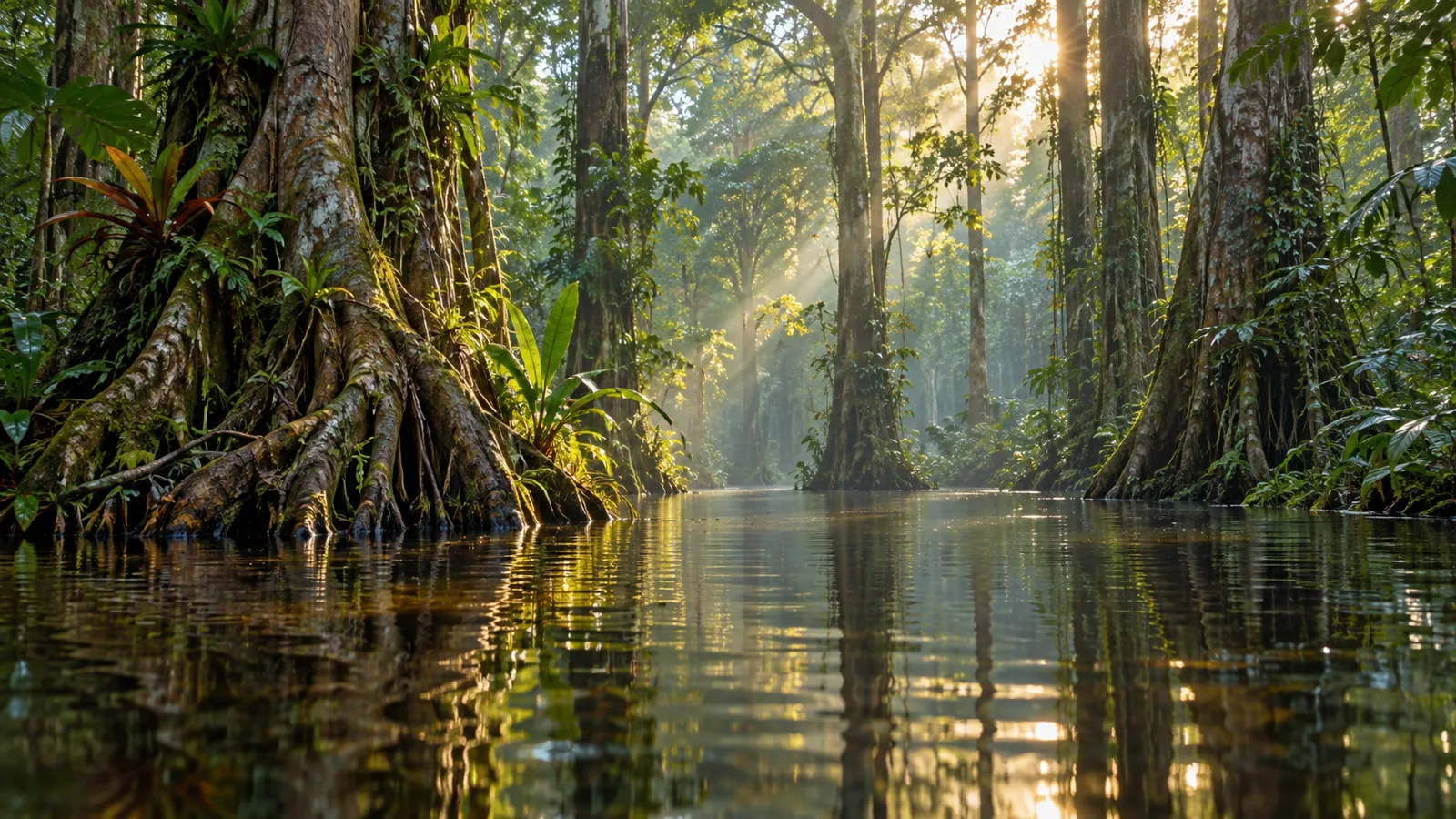
Q: What is várzea forest?
A: Seasonally flooded forest along sediment-rich Amazon rivers.
Q: What is igapó forest?
A: Forest seasonally flooded by dark or clear nutrient-poor water.
Q: Which large cat is the Amazon’s top feline predator?
A: The jaguar.
Q: Which Amazon mammal has a flexible snout and is an important seed disperser?
A: The South American tapir.
Q: Which aquatic mammal in the Amazon is also called the boto?
A: The Amazon river dolphin.
Q: Which enormous snake lives in Amazon wetlands and slow waterways?
A: The green anaconda.
Q: Which fish is famous for its powerful electrical discharge in Amazon waterways?
A: The electric eel.
Q: Which large Amazon fish can breathe air using a modified swim bladder?
A: The arapaima.
Q: Which tiny frogs are known for skin toxins and brilliant warning colors?
A: Poison dart frogs.
Q: Which slow-moving canopy mammal grows algae in its fur?
A: The sloth.
Q: Which primate is the world’s smallest monkey by body size?
A: The pygmy marmoset.
Q: Which Amazon bird has a huge colorful bill?
A: The toucan.
Q: Which eagle is one of the Amazon canopy’s most powerful predators?
A: The harpy eagle.
Q: What is terra firme forest?
A: Amazon forest on ground that normally does not flood.
Q: Which nut harvested from wild Amazon trees grows in large woody capsules?
A: The Brazil nut.
Q: What animal is a crucial pollinator of Brazil nut flowers?
A: Large female orchid bees.
Q: Which famous cultivated product originated in tropical South America and comes from cacao seeds?
A: Chocolate.
Q: Which rubber-producing tree is native to the Amazon?
A: Hevea brasiliensis.
Q: Which Indigenous-managed dark soil is called terra preta?
A: Human-enriched Amazonian soil containing charcoal and organic matter.
Q: Which Central American country is famous for Monteverde Cloud Forest?
A: Costa Rica.
Q: Which brightly colored bird inhabits Central American cloud forests?
A: The resplendent quetzal.
Q: Which temperate rainforest stretches along the Pacific coast from Alaska into northern California?
A: The Pacific temperate rainforest.
The Congo Basin and African Rainforests
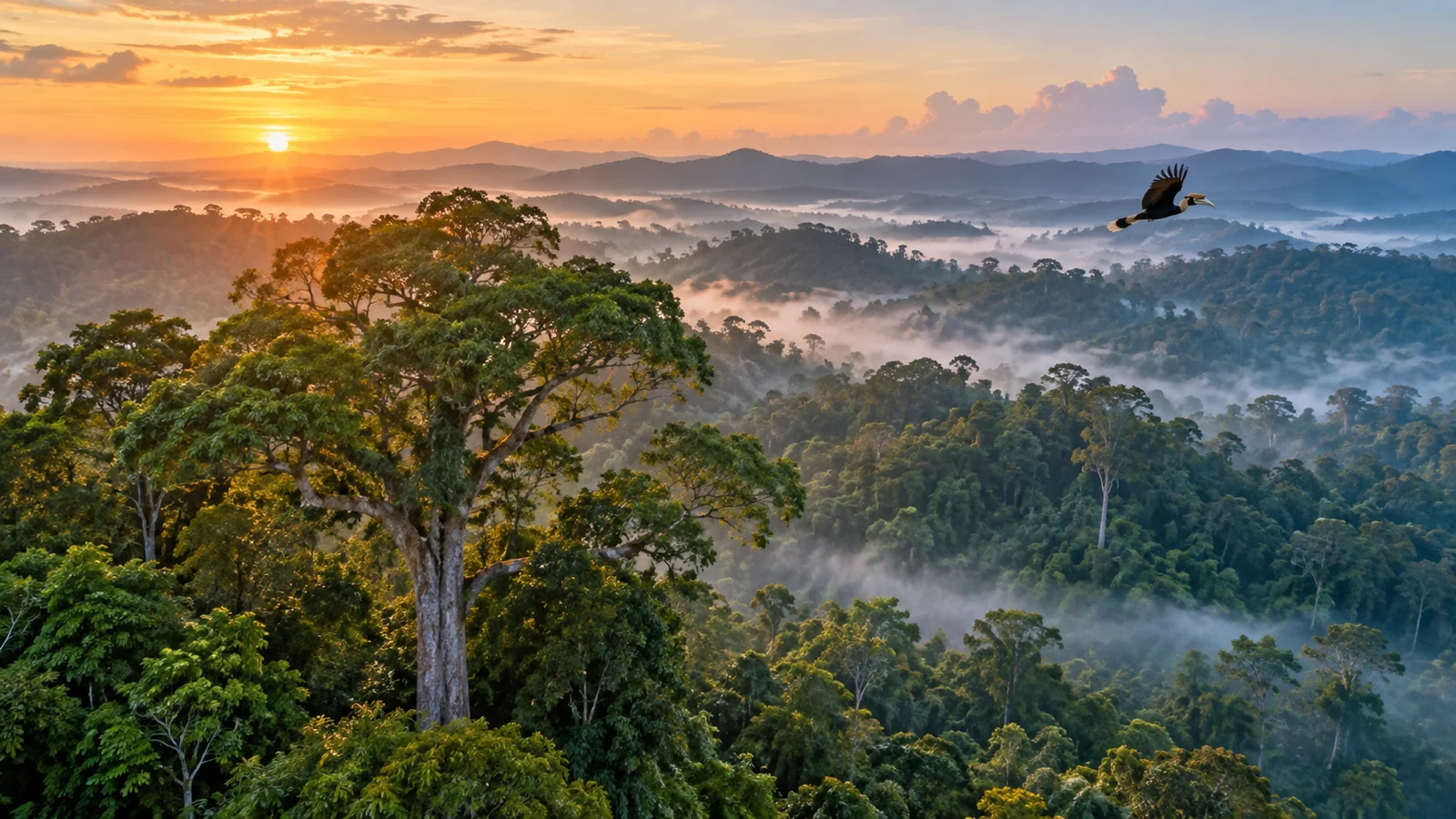
Central Africa’s rainforest holds giant rivers, mineral-rich clearings, forest elephants, and primates found nowhere else. It is also a place where political borders look especially flimsy beside a continuous living system.
Q: Which rainforest region is the world’s second largest tropical forest?
A: The Congo Basin rainforest.
Q: Which continent contains the Congo Basin?
A: Africa.
Q: Which river drains most of the Congo Basin?
A: The Congo River.
Q: Which river crosses the equator twice?
A: The Congo River.
Q: Which country contains the largest share of the Congo rainforest?
A: The Democratic Republic of the Congo.
Q: Which six countries are commonly included in the core Congo Basin rainforest region?
A: Cameroon, Central African Republic, Democratic Republic of the Congo, Republic of the Congo, Equatorial Guinea, and Gabon.
Q: Which great ape lives only in forests south of the Congo River?
A: The bonobo.
Q: Which river separates the wild ranges of bonobos and common chimpanzees?
A: The Congo River.
Q: Which great ape includes eastern and western species in Central African forests?
A: The gorilla.
Q: Which gorilla subspecies lives in the Virunga Mountains?
A: The mountain gorilla.
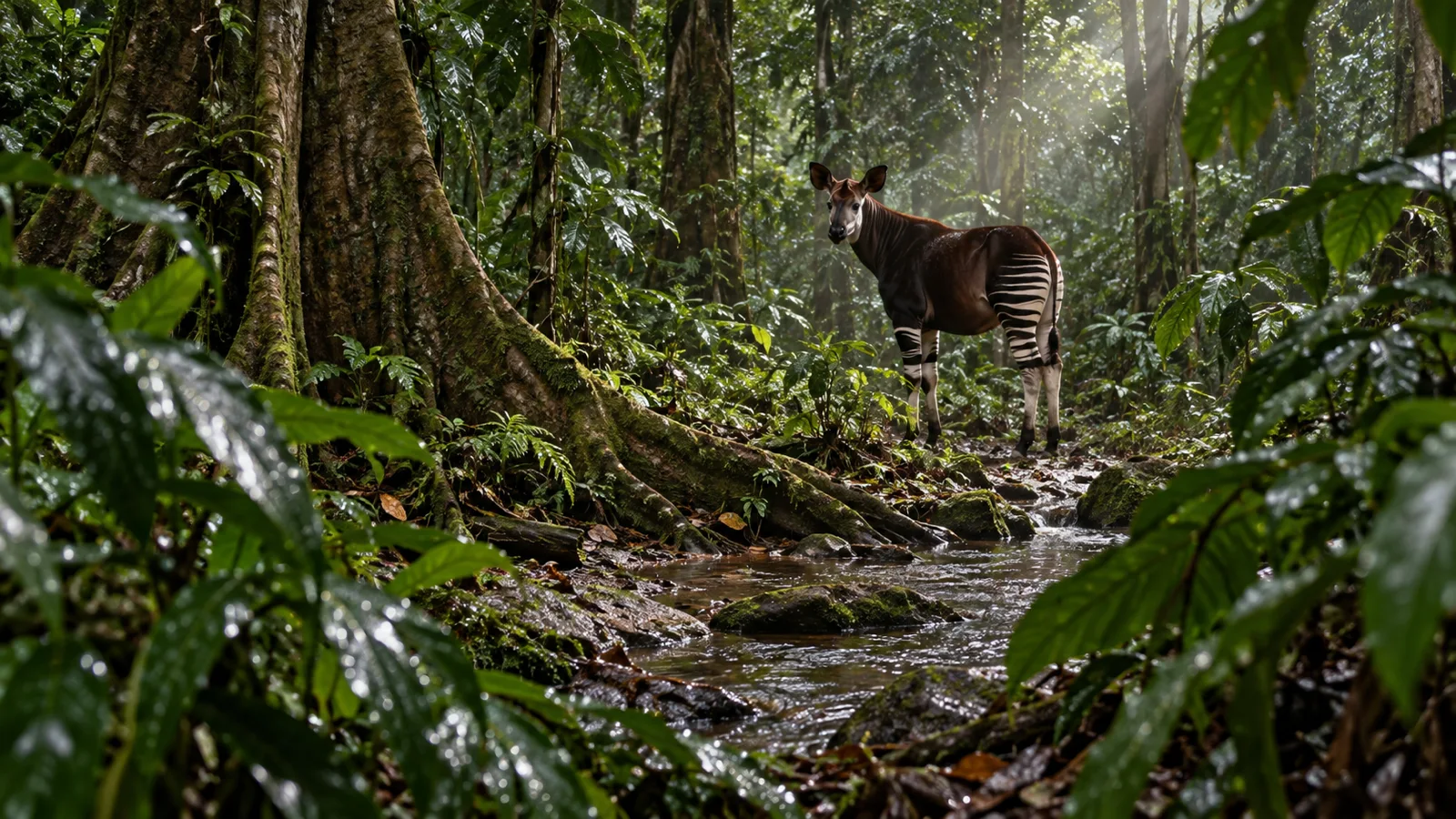
Q: Which striped relative of the giraffe lives in the Ituri rainforest?
A: The okapi.
Q: Which country is the okapi’s native home?
A: The Democratic Republic of the Congo.
Q: Which smaller elephant species lives in Central and West African forests?
A: The African forest elephant.
Q: How do forest elephants help rainforest plants?
A: They disperse seeds and create paths and clearings.
Q: Which scaly mammal threatened by illegal trade lives in African rainforests?
A: The pangolin.
Q: Which colorful primate has a red-and-blue face and lives in Central African forests?
A: The mandrill.
Q: Which nocturnal mainland African primates have large eyes and strong gripping hands?
A: Galagos and pottos.
Q: Which small nocturnal primates are often called bush babies?
A: Galagos.
Q: What is a bai in Central African rainforest geography?
A: A natural forest clearing, often wet and rich in minerals.
Q: Why do animals gather at mineral-rich forest clearings?
A: They seek salts, water, food, and social contact.
Q: Which national park in the Republic of the Congo is known for forest clearings and gorillas?
A: Odzala-Kokoua National Park.
Q: Which tri-national protected forest spans Cameroon, Central African Republic, and the Republic of the Congo?
A: The Sangha Trinational.
Q: Which Gabonese national park is famous for forest elephants visiting Atlantic beaches?
A: Loango National Park.
Q: Which African island supports rainforests rich in lemurs?
A: Madagascar.
Q: Why are Madagascar’s lemurs especially vulnerable?
A: They are endemic and depend on shrinking, fragmented habitats.
Q: Which Madagascar rainforest animal is the island’s largest native predator?
A: The fossa.
Q: Which West African rainforest lies across countries bordering the Gulf of Guinea?
A: The Upper Guinean forest region.
Q: Which crop expansion has contributed to forest loss in parts of West Africa?
A: Cocoa farming.
Q: What traditional shifting-farming system can be sustainable at low population density with long fallow periods?
A: Swidden agriculture.
Q: How do Congo Basin peatlands affect the climate?
A: They store enormous amounts of carbon in waterlogged soil.
Rainforests of Asia, Australia, and the Pacific
This final canopy includes orangutans, tree kangaroos, hornbills, giant flowers, and one Australian forest older than many familiar landscapes. My field notebook is now damp, but the facts survived.
Q: Which island is shared by Indonesia, Malaysia, and Brunei and holds extensive rainforest?
A: Borneo.
Q: Which great ape lives naturally on Borneo and Sumatra?
A: The orangutan.
Q: What does the Malay and Indonesian name orangutan mean?
A: Person of the forest.
Q: Which island contains the only wild Sumatran orangutans?
A: Sumatra.
Q: Which critically endangered striped cat lives in Sumatran rainforest?
A: The Sumatran tiger.
Q: Which rhinoceros is the smallest living rhino species?
A: The Sumatran rhinoceros.
Q: Which large flower in Southeast Asian rainforest smells like rotting flesh?
A: Rafflesia arnoldii.
Q: Why does a rafflesia flower smell like carrion?
A: The odor attracts flies that pollinate it.
Q: Which tree family includes many of Southeast Asia’s tallest rainforest trees?
A: Dipterocarps.
Q: Which bird family is known for large bills and casque structures in Asian rainforests?
A: Hornbills.
Q: How do hornbills help rainforest trees?
A: They disperse seeds after eating fruit.
Q: Which palm oil crop is a major driver of forest conversion in parts of Southeast Asia?
A: Oil palm.
Q: Which island is divided between Indonesia and Papua New Guinea?
A: New Guinea.
Q: Which colorful birds are famous in New Guinea rainforests?
A: Birds-of-paradise.
Q: Which climbing marsupials live in New Guinea and northeastern Australian forests?
A: Tree kangaroos.
Q: Which flightless bird with a casque lives in New Guinea and Australian rainforest?
A: The cassowary.
Q: Why is the cassowary important to rainforest regeneration?
A: It swallows large fruits and disperses their seeds.
Q: Which Australian rainforest is one of the world’s oldest continuously surviving tropical forests?
A: The Daintree Rainforest.
Q: Which Australian state contains the Daintree?
A: Queensland.
Q: Which reef system lies offshore from the Daintree region?
A: The Great Barrier Reef.
Q: Which island country contains the Sinharaja Forest Reserve?
A: Sri Lanka.
Q: Which monkey with a purple face is endemic to Sri Lanka?
A: The purple-faced langur.
Q: Which Indian mountain chain contains biodiverse tropical forests and many endemic species?
A: The Western Ghats.
Q: Which mangrove forest spans India and Bangladesh?
A: The Sundarbans.
Q: Which large cat inhabits the Sundarbans?
A: The Bengal tiger.
Q: What tree adaptation helps many mangroves obtain oxygen from waterlogged mud?
A: Aerial roots such as pneumatophores.
Q: Which Japanese islands contain subtropical forest inhabited by the Iriomote cat?
A: The Yaeyama Islands, especially Iriomote Island.
Q: Which New Zealand forests are dominated in places by massive kauri trees?
A: The northern North Island’s temperate rainforests.
Q: Which Pacific island group contains tropical rainforest across Viti Levu and Vanua Levu?
A: Fiji.
Q: What global benefit comes from protecting rainforests beyond carbon storage?
A: It safeguards biodiversity, water cycles, soils, cultures, and livelihoods.
How Did You Score?
If you found the igapó, recognized an okapi, and knew why cassowaries matter to seeds, your rainforest score belongs in the canopy. Mine got distracted by rafflesia smelling like carrion, which is fair.

Ellie Simons creates and edits Random Trivia. She researches trivia using primary and authoritative sources whenever possible and is currently reviewing the site's older trivia library for accuracy, clarity, and playability. Read more on the About page.
About this quiz
Site editor: Ellie Simons. Read our Trivia Methodology to learn how questions are researched and updated. Page last updated: . Report an error.