
Unzip the double helix and try not to lose an allele. These 120 genetics trivia questions cover DNA, Mendel’s peas, inheritance, chromosomes, mutations, cell division, genetic history, and modern tools, with enough science to make my family tree feel seriously under-labeled.
Keep experimenting with our biology trivia, science trivia, and human body trivia.
DNA, Genes & Chromosome Basics
Genetics begins with a molecule that can fit inside a cell yet carries an astonishing amount of information. I cannot keep four grocery items in my head, so DNA’s filing system has my respect.
Q: What does DNA stand for?
A: Deoxyribonucleic acid.
Q: What is a gene?
A: A DNA sequence that contributes to a functional product, such as an RNA or protein.
Q: What is a genome?
A: The complete set of an organism’s genetic material.
Q: What shape is a DNA molecule famous for?
A: A double helix.
Q: Which four chemical bases occur in DNA?
A: Adenine, thymine, cytosine, and guanine.
Q: Which DNA bases pair with each other?
A: Adenine pairs with thymine, while cytosine pairs with guanine.
Q: What type of bond holds paired DNA bases together?
A: Hydrogen bonds.
Q: What forms the sides of the DNA double helix?
A: Alternating sugar and phosphate groups.
Q: Which sugar occurs in DNA?
A: Deoxyribose.
Q: What is a nucleotide?
A: A base, a five-carbon sugar, and a phosphate group joined together.
Q: Where is most DNA stored in a human cell?
A: Inside the nucleus.
Q: Which cell structures contain a small separate genome?
A: Mitochondria.
Q: What is a chromosome?
A: A packaged DNA molecule associated with proteins.
Q: Which proteins help package DNA into chromosomes?
A: Histones.
Q: How many chromosomes occur in a typical human body cell?
A: Forty-six chromosomes arranged in 23 pairs.
Q: How many chromosomes occur in a typical human egg or sperm cell?
A: Twenty-three.
Q: What are autosomes?
A: Chromosomes other than the sex chromosomes.
Q: How many pairs of autosomes do typical human cells contain?
A: Twenty-two pairs.
Q: What name describes the constricted chromosome region important during cell division?
A: The centromere.
Q: What are telomeres?
A: Repetitive DNA sequences that protect the ends of linear chromosomes.
Q: What everyday object is commonly used to explain telomeres?
A: The protective plastic tip on a shoelace.
Q: What are sister chromatids?
A: Identical copies of a replicated chromosome joined at the centromere.
Q: What is chromatin?
A: DNA and associated proteins in a less condensed form within the nucleus.
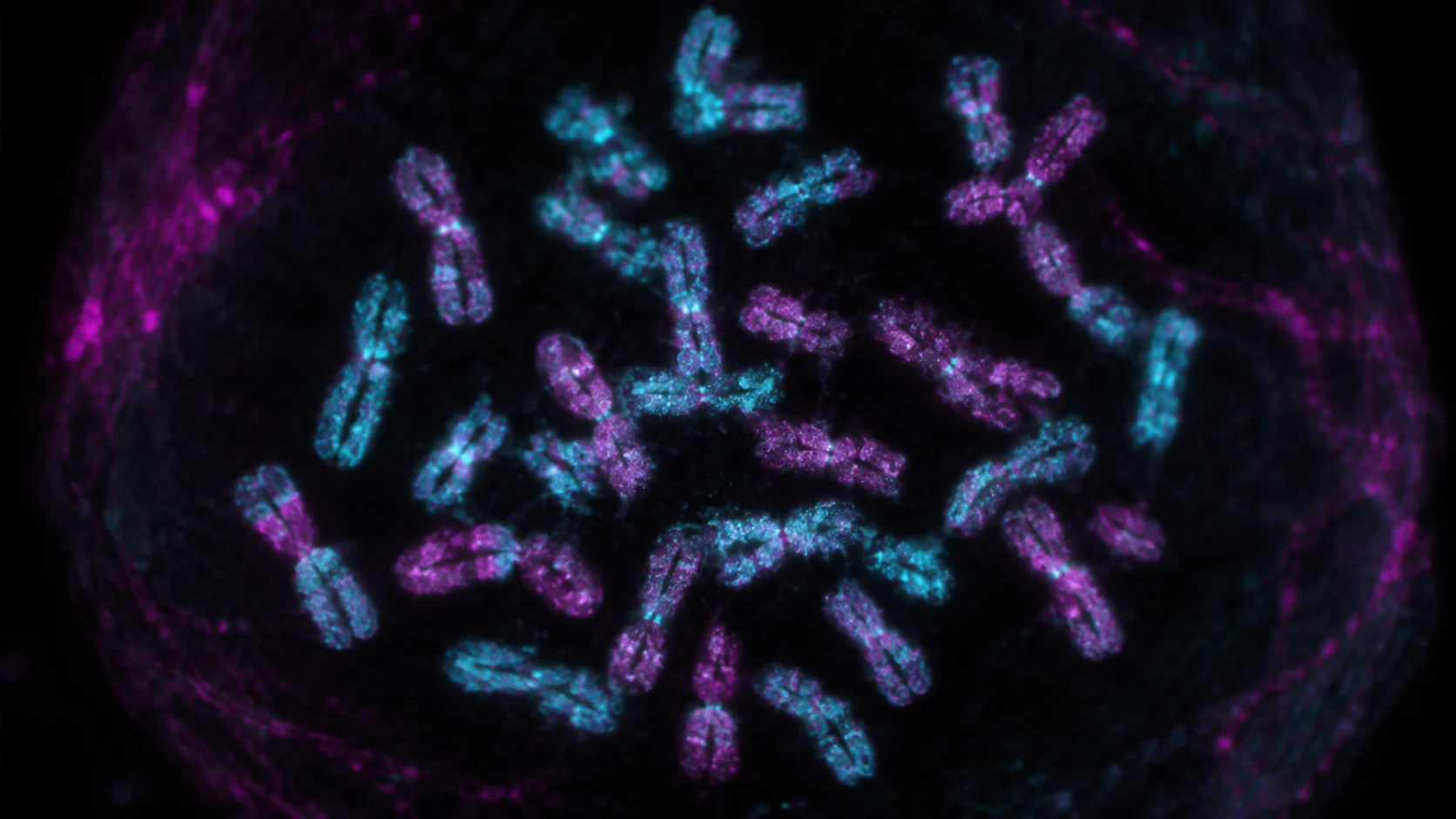
Q: What is a karyotype?
A: An organized image or display of an individual’s chromosomes.
Q: What does diploid mean?
A: Having two sets of chromosomes.
Q: What does haploid mean?
A: Having one set of chromosomes.
Q: Which human cells are normally haploid?
A: Egg and sperm cells.
Q: What is a locus?
A: A specific physical location on a chromosome.
Q: What is an allele?
A: One of two or more versions of a DNA sequence at a locus.
Q: Why are genes not the only DNA that matters?
A: Regulatory and other noncoding sequences help control when and how genes function.
Mendel, Inheritance & Family Traits
Inheritance is more complicated than the tidy pea-plant charts suggest, but Mendel gave science a sturdy starting point. He also had the patience to count thousands of peas, and I complain after sorting socks.
Q: Who is commonly called the father of genetics?
A: Gregor Mendel.
Q: What type of plant did Mendel study?
A: Garden pea plants.
Q: Where did Mendel conduct his famous pea experiments?
A: At the monastery in Brno, in what is now the Czech Republic.
Q: Which visible pea trait included purple and white versions?
A: Flower color.
Q: What is a dominant allele?
A: An allele whose effect appears in a heterozygote under a simple dominant pattern.
Q: What is a recessive allele?
A: An allele masked in a heterozygote under complete dominance.
Q: What does homozygous mean?
A: Having two identical alleles at a locus.
Q: What does heterozygous mean?
A: Having two different alleles at a locus.
Q: What is a genotype?
A: An organism’s genetic makeup at one or more loci.
Q: What is a phenotype?
A: An observable trait produced through genotype and environmental influences.
Q: What does Mendel’s law of segregation describe?
A: Two alleles separate when gametes form, so each gamete receives one.
Q: What does independent assortment describe?
A: Alleles of different genes can segregate independently when the genes are unlinked.
Q: Why does genetic linkage limit independent assortment?
A: Nearby genes on the same chromosome tend to be inherited together.
Q: What is a Punnett square?
A: A grid used to predict possible offspring genotypes from a genetic cross.
Q: Who developed the Punnett square?
A: British geneticist Reginald Punnett.
Q: What is incomplete dominance?
A: A heterozygote has a phenotype intermediate between the two homozygotes.
Q: What flower example commonly demonstrates incomplete dominance?
A: Red and white snapdragons producing pink heterozygous flowers.
Q: What is codominance?
A: Both alleles contribute distinctly to the heterozygous phenotype.
Q: Which human blood type demonstrates codominance?
A: AB blood, in which A and B antigens are both expressed.
Q: Which alleles form the ABO blood-group system?
A: I-A, I-B, and i.
Q: What is a polygenic trait?
A: A trait influenced by variants in many genes.
Q: Which human characteristic is strongly polygenic?
A: Height, although environment also affects it.
Q: What is pleiotropy?
A: One gene influencing multiple traits.
Q: What is epistasis?
A: One gene altering or masking the phenotypic effect of another gene.
Q: What is a pedigree in genetics?
A: A family diagram showing how a trait appears across generations.
Q: What shape usually represents a male in a traditional pedigree?
A: A square.
Q: What shape usually represents a female in a traditional pedigree?
A: A circle.
Q: What is a carrier in recessive inheritance?
A: A heterozygous person who carries a variant without showing the full recessive trait.
Q: How is mitochondrial DNA usually inherited in humans?
A: Through the egg from the mother.
Q: Why do identical twins sometimes develop different traits?
A: Environment, life experiences, random development, and epigenetic differences can diverge.
Replication, Gene Expression & Cell Division
Cells copy DNA with molecular proofreading that is good but not flawless. That tiny gap between excellent and perfect is where variation, disease, evolution, and a lot of genetics trivia enter the room.
Q: What is DNA replication?
A: The process of copying DNA before a cell divides.
Q: What does semiconservative replication mean?
A: Each new DNA molecule contains one old strand and one newly made strand.
Q: Which enzyme separates DNA strands during replication?
A: Helicase.
Q: Which enzyme builds a new DNA strand?
A: DNA polymerase.
Q: Which direction does DNA polymerase use to synthesize DNA?
A: From the 5-prime end toward the 3-prime end.
Q: What are Okazaki fragments?
A: Short DNA pieces made discontinuously on the lagging strand.
Q: Which enzyme joins Okazaki fragments?
A: DNA ligase.
Q: What is transcription?
A: The production of RNA from a DNA template.
Q: Which enzyme performs transcription?
A: RNA polymerase.
Q: What does RNA stand for?
A: Ribonucleic acid.
Q: Which base replaces thymine in RNA?
A: Uracil.
Q: Which sugar occurs in RNA?
A: Ribose.
Q: What is messenger RNA?
A: RNA that carries coding information from DNA to a ribosome.
Q: What is translation?
A: The process of building a polypeptide using an mRNA sequence.
Q: Where does translation occur?
A: At ribosomes in the cytoplasm or on rough endoplasmic reticulum.
Q: What is a codon?
A: A three-nucleotide mRNA sequence that specifies an amino acid or stop signal.
Q: Which codon usually starts translation?
A: AUG.
Q: Which amino acid does AUG encode?
A: Methionine.
Q: What is transfer RNA?
A: RNA that carries an amino acid and matches its anticodon to an mRNA codon.
Q: What is an anticodon?
A: A three-base tRNA sequence complementary to an mRNA codon.
Q: What is a mutation?
A: A change in a DNA sequence.
Q: What is a point mutation?
A: A change affecting a single nucleotide position.
Q: What is a frameshift mutation?
A: An insertion or deletion that shifts a coding sequence’s reading frame.
Q: What is a silent mutation?
A: A DNA change that does not alter the encoded amino acid.
Q: What is a missense mutation?
A: A DNA change that substitutes one amino acid for another.
Q: What is a nonsense mutation?
A: A DNA change that creates a premature stop codon.
Q: What is mitosis?
A: Nuclear division that generally produces genetically similar daughter nuclei.
Q: What is meiosis?
A: A two-stage cell division that produces haploid reproductive cells.
Q: What is crossing over?
A: The exchange of DNA between homologous chromosomes during meiosis.
Q: Why is crossing over important?
A: It creates new allele combinations and increases genetic variation.
Genetics History, Genomes & Modern Technology
Modern genetics moves from pea gardens to machines that read billions of DNA letters. The technology is dazzling, but the most useful question is still the plain one: what does the evidence actually show?
Q: Who first isolated a substance later recognized as DNA?
A: Friedrich Miescher in 1869.
Q: What name did Miescher give the material he isolated?
A: Nuclein.
Q: Who demonstrated that bacterial traits could be transformed by a heritable substance?
A: Frederick Griffith.
Q: Which researchers showed that DNA was the transforming principle?
A: Oswald Avery, Colin MacLeod, and Maclyn McCarty.
Q: What did the Hershey-Chase experiment support?
A: DNA, rather than protein, carries bacteriophage genetic information.
Q: Who produced the X-ray diffraction image known as Photo 51?
A: Raymond Gosling under Rosalind Franklin’s supervision.
Q: Which scientists produced crucial X-ray evidence about DNA structure?
A: Rosalind Franklin, Maurice Wilkins, Raymond Gosling, and their colleagues.
Q: Who proposed the famous double-helix model in 1953?
A: James Watson and Francis Crick.
Q: Which base-pair relationships are called Chargaff’s rules?
A: Adenine roughly equals thymine, and guanine roughly equals cytosine in double-stranded DNA.
Q: Who discovered the base-composition relationships called Chargaff’s rules?
A: Erwin Chargaff.
Q: Which scientist linked chromosomes with inheritance through fruit-fly experiments?
A: Thomas Hunt Morgan.
Q: What insect did Morgan’s laboratory study?
A: The fruit fly Drosophila melanogaster.
Q: What unusual fruit-fly trait helped Morgan study sex linkage?
A: White eyes.
Q: Who discovered transposable elements through corn research?
A: Barbara McClintock.
Q: What nickname is often given to transposable elements?
A: Jumping genes.
Q: What is DNA sequencing?
A: Determining the order of nucleotides in a DNA molecule.
Q: Who developed an influential chain-termination sequencing method?
A: Frederick Sanger.
Q: What laboratory method amplifies a chosen DNA segment?
A: Polymerase chain reaction, or PCR.
Q: Who developed PCR in the 1980s?
A: Kary Mullis.
Q: What does CRISPR stand for?
A: Clustered regularly interspaced short palindromic repeats.
Q: Which enzyme is widely used with CRISPR for targeted DNA cutting?
A: Cas9.
Q: Where did CRISPR systems originate?
A: As adaptive immune systems in bacteria and archaea.
Q: What was the Human Genome Project?
A: An international effort to sequence and map a reference human genome.
Q: When did the Human Genome Project formally begin?
A: 1990.
Q: When was the Human Genome Project declared complete?
A: 2003.
Q: What does genetic testing examine?
A: Chromosomes, DNA, RNA, proteins, or metabolites for medically relevant information.
Q: What is gene therapy?
A: Treating or preventing disease by adding, removing, or changing genetic material in cells.
Q: What is pharmacogenomics?
A: Studying how genetic variation affects medication response.
Q: What is epigenetics?
A: The study of heritable or persistent changes in gene regulation without changing DNA sequence.
Q: Why does genetic ancestry estimate a probability rather than a perfect identity?
A: It compares selected DNA variants with changing reference populations and statistical models.
How Did You Score?
If centromeres, Mendel’s segregation, codons, Okazaki fragments, Photo 51, jumping genes, PCR, and CRISPR all lined up correctly, your genetics score is beautifully expressed. I lost one allele somewhere in meiosis, but I am confident the Punnett square will help me file a report.

Ellie Simons creates and edits Random Trivia. She researches trivia using primary and authoritative sources whenever possible and is currently reviewing the site's older trivia library for accuracy, clarity, and playability. Read more on the About page.
About this quiz
Site editor: Ellie Simons. Read our Trivia Methodology to learn how questions are researched and updated. Page last updated: . Report an error.