
Six legs, 120 questions, zero need for bug spray. This insect trivia round covers anatomy, metamorphosis, butterflies, moths, bees, ants, beetles, dragonflies, mosquitoes, camouflage, colonies, pollination, communication, record holders, and the tiny animals that dominate terrestrial biodiversity while quietly keeping ecosystems running.
Insect Basics & Anatomy
Q: How many legs does an adult insect have?
A: Six.
Q: How many main body regions does an insect have?
A: Three: head, thorax, and abdomen.
Q: Where are an insect's legs attached?
A: The thorax.
Q: Where are an insect's wings attached?
A: The thorax.
Q: What hard outer covering supports an insect's body?
A: An exoskeleton.
Q: What material is a major component of insect exoskeletons?
A: Chitin.
Q: What is molting in insects?
A: Shedding the old exoskeleton so the animal can grow.
Q: What is an antenna used for?
A: Sensing chemicals, touch, air movement, humidity, and other environmental information.
Q: How many antennae do insects have?
A: Two.
Q: What type of eye is common in adult insects?
A: Compound eyes made of many visual units.
Q: What are ocelli?
A: Simple eyes that often help insects detect light intensity and orientation.
Q: Do insects have lungs like humans?
A: No.
Q: What tube system carries air through an insect's body?
A: The tracheal system.
Q: What external openings connect many insects to their tracheal system?
A: Spiracles.
Q: What fluid circulates through an insect's body?
A: Hemolymph.
Q: Does insect hemolymph usually carry most of the animal's oxygen?
A: No. The tracheal system delivers oxygen directly to tissues in most insects.
Q: Are spiders insects?
A: No. Spiders are arachnids with eight legs and two main body regions.
Q: Are centipedes insects?
A: No. They are myriapods.
Q: What animal phylum contains insects, spiders, crustaceans, and their relatives?
A: Arthropoda.
Q: What does “arthropod” refer to?
A: Jointed appendages, one of the group's defining features.
Q: What is complete metamorphosis?
A: Development through egg, larva, pupa, and adult stages.
Q: What is incomplete metamorphosis?
A: Development through egg, nymph, and adult without a pupal stage.
Q: What is a larva?
A: An immature feeding stage that can look very different from the adult.
Q: What is a pupa?
A: A developmental stage in which a completely metamorphosing insect transforms toward adulthood.
Q: What is a nymph?
A: An immature insect that generally resembles a smaller, undeveloped adult.
Q: Do all insects have wings?
A: No. Some groups are naturally wingless, and some castes or life stages lack wings.
Q: How many pairs of wings do many flying insects have?
A: Two pairs, although some groups have one functional pair or modified wings.
Q: What insect order has only one functional pair of wings?
A: Diptera, the true flies.
Q: What are halteres?
A: Modified hindwings in flies that act as gyroscopic balance organs.
Q: What field of science studies insects?
A: Entomology.
Butterflies, Moths, Bees & Pollination
Q: What order contains butterflies and moths?
A: Lepidoptera.
Q: What covers butterfly and moth wings?
A: Thousands of tiny scales.
Q: What is a caterpillar?
A: The larval stage of a butterfly or moth.
Q: What is a chrysalis?
A: The pupa of a butterfly.
Q: Is every moth pupa enclosed in a silk cocoon?
A: No. Some moths spin cocoons, while others pupate in soil, leaves, or other shelters.
Q: What butterfly is famous for long-distance migration across North America?
A: The monarch butterfly.
Q: What plant do monarch caterpillars depend on?
A: Milkweed.
Q: Why can monarchs be distasteful to many predators?
A: Caterpillars obtain defensive cardenolide chemicals from milkweed.
Q: Does one individual monarch complete the entire round-trip migration?
A: No. The annual cycle spans multiple generations, with one long-lived generation making the southward journey.
Q: What is the main difference between a butterfly and a moth?
A: There is no single perfect rule; antennae, resting posture, activity time, and pupation often differ but have exceptions.
Q: What insect group includes bees, ants, and wasps?
A: Hymenoptera.
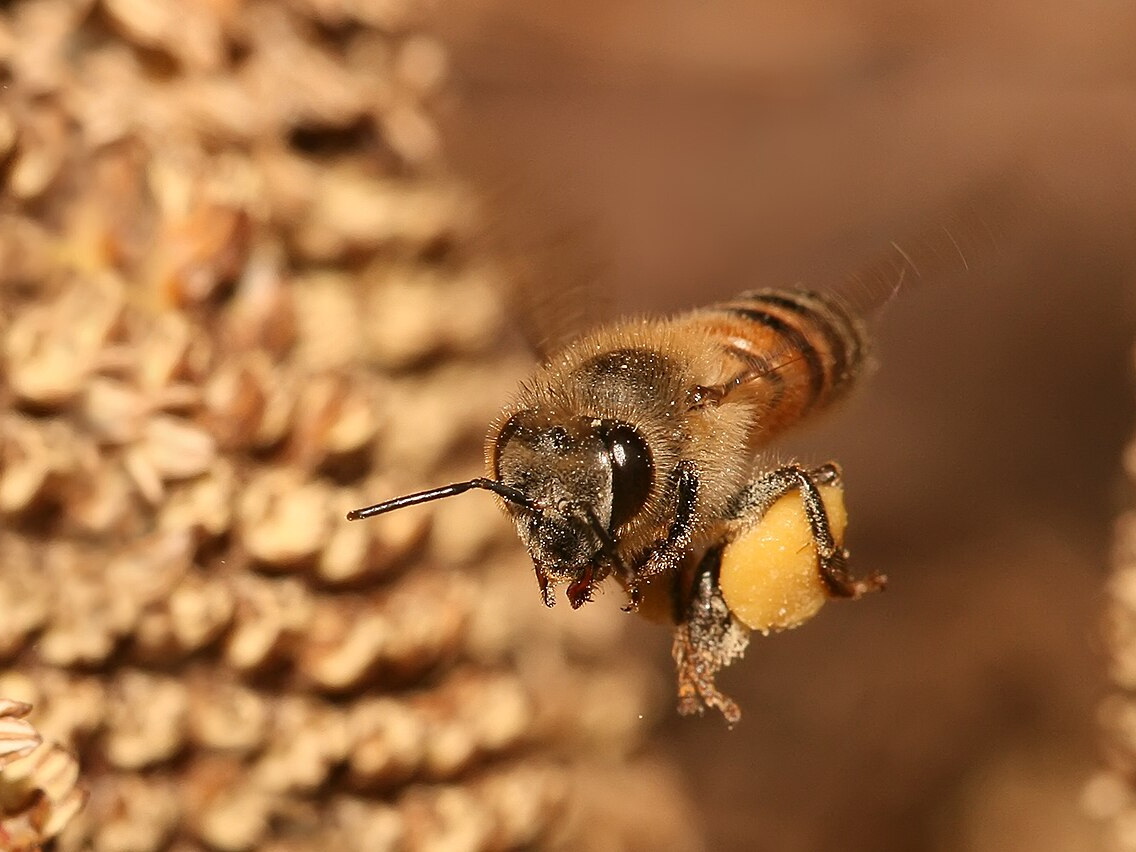
Q: What do bees collect from flowers as a protein-rich food source?
A: Pollen.
Q: What sugary liquid do many bees collect from flowers?
A: Nectar.
Q: What is pollination?
A: Transfer of pollen that allows seed plants to reproduce.
Q: Are honey bees the only important pollinating insects?
A: No. Native bees, flies, beetles, butterflies, moths, and wasps also pollinate plants.
Q: What species is the western honey bee?
A: Apis mellifera.
Q: What is a worker honey bee?
A: A non-reproductive female that performs most colony tasks.
Q: What is a drone honey bee?
A: A male whose primary reproductive role is mating with a queen.
Q: What is the queen's main role in a honey bee colony?
A: Laying eggs and producing chemical signals that influence colony organization.
Q: What is royal jelly?
A: A nutrient-rich secretion fed to bee larvae, with queen-destined larvae receiving it in a distinctive developmental program.
Q: What dance helps honey bees communicate food location?
A: The waggle dance.
Q: What information can the waggle dance convey?
A: Direction and approximate distance to a resource.
Q: Do bumble bees make large stores of honey like managed honey bees?
A: No. They make smaller nectar stores and usually have much smaller colonies.
Q: What is buzz pollination?
A: Vibrating a flower to shake loose pollen.
Q: What familiar crops benefit from buzz-pollinating bees?
A: Tomatoes, blueberries, peppers, and several other plants.
Q: Can honey bees perform buzz pollination?
A: No. Bumble bees and some solitary bees can, but honey bees do not.
Q: Why can a honey bee worker sting be fatal to the bee?
A: Its barbed stinger can lodge in elastic skin and tear away abdominal tissue as the bee departs.
Q: Can a honey bee queen sting more than once?
A: Yes. Her stinger is smoother and is mainly used against rival queens.
Q: What is a solitary bee?
A: A bee in which individual females generally build and provision their own nests rather than living in large worker colonies.
Q: Are most bee species highly social honey-producing bees?
A: No. Most bee species are solitary or have much simpler social systems.
Ants, Beetles, Dragonflies & Other Insects
Q: Are ants social insects?
A: Yes. All living ant species form colonies with cooperative social organization.
Q: What is an ant queen's main reproductive role?
A: Laying eggs for the colony.
Q: What sex are most worker ants?
A: Female.
Q: How do ants commonly communicate trails?
A: With chemical signals called pheromones.
Q: What are leafcutter ants actually farming?
A: Fungus grown on processed plant material.
Q: Do leafcutter ants eat the leaves directly as their main food?
A: No. The leaves primarily feed their cultivated fungus.
Q: What are army ants known for?
A: Large coordinated raids and highly mobile colony behavior in many species.
Q: What insect order contains beetles?
A: Coleoptera.
Q: What does Coleoptera refer to?
A: The hardened forewings that cover and protect the flight wings.
Q: What are a beetle's hardened forewings called?
A: Elytra.
Q: Which insect order contains more described species than any other?
A: Coleoptera, the beetles.
Q: Is a ladybug actually a beetle?
A: Yes. Ladybugs, or ladybirds, are beetles in the family Coccinellidae.
Q: Why are many lady beetles helpful in gardens?
A: Many species eat aphids and other plant pests.
Q: What beetles are famous for rolling balls of animal dung?
A: Dung beetles.
Q: What celestial cue can some dung beetles use for navigation?
A: The pattern of the Milky Way and polarized skylight cues.
Q: What beetles produce flashing light signals?
A: Fireflies, which are beetles rather than true flies.
Q: What produces a firefly's light?
A: A highly efficient bioluminescent chemical reaction involving luciferin and luciferase.
Q: Why do many adult fireflies flash?
A: To communicate during courtship, with patterns often differing by species.
Q: What insect order contains dragonflies and damselflies?
A: Odonata.
Q: Where do young dragonflies usually live?
A: In freshwater as aquatic nymphs.
Q: Are dragonflies predators?
A: Yes. Both nymphs and adults hunt other animals.
Q: What makes dragonflies exceptionally agile fliers?
A: Their two wing pairs can be controlled with substantial independence.
Q: What insect is famous for folded grasping front legs and a prayer-like posture?
A: The praying mantis.
Q: Are praying mantises herbivores?
A: No. They are predators.
Q: What insects make the loud summer sounds produced by vibrating membranes called tymbals?
A: Male cicadas.
Q: What are periodical cicadas famous for?
A: Some populations emerge synchronously after 13 or 17 years underground.
Q: What is a true bug in scientific classification?
A: An insect in the order Hemiptera, generally with piercing-sucking mouthparts.
Q: Are all insects casually called “bugs” true bugs?
A: No. Scientifically, “true bug” has a narrower meaning.
Q: What insect order includes grasshoppers, crickets, and katydids?
A: Orthoptera.
Q: How do many crickets make their chirping sounds?
A: By rubbing specialized parts of their forewings together, a process called stridulation.
Mosquitoes, Camouflage, Records & Ecology
Q: In mosquito species that blood-feed, which sex typically takes blood meals?
A: Females.
Q: What do male mosquitoes generally feed on?
A: Nectar and other plant sugars.
Q: Why are mosquitoes medically important?
A: Some species transmit pathogens that cause serious human and animal diseases.
Q: What causes malaria?
A: Plasmodium parasites transmitted to humans by infected Anopheles mosquitoes.
Q: What is a disease vector?
A: An organism that transmits a pathogen from one host to another.
Q: What mosquito genus includes important vectors of dengue, yellow fever, Zika, and chikungunya viruses?
A: Aedes.
Q: Can flies be useful pollinators?
A: Yes. Hoverflies and many other flies pollinate wild plants and crops.
Q: Why are fly larvae important decomposers?
A: Many maggots consume decaying organic material and help recycle nutrients.
Q: What is mimicry?
A: Evolving a resemblance to another organism or signal that provides an advantage.
Q: What is Batesian mimicry?
A: A relatively harmless species resembling a harmful or unpalatable one.
Q: What insects are masters of twig-like camouflage?
A: Stick insects, or phasmids.
Q: What insects can resemble leaves in shape, color, and even apparent leaf damage?
A: Leaf insects.
Q: What is aposematic coloration?
A: Warning coloration that advertises toxicity, danger, or unpalatability.
Q: What beetle famously sprays a hot defensive chemical mixture?
A: The bombardier beetle.
Q: Why are stink bugs called stink bugs?
A: Many release strong-smelling defensive chemicals from scent glands.
Q: What insect group are termites now classified within?
A: Blattodea, the same order that includes cockroaches.
Q: Are termites social insects?
A: Yes. Colonies include reproductive and worker or soldier castes.
Q: Can termite queens live for many years?
A: Yes. Queens of some species are exceptionally long-lived for insects.
Q: What is an ootheca?
A: An egg case produced by cockroaches and some other insects.
Q: What ancient-looking household insect is wingless and covered in silvery scales?
A: The silverfish.
Q: What insect order is famous for adults that may live only briefly while aquatic juveniles live much longer?
A: Mayflies, order Ephemeroptera.
Q: Why are aquatic insect communities useful to scientists?
A: Their presence or absence can help indicate water quality and ecosystem condition.
Q: What insects include some of the longest-bodied living species?
A: Stick insects.
Q: What male beetle is famous for an enormous horn-like structure used in contests?
A: The Hercules beetle.
Q: Why are insects considered extraordinarily diverse?
A: They include more described species than any other class of animals.
Q: How do insects help decomposition?
A: Many species break down dead plants, animals, dung, and other organic matter.
Q: What is biological control?
A: Using natural enemies such as predators or parasitoids to reduce pest populations.
Q: Why are insect declines concerning?
A: Insects support pollination, food webs, nutrient cycling, soil processes, and many other ecosystem functions.
Q: Why can broad-spectrum pesticides harm beneficial insects?
A: They may kill non-target pollinators, predators, and other species along with pests.
Q: How can ordinary people contribute useful insect observations?
A: Citizen-science platforms such as iNaturalist can document species, locations, and seasonal activity.
How Did You Score?
If you knew your halteres from your elytra, your waggle dance from your stridulation, and your phasmids from your fireflies, you earned your entomology wings.

Ellie Simons creates and edits Random Trivia. She researches trivia using primary and authoritative sources whenever possible and is currently reviewing the site's older trivia library for accuracy, clarity, and playability. Read more on the About page.
Explore more questions in our animals trivia guide.
About this quiz
Site editor: Ellie Simons. Read our Trivia Methodology to learn how questions are researched and updated. Page last updated: . Report an error.