
Scale up your trivia game. These 120 reptile questions cover snakes, lizards, turtles, tortoises, crocodilians, scales, venom, eggs, thermoregulation, record holders, ancient lineages, bizarre defenses, parental care, and the animals that prove “cold-blooded” does not mean slow, simple, or boring.
Reptile Basics, Scales & Thermoregulation
Q: What major living groups are commonly included among reptiles?
A: Turtles, crocodilians, lizards, snakes, tuatara, and their relatives.
Q: Are reptiles vertebrates?
A: Yes. They have backbones.
Q: What does ectothermic mean?
A: An animal relies heavily on external heat sources to regulate body temperature.
Q: Is “cold-blooded” a perfect description of reptile body temperature?
A: No. Many reptiles can become quite warm by basking and behaviorally regulating temperature.
Q: Why do reptiles bask?
A: To raise body temperature for movement, digestion, and other physiological functions.
Q: Why might a reptile retreat into shade or a burrow?
A: To avoid overheating and conserve moisture.
Q: What protein is prominent in reptile scales?
A: Keratin.
Q: Do reptile scales grow by simply stretching forever?
A: No. Reptiles periodically replace outer skin layers as they grow.
Q: What is ecdysis?
A: Shedding the outer skin.
Q: Do all reptiles shed their skin in one complete piece?
A: No. Snakes often do, while many lizards shed in patches.
Q: What is an amniotic egg?
A: An egg with membranes that support embryo development on land.
Q: Do all reptiles lay eggs?
A: No. Some species give birth to live young.
Q: What is oviparity?
A: Reproduction by laying eggs.
Q: What is viviparity?
A: Giving birth to live young that developed inside the parent.
Q: What organ do reptiles use to breathe?
A: Lungs.
Q: Do reptiles breathe through gills as adults?
A: No. Living reptiles breathe air with lungs.
Q: What is a cloaca?
A: A shared opening used by digestive, urinary, and reproductive systems.
Q: Are reptiles found naturally on Antarctica?
A: No native living reptiles occur there because the climate is too cold.
Q: What living reptile lineage is native only to New Zealand?
A: Tuatara.
Q: Are tuatara lizards?
A: No. They belong to a separate surviving reptile lineage, Rhynchocephalia.
Q: What is the parietal “third eye” associated with tuatara?
A: A light-sensitive structure on the top of the head, most visible in young animals.
Q: What is sexual dimorphism?
A: Physical differences between males and females of the same species beyond reproductive organs.
Q: Can incubation temperature influence sex in some reptiles?
A: Yes. Temperature-dependent sex determination occurs in many turtles and crocodilians.
Q: Do reptiles generally chew food like humans?
A: Many do little chewing, though feeding mechanics vary greatly among groups.
Q: What is brumation?
A: A cold-season period of reduced activity and metabolism in many reptiles.
Q: Is brumation identical to mammalian hibernation?
A: No. The physiology and patterns differ, and reptiles may become active during warmer intervals.
Q: What does arboreal mean?
A: Adapted for living mainly in trees.
Q: What does fossorial mean?
A: Adapted for digging or living underground.
Q: What does semi-aquatic mean?
A: Spending substantial time both in water and on land.
Q: What science specializes in reptiles and amphibians?
A: Herpetology.
Snakes, Venom & Serpent Adaptations
Q: Do snakes have legs?
A: Modern snakes lack functional walking limbs, although some retain tiny internal or external vestiges.
Q: What snakes have small pelvic spurs near the cloaca?
A: Boas and pythons are well-known examples.
Q: How do snakes smell chemical traces with their tongues?
A: The forked tongue collects particles and delivers them to the vomeronasal, or Jacobson's, organ.
Q: Why is a snake's tongue forked?
A: It can sample chemical information from two directions and help track odor gradients.
Q: Do snakes dislocate their jaws to swallow large prey?
A: No. Their skull bones and jaw joints are highly mobile but do not simply “dislocate.”
Q: What allows snakes to swallow prey wider than their heads?
A: Flexible skull joints, stretchy soft tissues, and independently moving jaw elements.
Q: What is constriction?
A: Coiling around prey and applying pressure that rapidly disrupts circulation.
Q: Do constrictors primarily kill prey by crushing bones?
A: No. Circulatory failure is a major mechanism.
Q: What is venom?
A: A biologically produced toxin mixture delivered into another animal through a specialized apparatus.
Q: What is the difference between venomous and poisonous?
A: Venom is actively delivered, while poison generally harms when touched, eaten, or otherwise absorbed.
Q: What snake family includes rattlesnakes?
A: Viperidae.
Q: What structure gives rattlesnakes their warning sound?
A: Interlocking keratin segments at the end of the tail.
Q: Does a rattlesnake gain exactly one rattle segment per year?
A: No. A new segment is added with each shed, and segments can break off.
Q: What sensory organs help many pit vipers detect warm prey?
A: Heat-sensitive facial pits.
Q: What snake family includes cobras, mambas, and coral snakes?
A: Elapidae.
Q: What does a cobra do when threatened?
A: Many species spread ribs in the neck to form a hood.
Q: What is a spitting cobra able to do?
A: Project venom toward the eyes of a threat as a defense.
Q: What is the world's longest living snake species by reliable maximum length?
A: The reticulated python.
Q: What snake is generally considered the heaviest living species?
A: The green anaconda.
Q: Where do green anacondas naturally live?
A: Tropical South America, especially wetlands and slow-moving waters.
Q: What is a sea snake?
A: A venomous snake adapted to marine life, mainly in warm Indo-Pacific waters.
Q: Can sea snakes breathe underwater indefinitely?
A: No. They have lungs and must surface for air.
Q: What adaptation helps sea snakes swim?
A: Many have laterally flattened, paddle-like tails.
Q: What is a snake's transparent eye covering called?
A: A spectacle, or brille.
Q: Do snakes blink with movable eyelids?
A: No. The transparent spectacle permanently covers the eye.
Q: Why can a snake's eyes look cloudy before shedding?
A: Fluid separates old and new skin layers, including the spectacle.
Q: What is autotomy?
A: Deliberately shedding a body part to escape danger, common in some lizards but not typical of snakes.
Q: Can snakes hear airborne sound?
A: Yes, though differently from humans; they are especially sensitive to vibrations and low-frequency sound.
Q: Do snakes hypnotize prey with their eyes?
A: No. That is folklore, not a biological hunting mechanism.
Q: Why are snakes ecologically useful?
A: They control prey populations and also serve as food for many other animals.
Turtles, Crocodilians & Lizards
Q: What is a turtle shell made from internally?
A: Bone covered by keratinous scutes in most species, with ribs and vertebrae integrated into the shell.
Q: Can a turtle crawl out of its shell?
A: No. The shell is part of its skeleton.
Q: What is the upper part of a turtle shell called?
A: The carapace.
Q: What is the lower shell called?
A: The plastron.
Q: What is a tortoise?
A: A primarily land-dwelling turtle in the family Testudinidae.
Q: Are all turtles tortoises?
A: No. Tortoises are one branch within the broader turtle group.
Q: What is the largest living turtle?
A: The leatherback sea turtle.
Q: What is unusual about a leatherback's shell?
A: It lacks the hard scutes typical of most turtles and has a flexible leathery covering.
Q: Why do sea turtles return to land?
A: Females must lay eggs on land.
Q: What cues can sea turtle hatchlings use to find the ocean?
A: The brighter open horizon, beach slope, wave cues, and other environmental signals.
Q: How can artificial beachfront lighting harm hatchlings?
A: It can disorient them away from the sea.
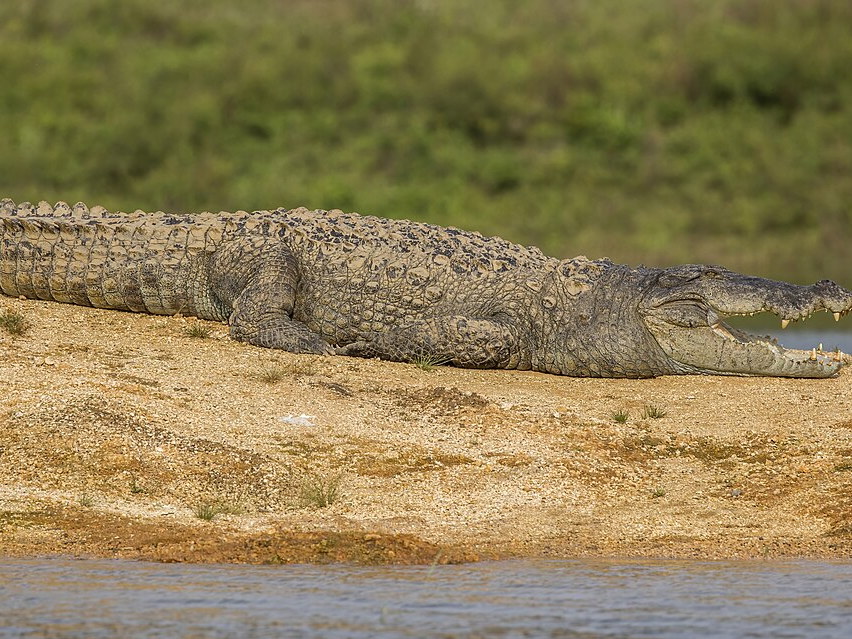
Q: What reptile group includes crocodiles, alligators, caimans, and gharials?
A: Crocodilians.
Q: What is one visible snout difference between many alligators and crocodiles?
A: Alligators often have broader U-shaped snouts, while many crocodiles have narrower V-shaped snouts.
Q: Can crocodilians live in salt water?
A: Some can tolerate it well, especially saltwater crocodiles, while others favor freshwater.
Q: What is the largest living reptile?
A: The saltwater crocodile.
Q: Do crocodilian mothers provide parental care?
A: Yes. Many guard nests and help hatchlings reach water.
Q: What sound can baby crocodilians make before hatching?
A: Chirping or grunting calls that can stimulate nest-opening behavior by the mother.
Q: What is a crocodilian death roll?
A: Rapid body rotation used to tear food or subdue prey.
Q: What lizard is the largest living species?
A: The Komodo dragon.
Q: Where are wild Komodo dragons native?
A: A small group of Indonesian islands.
Q: Are Komodo dragons venomous?
A: Yes. Their bite involves venom as well as severe mechanical injury.
Q: What is autotomy in lizards?
A: Deliberately shedding the tail to distract a predator.
Q: Can a regenerated lizard tail be identical to the original?
A: No. Regenerated tails often differ in internal structure and appearance.
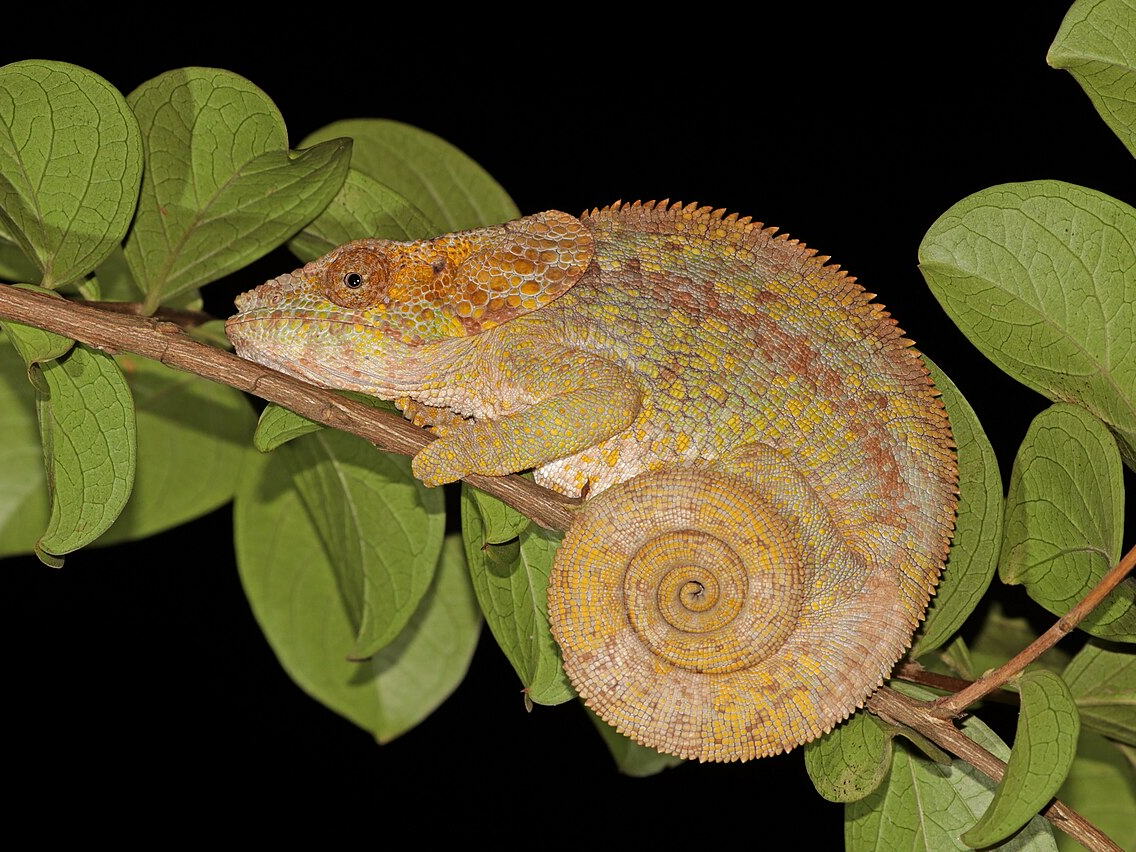
Q: What lizard is famous for changing color?
A: Chameleons.
Q: Do chameleons change color only to match backgrounds?
A: No. Temperature, light, mood, communication, and social signals are major reasons.
Q: What is unusual about chameleon eyes?
A: They can move largely independently and provide a wide field of view.
Q: How does a chameleon capture many prey items?
A: By rapidly projecting a sticky tongue.
Q: What lizards are famous for adhesive toe pads that let them climb smooth surfaces?
A: Geckos.
Q: How do gecko toe pads grip without glue?
A: Microscopic hair-like structures create enormous contact area and intermolecular attraction.
Q: What desert lizard can squirt blood from around its eyes as a defense?
A: Some horned lizards.
Evolution, Records, Strange Adaptations & Conservation
Q: What major reptile lineage includes crocodilians, dinosaurs, and birds?
A: Archosaurs.
Q: What are the closest living relatives of crocodilians?
A: Birds.
Q: Were non-avian dinosaurs reptiles?
A: Yes. They were part of the reptile evolutionary tree.
Q: Were pterosaurs dinosaurs?
A: No. They were flying archosaur relatives of dinosaurs.
Q: Were mosasaurs dinosaurs?
A: No. They were giant marine squamate reptiles related more closely to lizards and snakes.
Q: What were ichthyosaurs?
A: Extinct marine reptiles with streamlined bodies that independently evolved a fish- or dolphin-like shape.
Q: Are turtles an ancient reptile lineage?
A: Yes. Their distinctive body plan has roots more than 200 million years old.
Q: What reptiles are famous for exceptional longevity on islands such as the Galápagos and Seychelles?
A: Giant tortoises.
Q: How many chambers does a crocodilian heart have?
A: Four.
Q: How many main chambers does the heart of most non-crocodilian reptiles have?
A: Three functional chambers, with internal separation varying among groups.
Q: Why is temperature-dependent sex determination a conservation concern?
A: Changing nest temperatures can skew the sex ratios of some reptile populations.
Q: What is parthenogenesis?
A: Reproduction in which an embryo develops without fertilization by a male.
Q: Has parthenogenesis been documented in Komodo dragons?
A: Yes.
Q: What is caudal luring?
A: Moving the tail like prey to attract an animal close enough to strike.
Q: What snakes are famous for sidewinding across loose sand?
A: Sidewinders and several other desert snakes.
Q: Why is sidewinding useful on hot loose sand?
A: It provides traction while limiting how much of the body contacts the surface at once.
Q: What lizard is nicknamed the “Jesus lizard” for running across water?
A: The basilisk lizard.
Q: Can Draco lizards truly fly with powered wingbeats?
A: No. They glide using skin membranes supported by elongated ribs.
Q: What living lizard forages in the ocean for algae?
A: The marine iguana.
Q: Where are marine iguanas native?
A: The Galápagos Islands.
Q: How do marine iguanas remove excess salt?
A: Specialized nasal salt glands allow them to sneeze out concentrated salt.
Q: What crocodilian has an extremely long narrow snout specialized for catching fish?
A: The gharial.
Q: How can American alligators survive brief freezing conditions in shallow water?
A: They may enter a low-activity state with their nostrils held above ice so they can breathe.
Q: Do crocodiles literally cry because they feel guilty while eating?
A: No. They can produce tears for eye lubrication, but the emotional folklore is false.
Q: What global cue can sea turtles use during navigation?
A: Earth's magnetic field.
Q: What fishing problem can accidentally kill sea turtles?
A: Bycatch in nets, trawls, and longline fisheries.
Q: What device can help sea turtles escape shrimp trawl nets?
A: A turtle excluder device, or TED.
Q: Why is habitat fragmentation dangerous for reptiles?
A: Roads and development can isolate populations and block movement between feeding, nesting, and breeding areas.
Q: What large invasive snake has become established in South Florida's Everglades region?
A: The Burmese python.
Q: Why does reptile conservation matter beyond saving individual species?
A: Reptiles function as predators, prey, seed dispersers, scavengers, and important parts of food webs.
How Did You Score?
If you knew your brille from your plastron, your tuatara from your Komodo dragon, and your gharial from your green anaconda, your reptile trivia has serious bite.

Ellie Simons creates and edits Random Trivia. She researches trivia using primary and authoritative sources whenever possible and is currently reviewing the site's older trivia library for accuracy, clarity, and playability. Read more on the About page.
Explore more questions in our animals trivia guide.
About this quiz
Site editor: Ellie Simons. Read our Trivia Methodology to learn how questions are researched and updated. Page last updated: . Report an error.