
Pack your caravan for Silk Road trivia filled with mountain passes, desert oases, precious cargo, bold travelers, and ideas that crossed continents.
These questions follow a vast network rather than one road, connecting ancient China, Central Asia, the Middle East, Europe, and the sea.
Mapping the Silk Roads
Q: Was the Silk Road a single paved highway?
A: No, it was a network of land and sea routes.
Q: Which German geographer coined the term “Silk Road” in the 19th century?
A: Ferdinand von Richthofen.
Q: What German term did Richthofen use for the routes?
A: Seidenstrassen.
Q: Which luxury fiber gave the Silk Road its modern name?
A: Silk.
Q: Which Chinese dynasty helped open sustained routes into Central Asia?
A: The Han dynasty.
Q: Around which century BCE did Han expansion help the routes flourish?
A: The second century BCE.
Q: Which city served as the Han dynasty's capital and an eastern starting point?
A: Chang'an.
Q: What is Chang'an called today?
A: Xi'an.
Q: Which broad region formed the central bridge between China and western Asia?
A: Central Asia.
Q: Which sea formed a western hub for routes reaching Europe?
A: The Mediterranean Sea.
Q: What term describes the seaborne trading network linked to the overland routes?
A: The Maritime Silk Road.
Q: Which ocean connected ports from East Africa to India and Southeast Asia?
A: The Indian Ocean.
Q: Did most merchants travel the entire distance from China to Europe?
A: No, goods usually changed hands many times.
Q: What made the routes valuable beyond trade in objects?
A: They carried religions, technologies, art, and ideas.
Q: Did the Silk Roads operate at the same intensity throughout history?
A: No, activity rose and fell with political and economic conditions.
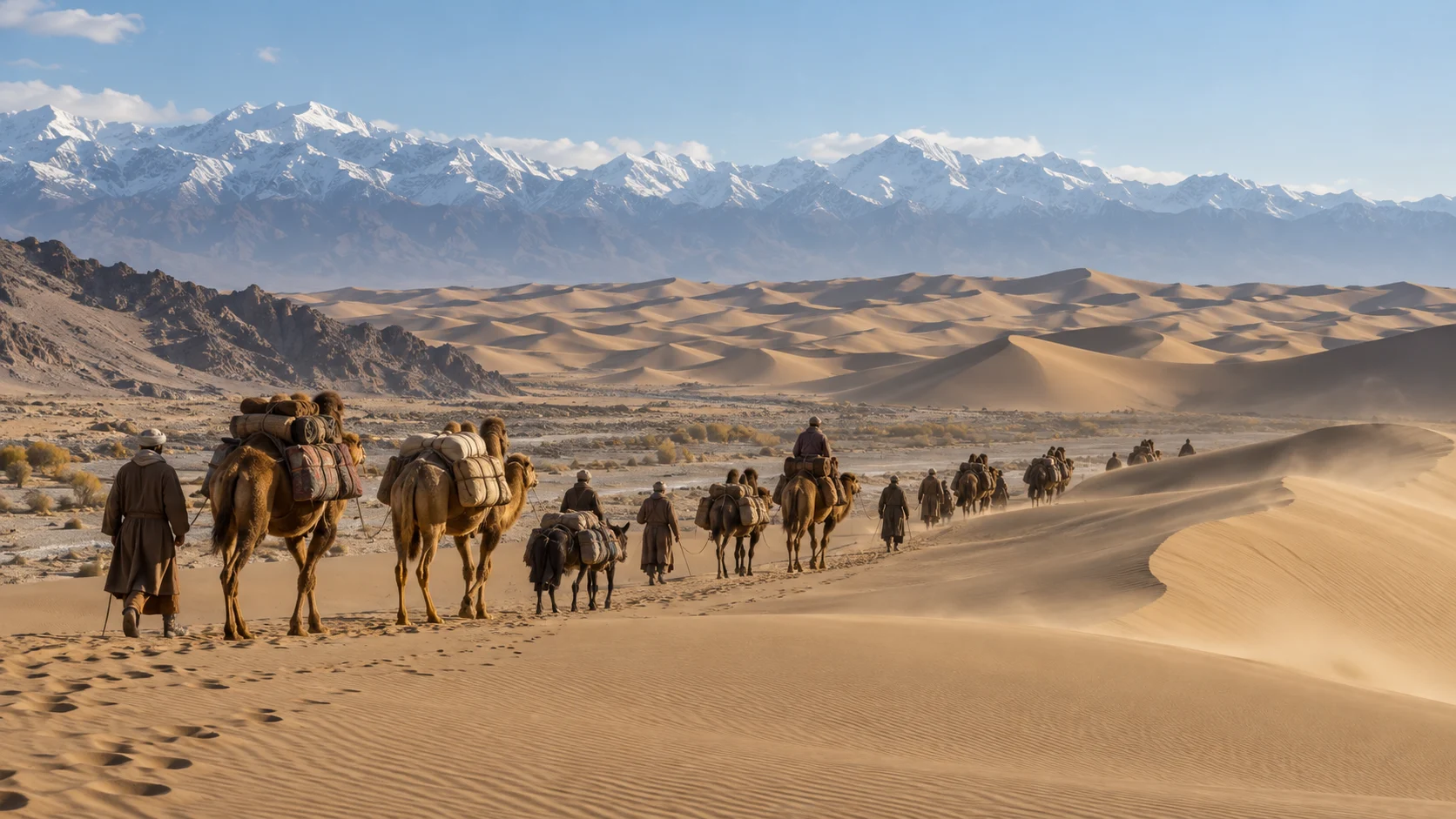
Caravans, Deserts, and Mountain Passes
Q: Which desert challenged travelers west of China's Gansu Corridor?
A: The Taklamakan Desert.
Q: What does the word “oasis” describe?
A: A fertile, watered place in a desert.
Q: Which basin contains the Taklamakan Desert?
A: The Tarim Basin.
Q: What narrow route linked central China to the Tarim Basin?
A: The Gansu Corridor.
Q: Which mountain range rises south of the Tarim Basin?
A: The Kunlun Mountains.
Q: Which mountain range lies north of the Tarim Basin?
A: The Tian Shan.
Q: Which high Central Asian range was known historically as the Pamir Knot?
A: The Pamir Mountains.
Q: Which camel species was especially suited to cold Central Asian deserts?
A: The Bactrian camel.
Q: How many humps does a Bactrian camel have?
A: Two.
Q: What traveling group offered merchants safety and shared resources?
A: A caravan.
Q: What roadside lodging served merchants and animals along many routes?
A: A caravanserai.
Q: Which oasis city near the western edge of China became a major trading center?
A: Kashgar.
Q: Which Chinese oasis guarded the meeting of routes around the Taklamakan?
A: Dunhuang.
Q: Which pass through the Hindu Kush linked Central Asia with the Indian subcontinent?
A: The Khyber Pass.
Q: Why did caravans often travel at night in hot deserts?
A: To avoid the worst daytime heat.
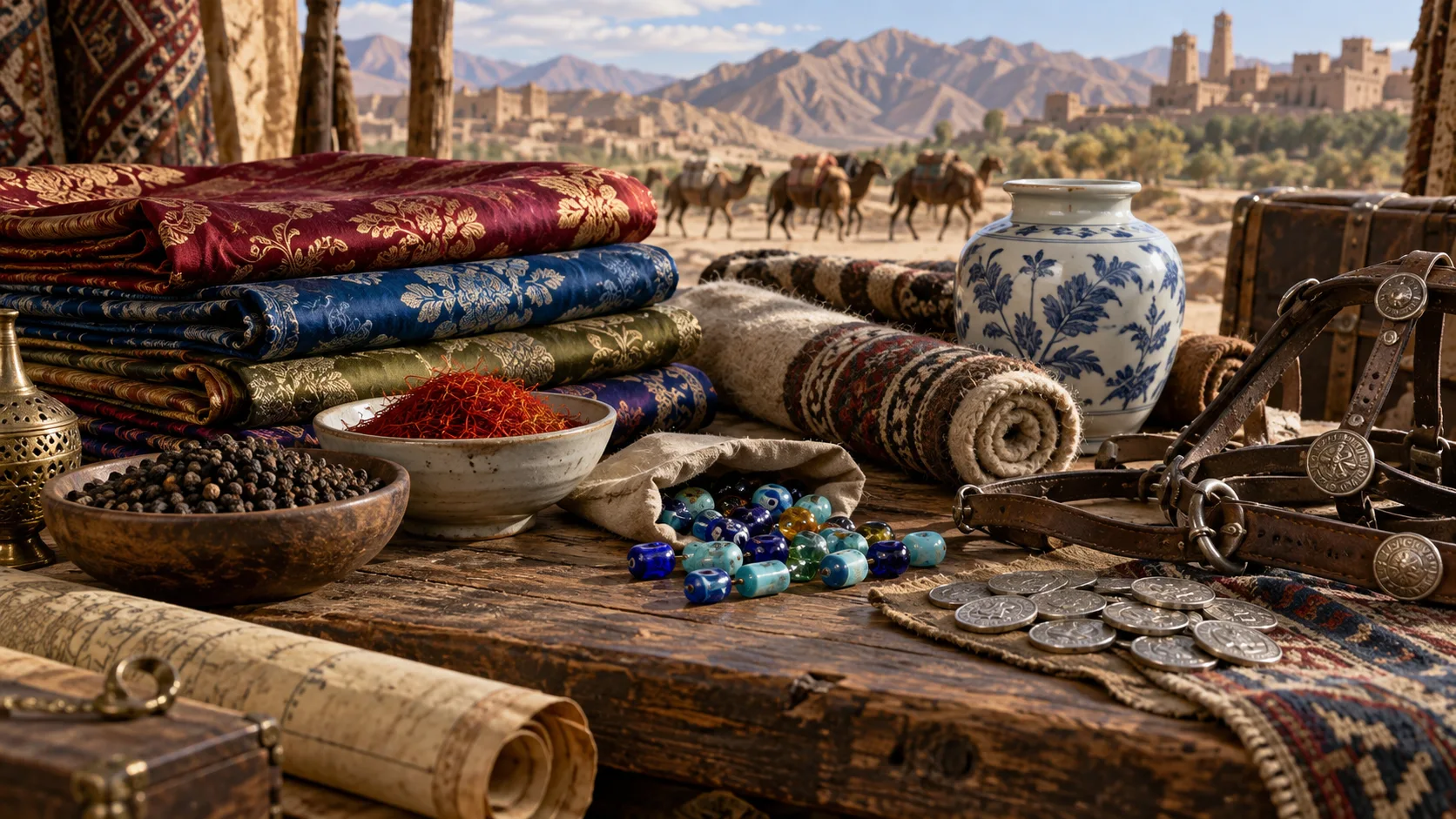
Silk, Spices, Horses, and More
Q: What insect produces the fiber used to make silk?
A: The silkworm.
Q: What tree supplies the leaves eaten by domesticated silkworms?
A: The mulberry tree.
Q: What is the raising of silkworms for silk called?
A: Sericulture.
Q: Which empire prized Chinese silk so highly that it became a symbol of luxury?
A: The Roman Empire.
Q: Which strong Central Asian horses were highly valued by Han rulers?
A: Ferghana horses.
Q: What poetic nickname did Chinese sources give the Ferghana horses?
A: Heavenly horses.
Q: Which blue gemstone traveled west from mines in Badakhshan?
A: Lapis lazuli.
Q: Which fragrant spice made from dried flower stigmas moved through Eurasian trade?
A: Saffron.
Q: Which lightweight Chinese invention gradually transformed recordkeeping across Eurasia?
A: Paper.
Q: Which explosive Chinese technology eventually traveled westward?
A: Gunpowder.
Q: Which navigation tool developed in China aided long-distance seafaring?
A: The magnetic compass.
Q: What ceramic ware became a prized Chinese export?
A: Porcelain.
Q: Which precious metal often flowed eastward in exchange for luxury goods?
A: Silver.
Q: Which Mediterranean product was traded east in fine vessels and beads?
A: Glass.
Q: Were spices carried only on the overland Silk Roads?
A: No, maritime routes were especially important to the spice trade.
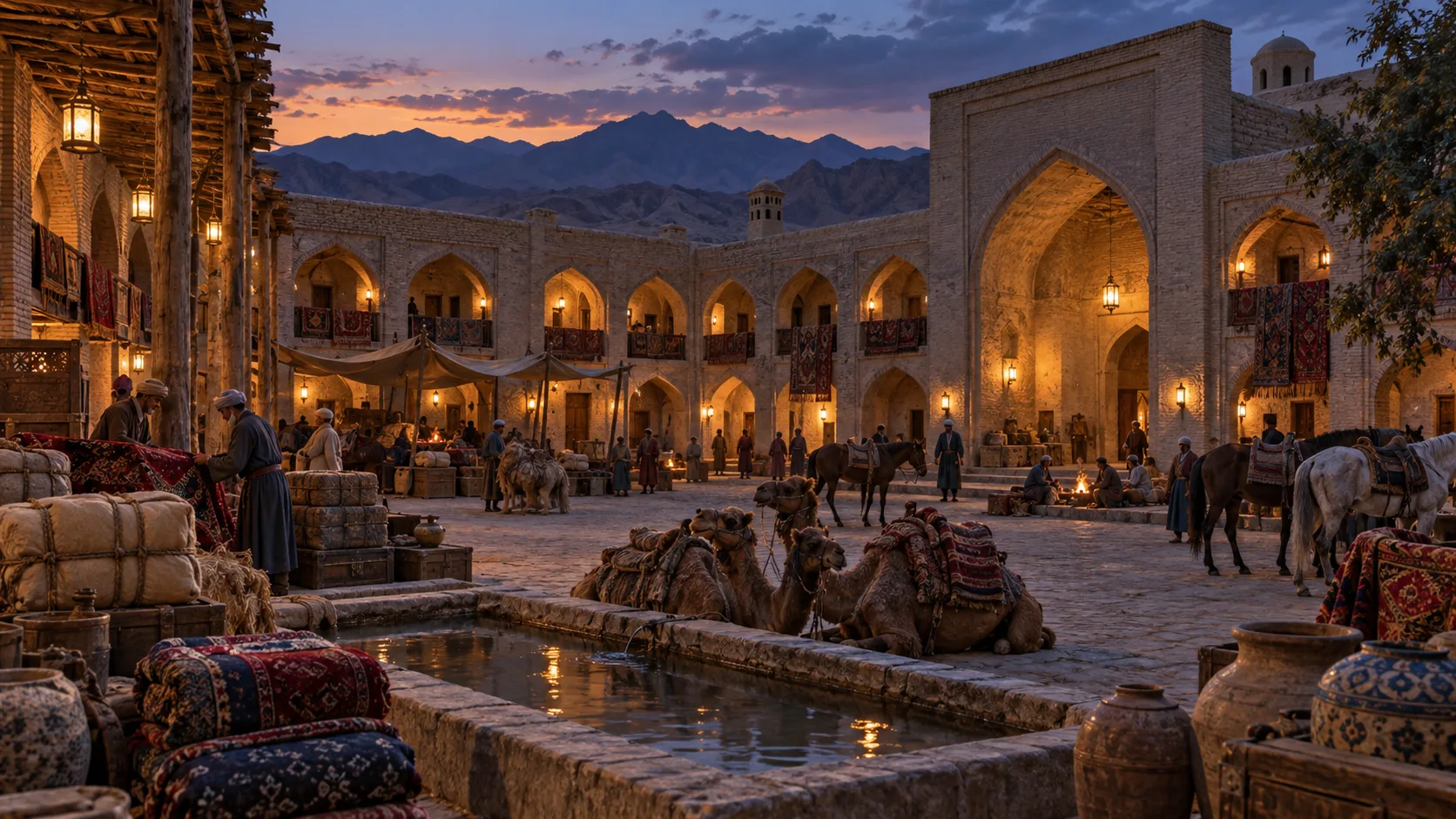
Empires That Kept Trade Moving
Q: Which Han emperor sent Zhang Qian westward?
A: Emperor Wu.
Q: Which Central Asian confederation was Zhang Qian originally sent to contact?
A: The Yuezhi.
Q: Which empire controlled Iran and Mesopotamia when Roman trade with Asia expanded?
A: The Parthian Empire.
Q: Which later Persian empire succeeded the Parthians?
A: The Sasanian Empire.
Q: Which empire founded by nomadic Yuezhi rulers linked northern India and Central Asia?
A: The Kushan Empire.
Q: Which Kushan ruler is closely associated with Buddhist patronage?
A: Kanishka.
Q: Which Chinese dynasty made Chang'an a famously cosmopolitan capital?
A: The Tang dynasty.
Q: Which caliphate ruled from Baghdad during a major era of Eurasian commerce?
A: The Abbasid Caliphate.
Q: Which Byzantine capital linked Black Sea and Mediterranean trade?
A: Constantinople.
Q: Which Turkic people became influential middlemen in Central Asian trade?
A: The Sogdians.
Q: Which Central Asian city was a major Sogdian center in present-day Uzbekistan?
A: Samarkand.
Q: Which other great Uzbek oasis city stood west of Samarkand?
A: Bukhara.
Q: Which empire created unusually secure transcontinental routes in the 13th century?
A: The Mongol Empire.
Q: What phrase describes the relative stability under Mongol rule?
A: Pax Mongolica.
Q: Which conqueror made Samarkand his capital in the 14th century?
A: Timur.
Travelers, Envoys, and Storytellers
Q: Which Han envoy's journeys opened Chinese knowledge of lands to the west?
A: Zhang Qian.
Q: Which Chinese Buddhist monk traveled to India in the early fifth century?
A: Faxian.
Q: Which Tang monk journeyed to India and returned with Buddhist texts?
A: Xuanzang.
Q: Which classic Chinese novel was inspired partly by Xuanzang's pilgrimage?
A: Journey to the West.
Q: Which Venetian traveler described the court of Kublai Khan?
A: Marco Polo.
Q: Which Mongol ruler did Marco Polo say his family served?
A: Kublai Khan.
Q: What title is commonly given to the book recounting Marco Polo's travels?
A: The Travels of Marco Polo.
Q: Which Moroccan traveler crossed much of Africa and Asia in the 14th century?
A: Ibn Battuta.
Q: What is Ibn Battuta's travel account commonly called?
A: The Rihla.
Q: Which Franciscan friar visited the Mongol court before Marco Polo?
A: William of Rubruck.
Q: Which papal envoy reached the Mongol capital of Karakorum in the 1240s?
A: Giovanni da Pian del Carpine.
Q: Which Chinese admiral led major Indian Ocean voyages in the early 1400s?
A: Zheng He.
Q: Which dynasty sponsored Zheng He's voyages?
A: The Ming dynasty.
Q: Which Korean kingdom did the monk Hyecho leave to travel across Asia?
A: Silla.
Q: Why should Marco Polo's account be read critically?
A: Some details are disputed or shaped by literary retelling.
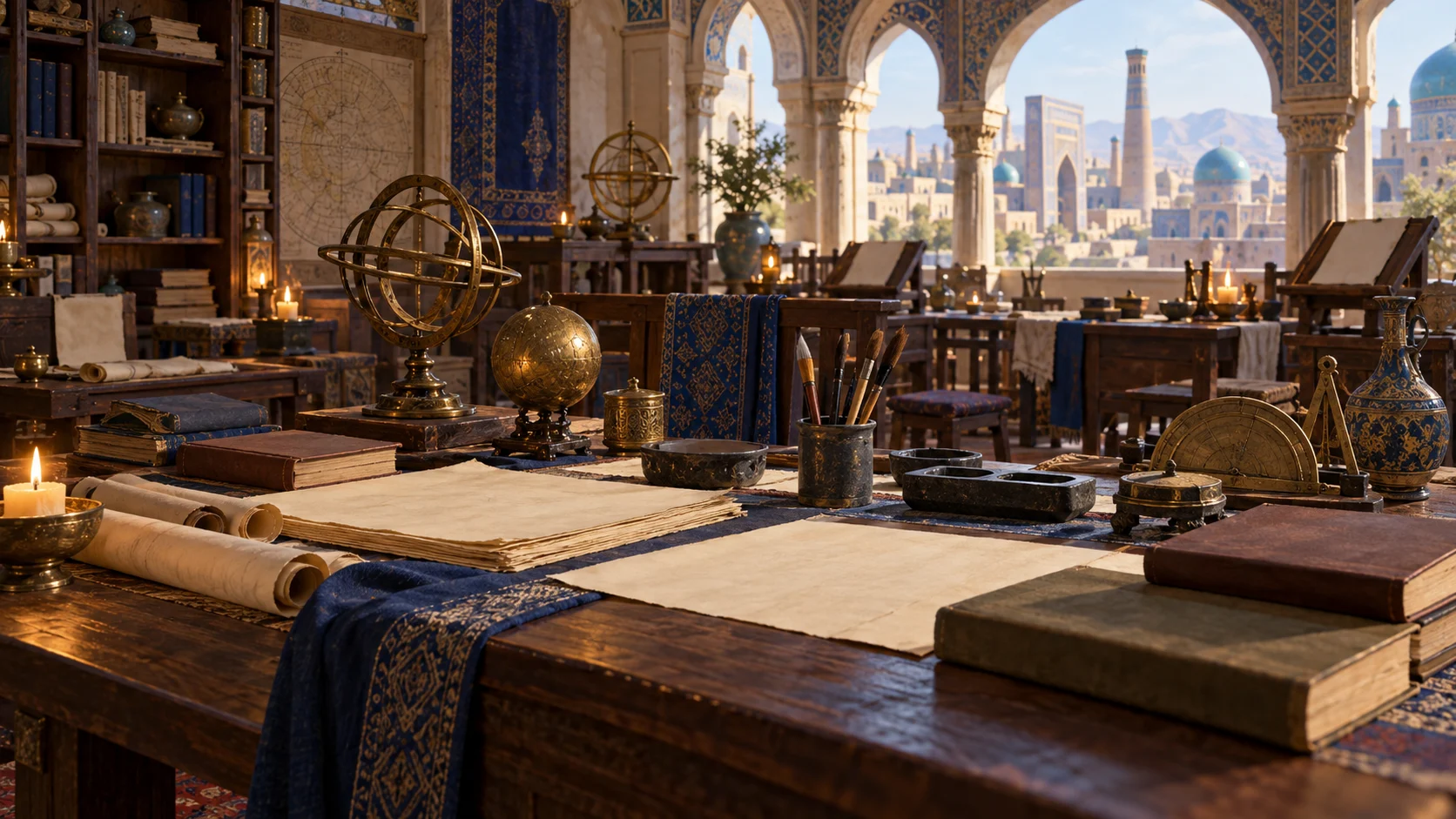
Religions, Languages, and Art on the Move
Q: Which religion spread from India into Central Asia and China along the routes?
A: Buddhism.
Q: Which branch of Buddhism became especially influential in China?
A: Mahayana Buddhism.
Q: What are the celebrated Buddhist cave temples near Dunhuang called?
A: The Mogao Caves.
Q: Which ancient Indian language appears in many Buddhist scriptures?
A: Sanskrit.
Q: Which Iranian religion was founded by Zarathustra?
A: Zoroastrianism.
Q: Which religion founded by Mani spread across Eurasia through merchant networks?
A: Manichaeism.
Q: Which form of Christianity reached China during the Tang dynasty?
A: Church of the East Christianity.
Q: What monument records the arrival of Church of the East Christianity in Tang China?
A: The Xi'an Stele.
Q: Which religion spread widely through Central Asian trade cities after the seventh century?
A: Islam.
Q: Which merchant language served as a Silk Road lingua franca in much of Central Asia?
A: Sogdian.
Q: What artistic tradition blended Greek and Buddhist features in the northwest Indian region?
A: Gandharan art.
Q: Which Greek hero may have influenced muscular guardian figures in Buddhist art?
A: Heracles.
Q: What stringed instrument traveled east and helped inspire the Chinese pipa?
A: A Central Asian lute.
Q: Which dance style from Sogdiana became fashionable in Tang China?
A: The Sogdian whirl.
Q: What do multilingual manuscripts reveal about Silk Road cities?
A: They were culturally and linguistically diverse.
Knowledge, Disease, and Unintended Cargo
Q: Which papermaking battle is traditionally linked to the technology's westward spread?
A: The Battle of Talas.
Q: In what year was the Battle of Talas fought?
A: 751.
Q: Which two powers fought at Talas?
A: The Abbasid Caliphate and Tang China.
Q: Which numeral system traveled from India through the Islamic world to Europe?
A: Hindu-Arabic numerals.
Q: Which crop from Central Asia became prized in China and appears in Tang art?
A: Grapes.
Q: Which fruit probably originated in Central Asia before spreading widely?
A: The apple.
Q: Which devastating 14th-century pandemic spread along trade and military routes?
A: The Black Death.
Q: What bacterium causes plague?
A: Yersinia pestis.
Q: Which rodents and their fleas have often been associated with plague transmission?
A: Rats.
Q: Did long-distance trade create disease, or help pathogens travel?
A: It helped pathogens travel.
Q: Which medical tradition from India circulated knowledge of herbs and treatments?
A: Ayurveda.
Q: Which Chinese process reproduced texts from carved blocks?
A: Woodblock printing.
Q: What material made books lighter and cheaper than parchment?
A: Paper.
Q: Which field benefited from the exchange of star charts and instruments?
A: Astronomy.
Q: What does the exchange of crops across the routes demonstrate?
A: Trade reshaped diets and agriculture as well as markets.
Ports, Decline, Rediscovery, and Legacy
Q: Which seasonal winds powered sailing across the Indian Ocean?
A: Monsoon winds.
Q: Which strait links the Indian Ocean trade world with the South China Sea?
A: The Strait of Malacca.
Q: Which city near the strait became a major trading port in the 1400s?
A: Malacca.
Q: Which Chinese port was a major center for foreign merchants during the Song era?
A: Quanzhou.
Q: Which East African coastal culture grew through Indian Ocean trade?
A: Swahili culture.
Q: Which language blended Bantu foundations with many Arabic loanwords?
A: Swahili.
Q: Which Egyptian port on the Red Sea served medieval trade with the Indian Ocean?
A: Aydhab.
Q: Which Italian city-state became a powerful eastern Mediterranean trading center?
A: Venice.
Q: What development offered Europeans direct sea routes around Africa to Asia?
A: Oceanic navigation around the Cape of Good Hope.
Q: Which Portuguese explorer reached India by sea in 1498?
A: Vasco da Gama.
Q: Did maritime expansion instantly end all overland Eurasian trade?
A: No.
Q: Which hidden Dunhuang chamber preserved thousands of manuscripts?
A: The Library Cave.
Q: Who discovered the sealed Library Cave around 1900?
A: Wang Yuanlu.
Q: Which UNESCO designation recognizes a route corridor from Chang'an to the Tian Shan?
A: A World Heritage Site.
Q: What is the Silk Roads' most enduring lesson?
A: Distant societies have long been connected through exchange.
Your Caravan Made It Home
If you crossed all 120 questions without losing a camel, your trivia passport is impressively full. Continue meeting remarkable travelers and rulers with our famous people trivia, or follow history into modern times with decades trivia.

Ellie Ewert is the founder and author of RandomTrivia.co, blending her passion for research with years of experience in content creation to deliver accurate, engaging, and well-sourced trivia. Dedicated to providing readers with trustworthy and entertaining facts, she applies meticulous fact-checking and SEO expertise to ensure every article meets the highest standards. Read more about our high standards in our Editorial Guidelines.