From Odin’s one-eyed wisdom to the world-ending clash of Ragnarök, Norse mythology is packed with unforgettable gods, monsters, and mysteries.
This ultimate trivia guide ranges from beginner-friendly questions to brain-twisting lore, covering the Aesir, Vanir, giants, heroes, runes, rituals, and the Nine Realms perfect for quiz nights and mythology fans alike.
Why Norse Mythology Makes Great Trivia
Norse myth blends stark, atmospheric storytelling with vivid characters: a hammer-wielding thunderer, a shape-shifting trickster, fate-weaving Norns, and sea giants hosting ale-feasts.
The myths are preserved in poetic fragments and prose retellings, inviting clever questions that reward careful reading and cultural context.
It also intersects with language and daily life, our weekday names nod to the gods, modern fantasy riffs on valkyries and runes, and archaeological finds echo mythic artifacts.
That combination of literary depth, ritual practice, and living legacy makes Norse lore a trivia goldmine.
The Nine Realms & Cosmic Order
Q: What is the great ash that links the worlds in Norse cosmology?
A: Yggdrasil, the world tree.
Q: How many realms are traditionally counted beneath Yggdrasil’s boughs?
A: Nine.
Q: What rainbow bridge connects Midgard to Asgard?
A: Bifröst.
Q: Who stands watch over Bifröst?
A: Heimdallr.
Q: Which realm is home to humankind?
A: Midgard.
Q: Which realm is the gods’ stronghold and court?
A: Asgard.
Q: Which icy realm lies in the primordial north?
A: Niflheim.
Q: Which fiery realm lies in the scorching south?
A: Muspelheim.
Q: Where do many giants dwell?
A: Jötunheim.
Q: What underworld is ruled by the being named Hel?
A: Hel (often called Helheim).
Q: What is the yawning void before creation?
A: Ginnungagap.
Q: From whose body was the world shaped?
A: The primeval giant Ymir.
Q: What river never freezes and marks a boundary with the giants?
A: Ífing.
Q: What serpent encircles the earth beneath the seas?
A: Jörmungandr, the Midgard Serpent.
Q: Which dragon gnaws at the roots of Yggdrasil?
A: Níðhöggr.
Q: What nimble messenger scurries along the tree’s trunk?
A: Ratatoskr the squirrel.
Q: Name the three wells at Yggdrasil’s roots.
A: Urðarbrunnr (Well of Urd), Mímir’s Well, and Hvergelmir.
Q: Who carves fate at the Well of Urd?
A: The Norns—Urðr, Verðandi, and Skuld.
Q: What bird sits atop Yggdrasil with a hawk between its eyes?
A: An unnamed eagle with Veðrfölnir perched between its eyes.
Q: Who personify the sun and the moon?
A: Sól (the Sun) and Máni (the Moon).
Q: Which wolves chase Sól and Máni across the sky?
A: Sköll (after the sun) and Hati (after the moon).
Odin, Thor & the Aesir
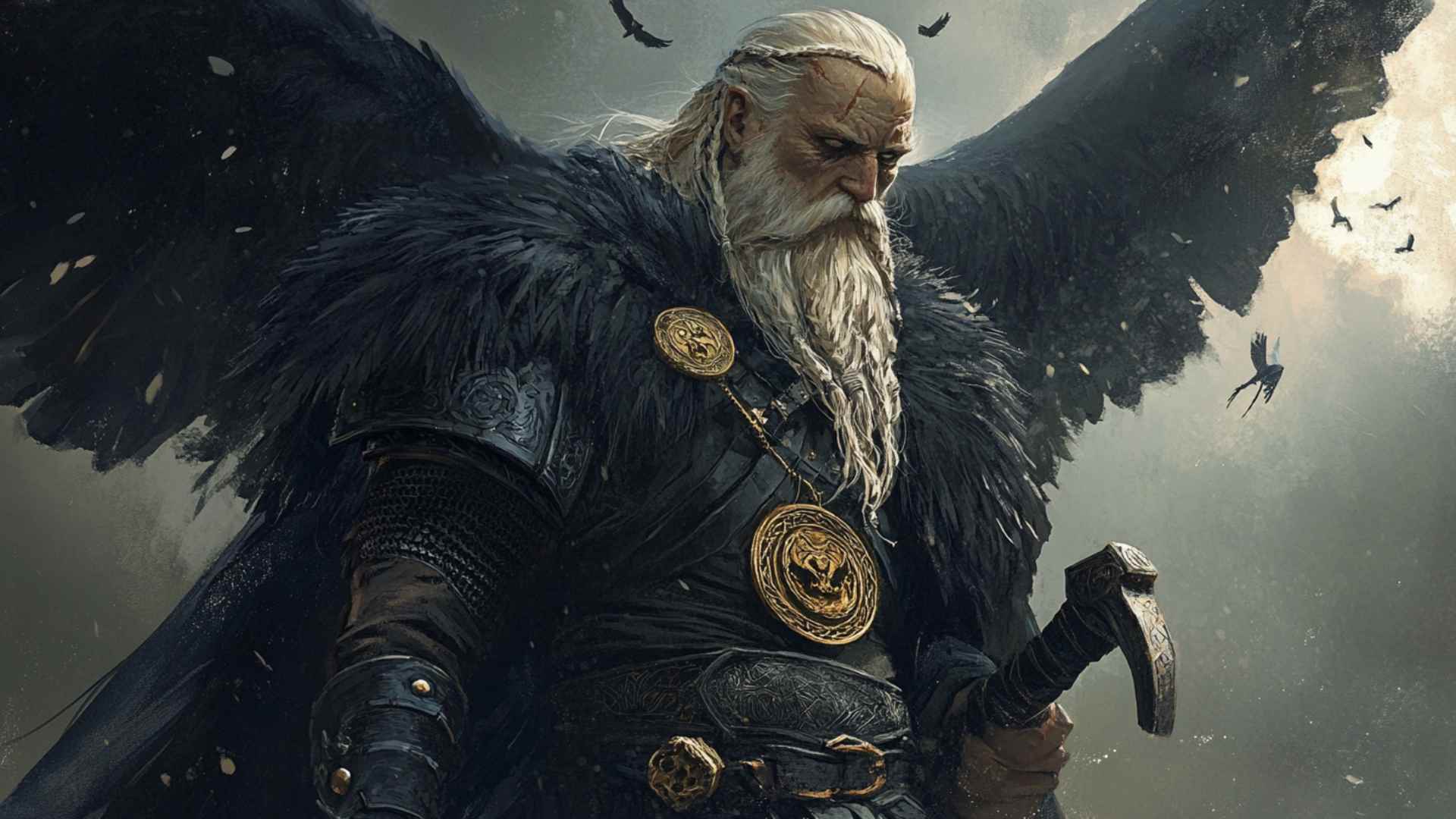
Q: Who is called the All-Father of the gods?
A: Odin.
Q: What did Odin sacrifice for a drink of wisdom?
A: One eye, given at Mímir’s well.
Q: What is the name of Odin’s unerring spear?
A: Gungnir.
Q: What are the names of Odin’s ravens?
A: Huginn (“Thought”) and Muninn (“Memory”).
Q: What are the names of Odin’s wolves?
A: Geri and Freki.
Q: What high seat lets Odin see into all worlds?
A: Hliðskjálf.
Q: What is Thor’s famed weapon?
A: Mjölnir, the hammer.
Q: What belt doubles Thor’s strength?
A: Megingjörð.
Q: Which weekday bears Thor’s name?
A: Thursday.
Q: Who is Odin’s queen and goddess of marriage?
A: Frigg.
Q: Which war god lost a hand to a wolf?
A: Týr, bitten by Fenrir.
Q: Who is the god of poetry and eloquence?
A: Bragi.
Q: Who keeps the apples that preserve the gods’ youth?
A: Iðunn.
Q: Which archer-ski god is invoked for winter hunts?
A: Ullr.
Q: Which blind god was tricked into killing Baldr?
A: Höðr.
Q: Who rode to Hel to plead for Baldr’s release?
A: Hermóðr.
Q: Which “silent” god avenges Odin at Ragnarök?
A: Víðarr.
Q: Which son of Odin avenges Baldr by slaying Höðr?
A: Váli.
Q: Which mediator-god is associated with justice and peace?
A: Forseti.
Q: Who is the watchman of the gods with the resounding horn?
A: Heimdallr, keeper of Gjallarhorn.
Q: What are the chosen slain who feast and train in Odin’s hall called?
A: The Einherjar.
The Vanir, Freyr & Freyja
Q: What second tribe of gods rivals the Aesir?
A: The Vanir.
Q: What conflict ended with a wise truce and hostage exchange?
A: The Aesir–Vanir War.
Q: Which sea-god is father to Freyr and Freyja?
A: Njörðr.
Q: Freyr is chiefly a god of what?
A: Fertility, peace, and prosperity.
Q: Freyja is goddess of love and what powerful magic?
A: Seiðr.
Q: What is Freyja’s famed necklace?
A: Brísingamen.
Q: What field receives half the battle-slain under Freyja?
A: Fólkvangr.
Q: What is the name of Freyja’s hall within Fólkvangr?
A: Sessrúmnir.
Q: What marvelous ship belongs to Freyr?
A: Skíðblaðnir, which always finds a fair wind.
Q: What golden-bristled boar serves Freyr?
A: Gullinbursti.
Q: What boar is associated with Freyja (often her lover Óttar in disguise)?
A: Hildisvíni.
Q: Who is Freyr’s messenger who woos Gerðr?
A: Skírnir.
Q: What crucial weapon does Freyr surrender for love?
A: His sword.
Q: Whom does Freyr love and wed?
A: The jötunn Gerðr.
Q: What is Njörðr’s sea-home called?
A: Nóatún.
Q: Which mountain goddess chose a husband by looking at feet?
A: Skaði, who chose Njörðr.
Q: What super-wise being was made from the gods’ spit?
A: Kvasir.
Q: What became of Kvasir?
A: He was killed; his blood brewed into the mead of poetry.
Q: Which dwarfs brewed that mead?
A: Fjalar and Galar.
Q: Who guarded the mead after the dwarfs?
A: The giant Suttungr (with his daughter Gunnlöð).
Q: In what form did Odin escape with the mead of poetry?
A: As an eagle.
Loki, Giants & Tricksters
Q: Who is the shape-shifting trickster among the gods?
A: Loki.
Q: Who are Loki’s parents?
A: Fárbauti (a jötunn) and Laufey (Nál).
Q: Is Loki Aesir or jötunn by birth?
A: Jötunn, though he moves among the Aesir.
Q: Name Loki’s three monstrous children with Angrboða.
A: Fenrir, Jörmungandr, and Hel.
Q: Which child of Loki rules the underworld?
A: Hel.
Q: Which giant stole Thor’s hammer in Þrymskviða?
A: Þrymr.
Q: Who impersonated Freyja to reclaim Mjölnir?
A: Thor (with Loki’s help).
Q: What magical fetter bound Fenrir?
A: Gleipnir.
Q: From what uncanny “things” was Gleipnir made?
A: A cat’s footfall, woman’s beard, mountain roots, bear sinews, fish’s breath, bird’s spittle.
Q: How did the gods trick Fenrir into accepting the binding?
A: They pledged safety, placing Týr’s hand in his mouth as surety.
Q: Which master builder demanded Freyja, the sun, and moon as payment?
A: The unnamed builder of Asgard’s wall.
Q: What was the name of his powerful stallion?
A: Svaðilfari.
Q: What animal form did Loki take to distract Svaðilfari?
A: A mare.
Q: What extraordinary horse was born from Loki’s ruse?
A: Sleipnir, Odin’s eight-legged steed.
Q: Who is the crafty giant-king who baffled Thor with illusions?
A: Útgarða-Loki.
Q: Which stone-headed giant did Thor slay after a duel?
A: Hrungnir.
Q: Which figure refused to weep for Baldr, likely Loki in disguise?
A: Þökk.
Q: What torment dripped upon bound Loki after Baldr’s death?
A: Serpent venom.
Q: Who held a bowl to spare Loki from the venom?
A: Sigyn, his loyal wife.
Q: With what was Loki bound in his cave?
A: The entrails of his son (Nari/Narfi).
Q: At Ragnarök, who and Loki slay each other?
A: Heimdallr and Loki.

Mythic Creatures & Supernatural Beings
Q: Who selects the slain on battlefields?
A: The valkyries.
Q: What ancestral female spirits were honored at dísablót?
A: The dísir.
Q: What personal guardian or “fetch” follows a person’s fate?
A: A fylgja.
Q: What transferable store of luck or fortune did people speak of?
A: Hamingja.
Q: What frenzy-driven warriors fought like bears?
A: Berserkers.
Q: What wolf-warrior champions are their counterparts?
A: Úlfhéðnar.
Q: Name Thor’s two goat steeds.
A: Tanngrisnir and Tanngnjóstr.
Q: What hound howls from Gnipahellir at Ragnarök?
A: Garmr.
Q: What goat on Valhalla’s roof yields mead from her udder?
A: Heiðrún.
Q: Which stag’s antlers drip streams into Hvergelmir?
A: Eikþyrnir.
Q: Name any one of the four stags that nibble Yggdrasil’s leaves.
A: Dáinn, Dvalinn, Duneyrr, or Duraþrór.
Q: Who are the nine wave-daughters of Ægir and Rán?
A: The Nine Daughters of the Sea (e.g., Himinglæva, Dúfa, etc.).
Q: Which sea-giant hosts the gods’ ale-feasts?
A: Ægir (also called Hlér).
Q: Which monstrous wolf is a child of Loki?
A: Fenrir.
Q: Which sea-serpent is Fenrir’s sibling?
A: Jörmungandr.
Q: Which underworld ruler is their sister?
A: Hel.
Q: What spirits guard lands and natural features?
A: Landvættir (land-spirits).
Q: What term is often used for “black elves,” frequently equated with dwarfs?
A: Svartálfar.
Q: What realm is associated with “light elves”?
A: Álfheimr.
Q: What taunting messenger scampers on Yggdrasil’s trunk?
A: Ratatoskr.
Q: In Völundarkviða, what bird-form do visiting valkyries wear?
A: Swan plumage.
Valkyries, Heroes & Legendary Mortals
Q: Which valkyrie defied Odin and was ringed by fire?
A: Brynhildr.
Q: Who rode through flame to awaken her?
A: Sigurðr.
Q: Which dragon did Sigurðr slay?
A: Fáfnir.
Q: What sword did Sigurðr reforge from shards?
A: Gram.
Q: Who was Sigurðr’s foster father and smith?
A: Reginn.
Q: What cursed ring did Sigurðr take from the hoard?
A: Andvaranaut.
Q: From whom was that ring taken?
A: The dwarf Andvari.
Q: Which saga tells the tale of the Volsungs?
A: Völsunga saga.
Q: Which hero plays a harp with his toes in a snake pit?
A: Gunnarr.
Q: Who becomes Brynhildr’s rival and tragic wife?
A: Guðrún.
Q: Which legendary queen appears in stories around Hrólfr Kraki?
A: Yrsa (mother of Hrólfr Kraki).
Q: Which wise woman becomes Ragnar Loðbrók’s wife?
A: Aslaug (Kráka).
Q: What fate befalls Ragnar according to legend?
A: He is cast into King Ælla’s snake pit.
Q: Name a son of Ragnar Loðbrók.
A: Ivarr the Boneless, Björn Ironside, Sigurd Snake-in-the-Eye, Hvitserk, or Ubba.
Q: Which saga features a warrior-maiden wielding the cursed sword Tyrfing?
A: Hervarar saga.
Q: What is the name of that deadly sword?
A: Tyrfing.
Q: Which outcast strongman stars in a namesake saga?
A: Grettir Ásmundarson (Grettis saga).
Q: Which poet-warrior is central to Egils saga?
A: Egill Skallagrímsson.
Q: Which explorer reached Vinland around the year 1000?
A: Leif Erikson.
Q: What are Odin’s serving maidens in Valhalla called?
A: Valkyries.
Q: What is Odin’s hall of the slain called?
A: Valhalla.
Q: What shield-maiden is celebrated in Saxo’s history?
A: Lagertha.
Ragnarök & the End of the Worlds
Q: What does “Ragnarök” most commonly mean?
A: The fate/doom of the gods.
Q: What three-year winter precedes the final battle?
A: Fimbulwinter.
Q: Whose horn blast heralds the doom to come?
A: Heimdallr’s Gjallarhorn.
Q: What ship of dead men’s nails carries foes to battle?
A: Naglfar.
Q: Which wolf devours the sun at the end?
A: Sköll.
Q: Which wolf devours the moon?
A: Hati.
Q: Who kills Odin on the battlefield?
A: The wolf Fenrir.
Q: Who avenges Odin by rending the wolf’s jaws?
A: Víðarr.
Q: Who battles the Midgard Serpent?
A: Thor.
Q: What becomes of Thor after slaying the serpent?
A: He takes nine steps and dies of its venom.
Q: Which fire-giant leads the hosts of Muspel?
A: Surtr.
Q: Which god falls to Surtr, lacking his sword?
A: Freyr.
Q: Which hound fights Týr to the death?
A: Garmr.
Q: Which two enemies slay each other at the end?
A: Heimdallr and Loki.
Q: What happens to Bifröst during the onslaught?
A: It breaks.
Q: Which human pair survives to renew humankind?
A: Líf and Lífþrasir.
Q: Where do they hide through the flames?
A: In Hoddmímis holt (a wood).
Q: Who lights the sky again after the old sun is devoured?
A: Sól’s daughter, a new sun.
Q: Which gods survive or return to rebuild?
A: Víðarr, Váli, Magni, Móði, Höðr, and Baldr.
Q: Who inherits Mjölnir after the battle?
A: Magni and Móði.
Q: What game’s golden pieces do the gods find in the new world’s grass?
A: Tafl (board-game) pieces.
Runes, Rituals, Language & Sources
Q: What is the Norse runic alphabet called?
A: Futhark.
Q: How many characters are in the Elder Futhark?
A: Twenty-four.
Q: How many characters are in the Younger Futhark?
A: Sixteen.
Q: Why is it called “futhark”?
A: It’s named after its first six sounds: f-u-þ-a-r-k.
Q: What ordeal gave Odin mastery of the runes?
A: Hanging nine nights on Yggdrasil, pierced by his spear.
Q: What are sung magical incantations called?
A: Galdr.
Q: What shamanic magic, often led by women, did Odin also practice?
A: Seiðr.
Q: What is a female seeress called?
A: A völva.
Q: Which wisdom-poem preserves Odin’s advice and rune lore?
A: Hávamál.
Q: Which prophetic poem describes the creation and fate of the world?
A: Völuspá.
Q: What 13th-century work by Snorri preserves myth for poets?
A: The Prose Edda.
Q: Name its three main sections.
A: Gylfaginning, Skáldskaparmál, and Háttatal.
Q: What manuscript preserves many eddic poems?
A: Codex Regius.
Q: What is the collection of mythic and heroic poems called overall?
A: The Poetic Edda.
Q: What metaphorical compound, like “whale-road” for sea, do skalds use?
A: A kenning.
Q: What sacrificial feast honored gods, spirits, or ancestors?
A: Blót.
Q: What midwinter festival gives English the word “Yule”?
A: Jól.
Q: What small pendants are common in Viking-age finds?
A: Mjölnir (Thor’s hammer) amulets.
Q: Which interlaced triple-triangle symbol is linked—uncertainly—to Odin?
A: The valknut (meaning debated).
Q: What was the public assembly and law-court of Norse communities?
A: The þing (thing).
Q: Which weekday names in English derive from Norse gods?
A: Tuesday (Týr), Wednesday (Odin/Woden), Thursday (Thor), Friday (often Frigg or Freyja—traditions vary).

Ellie Ewert is the founder and author of RandomTrivia.co, blending her passion for research with years of experience in content creation to deliver accurate, engaging, and well-sourced trivia. Dedicated to providing readers with trustworthy and entertaining facts, she applies meticulous fact-checking and SEO expertise to ensure every article meets the highest standards. Read more about our high standards in our Editorial Guidelines.