
From radiant sun goddesses to mischievous foxes and haunted wells, Japanese mythology and folklore brim with unforgettable characters and cautionary tales.
This quiz starts simple and builds in difficulty, exploring Shinto creation stories, Buddhist blends, yōkai lore, sacred sites, and legendary heroes.
Ready to challenge what you think you know?
Cosmic Origins & Creation Myths
Q: What are the two earliest written sources compiling Japan’s foundational myths?
A: The Kojiki (712 CE) and Nihon Shoki (720 CE), which together preserve core Shinto creation narratives.
Q: Which divine pair is credited with birthing the islands of Japan in myth?
A: Izanagi and Izanami, the proto-creator kami who stir the primordial brine to form land.
Q: What is the name of the heavenly jeweled spear used to churn the sea at creation?
A: Ame-no-Nuboko, the “Heavenly Jeweled Spear” that drips into becoming the first island.
Q: The first island where the divine couple descends is often called what?
A: Onogoroshima (Onogoro-shima), the “self-forming” island where they build a pillar and palace.
Q: Which fire deity’s birth mortally wounds Izanami, sending her to the land of the dead?
A: Kagutsuchi, whose fiery arrival causes Izanami’s death and Izanagi’s descent to Yomi.
Q: What is the name of the shadowy underworld Izanagi visits to retrieve Izanami?
A: Yomi-no-Kuni—an impure realm from which the living should not look back.
Q: Which purifying act following Yomi births three major deities?
A: Misogi (purification): from washing his eyes and nose, Izanagi produces Amaterasu, Tsukuyomi, and Susanoo.
Q: What celestial realm do the heavenly deities inhabit in Shinto myth?
A: Takamagahara, the “Plain of High Heaven,” seat of the Amatsukami.
Q: Which deity is often invoked as the kami of wise counsel in the heavenly court?
A: Omoikane, a thoughtful counselor who devises clever plans in divine crises.
Q: What is the name of the myth in which the sun goddess hides in a cave, plunging the world into darkness?
A: The Ama-no-Iwato myth, where Amaterasu retreats and must be lured out to restore light.
The Sun, Storm, and Moon: Major Kami
Q: Who is the Shinto sun goddess central to imperial lineage myths?
A: Amaterasu Ōmikami, revered as the radiant ancestor of Japan’s imperial line.
Q: Which tempestuous deity is Amaterasu’s brother and a source of cosmic mischief?
A: Susanoo-no-Mikoto, a storm and sea kami known for chaotic outbursts and bravery.
Q: Who rules the night sky in Shinto myth as the moon god?
A: Tsukuyomi-no-Mikoto, associated with order and the lunar cycle.
Q: What dramatic feat does Susanoo accomplish to redeem his earlier misdeeds?
A: He slays the eight-headed serpent Yamata no Orochi in Izumo.
Q: What legendary sword does Susanoo discover in the serpent’s tail?
A: The blade later known as Kusanagi-no-Tsurugi, a key imperial treasure.
Q: Which deity descends to earth to rule, marking the “Heavenly Grandchild’s Descent”?
A: Ninigi-no-Mikoto, whose mission establishes the divine mandate in the human realm.
Q: Ninigi marries which blossom princess, symbol of fleeting beauty and life?
A: Konohanasakuya-hime, linked to cherry blossoms and volcanic peaks like Fuji.
Q: Which widely worshiped kami of rice and prosperity is closely associated with fox messengers?
A: Inari Ōkami, patron of harvests, industry, and entrepreneurial success.
Q: What quality makes Amaterasu’s light essential to both rice cultivation and social order in mythic logic?
A: Its life-giving regularity—sunlight underpins the agrarian calendar and cosmic harmony.
Q: In some cycles, which sword-wielding culture hero later borrows Kusanagi and tames the wind?
A: Yamato Takeru, who uses the blade to survive a grassfire, earning it the epithet “Grass-Cutter.”
Tricksters, Shapeshifters & Yōkai Basics
Q: What umbrella term covers Japan’s supernatural creatures, from imps to monsters?
A: Yōkai, a broad category of uncanny beings ranging from playful to perilous.
Q: Which fox spirits are famed for shapeshifting, cleverness, and foxfire?
A: Kitsune, who can assume human forms—often beautiful women or mysterious nobles.
Q: Which jovial trickster is a raccoon dog known for illusion and transformation?
A: The tanuki (bake-danuki), notorious for pranks and magical disguises.
Q: Which water-dwelling imp has a water-filled dish on its head and a fondness for cucumbers?
A: The kappa, compelled by etiquette; bowing can spill its head-water and weaken it.
Q: What general term describes everyday objects that come alive after a century?
A: Tsukumogami, household items like tea kettles or sandals gaining spirits over time.
Q: Which hopping umbrella spirit with a long tongue is a classic tsukumogami?
A: The karakasa-obake, a single-eyed paper-umbrella yōkai.
Q: What invisible “wall” yōkai is blamed for blocking roads and travelers at night?
A: The nurikabe, an obstructive spirit said to frustrate walkers until appeased.
Q: Which alluring spider-woman ensnares men with silk and beauty?
A: Jorōgumo, a predator that lures victims near waterfalls or bridges.
Q: What gigantic skeleton is said to form from masses of unburied bones?
A: The gashadokuro, a towering, bone-rattling spirit stalking lonely roads.
Q: Which hut-dwelling mountain witch appears in many tales as both threat and helper?
A: Yama-uba, a wild crone of the mountains who raises the hero Kintarō in some versions.
Spirits, Ghosts & the Afterlife
Q: What is the common Japanese term for a ghostly spirit?
A: Yūrei, typically depicted with flowing hair, white garments, and limp hands.
Q: What term refers to a vengeful ghost driven by rage or injustice?
A: Onryō, a wrathful spirit whose grievance disturbs the living.
Q: Which summertime festival welcomes ancestral spirits back home?
A: Obon, featuring lanterns, dances, and family remembrances.
Q: What white garment do yūrei often wear, echoing funeral attire?
A: A white burial kimono (katabira), signaling liminality between worlds.
Q: Which famous ghost story tells of a maid who counts plates from a haunted well?
A: Banchō Sarayashiki—Okiku’s tragic tale of betrayal and spectral counting.
Q: Which classic onryō story centers on a betrayed wife named Oiwa?
A: Yotsuya Kaidan, a kabuki staple cautioning against treachery and obsession.
Q: Which legend tells of a woman who transforms into a serpent through consuming jealousy?
A: Kiyohime of Dōjōji, whose passion becomes dragon-like fury.
Q: What are the paper streamers often attached to sacred ropes that also mark purification?
A: Shide, zigzag paper strips that repel impurity and delineate sacred space.
Q: What term describes rites to pacify dangerous or aggrieved spirits in court and shrine contexts?
A: Goryō-e, ceremonies aimed at soothing or redirecting vengeful presences.
Q: Which blind spirit-mediums of Tōhoku are known for summoning the dead?
A: Itako, female shamans traditionally performing possession rites and oracles.
Legendary Heroes & Folktales
Q: Which “Peach Boy” hero sets out to defeat ogres on Onigashima?
A: Momotarō, aided by a dog, monkey, and pheasant who share his millet dumplings.
Q: Which moon princess from a bamboo stalk returns to the lunar realm?
A: Kaguya-hime from The Tale of the Bamboo Cutter, who sets impossible tasks for suitors.
Q: Which fisherman visits the Dragon Palace and returns to find centuries have passed?
A: Urashima Tarō, whose opening of a forbidden box (tamatebako) seals his fate.
Q: Which prodigious child raised by a mountain witch becomes a famed strongman?
A: Kintarō, later known as Sakata no Kintoki, famed for wrestling bears.
Q: Which thumb-sized boy sails in a rice bowl and wields a needle-sword?
A: Issun-bōshi, the one-inch hero who wins stature through courage and wit.
Q: Which archer-hero slays a giant centipede at Lake Biwa’s Seta Bridge?
A: Tawara Tōda (Fujiwara no Hidesato), rewarded by the Dragon Palace.
Q: Which courtly general meets and then recruits the warrior monk Benkei on a Kyoto bridge?
A: Minamoto no Yoshitsune, who bests Benkei at Gojō Bridge before their famed partnership.
Q: Which Izumo tale features a flayed rabbit aided by a compassionate deity?
A: “The Hare of Inaba,” where Ōkuninushi shows kindness and gains wisdom.
Q: Which female avenger is said to haunt Uji Bridge, transformed by ritual fury?
A: Hashihime of Uji, a woman who becomes a fearsome spirit to destroy rivals.
Q: Which trickster often tests travelers with riddles or hospitality in folktales?
A: Foxes (kitsune), who reward respect and punish arrogance—morals vary by tale.
Shrines, Rituals & Sacred Geography
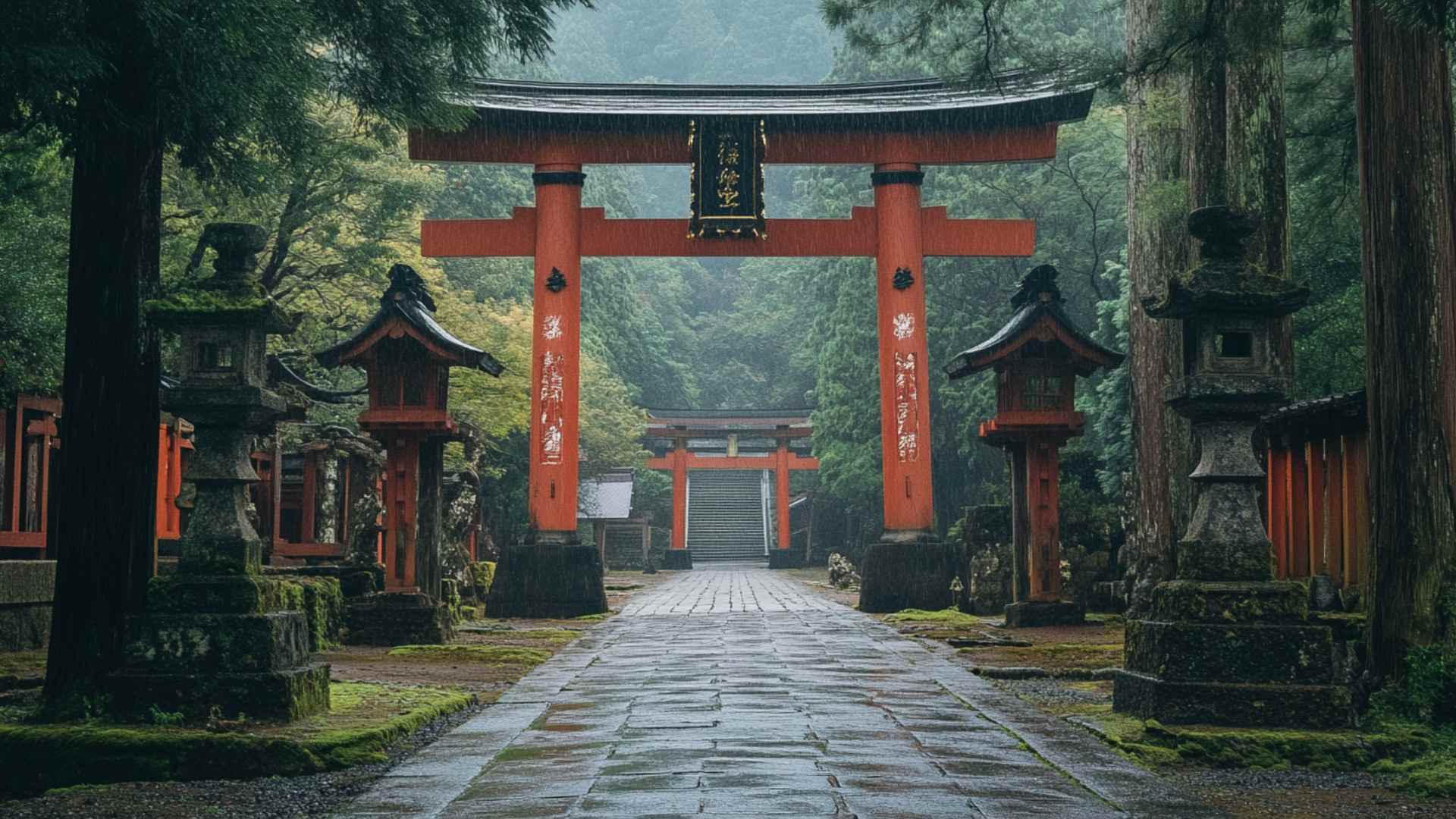
Q: What iconic gate marks the entrance to Shinto shrine precincts?
A: A torii, a liminal gateway from the ordinary to the sacred.
Q: Which grand shrine dedicated to Amaterasu is ritually rebuilt at intervals?
A: Ise Grand Shrine, renewed through shikinen sengū to transmit craft and purity.
Q: Which ancient Izumo shrine is associated with Ōkuninushi and annual kami gatherings?
A: Izumo Taisha, linked to the “Month with Kami” (Kamiarizuki) when deities convene there.
Q: What are the small wooden plaques on which worshippers write prayers?
A: Ema, votive tablets left hanging at shrine racks.
Q: What are the cloth or brocade amulets sold for protection and luck?
A: Omamori, charm pouches for travel safety, exams, health, and more.
Q: What braided sacred rope and zigzag paper mark consecrated objects or trees?
A: Shimenawa with shide, signaling a kami’s presence and warding impurity.
Q: What is the ritual of purification commonly performed with a wand of paper streamers?
A: Harai using a haraegushi or ōnusa to cleanse people and spaces.
Q: Which dance-theater forms, originally offerings to the gods, are performed at shrines?
A: Kagura, sacred music and dance with regional styles and mythic themes.
Q: Which Kyoto shrine is famed for thousands of vermilion gates ascending a hillside?
A: Fushimi Inari Taisha, a pilgrimage of torii paths honoring Inari.
Q: What earthquake folklore tells of a giant namazu (catfish) subdued beneath Japan?
A: The Namazu-e tradition: a catfish restrained by a keystone stone and deity’s power.
Syncretism: Buddhism Meets Shinto
Q: What term describes the historical blending of Buddhist and Shinto beliefs?
A: Shinbutsu-shūgō, a syncretic fusion shaping medieval religious practice.
Q: What doctrine framed kami as “local traces” of cosmic buddhas?
A: Honji suijaku, positing buddhas as true essence and kami as manifestations.
Q: With which cosmic buddha was Amaterasu often identified in medieval thought?
A: Dainichi Nyorai (Mahāvairocana), aligning solar brilliance with cosmic truth.
Q: Which war-god kami also became a Buddhist protector known as Hachiman Daibosatsu?
A: Hachiman, guardian of warriors and communities.
Q: Which deified scholar is worshipped as the kami of learning and exams?
A: Tenjin, the apotheosis of Sugawara no Michizane, patron of students.
Q: What group of jovial deities sails on the “Treasure Ship” bringing New Year luck?
A: The Seven Lucky Gods (Shichifukujin) aboard the Takarabune.
Q: Which of the Seven Lucky Gods derive from Buddhist or Hindu deities?
A: Daikokuten (Mahākāla), Bishamonten (Vaiśravaṇa), and Benzaiten (Sarasvatī), among others.
Q: Which member of the Seven is often presented as most “indigenous” to Japan?
A: Ebisu, sometimes said to be native, though origins vary by tradition.
Q: What Meiji-era policy attempted to separate Buddhism and Shinto institutions?
A: Shinbutsu bunri, state-mandated disentanglement with lasting effects on shrines and temples.
Q: What compassionate bodhisattva became immensely popular in Japan under many forms?
A: Kannon (Avalokiteśvara), venerated in temples and folk devotion alike.
Onmyōdō, Divination & Court Magic
Q: What is the name of Japan’s yin–yang-based esoteric system of divination and cosmology?
A: Onmyōdō, blending Taoist, Buddhist, and native practices for state and private rites.
Q: Who is the most famous onmyōji (court diviner) of the Heian period?
A: Abe no Seimei, a legendary master of rituals, astrology, and spirit control.
Q: Who is Seimei’s frequent rival in folklore and drama?
A: Ashiya Dōman, cast as his cunning antagonist in later tales.
Q: What term denotes the small spirit-servitors commanded by onmyōji?
A: Shikigami, magically bound entities performing tasks or protections.
Q: What government bureau managed calendrics, omens, and rituals at court?
A: The Onmyōryō, the Office of Yin-Yang, essential for auspicious state timing.
Q: What five-phase theory intertwines with yin–yang in onmyōdō calculations?
A: The gogyō (wood, fire, earth, metal, water), guiding cycles and correspondences.
Q: What protective star seal associated with Seimei resembles a pentagram?
A: The seiman, a five-pointed emblem warding malevolent forces.
Q: What directional taboo marks the “demon gate” from which harm is believed to enter?
A: The northeast (kimon), guarded symbolically by temples and rites.
Q: Which family line carried on onmyōdō traditions after Seimei?
A: The Tsuchimikado lineage, custodians of calendars, omens, and ritual expertise.
Q: What six-day folk calendar for luck still appears on modern almanacs?
A: The rokuyō, labeling days like taian (good) or butsumetsu (inauspicious).
Tengu, Oni & Monster-Slaying Epics
Q: What do horned ogres in Japanese lore wield to terrifying effect?
A: Iron clubs (kanabō), giving rise to the phrase “like giving a kanabō to an oni.”
Q: What bean-throwing ritual every spring symbolically drives out demons?
A: Setsubun: people shout “Oni wa soto! Fuku wa uchi!”—“Demons out! Fortune in!”
Q: Which capital-dwelling demon king is defeated by a band of heroes with enchanted sake?
A: Shuten-dōji of Mount Ōe, tricked and slain by Minamoto no Raikō and his retainers.
Q: What is the name of Raikō’s famed retainer who cuts off an oni’s arm at Rashōmon?
A: Watanabe no Tsuna, a legendary demon-slayer in multiple episodes.
Q: What monstrous spider opposes Raikō in tales where it masquerades as a priest?
A: The Tsuchigumo, an earth-spider demon revealed and vanquished.
Q: What coastal New Year custom features men as admonishing “ogres” visiting homes?
A: Namahage in Akita, costumed figures who warn the lazy and reward diligence.
Q: What avian mountain spirits range from crow-faced imps to long-nosed sages?
A: Tengu, including karasu-tengu and daitengu, guardians and tricksters of peaks.
Q: Which great tengu of Mount Kurama famously trains a youthful Yoshitsune?
A: Sōjōbō, a master swordsman who imparts secret arts in legend.
Q: On which mythical island do many ogres supposedly dwell and hoard treasure?
A: Onigashima (“Ogre Island”), the destination of Momotarō’s expedition.
Q: In some versions of the Shuten-dōji tale, what does the severed head do postmortem?
A: It bites at Raikō’s helmet, showing oni malice even in death.
Treasures, Talismans & Magical Items
Q: What is the collective name of the mirror, sword, and jewel symbolizing imperial authority?
A: The Three Sacred Treasures (Sanshu no Jingi), emblems of legitimacy and virtue.
Q: What are the traditional names of those three regalia?
A: Yata no Kagami (mirror), Kusanagi-no-Tsurugi (sword), and Yasakani no Magatama (jewel).
Q: What are magatama, and what do they signify in myth and archaeology?
A: Curved beads symbolizing vitality, status, and spiritual power, found in ancient burials.
Q: Which hero famously uses Kusanagi to cut grass and control winds to escape a blaze?
A: Yamato Takeru, turning disaster into victory—hence the “Grass-Cutter” epithet.
Q: What feathered garment allows celestial maidens to descend and ascend between worlds?
A: The hagoromo (feather robe), central to many “angel robe” legends.
Q: What paper or wooden slips inscribed with a deity’s name are placed at home altars?
A: Ofuda, protective talismans issued by shrines and temples.
Q: What slender fortune slips do visitors draw at shrines and tie to racks or trees?
A: Omikuji, fortunes ranging from great blessing to great curse.
Q: What good-luck mallet grants wishes in folklore and features in Issun-bōshi’s tale?
A: The uchide no kozuchi, a “lucky mallet” producing riches or transformations.
Q: What auspicious New Year motif features a ship laden with treasures and lucky gods?
A: The Takarabune, whose image under pillows is said to bring good dreams.
Q: What legendary “keystone” pins the earthquake catfish in place in Edo-period prints?
A: The kaname-ishi, a mythical stone that restrains the namazu’s thrashing.
Culture Crossovers & Modern Echoes
Q: Which studio’s films often reimagine yōkai, kami, and spirits for modern audiences?
A: Studio Ghibli—works like Spirited Away echo bathhouse gods and folk motifs.
Q: What classical theater form stages ghostly revenge and yōkai tales with stylized masks?
A: Noh, whose minimalist stages and chant evoke spectral presences.
Q: Which writer’s 19th-century collections introduced Japanese ghost stories to the West?
A: Lafcadio Hearn (Koizumi Yakumo), author of Kwaidan and other retellings.
Q: What Kyoto festival features elaborate floats and has mythic pageantry?
A: Gion Matsuri, with processions, talismans, and seasonal purification.
Q: What mountain ascetics linked to tengu lore blend Shinto, Buddhist, and folk practices?
A: Yamabushi, practitioners of Shugendō, famed for austerities and mountain rites.
Q: Which fox-protected shrine is also popular with business owners seeking prosperity?
A: Fushimi Inari Taisha, where offerings for commerce and success abound.
Q: What anime/manga trope of “spirit marriage” echoes older kitsune and onryō lore?
A: Human–spirit unions, often testing vows, gratitude, and taboo in updated settings.
Q: What popular summer pastime involves telling ghost stories to induce chills?
A: Hyakumonogatari Kaidankai, once a candle-lit game of a hundred tales.
Q: Which festival’s bean-throwing often appears in TV dramas and school events?
A: Setsubun, dramatized with paper oni masks and shouted blessings.
Q: What shrine practice lets visitors stamp booklets as a record of pilgrimages?
A: Collecting goshuin—calligraphic seals from shrines and temples.
Nature Spirits, Animals & Weather Lore
Q: What term describes the myriad nature-spirits inhabiting rocks, trees, and rivers?
A: Kami—beings of awe and agency, not strictly “gods” in the Western sense.
Q: Which deity of thunder and drums is depicted with a ring of taiko around him?
A: Raijin, thunder kami, often paired with the wind god Fūjin.
Q: Which fox-related phenomenon explains mysterious lights flickering over fields?
A: Kitsune-bi (“foxfire”), phosphorescent or illusionary lights in folk belief.
Q: Which river goblin is blamed for drownings yet respected for medical knowledge?
A: The kappa, sometimes said to know bone-setting and reward kindness.
Q: Which crane and turtle pair symbolize longevity and good fortune in art and lore?
A: Tsuru (crane) and kame (turtle), classic auspicious emblems.
Q: Which deer-roaming shrine town treats deer as messengers of the kami?
A: Nara’s Kasuga Taisha vicinity, where deer are traditionally protected.
Q: Which mountain is sacred to the blossom princess and central to pilgrimage and art?
A: Mount Fuji, linked to Konohanasakuya-hime and enduring spiritual awe.
Q: What rope-bound sacred boulders off Mie Prefecture symbolize divine marriage?
A: Meoto Iwa (“Wedded Rocks”), ritually connected by shimenawa.
Q: Which earthquake-print genre satirized disasters with catfish imagery?
A: Namazu-e, woodblock prints depicting the quake-causing namazu and social commentary.
Q: Which harvest rite thanks the rice deity with offerings of the first fruits?
A: Niiname-sai, a thanksgiving festival rooted in agrarian cosmology.
From creation spears and sunlit caves to tengu sages and treasure-laden ships, you’ve journeyed across a millennium of tales.
Keep exploring, every shrine path, festival dance, and folk story holds another clue for your next high score in Japanese mythology & folklore trivia!

Ellie Simons creates and edits Random Trivia. She researches trivia using primary and authoritative sources whenever possible and is currently reviewing the site's older trivia library for accuracy, clarity, and playability. Read more on the About page.
About this quiz
Site editor: Ellie Simons. Read our Trivia Methodology to learn how questions are researched and updated. Page last updated: . Report an error.