
Hop on a bicycle and mind the canal edge, because the Netherlands packs an astonishing amount into a very flat map.
These Netherlands trivia questions explore ingenious waterworks, Golden Age art, historic cities, beloved snacks, scientific breakthroughs, and plenty of orange.
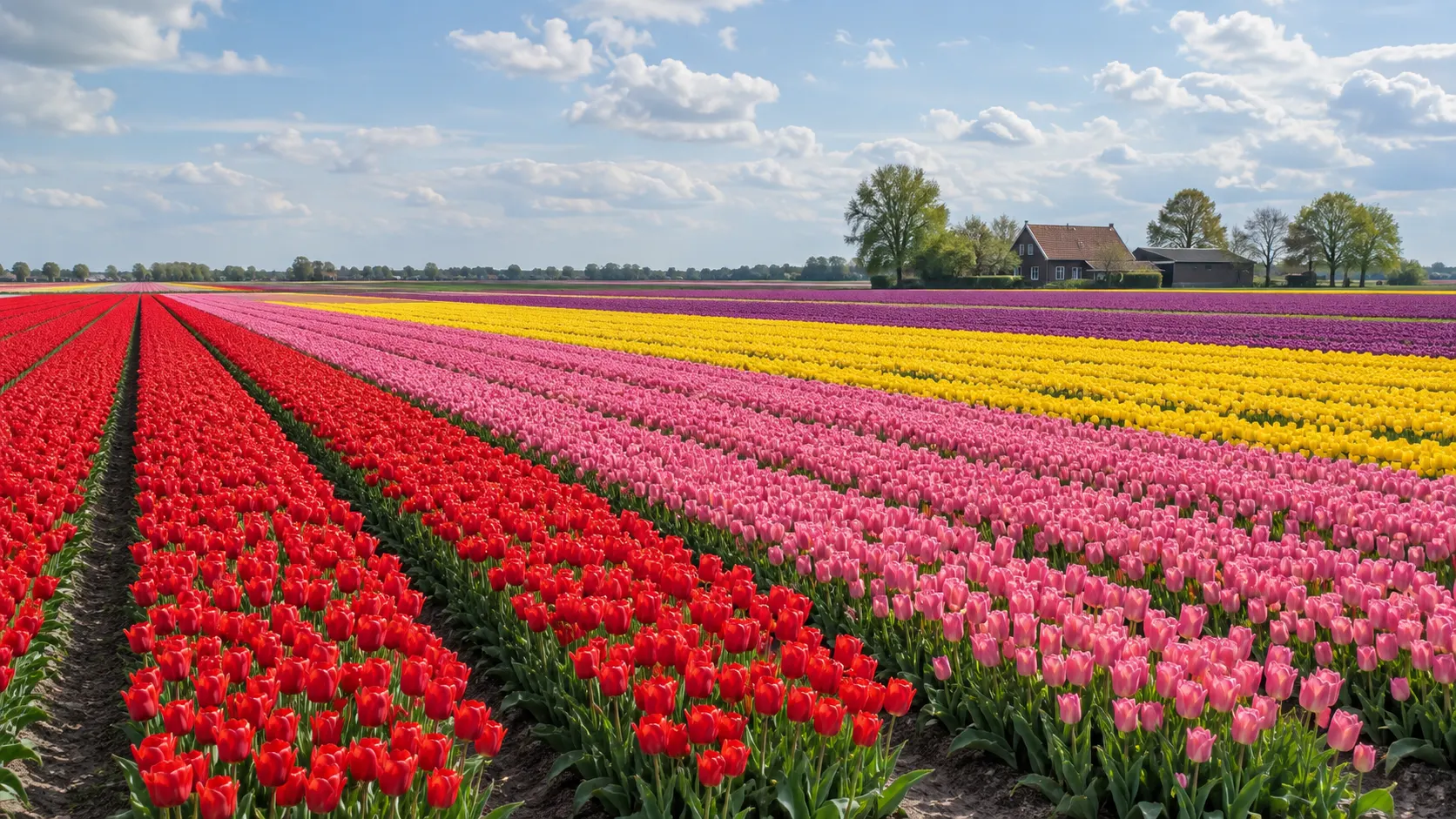
The Netherlands on the Map
Q: What is the capital of the Netherlands?
A: Amsterdam.
Q: In which city are the Dutch government and parliament based?
A: The Hague.
Q: Which sea borders the Netherlands?
A: The North Sea.
Q: Which two countries border the European Netherlands?
A: Germany and Belgium.
Q: How many provinces make up the European Netherlands?
A: Twelve.
Q: What is the official language of the Netherlands?
A: Dutch.
Q: Which second official language is recognized in the province of Friesland?
A: West Frisian.
Q: What currency is used in the European Netherlands?
A: The euro.
Q: What does the name “Netherlands” refer to geographically?
A: Low-lying lands.
Q: What is Holland in relation to the Netherlands?
A: A region consisting of North Holland and South Holland, not the whole country.
Q: Which three major European rivers form a delta in the Netherlands?
A: The Rhine, Meuse, and Scheldt.
Q: What is the highest point in the European Netherlands?
A: Vaalserberg.
Q: What is the highest point in the entire country of the Netherlands?
A: Mount Scenery on Saba.
Q: Which Caribbean islands are special municipalities of the Netherlands?
A: Bonaire, Sint Eustatius, and Saba.
Q: What is the national flag's color order from top to bottom?
A: Red, white, and blue.
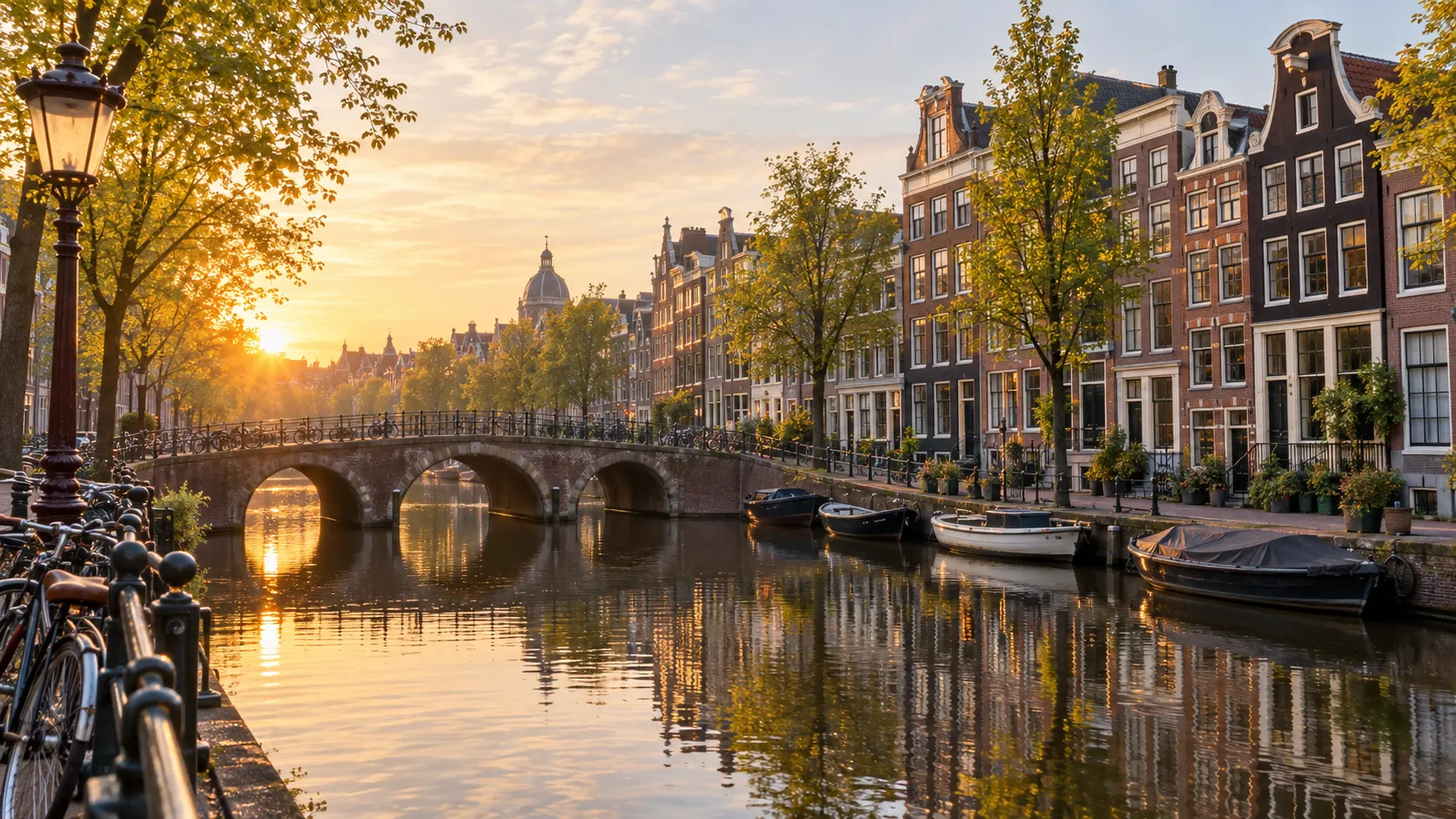
Amsterdam's Canals and Museums
Q: Which river gives Amsterdam its name?
A: The Amstel.
Q: What 17th-century urban feature forms concentric rings around central Amsterdam?
A: The canal belt.
Q: What is the Dutch name for Amsterdam's canal belt?
A: Grachtengordel.
Q: Which museum displays Rembrandt's The Night Watch?
A: The Rijksmuseum.
Q: Which museum holds the world's largest collection of Vincent van Gogh's work?
A: The Van Gogh Museum.
Q: What historic house preserves the hiding place where Anne Frank wrote her diary?
A: The Anne Frank House.
Q: What central Amsterdam square is home to the Royal Palace?
A: Dam Square.
Q: What was the Royal Palace on Dam Square originally built to be?
A: Amsterdam's city hall.
Q: What is the main railway station in central Amsterdam called?
A: Amsterdam Centraal.
Q: What nickname is given to Amsterdam's famous skinny drawbridge?
A: The Magere Brug, or Skinny Bridge.
Q: What decorative roofline feature distinguishes many Amsterdam canal houses?
A: Ornamental gables.
Q: What beam-and-hook feature helped residents move furniture into narrow canal houses?
A: Hoisting beams on the gables.
Q: What is Amsterdam's large urban park named after a Dutch playwright?
A: Vondelpark.
Q: Which mode of transportation is famously common in Amsterdam?
A: Bicycles.
Q: Which former brewery houses the Heineken Experience?
A: Heineken's original Amsterdam brewery.
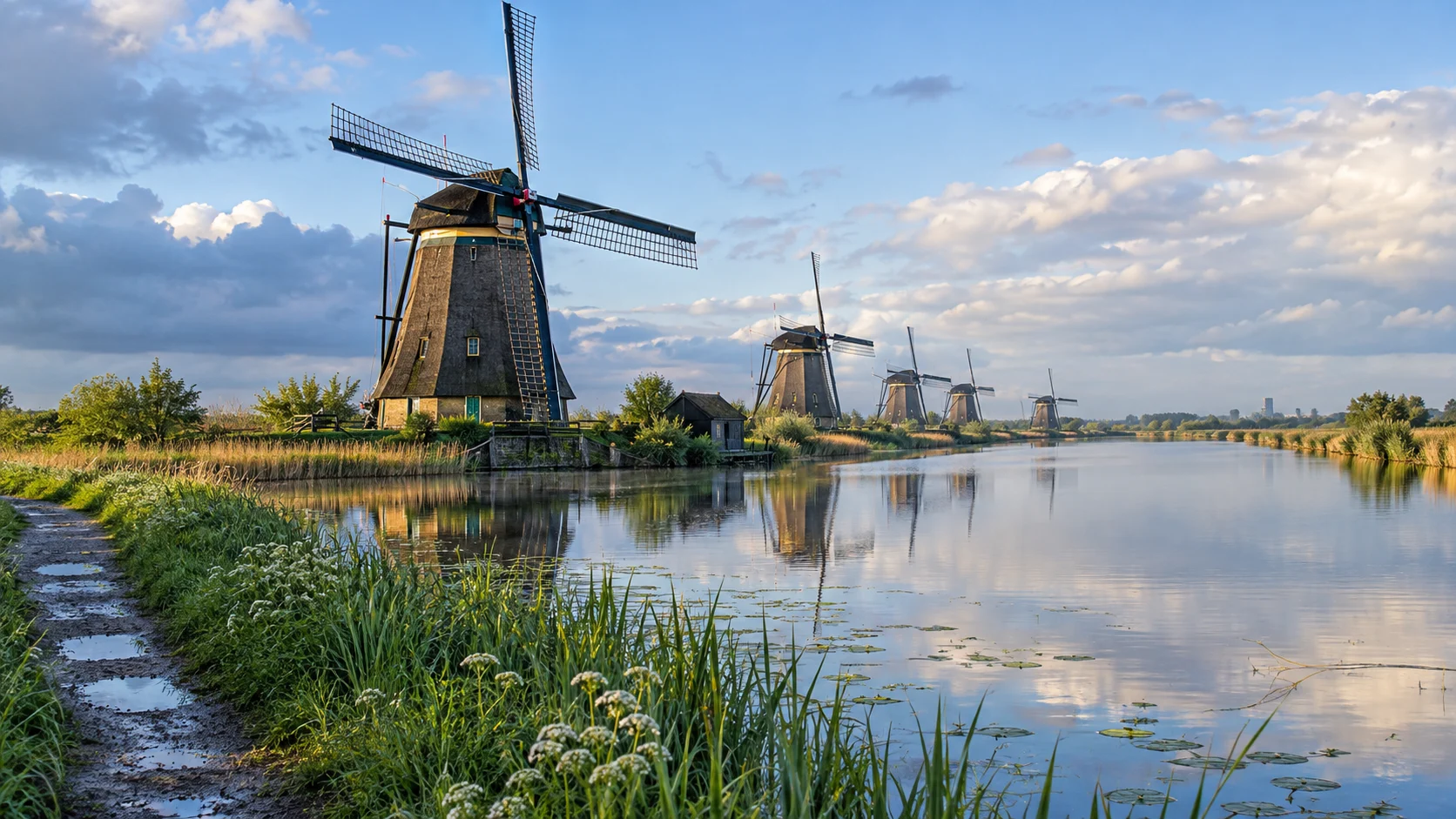
Water, Windmills, and New Land
Q: What is a polder?
A: Low-lying land reclaimed from water and protected by dikes.
Q: What structures have long helped pump water from Dutch polders?
A: Windmills.
Q: What UNESCO site has 19 historic windmills near Rotterdam?
A: Kinderdijk.
Q: What massive Dutch project closed off part of the Zuiderzee?
A: The Zuiderzee Works.
Q: What long causeway separates the IJsselmeer from the Wadden Sea?
A: The Afsluitdijk.
Q: What freshwater lake was created from much of the former Zuiderzee?
A: The IJsselmeer.
Q: Which Dutch province was largely created through land reclamation?
A: Flevoland.
Q: What catastrophic 1953 disaster killed more than 1,800 people in the Netherlands?
A: The North Sea flood.
Q: What ambitious flood-control system was built after the 1953 disaster?
A: The Delta Works.
Q: Which movable storm-surge barrier protects the approach to Rotterdam?
A: The Maeslantkering.
Q: What are the artificial mounds built as ancient refuges from floods in the north called?
A: Terpen.
Q: What shallow coastal sea lies between the Dutch mainland and the Frisian Islands?
A: The Wadden Sea.
Q: What is the largest of the Dutch West Frisian Islands?
A: Texel.
Q: Which engineering field has become a Dutch specialty because of the country's geography?
A: Water management.
Q: Which engineer developed the plan behind the Zuiderzee Works?
A: Cornelis Lely.
Revolt, Republic, and Golden Age
Q: Which Germanic people lived near the Rhine delta in Roman times?
A: The Batavians.
Q: Which European dynasty ruled the Low Countries before the Dutch Revolt?
A: The Habsburgs.
Q: What long revolt against Spanish rule began in 1568?
A: The Eighty Years' War.
Q: Who is known as the Father of the Fatherland in Dutch history?
A: William the Silent.
Q: Which royal house descends from William the Silent?
A: The House of Orange-Nassau.
Q: What 1579 alliance helped unite the northern provinces?
A: The Union of Utrecht.
Q: What 1581 declaration rejected the Spanish king's authority?
A: The Act of Abjuration.
Q: What republic emerged from the rebellious northern provinces?
A: The Dutch Republic.
Q: Which 1648 peace recognized Dutch independence from Spain?
A: The Peace of Münster.
Q: What century is usually called the Dutch Golden Age?
A: The 17th century.
Q: What powerful trading company was founded in 1602?
A: The Dutch East India Company, or VOC.
Q: What was the VOC's Dutch name?
A: Vereenigde Oostindische Compagnie.
Q: What speculative craze involved rare flower bulbs in the 1630s?
A: Tulip mania.
Q: Which Dutch city became a global center of trade and finance during the Golden Age?
A: Amsterdam.
Q: What title was used for the chief executive in several Dutch provinces?
A: Stadtholder.
Kingdom, War, and Modern Change
Q: In what year was the Kingdom of the Netherlands established?
A: 1815.
Q: Which neighboring country broke away from the kingdom in 1830?
A: Belgium.
Q: Which war reached the neutral Netherlands in May 1940?
A: World War II.
Q: Which city was heavily bombed during the German invasion of 1940?
A: Rotterdam.
Q: What name is given to the Dutch famine during the winter of 1944 to 1945?
A: The Hunger Winter.
Q: Which Jewish teenager wrote a famous diary while hiding in Amsterdam?
A: Anne Frank.
Q: In what year was the Netherlands liberated from German occupation?
A: 1945.
Q: On what date does the Netherlands commemorate those killed in wars and peacekeeping missions?
A: May 4.
Q: On what date does the Netherlands celebrate liberation?
A: May 5.
Q: Which Indonesian city was once called Batavia under Dutch colonial rule?
A: Jakarta.
Q: What South American country gained independence from the Netherlands in 1975?
A: Suriname.
Q: Which treaty signed in a Dutch city created the European Union?
A: The Maastricht Treaty.
Q: In what year was the Maastricht Treaty signed?
A: 1992.
Q: What form of government does the Netherlands have?
A: A constitutional monarchy and parliamentary democracy.
Q: What color is closely associated with the Dutch royal family?
A: Orange.
Dutch Masters and Design
Q: Who painted The Night Watch?
A: Rembrandt van Rijn.
Q: Which Delft painter created Girl with a Pearl Earring?
A: Johannes Vermeer.
Q: Which artist painted The Starry Night and many versions of Sunflowers?
A: Vincent van Gogh.
Q: Which Dutch artist helped found the De Stijl movement?
A: Piet Mondrian.
Q: What colors and forms characterize Mondrian's best-known abstract works?
A: Primary colors, black lines, and rectangular grids.
Q: Which Dutch graphic artist created mathematically inspired impossible spaces?
A: M.C. Escher.
Q: Which portrait painter became famous for lively group scenes such as militia companies?
A: Frans Hals.
Q: What blue-and-white pottery is associated with the city of Delft?
A: Delftware.
Q: What art movement's name means “The Style” in Dutch?
A: De Stijl.
Q: Which architect designed the Rietveld Schröder House?
A: Gerrit Rietveld.
Q: What wooden footwear is a traditional Dutch symbol?
A: Clogs, or klompen.
Q: What spring garden near Lisse is famous for millions of flowering bulbs?
A: Keukenhof.
Q: Which flower became an enduring symbol of the Netherlands?
A: The tulip.
Q: What April holiday fills Dutch streets with orange clothing and markets?
A: King's Day.
Q: What traditional winter gift-giver arrives by steamboat?
A: Sinterklaas.
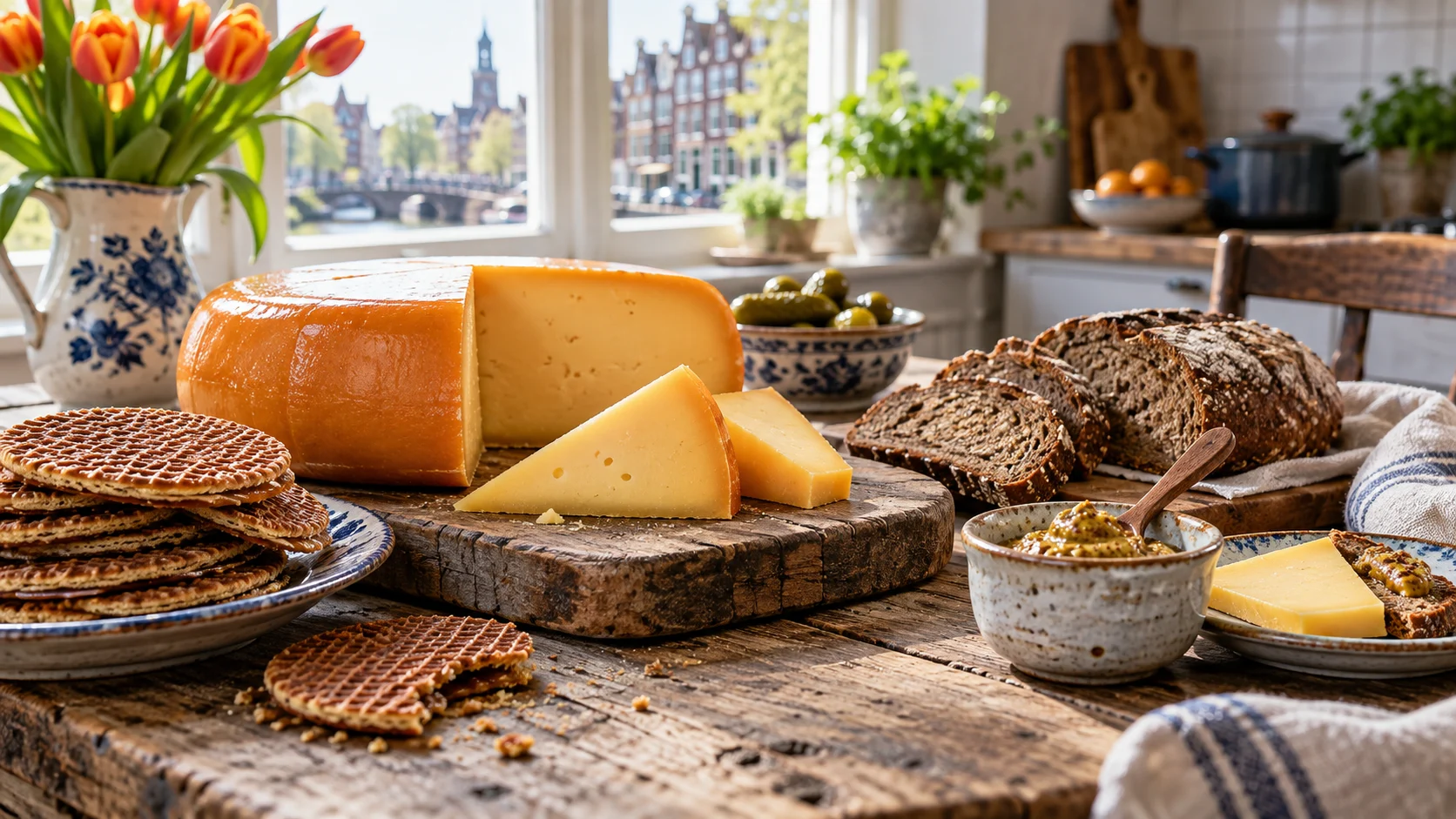
Cheese, Sweets, and Dutch Comfort Food
Q: What syrup-filled waffle cookie is a Dutch favorite?
A: Stroopwafel.
Q: Which cheese is named for a city in South Holland?
A: Gouda.
Q: Which round cheese is named for a North Holland town?
A: Edam.
Q: What snack consists of raw herring often served with onions and pickles?
A: Hollandse nieuwe.
Q: What are bitterballen?
A: Breaded, deep-fried balls filled with a thick meat ragout.
Q: What tiny fluffy pancakes are served with butter and powdered sugar?
A: Poffertjes.
Q: What deep-fried dough treats are eaten around New Year's Eve?
A: Oliebollen.
Q: What thick split-pea soup is also called snert?
A: Erwtensoep.
Q: What dish mashes potatoes with vegetables such as kale or sauerkraut?
A: Stamppot.
Q: What chocolate sprinkles are commonly eaten on bread?
A: Hagelslag.
Q: What spiced biscuit is associated with Sinterklaas season?
A: Speculaas.
Q: What salty licorice candy do many Dutch people love?
A: Drop.
Q: What Indonesian-inspired feast became part of Dutch food culture?
A: Rijsttafel.
Q: What juniper-flavored Dutch spirit preceded modern gin?
A: Jenever.
Q: What fast-food vending-wall concept is found in many Dutch cities?
A: An automat, famously used by FEBO.
Cities, Science, and Sports
Q: Which Dutch city has one of Europe's largest ports?
A: Rotterdam.
Q: What cube-shaped homes are a Rotterdam architectural landmark?
A: The Cube Houses.
Q: What nickname is given to Rotterdam's Erasmus Bridge?
A: The Swan.
Q: Which city is home to the Peace Palace?
A: The Hague.
Q: Which United Nations court sits in the Peace Palace?
A: The International Court of Justice.
Q: Which university city has the country's tallest church tower, the Dom Tower?
A: Utrecht.
Q: Which Dutch university was founded in 1575?
A: Leiden University.
Q: Which scientist improved microscopes and observed microorganisms?
A: Antoni van Leeuwenhoek.
Q: Which Dutch scientist invented a practical pendulum clock?
A: Christiaan Huygens.
Q: Which physicist discovered superconductivity in 1911?
A: Heike Kamerlingh Onnes.
Q: Which Dutch company was founded in Eindhoven as a lightbulb manufacturer?
A: Philips.
Q: What soccer philosophy is associated with Dutch teams of the 1970s?
A: Total Football.
Q: Which Dutch star became the great symbol of Total Football?
A: Johan Cruyff.
Q: In what year did the Netherlands win the men's UEFA European Championship?
A: 1988.
Q: What legendary skating tour links eleven Frisian cities?
A: The Elfstedentocht.
One More Lap Around the Canals
If you kept every polder, painter, and pastry straight, your score deserves a bouquet of tulips. Continue across Europe with our Greece trivia or head to famous people trivia for more remarkable names.

Ellie Ewert is the founder and author of RandomTrivia.co, blending her passion for research with years of experience in content creation to deliver accurate, engaging, and well-sourced trivia. Dedicated to providing readers with trustworthy and entertaining facts, she applies meticulous fact-checking and SEO expertise to ensure every article meets the highest standards. Read more about our high standards in our Editorial Guidelines.