
Saddle up, because this Mongol Empire trivia set crosses more ground than a relay rider with fresh horses waiting.
From Temüjin's rise on the steppe to four sprawling khanates, these questions explore conquest, diplomacy, trade, belief, and a legacy that reshaped Eurasia.
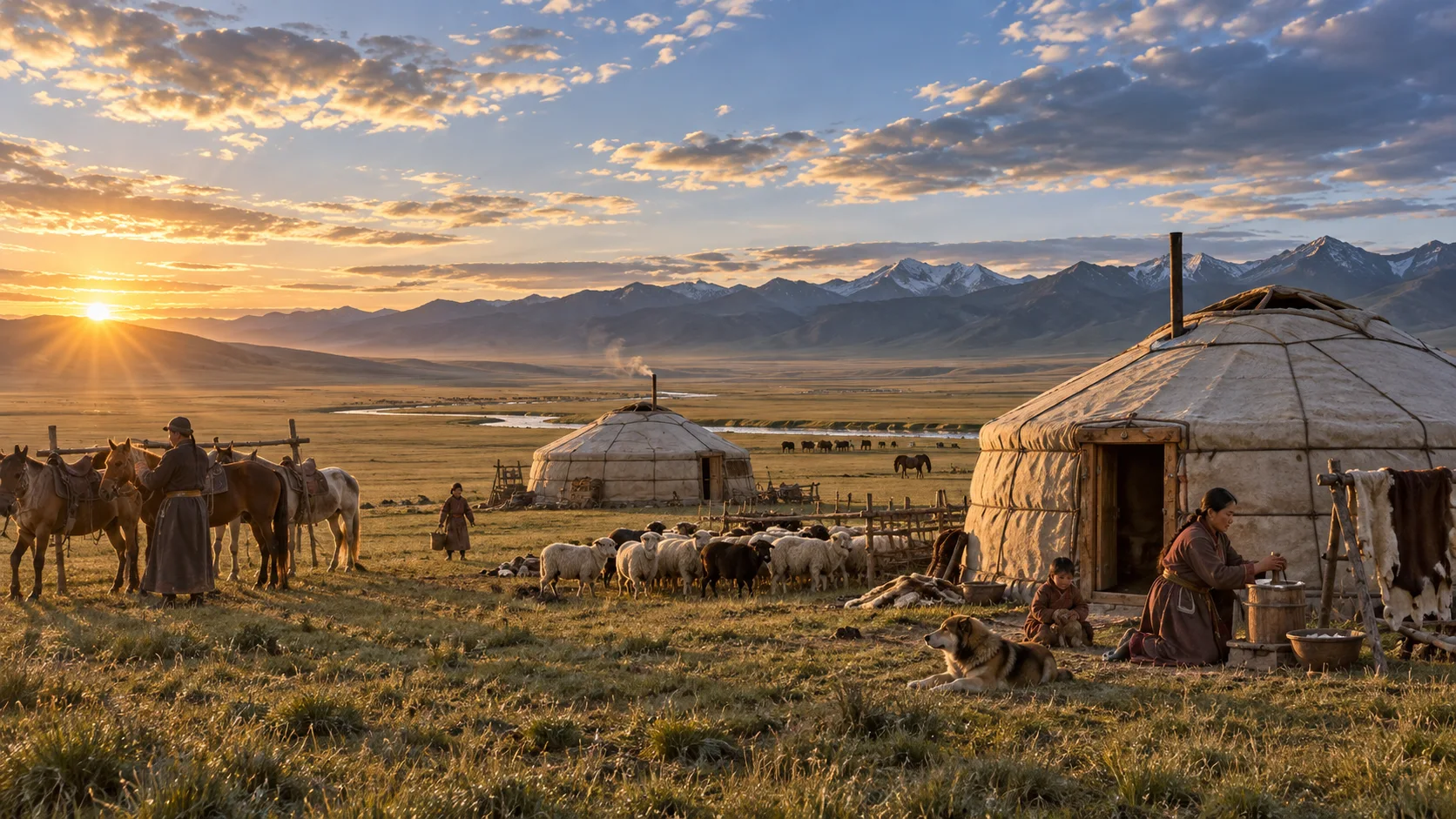
Steppe Geography and Mongol Beginnings
Q: On which broad grassland did the Mongols emerge?
A: The Eurasian steppe.
Q: Which modern country contains the Mongol heartland?
A: Mongolia.
Q: What is the traditional portable dwelling of Mongol nomads called?
A: A ger, also called a yurt.
Q: What livestock animal was essential for Mongol transport and warfare?
A: The horse.
Q: What was Genghis Khan's birth name?
A: Temüjin.
Q: Near which river was Temüjin probably born?
A: The Onon River.
Q: Who was Temüjin's father?
A: Yesügei.
Q: Who was Temüjin's mother, remembered for holding the family together after Yesügei's death?
A: Hö'elün.
Q: Who became Temüjin's principal wife?
A: Börte.
Q: Which rival was once Temüjin's anda, or sworn brother?
A: Jamukha.
Q: What assembly of leaders selected and confirmed major Mongol rulers?
A: A kurultai.
Q: In what year was Temüjin proclaimed Genghis Khan?
A: 1206.
Q: What title did Temüjin receive after uniting the Mongol tribes?
A: Genghis Khan.
Q: What major narrative source recounts Temüjin's early life and Mongol traditions?
A: The Secret History of the Mongols.
Q: What seasonal movement helped pastoral communities find fresh grazing land?
A: Nomadic migration.
Genghis Khan Builds an Empire
Q: Which kingdom in northwestern China became an early target of Genghis Khan?
A: Western Xia.
Q: Which dynasty ruled northern China when the Mongols invaded in 1211?
A: The Jin dynasty.
Q: What city, then called Zhongdu, did the Mongols capture in 1215?
A: Beijing.
Q: Which Central Asian empire was invaded after a trade caravan and envoys were killed?
A: The Khwarazmian Empire.
Q: In which city were members of the Mongol caravan arrested and killed?
A: Otrar.
Q: Which Khwarazmian ruler fled westward from the Mongol invasion?
A: Muhammad II.
Q: Which great Central Asian city fell to Genghis Khan's forces in 1220?
A: Bukhara.
Q: Which city, the Khwarazmian capital, endured a major Mongol siege?
A: Gurganj, or Urgench.
Q: Which two generals led a long reconnaissance campaign west of the Caspian Sea?
A: Jebe and Subutai.
Q: At what 1223 battle did Jebe and Subutai defeat a coalition of Rus princes and Cumans?
A: The Battle of the Kalka River.
Q: In what year did Genghis Khan die?
A: 1227.
Q: During a campaign against which kingdom did Genghis Khan die?
A: Western Xia.
Q: Has the location of Genghis Khan's tomb been conclusively identified?
A: No.
Q: Which son of Genghis Khan received lands in Central Asia?
A: Chagatai.
Q: Which youngest son inherited much of the Mongol homeland under steppe custom?
A: Tolui.
Great Khans and Far-Flung Campaigns
Q: Who succeeded Genghis Khan as Great Khan?
A: Ögedei.
Q: What city did Ögedei develop as the imperial capital?
A: Karakorum.
Q: Which grandson of Genghis Khan led the conquest of much of the Rus lands?
A: Batu Khan.
Q: Which brilliant general helped direct the Mongol invasion of Europe?
A: Subutai.
Q: What 1241 battle ended in a Mongol victory over a European coalition in Poland?
A: The Battle of Legnica.
Q: What 1241 battle brought a major Mongol victory over Hungary?
A: The Battle of Mohi.
Q: Which Great Khan's death in 1241 helped prompt Mongol commanders to withdraw from Central Europe?
A: Ögedei's.
Q: Who became Great Khan in 1246 after a regency led by his mother?
A: Güyük.
Q: Which son of Tolui became Great Khan in 1251?
A: Möngke.
Q: Which brother of Möngke conquered Baghdad in 1258?
A: Hülegü.
Q: Which caliphate's rule in Baghdad ended with the Mongol conquest?
A: The Abbasid Caliphate.
Q: At what 1260 battle did the Mamluks defeat a Mongol army?
A: The Battle of Ain Jalut.
Q: Which grandson of Genghis Khan founded China's Yuan dynasty?
A: Kublai Khan.
Q: In what year did Kublai proclaim the Yuan dynasty?
A: 1271.
Q: Which Chinese dynasty was fully conquered by the Yuan in 1279?
A: The Southern Song dynasty.
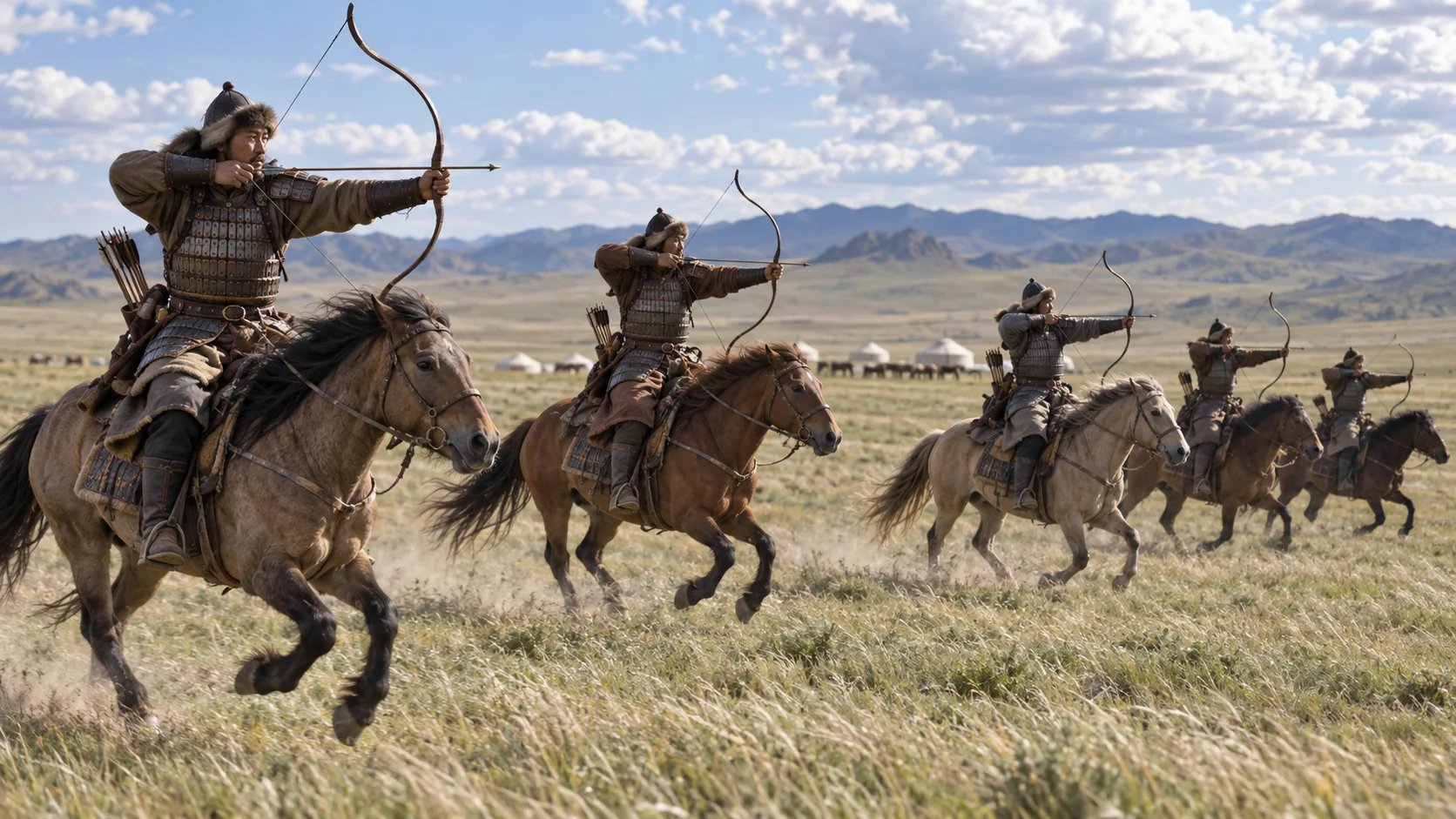
Horse Archers and Battlefield Strategy
Q: What compact weapon gave Mongol riders great range and power?
A: The composite bow.
Q: What tactic lured enemies into pursuit before a sudden counterattack?
A: The feigned retreat.
Q: Why did Mongol warriors often travel with several horses?
A: They could switch mounts to maintain speed.
Q: What was the smallest standard unit in the Mongol decimal military system?
A: An arban of ten.
Q: How many warriors made up a jaghun?
A: One hundred.
Q: How many warriors made up a mingghan?
A: One thousand.
Q: How many warriors were organized in a tümen?
A: Ten thousand.
Q: What signal devices helped commanders coordinate troops across wide battlefields?
A: Flags, horns, and drums.
Q: What food could riders carry as lightweight dried provisions?
A: Dried meat.
Q: What fermented mare's milk drink was common on the steppe?
A: Airag, or kumis.
Q: What type of specialists helped the Mongols capture fortified cities?
A: Siege engineers.
Q: From which conquered regions did Mongol armies recruit many engineers?
A: China, Persia, and Central Asia.
Q: What did Mongol commanders often do before invading unfamiliar territory?
A: Gather intelligence through scouts and spies.
Q: What policy could persuade a city to surrender without a prolonged siege?
A: Offering lenient terms for prompt submission.
Q: What reputation did Mongol forces deliberately cultivate to discourage resistance?
A: A reputation for devastating punishment.
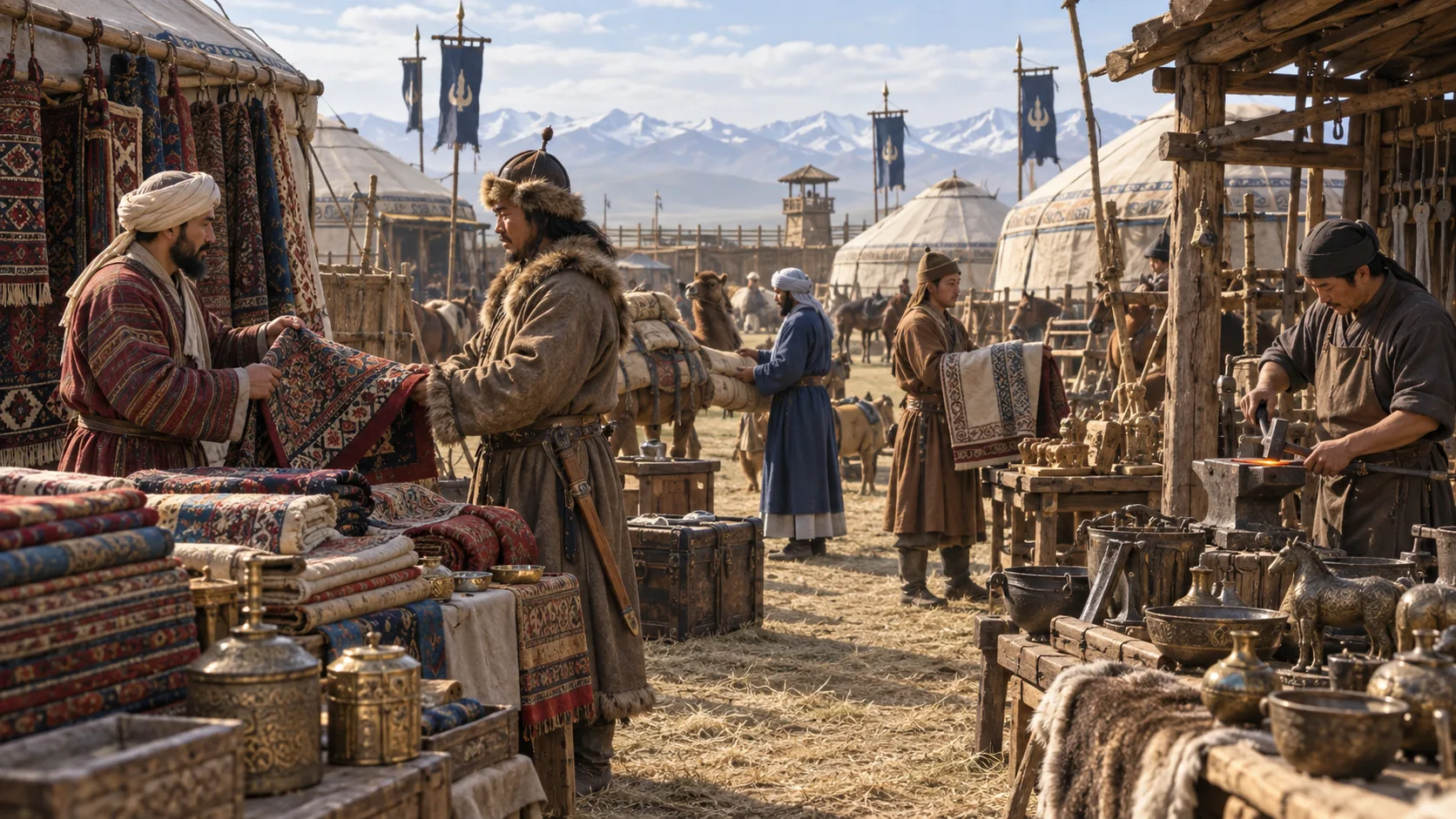
Law, Belief, and Life at Court
Q: What name is often given to the body of rules associated with Genghis Khan?
A: The Yassa.
Q: Does a complete original text of the Yassa survive?
A: No.
Q: What sky deity held a central place in traditional Mongol belief?
A: Tengri.
Q: What religious specialists communicated with the spirit world in Mongol tradition?
A: Shamans.
Q: What policy allowed Christians, Muslims, Buddhists, and others to worship under Mongol rule?
A: Religious tolerance.
Q: Which branch of Christianity had followers among some Mongol and allied steppe peoples?
A: The Church of the East.
Q: What title could be used for a Mongol queen or noblewoman?
A: Khatun.
Q: Which widow of Ögedei served as regent and promoted Güyük's election?
A: Töregene Khatun.
Q: Which influential mother raised Möngke, Kublai, Hülegü, and Ariq Böke?
A: Sorghaghtani Beki.
Q: Which script was adapted to write Mongolian under Genghis Khan?
A: The Uyghur script.
Q: In what direction is traditional Mongolian script written?
A: Vertically from top to bottom.
Q: What did elite Mongol women often manage while men campaigned?
A: Households, herds, estates, and political affairs.
Q: What practice distributed conquered people and resources among imperial family members?
A: Appanage allocation.
Q: What dried curd snack provided portable dairy food on the steppe?
A: Aaruul.
Q: What material covered the wooden frame of a traditional ger?
A: Felt.
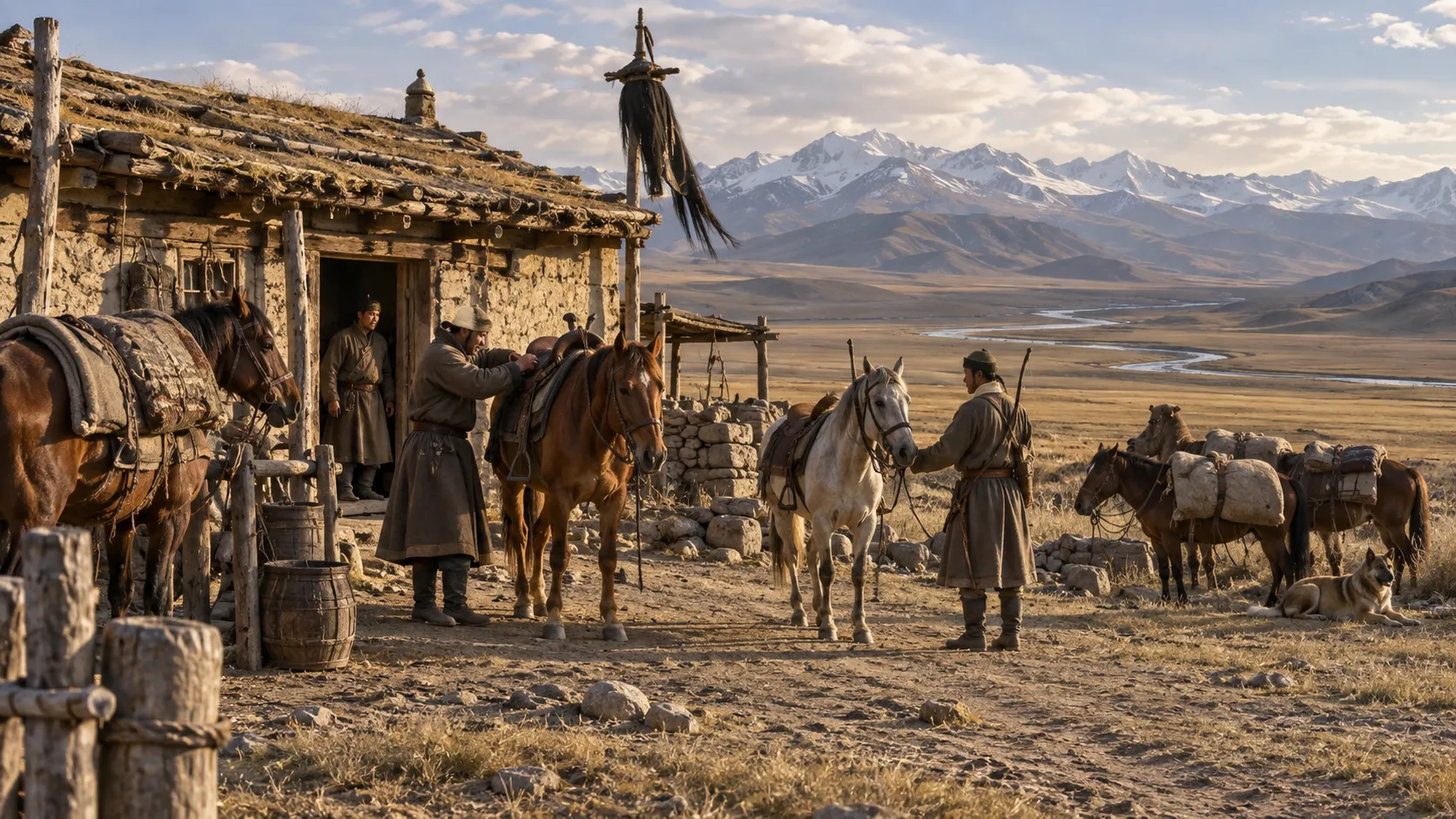
Messengers, Merchants, and the Pax Mongolica
Q: What relay-post network sped messages across Mongol territory?
A: The yam.
Q: What tablet gave officials and envoys authority to use relay stations?
A: A paiza.
Q: What modern phrase describes the relative security of Eurasian trade under Mongol rule?
A: Pax Mongolica.
Q: Which trade-route network benefited from Mongol control across much of Eurasia?
A: The Silk Roads.
Q: Which Venetian traveler described the court of Kublai Khan?
A: Marco Polo.
Q: Which Franciscan friar traveled to the Mongol court for Pope Innocent IV?
A: John of Plano Carpini.
Q: Which Flemish Franciscan visited Möngke's court at Karakorum?
A: William of Rubruck.
Q: What kind of artisans did Mongol rulers frequently relocate across the empire?
A: Skilled craftspeople.
Q: What Chinese invention helped spread documents and texts across Eurasia?
A: Printing.
Q: What explosive technology traveled westward from China during the Mongol era?
A: Gunpowder technology.
Q: What monetary innovation did Kublai's Yuan government use on a large scale?
A: Paper money.
Q: Which Persian historian wrote a sweeping universal history for the Ilkhanate?
A: Rashid al-Din.
Q: What is Rashid al-Din's famous history called?
A: Jami al-Tawarikh.
Q: Which devastating disease also traveled along Eurasian trade and military routes in the 14th century?
A: The Black Death.
Q: What was one cost of increased long-distance connection under Mongol rule?
A: Diseases could spread more widely.
Four Khanates, Four Directions
Q: What khanate ruled much of the western steppe and the Rus principalities?
A: The Golden Horde.
Q: Who founded the Golden Horde's ruling line?
A: Batu Khan.
Q: What city on the lower Volga became a Golden Horde capital?
A: Sarai.
Q: Which Golden Horde ruler converted to Islam and clashed with Hülegü?
A: Berke Khan.
Q: What tribute relationship tied many Rus princes to the Golden Horde?
A: They paid taxes and received authority from the khan.
Q: What Mongol state ruled Persia and neighboring lands?
A: The Ilkhanate.
Q: Who founded the Ilkhanate?
A: Hülegü.
Q: Which Ilkhan converted to Islam in 1295?
A: Ghazan Khan.
Q: What khanate covered much of Central Asia?
A: The Chagatai Khanate.
Q: Which son of Genghis Khan gave the Chagatai Khanate its name?
A: Chagatai.
Q: What dynasty ruled China and Mongolia from Kublai's reign?
A: The Yuan dynasty.
Q: What city did Kublai make his principal capital, calling it Dadu?
A: Beijing.
Q: Which rebel leader founded the Ming dynasty and expelled the Yuan from China in 1368?
A: Zhu Yuanzhang.
Q: To what region did the Yuan court retreat after losing China?
A: Mongolia.
Q: What name is given to the post-1368 Yuan regime in Mongolia?
A: The Northern Yuan.
Invasions at Sea and a Continental Legacy
Q: Which island nation did Kublai Khan try to invade in 1274 and 1281?
A: Japan.
Q: What Japanese word for “divine wind” became associated with storms that struck the invasion fleets?
A: Kamikaze.
Q: Which Southeast Asian kingdom resisted a Yuan invasion and later became a tributary?
A: Đại Việt.
Q: Which general is celebrated in Vietnam for defeating Mongol-led invasions?
A: Trần Hưng Đạo.
Q: Which island did a Yuan expedition unsuccessfully invade in 1293?
A: Java.
Q: Which Southeast Asian kingdom emerged soon after the Yuan expedition left Java?
A: Majapahit.
Q: What record does the Mongol Empire hold among contiguous land empires?
A: It was the largest in history.
Q: At its height, the empire stretched from the Pacific toward which European river region?
A: The Danube region.
Q: Did all Mongol successor states keep traditional steppe religion?
A: No, rulers adopted religions including Islam and Buddhism.
Q: Which form of Buddhism gained strong support under Kublai Khan?
A: Tibetan Buddhism.
Q: Which Tibetan lama became a leading religious adviser to Kublai?
A: Phagpa.
Q: What script did Phagpa design for Kublai's multilingual empire?
A: The Phagpa script.
Q: Which later conqueror ruled from Samarkand and sought legitimacy through marriage ties to Genghis Khan's family?
A: Timur.
Q: What dynasty founded by Timur carried steppe imperial traditions into Central and South Asia?
A: The Timurid dynasty.
Q: Which modern nation honors Genghis Khan as a central historical figure?
A: Mongolia.
Your Ride Across Eurasia Is Complete
If you kept pace from the Onon River to the Golden Horde, your score belongs at the front of the column. Continue the historical adventure with our famous people trivia and decades trivia.

Ellie Ewert is the founder and author of RandomTrivia.co, blending her passion for research with years of experience in content creation to deliver accurate, engaging, and well-sourced trivia. Dedicated to providing readers with trustworthy and entertaining facts, she applies meticulous fact-checking and SEO expertise to ensure every article meets the highest standards. Read more about our high standards in our Editorial Guidelines.