
Bone up on human skeleton trivia, from the tiny stapes to the mighty femur.
These questions explore the body's framework, joints, marrow, movement, growth, and a whole closetful of memorable bone names.
Your Living Framework
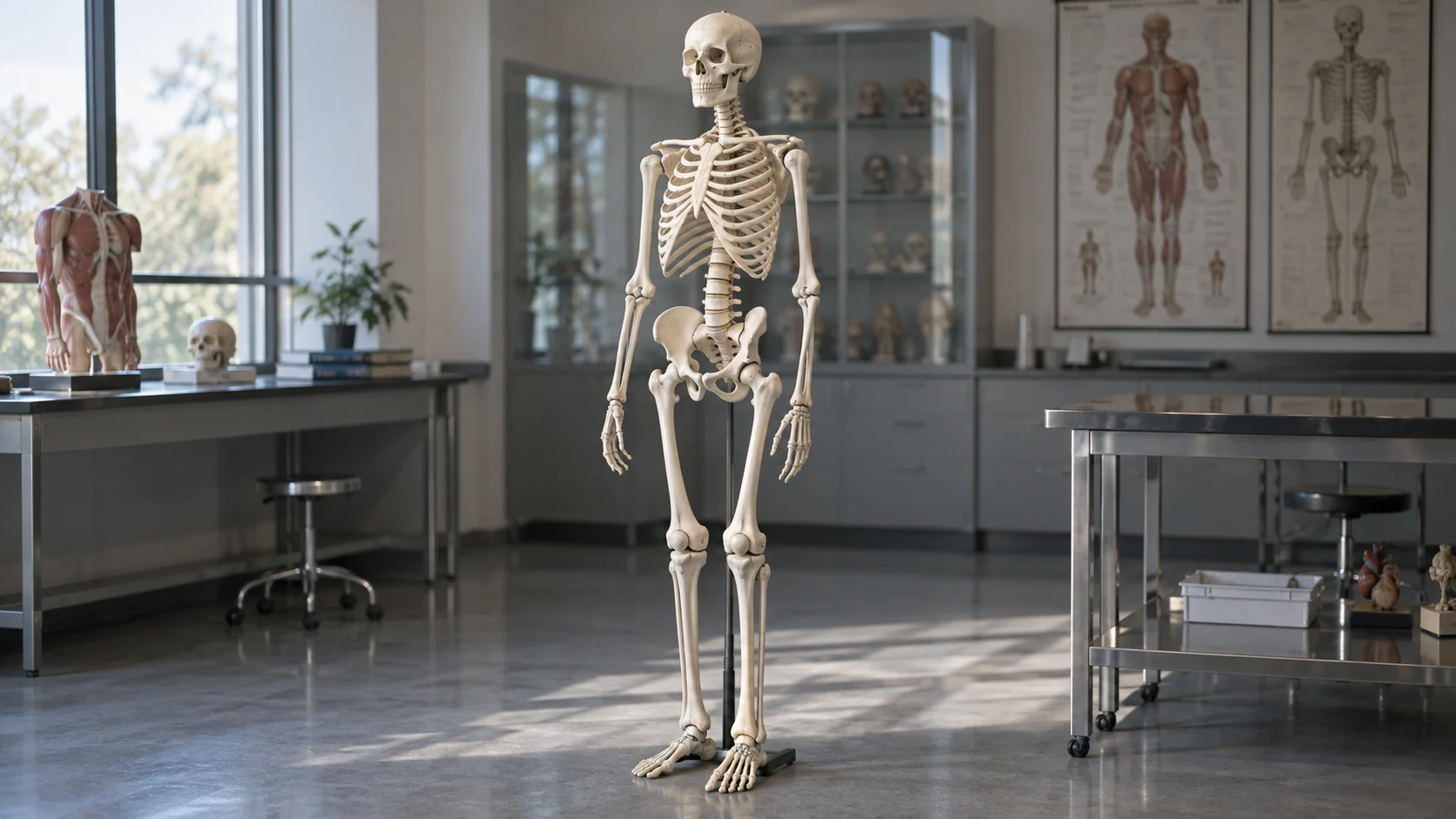
Q: How many bones are typically counted in an adult human skeleton?
A: 206.
Q: What are the two main divisions of the human skeleton?
A: The axial and appendicular skeletons.
Q: What does the axial skeleton include?
A: The skull, vertebral column, ribs, and sternum.
Q: What does the appendicular skeleton include?
A: The limbs and the shoulder and pelvic girdles.
Q: How many bones make up the typical adult axial skeleton?
A: 80.
Q: How many bones make up the typical adult appendicular skeleton?
A: 126.
Q: Are bones living organs?
A: Yes.
Q: What organ system includes bones, cartilage, ligaments, and joints?
A: The skeletal system.
Q: What major skeletal function gives the body its structural framework?
A: Support.
Q: What major skeletal function shields organs such as the brain and heart?
A: Protection.
Q: What does the skeleton work with to produce body movement?
A: Muscles.
Q: Which two important minerals are stored in bone?
A: Calcium and phosphorus.
Q: What process of blood cell production takes place in red bone marrow?
A: Hematopoiesis.
Q: Why do babies have more separate bones than adults?
A: Many bones fuse during growth.
Q: What branch of anatomy studies bones?
A: Osteology.
Skull and Face
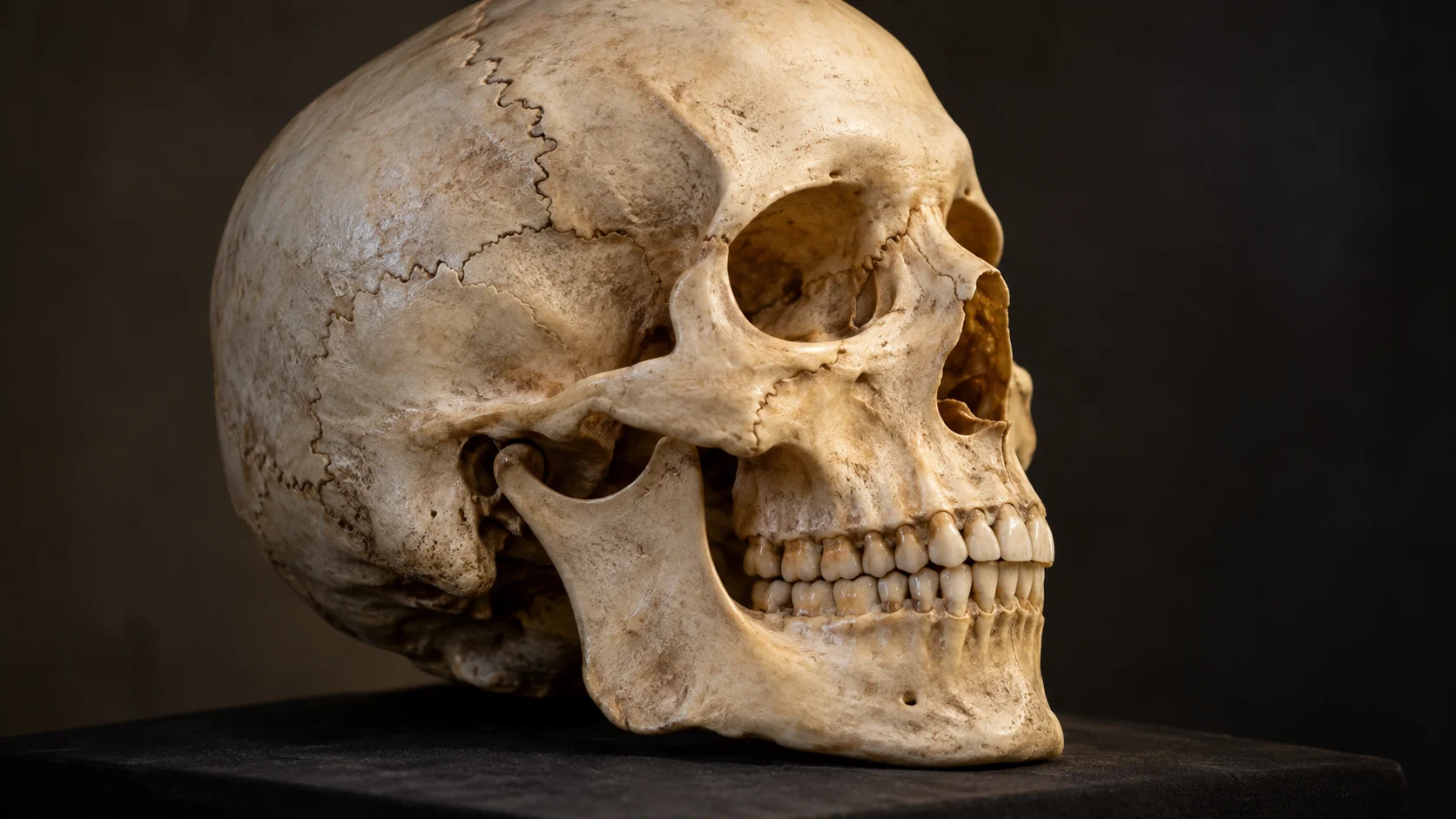
Q: How many bones are usually counted in the adult skull, excluding the auditory ossicles and hyoid?
A: 22.
Q: How many cranial bones surround the brain?
A: Eight.
Q: How many facial bones form the framework of the face?
A: Fourteen.
Q: What is the movable bone of the lower jaw?
A: The mandible.
Q: What pair of bones forms the upper jaw?
A: The maxillae.
Q: What bone forms the forehead?
A: The frontal bone.
Q: What pair of bones forms much of the roof and sides of the cranium?
A: The parietal bones.
Q: What bone forms much of the back and base of the skull?
A: The occipital bone.
Q: What large opening in the occipital bone allows the spinal cord to pass?
A: The foramen magnum.
Q: What bones form the prominent parts of the cheeks?
A: The zygomatic bones.
Q: What small U-shaped bone in the neck does not directly articulate with another bone?
A: The hyoid.
Q: What are the three tiny bones in each middle ear?
A: The malleus, incus, and stapes.
Q: What is the smallest bone in the human body?
A: The stapes.
Q: What immovable fibrous joints connect most skull bones?
A: Sutures.
Q: What cavities inside several skull bones help lighten the skull and affect voice resonance?
A: The paranasal sinuses.
Spine and Rib Cage
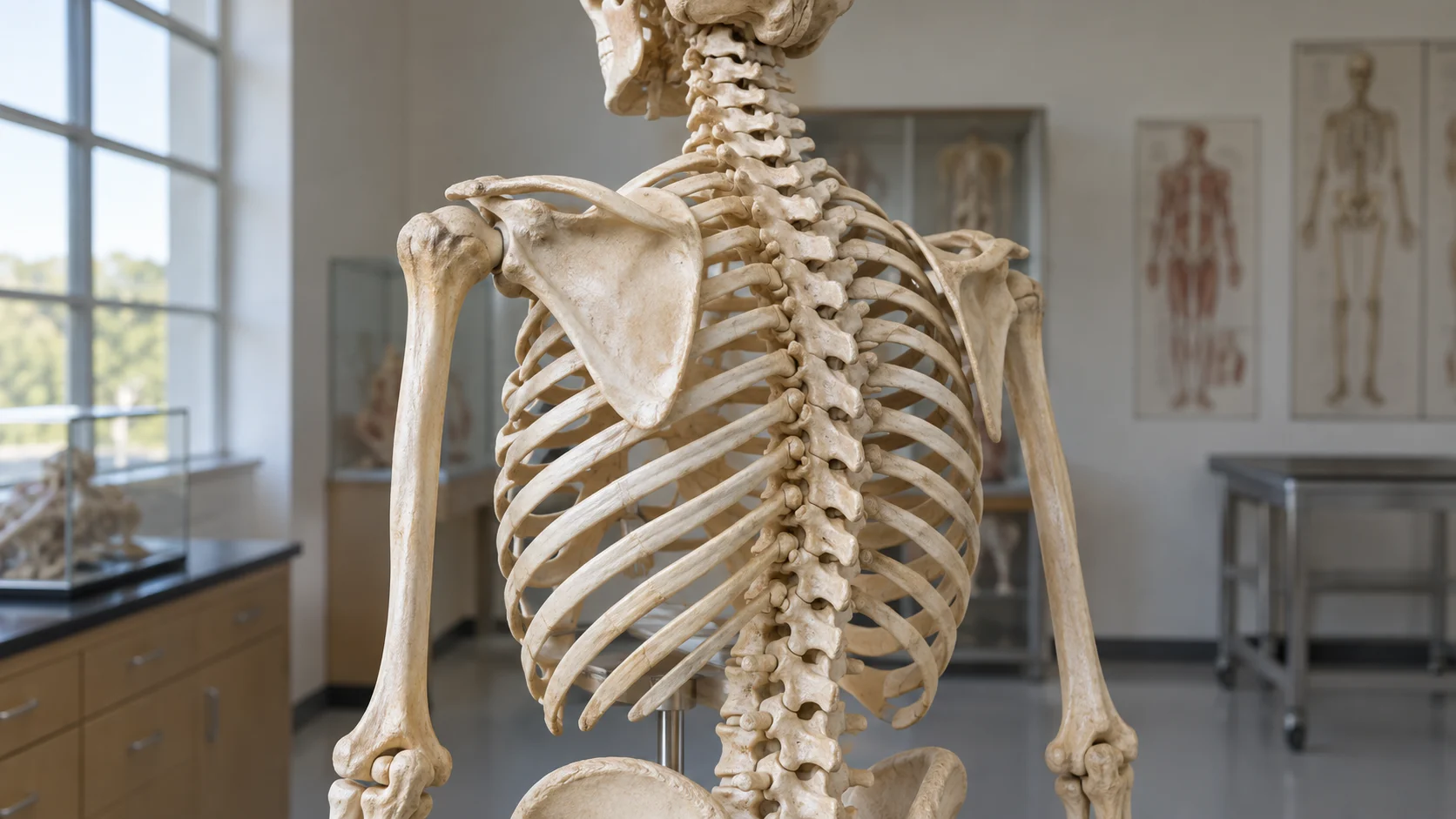
Q: What is another name for the vertebral column?
A: The spine, or backbone.
Q: How many vertebrae are present before the sacral and coccygeal bones finish fusing?
A: Usually 33.
Q: How many cervical vertebrae are in the neck?
A: Seven.
Q: How many thoracic vertebrae are in the upper and middle back?
A: Twelve.
Q: How many lumbar vertebrae are in the lower back?
A: Five.
Q: What is the first cervical vertebra called?
A: The atlas.
Q: What is the second cervical vertebra called?
A: The axis.
Q: What fused triangular bone sits at the base of the spine?
A: The sacrum.
Q: What small terminal bone is commonly called the tailbone?
A: The coccyx.
Q: What pads between most vertebrae absorb shock and permit movement?
A: Intervertebral discs.
Q: How many pairs of ribs do most people have?
A: Twelve pairs.
Q: Which rib pairs attach directly to the sternum through their own costal cartilage?
A: Pairs one through seven.
Q: Which rib pairs are commonly called floating ribs?
A: Pairs eleven and twelve.
Q: What flat bone runs down the front center of the chest?
A: The sternum.
Q: What three parts make up the sternum?
A: The manubrium, body, and xiphoid process.
Shoulders, Arms, and Hands
Q: What two bones form each shoulder girdle?
A: The clavicle and scapula.
Q: What is the common name for the clavicle?
A: The collarbone.
Q: What is the common name for the scapula?
A: The shoulder blade.
Q: What long bone runs from the shoulder to the elbow?
A: The humerus.
Q: What are the two bones of the forearm?
A: The radius and ulna.
Q: Which forearm bone is on the thumb side in anatomical position?
A: The radius.
Q: Which forearm bone forms the point of the elbow?
A: The ulna.
Q: What is the bony point of the elbow called?
A: The olecranon.
Q: How many bones are in one adult hand and wrist?
A: 27.
Q: What are the eight wrist bones called?
A: Carpals.
Q: What are the five bones of the palm called?
A: Metacarpals.
Q: What are the finger bones called?
A: Phalanges.
Q: How many phalanges are in each hand?
A: Fourteen.
Q: How many phalanges does the thumb have?
A: Two.
Q: What wrist bone is most commonly fractured?
A: The scaphoid.
Pelvis, Legs, and Feet
Q: What is the longest bone in the human body?
A: The femur.
Q: What is the common name for the femur?
A: The thighbone.
Q: What bone is commonly called the kneecap?
A: The patella.
Q: What is the largest sesamoid bone in the body?
A: The patella.
Q: What are the two bones of the lower leg?
A: The tibia and fibula.
Q: Which lower-leg bone bears most of the body's weight?
A: The tibia.
Q: What is the common name for the tibia?
A: The shinbone.
Q: Which lower-leg bone is thinner and lies on the outer side?
A: The fibula.
Q: What three bones fuse to form each adult hip bone?
A: The ilium, ischium, and pubis.
Q: What cup-shaped socket receives the head of the femur?
A: The acetabulum.
Q: How many bones are in one adult foot and ankle?
A: 26.
Q: What are the seven ankle and rear-foot bones called?
A: Tarsals.
Q: What are the five long bones of the midfoot called?
A: Metatarsals.
Q: What is the heel bone called?
A: The calcaneus.
Q: What ankle bone receives the body's weight from the tibia?
A: The talus.
Joints Make the Moves
Q: What is the place where two or more bones meet called?
A: A joint, or articulation.
Q: What type of joint has a fluid-filled cavity and permits wide movement?
A: A synovial joint.
Q: What slippery tissue covers the ends of bones in most movable joints?
A: Articular cartilage.
Q: What lubricating liquid fills a synovial joint cavity?
A: Synovial fluid.
Q: What tough bands connect bone to bone?
A: Ligaments.
Q: What cords or sheets connect muscle to bone?
A: Tendons.
Q: What type of joint is the elbow?
A: A hinge joint.
Q: What type of joint allows the shoulder its broad range of motion?
A: A ball-and-socket joint.
Q: What type of synovial joint lets the atlas rotate around the axis?
A: A pivot joint.
Q: What type of joint at the base of the thumb aids opposition?
A: A saddle joint.
Q: What type of joint allows small sliding motions between many wrist bones?
A: A plane, or gliding, joint.
Q: What fibrocartilage pads help cushion and stabilize the knee?
A: The menisci.
Q: What flexible tissue connects the ribs to the sternum?
A: Costal cartilage.
Q: What nearly immovable joint type connects skull bones?
A: A fibrous joint.
Q: What joint joins the left and right pubic bones with a pad of cartilage?
A: The pubic symphysis.
Bone From the Inside Out
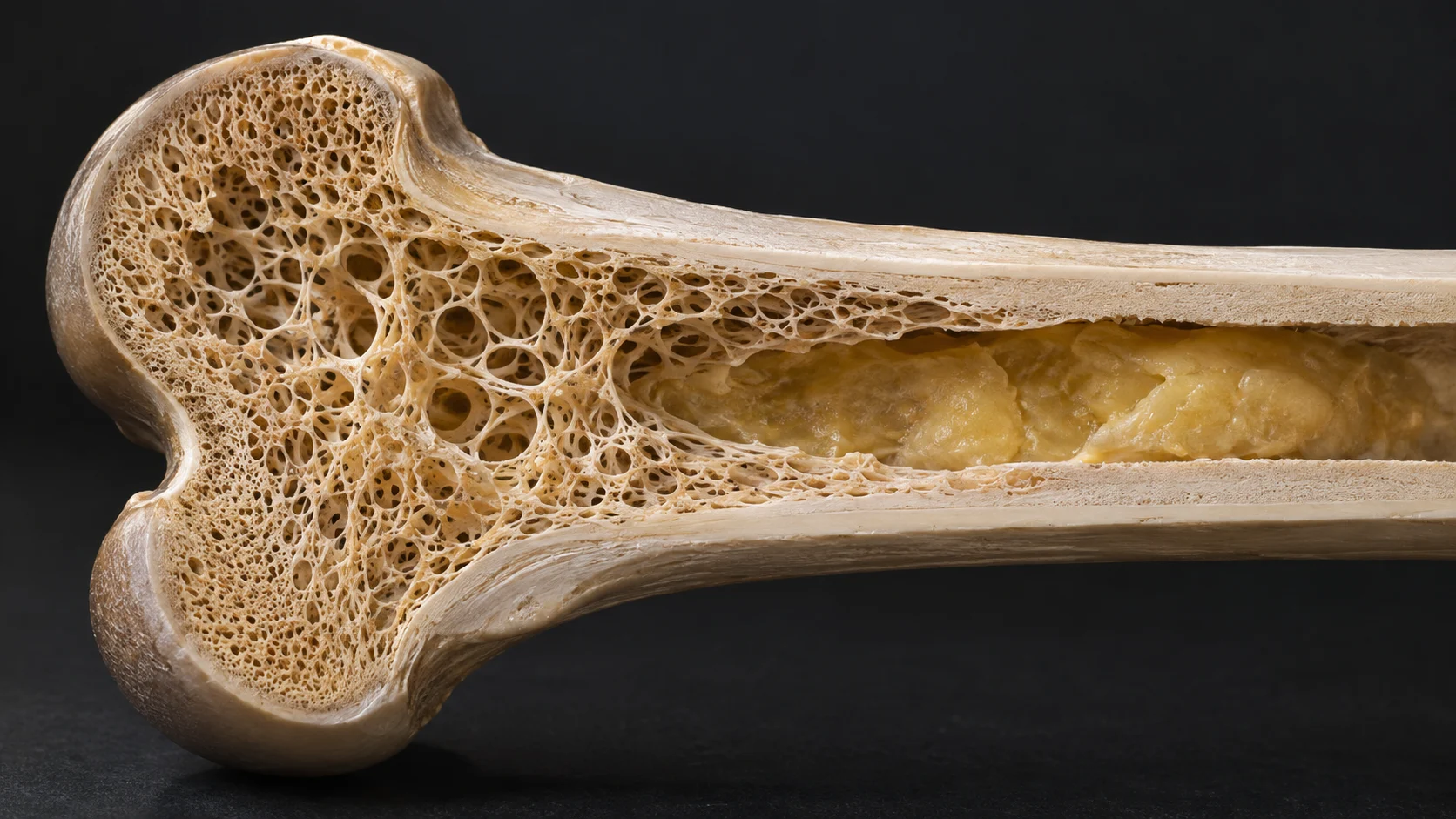
Q: What dense outer bone tissue provides strength?
A: Compact bone.
Q: What light, lattice-like bone tissue lies inside many bones?
A: Spongy, or trabecular, bone.
Q: What membrane covers the outer surface of a bone except at joint surfaces?
A: The periosteum.
Q: What membrane lines the internal surfaces of bone?
A: The endosteum.
Q: What is the shaft of a long bone called?
A: The diaphysis.
Q: What are the expanded ends of a long bone called?
A: The epiphyses.
Q: What hollow space runs through the shaft of a long bone?
A: The medullary cavity.
Q: What type of marrow produces blood cells?
A: Red bone marrow.
Q: What type of marrow stores a large amount of fat?
A: Yellow bone marrow.
Q: What mature bone cells maintain bone tissue?
A: Osteocytes.
Q: What bone cells build new bone matrix?
A: Osteoblasts.
Q: What large cells break down bone tissue?
A: Osteoclasts.
Q: What structural protein gives bone flexibility and tensile strength?
A: Collagen.
Q: What calcium-rich mineral gives bone much of its hardness?
A: Hydroxyapatite.
Q: What cylindrical structural unit is found in compact bone?
A: An osteon.
Growing, Healing, and Adapting
Q: What process forms bone tissue?
A: Ossification.
Q: What cartilage zones let long bones lengthen during childhood and adolescence?
A: Growth plates.
Q: What line may remain after a growth plate closes?
A: An epiphyseal line.
Q: What lifelong process replaces old bone with new bone?
A: Bone remodeling.
Q: Which cells remove old bone during remodeling?
A: Osteoclasts.
Q: Which cells lay down new bone during remodeling?
A: Osteoblasts.
Q: What is a break in a bone called?
A: A fracture.
Q: What temporary bridge of repair tissue stabilizes a healing fracture?
A: A callus.
Q: What blood collection forms soon after many fractures?
A: A fracture hematoma.
Q: What principle says bone adapts to the loads placed upon it?
A: Wolff's law.
Q: What vitamin helps the body absorb calcium needed for bone mineralization?
A: Vitamin D.
Q: What hormone made by the parathyroid glands helps regulate blood calcium?
A: Parathyroid hormone.
Q: What hormone made by thyroid C cells can lower blood calcium by reducing bone resorption?
A: Calcitonin.
Q: Around what stage of adulthood does bone mass generally reach its peak?
A: The twenties.
Q: Does bone remodeling continue after a person stops growing taller?
A: Yes.
You Crushed This Bone Quiz
If you got all 120 answers, your skeletal knowledge is standing tall. Flex the rest of your brain with our science trivia.

Ellie Ewert is the founder and author of RandomTrivia.co, blending her passion for research with years of experience in content creation to deliver accurate, engaging, and well-sourced trivia. Dedicated to providing readers with trustworthy and entertaining facts, she applies meticulous fact-checking and SEO expertise to ensure every article meets the highest standards. Read more about our high standards in our Editorial Guidelines.