
Step into Gilded Age trivia, where railroad fortunes, crowded tenements, political machines, bold inventions, and spectacular mansions shared the same city blocks.
These questions explore both the era's glitter and its grit, with plenty of reformers, workers, writers, and larger-than-life tycoons along the way.
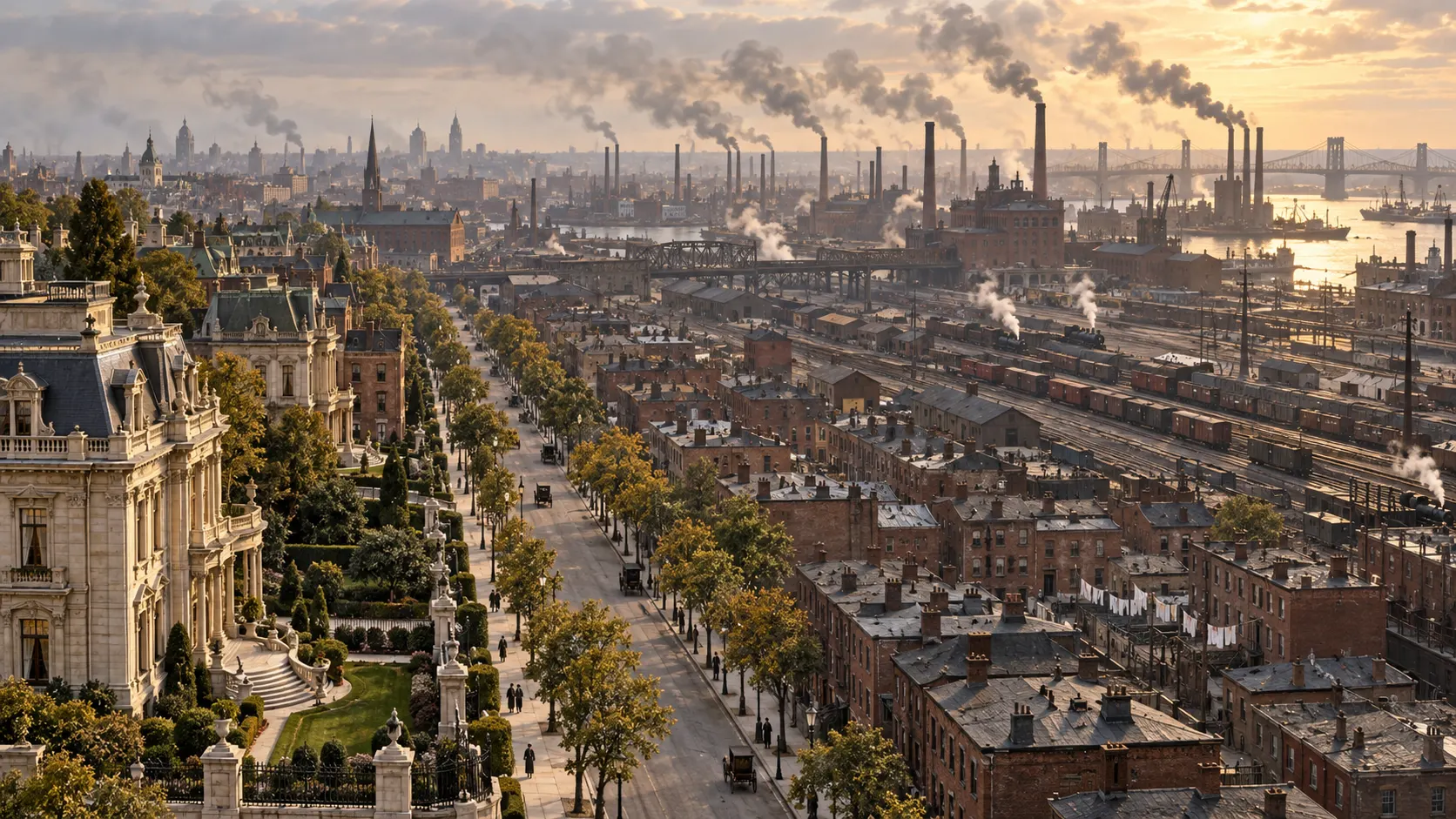
A Gilded Name for a Complicated Era
Q: Which two authors wrote the 1873 novel that gave the Gilded Age its name?
A: Mark Twain and Charles Dudley Warner.
Q: What did the word “gilded” suggest about the era?
A: A glittering surface covering serious problems.
Q: Which decades are most commonly associated with the Gilded Age?
A: The 1870s through the 1890s.
Q: Which war had ended just before the Gilded Age began?
A: The Civil War.
Q: What 1877 political settlement effectively ended Reconstruction?
A: The Compromise of 1877.
Q: Which census year famously announced that a clear frontier line no longer existed?
A: 1890.
Q: Which historian presented the frontier thesis in 1893?
A: Frederick Jackson Turner.
Q: What 1893 exposition showcased American industry and culture in Chicago?
A: The World's Columbian Exposition.
Q: What nickname was given to that exposition's grand white exhibition district?
A: The White City.
Q: Which invention debuted as a towering attraction at the Chicago fair?
A: The Ferris wheel.
Q: Who designed the original Ferris wheel?
A: George Washington Gale Ferris Jr.
Q: Which economic crisis began with a major railroad collapse in 1873?
A: The Panic of 1873.
Q: Which severe depression began in 1893?
A: The Panic of 1893.
Q: What term described the postwar South's campaign to attract industry and investment?
A: The New South.
Q: Which reform era followed the Gilded Age around the turn of the century?
A: The Progressive Era.
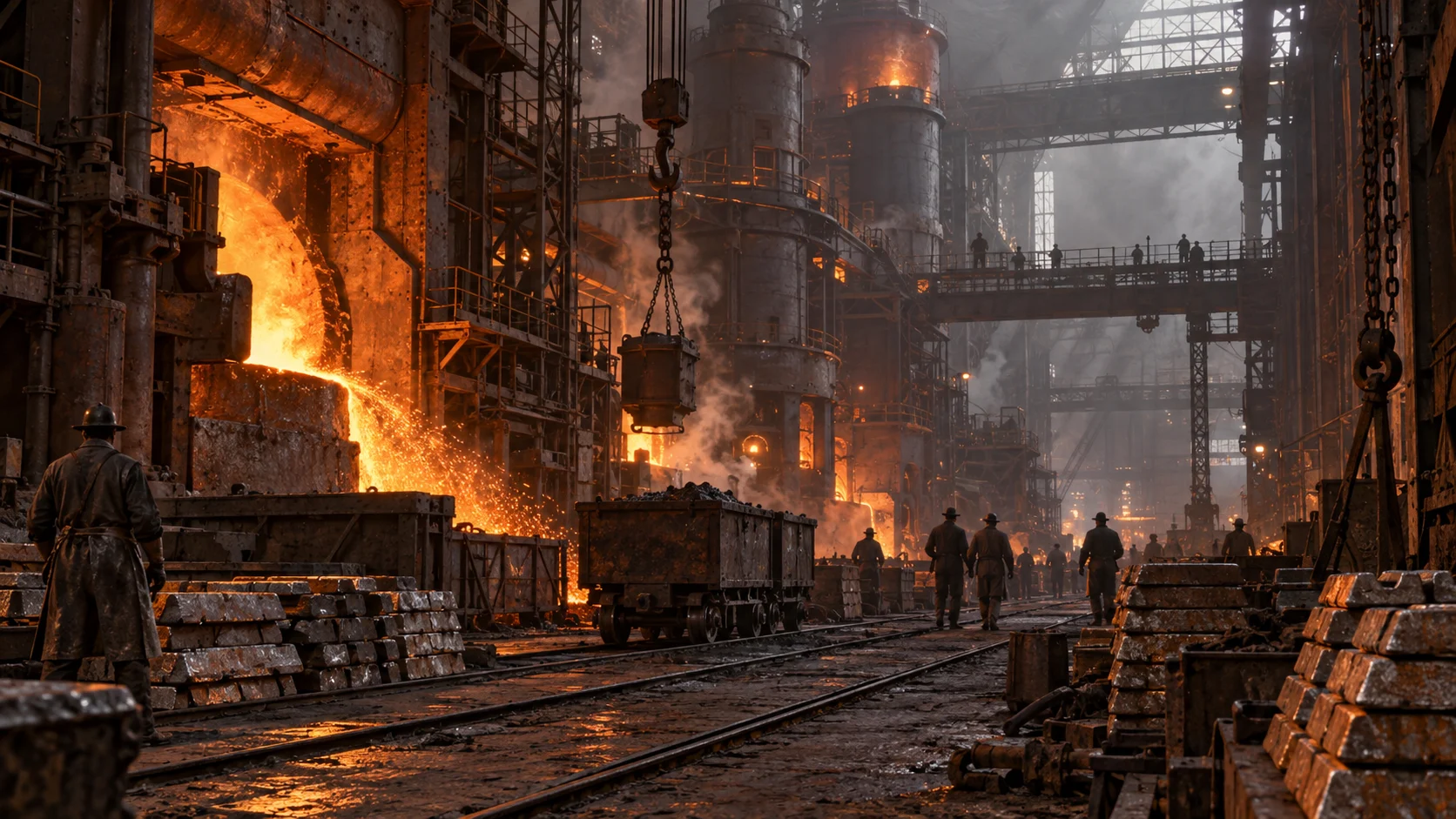
Railroads, Steel, Oil, and Big Business
Q: Which railroad executive became famous for consolidating lines into a vast system?
A: Cornelius Vanderbilt.
Q: Where was the first transcontinental railroad completed in 1869?
A: Promontory Summit, Utah.
Q: Which two railroads joined at Promontory Summit?
A: The Union Pacific and Central Pacific.
Q: What ceremonial object marked completion of the transcontinental railroad?
A: The Golden Spike.
Q: Which industrialist built Carnegie Steel?
A: Andrew Carnegie.
Q: What steelmaking method helped Carnegie produce steel cheaply in large quantities?
A: The Bessemer process.
Q: Which financier formed U.S. Steel in 1901 by buying Carnegie's company?
A: J. P. Morgan.
Q: Which company made John D. Rockefeller the dominant figure in American oil?
A: Standard Oil.
Q: What business arrangement placed multiple companies under one group of trustees?
A: A trust.
Q: What strategy controls suppliers and production stages within one company?
A: Vertical integration.
Q: What strategy expands control by absorbing competitors in the same industry?
A: Horizontal integration.
Q: What critical label compared powerful industrialists to feudal plunderers?
A: Robber barons.
Q: What friendlier label praised wealthy entrepreneurs as national builders?
A: Captains of industry.
Q: Which 1887 law created the Interstate Commerce Commission?
A: The Interstate Commerce Act.
Q: Which 1890 federal law targeted monopolistic business practices?
A: The Sherman Antitrust Act.
Workers, Unions, and Industrial Conflict
Q: Which labor organization led by Terence V. Powderly welcomed many skilled and unskilled workers?
A: The Knights of Labor.
Q: Who founded the American Federation of Labor in 1886?
A: Samuel Gompers.
Q: What type of workers did the early AFL mainly organize?
A: Skilled workers.
Q: What nationwide railroad conflict erupted in 1877?
A: The Great Railroad Strike.
Q: In which city did the 1886 Haymarket affair occur?
A: Chicago.
Q: What object thrown at police turned the Haymarket rally deadly?
A: A bomb.
Q: Which company town was the center of an 1894 railroad strike?
A: Pullman, Illinois.
Q: Which union leader was jailed during the Pullman Strike?
A: Eugene V. Debs.
Q: Which union led the Pullman Strike?
A: The American Railway Union.
Q: Which 1892 strike pitted steelworkers against Carnegie Steel?
A: The Homestead Strike.
Q: Who managed Carnegie Steel during the Homestead conflict?
A: Henry Clay Frick.
Q: Which private guards fought strikers at Homestead?
A: Pinkerton agents.
Q: What payment system compensated workers according to what they produced?
A: Piecework.
Q: What protest tactic involved employees refusing to work?
A: A strike.
Q: Why did many families send children to industrial jobs?
A: Their wages helped the household survive.
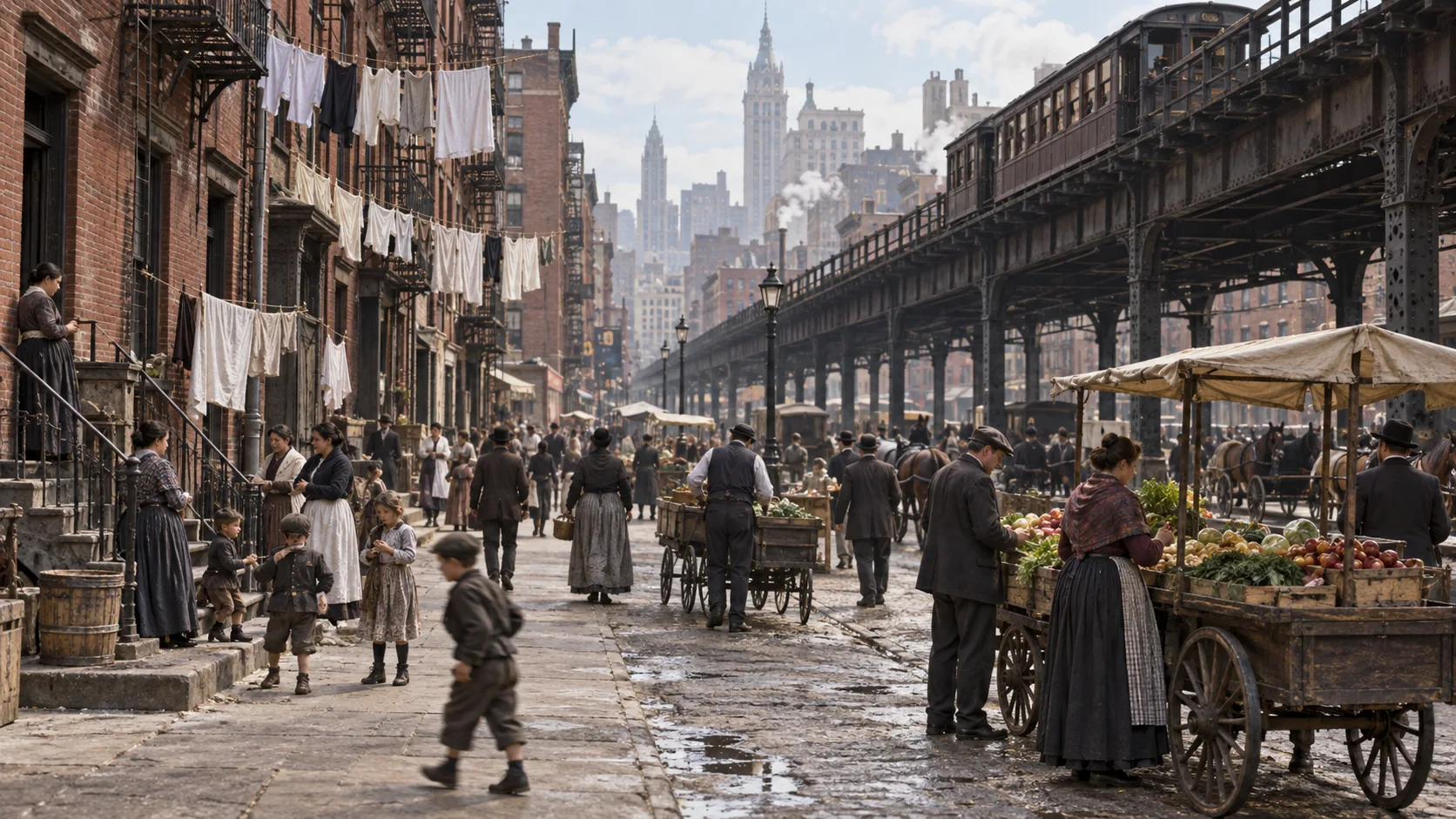
Immigration and the Growing City
Q: Which New York immigration station opened in 1892?
A: Ellis Island.
Q: Which West Coast immigration station opened later, in 1910?
A: Angel Island.
Q: Which 1882 law barred most Chinese laborers from entering the United States?
A: The Chinese Exclusion Act.
Q: What crowded urban apartment buildings housed many working-class families?
A: Tenements.
Q: Which journalist exposed New York tenement conditions in How the Other Half Lives?
A: Jacob Riis.
Q: What new construction technology made tall skyscrapers practical?
A: Steel-frame construction.
Q: Which city is closely associated with the first generation of skyscrapers?
A: Chicago.
Q: What transit system opened in Boston in 1897, the first of its kind in America?
A: A subway.
Q: Which landscape architect helped design New York's Central Park?
A: Frederick Law Olmsted.
Q: Which French sculptor created the Statue of Liberty?
A: Frédéric Auguste Bartholdi.
Q: Which poem by Emma Lazarus is mounted inside the Statue of Liberty's pedestal?
A: “The New Colossus.”
Q: In what year was the Statue of Liberty dedicated?
A: 1886.
Q: What neighborhood-based organizations traded services for political support?
A: Political machines.
Q: Which New York political machine operated from Tammany Hall?
A: Tammany Hall.
Q: Which cartoonist relentlessly attacked Tammany leader Boss Tweed?
A: Thomas Nast.
Votes, Patronage, and Reform
Q: Which president was assassinated by a disappointed office seeker in 1881?
A: James A. Garfield.
Q: Which president signed the Pendleton Civil Service Reform Act?
A: Chester A. Arthur.
Q: What hiring system did the Pendleton Act begin replacing?
A: The spoils system.
Q: Which president served two nonconsecutive terms during the Gilded Age?
A: Grover Cleveland.
Q: Which president won the disputed election of 1876?
A: Rutherford B. Hayes.
Q: Who lost the electoral vote to Hayes despite winning the popular vote?
A: Samuel J. Tilden.
Q: Which Republican defeated Grover Cleveland in 1888?
A: Benjamin Harrison.
Q: What tariff signed in 1890 became a major political liability for Republicans?
A: The McKinley Tariff.
Q: Which movement spoke for many indebted farmers in the 1890s?
A: Populism.
Q: What political party did the Populists formally organize in 1891?
A: The People's Party.
Q: Which 1892 platform outlined Populist demands?
A: The Omaha Platform.
Q: Which monetary policy did many Populists support?
A: Free coinage of silver.
Q: Who delivered the “Cross of Gold” speech in 1896?
A: William Jennings Bryan.
Q: Which Republican defeated Bryan in the 1896 presidential election?
A: William McKinley.
Q: What secret ballot reform reduced parties' control over voting?
A: The Australian ballot.
Segregation, Western Expansion, and Resistance
Q: What name is given to laws enforcing racial segregation in the South?
A: Jim Crow laws.
Q: Which 1896 Supreme Court case upheld “separate but equal”?
A: Plessy v. Ferguson.
Q: Which journalist led an international campaign against lynching?
A: Ida B. Wells.
Q: Which educator founded Tuskegee Institute in Alabama?
A: Booker T. Washington.
Q: What name was given to Black southerners who migrated to Kansas after Reconstruction?
A: Exodusters.
Q: Which 1862 law offered western land to settlers who met its requirements?
A: The Homestead Act.
Q: Which 1887 law divided many tribal lands into individual allotments?
A: The Dawes Act.
Q: What devastating 1890 event killed Lakota people in South Dakota?
A: The Wounded Knee Massacre.
Q: Which Lakota leader was killed shortly before Wounded Knee?
A: Sitting Bull.
Q: Which Nez Perce leader became famous during the 1877 flight toward Canada?
A: Chief Joseph.
Q: Which Apache leader surrendered to U.S. forces in 1886?
A: Geronimo.
Q: What type of ranching operation drove cattle north to railroad towns?
A: Cattle drives.
Q: Which Kansas town became a famous cattle-shipping center?
A: Abilene.
Q: What invention helped ranchers fence the open range?
A: Barbed wire.
Q: Which 1889 event opened unassigned Oklahoma lands to settlers?
A: The Oklahoma Land Rush.
Inventions, Culture, and New Ways to Live
Q: Who patented a practical telephone in 1876?
A: Alexander Graham Bell.
Q: Which inventor developed a commercially practical incandescent lighting system?
A: Thomas Edison.
Q: At which New Jersey laboratory did Edison and his team create many inventions?
A: Menlo Park.
Q: Which inventor promoted alternating-current electrical systems?
A: Nikola Tesla.
Q: Which company backed AC power and employed Tesla's patents?
A: Westinghouse Electric.
Q: Who invented the typewriter keyboard arrangement called QWERTY?
A: Christopher Latham Sholes.
Q: Which office job expanded rapidly as typewriters became common?
A: Typist.
Q: What mail-order company began with Richard Sears selling watches?
A: Sears, Roebuck and Company.
Q: Which retailer opened a famous department store in Philadelphia?
A: John Wanamaker.
Q: Which novelist wrote The Portrait of a Lady?
A: Henry James.
Q: Which novelist created the adventurous character Huckleberry Finn?
A: Mark Twain.
Q: Which poet wrote “Because I could not stop for Death”?
A: Emily Dickinson.
Q: Which artist painted society portraits and Madame X?
A: John Singer Sargent.
Q: Which architect designed the lavish Newport mansion called The Breakers?
A: Richard Morris Hunt.
Q: Which wealthy family commissioned The Breakers?
A: The Vanderbilt family.
Philanthropy, Social Criticism, and Legacy
Q: Which essay set out Andrew Carnegie's philosophy of philanthropy?
A: “The Gospel of Wealth.”
Q: What public institutions did Carnegie fund by the thousands?
A: Libraries.
Q: Which settlement house did Jane Addams and Ellen Gates Starr found in Chicago?
A: Hull House.
Q: What did settlement houses provide in immigrant neighborhoods?
A: Education, childcare, recreation, and social services.
Q: Which economist wrote Progress and Poverty in 1879?
A: Henry George.
Q: Which writer argued for a single tax on land values?
A: Henry George.
Q: Which 1888 novel imagined a cooperative America in the year 2000?
A: Looking Backward.
Q: Who wrote Looking Backward?
A: Edward Bellamy.
Q: Which naturalist novel by Stephen Crane followed a poor young woman in New York?
A: Maggie: A Girl of the Streets.
Q: What term described investigative reform journalists who rose to prominence after the Gilded Age?
A: Muckrakers.
Q: Which photographer used flash powder to document dark tenement interiors?
A: Jacob Riis.
Q: Which Black leader delivered the Atlanta Exposition Address in 1895?
A: Booker T. Washington.
Q: Which women's voting organization was formed by a merger in 1890?
A: The National American Woman Suffrage Association.
Q: Which two suffrage leaders headed the newly merged organization?
A: Elizabeth Cady Stanton and Susan B. Anthony.
Q: What central contradiction defines the Gilded Age?
A: Rapid growth and spectacular wealth existed beside deep inequality and hardship.
You Struck Trivia Gold
If you polished off all 120 questions, your score shines brighter than a Fifth Avenue ballroom. Keep the timeline rolling with our decades trivia or meet more era-defining names in famous people trivia.

Ellie Ewert is the founder and author of RandomTrivia.co, blending her passion for research with years of experience in content creation to deliver accurate, engaging, and well-sourced trivia. Dedicated to providing readers with trustworthy and entertaining facts, she applies meticulous fact-checking and SEO expertise to ensure every article meets the highest standards. Read more about our high standards in our Editorial Guidelines.