
Step through the bronze gates, because Byzantine history is packed with palace plots, glittering mosaics, formidable walls, and emperors who rarely had a quiet week.
These Byzantine Empire trivia questions trace more than a thousand years of Roman rule from Constantinople to the empire's dramatic final siege.
Rome's Eastern Empire
Q: What did the people now called Byzantines usually call themselves?
A: Romans.
Q: What modern label is used for the medieval eastern Roman Empire?
A: The Byzantine Empire.
Q: Which emperor refounded Byzantium as Constantinople in 330?
A: Constantine I.
Q: Which modern city occupies the site of Constantinople?
A: Istanbul.
Q: On which strait was Constantinople built?
A: The Bosporus.
Q: What two continents meet at the Bosporus?
A: Europe and Asia.
Q: Which two seas does the Bosporus connect through the Sea of Marmara and the Dardanelles?
A: The Black Sea and the Mediterranean Sea.
Q: What ancient Greek settlement gave the Byzantine Empire its modern name?
A: Byzantium.
Q: Which emperor was the last to rule a unified Roman Empire before its permanent administrative division?
A: Theodosius I.
Q: In what year did Theodosius I die, leaving eastern and western halves to his sons?
A: 395.
Q: Who became emperor in the East after Theodosius I died?
A: Arcadius.
Q: Which language gradually became dominant in Byzantine government and culture?
A: Greek.
Q: Which language dominated imperial administration in the empire's earlier centuries?
A: Latin.
Q: What title derived from the Greek word for king became the standard imperial title?
A: Basileus.
Q: Roughly how long did the eastern Roman Empire endure after Constantinople's founding?
A: More than 1,100 years.
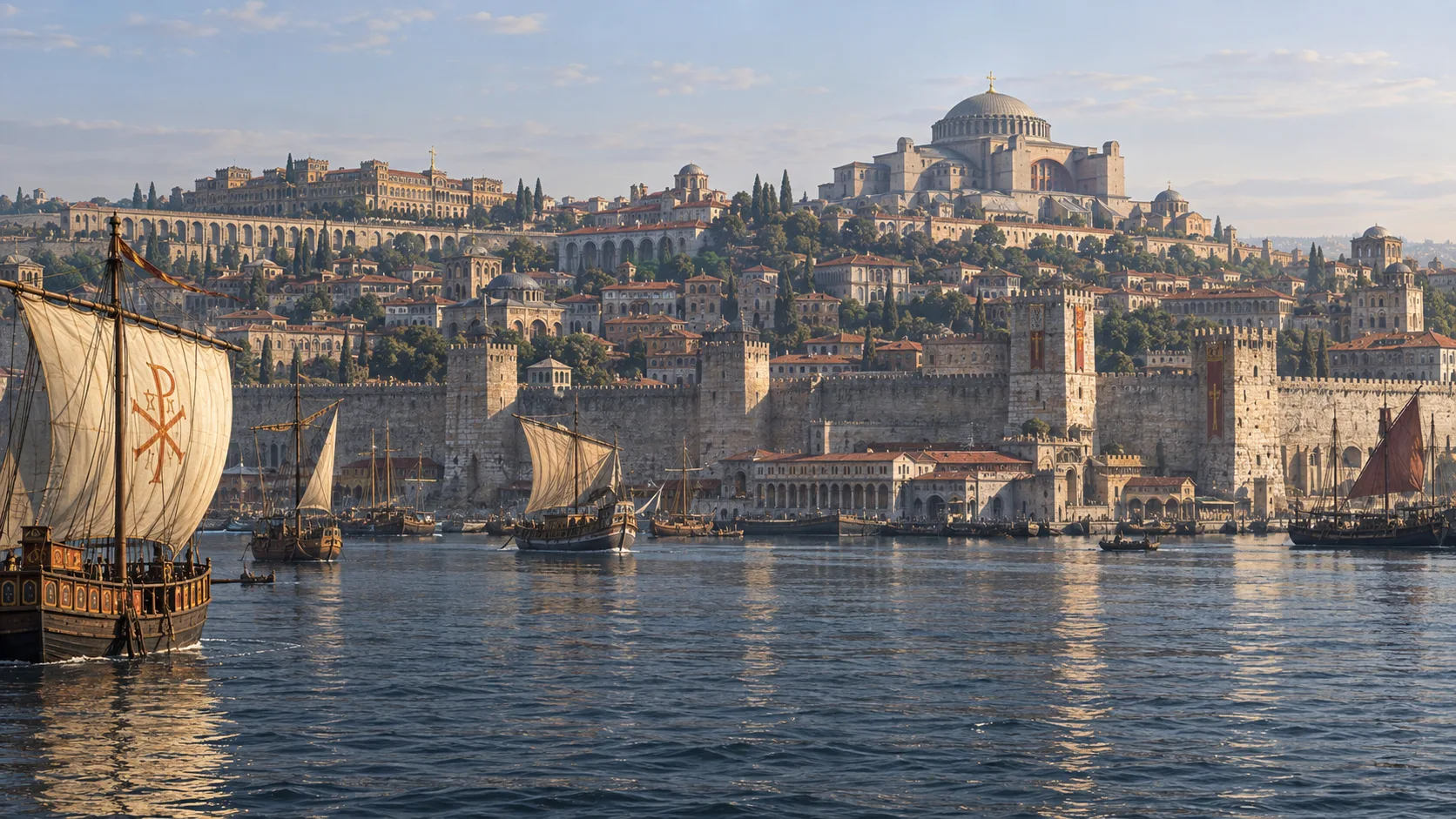
Constantinople Behind the Walls
Q: What massive defenses protected Constantinople on its landward side?
A: The Theodosian Walls.
Q: Which emperor gave his name to the walls built in the early fifth century?
A: Theodosius II.
Q: What inlet formed Constantinople's sheltered natural harbor?
A: The Golden Horn.
Q: What enormous arena hosted chariot racing and public ceremonies?
A: The Hippodrome.
Q: Which two color factions dominated Hippodrome racing?
A: The Blues and the Greens.
Q: What giant underground cistern supported the capital's water supply?
A: The Basilica Cistern.
Q: What famous column in Constantinople commemorated Constantine I?
A: The Column of Constantine.
Q: Which Egyptian monument still stands on the former Hippodrome site?
A: The Obelisk of Theodosius.
Q: What palace complex served as the main imperial residence for centuries?
A: The Great Palace of Constantinople.
Q: What ceremonial gate of the Great Palace took its name from its bronze doors or roof?
A: The Chalke Gate.
Q: What street lined with porticoes formed a major ceremonial route through the capital?
A: The Mese.
Q: What great chain could be raised to block enemy ships from entering the Golden Horn?
A: The Golden Horn chain.
Q: What nickname celebrated Constantinople as the successor to ancient Rome?
A: New Rome.
Q: What adjective described an imperial child born in the palace's purple chamber?
A: Porphyrogenitus, or “born in the purple.”
Q: Which neighborhood across the Golden Horn became a center for Genoese merchants?
A: Galata.
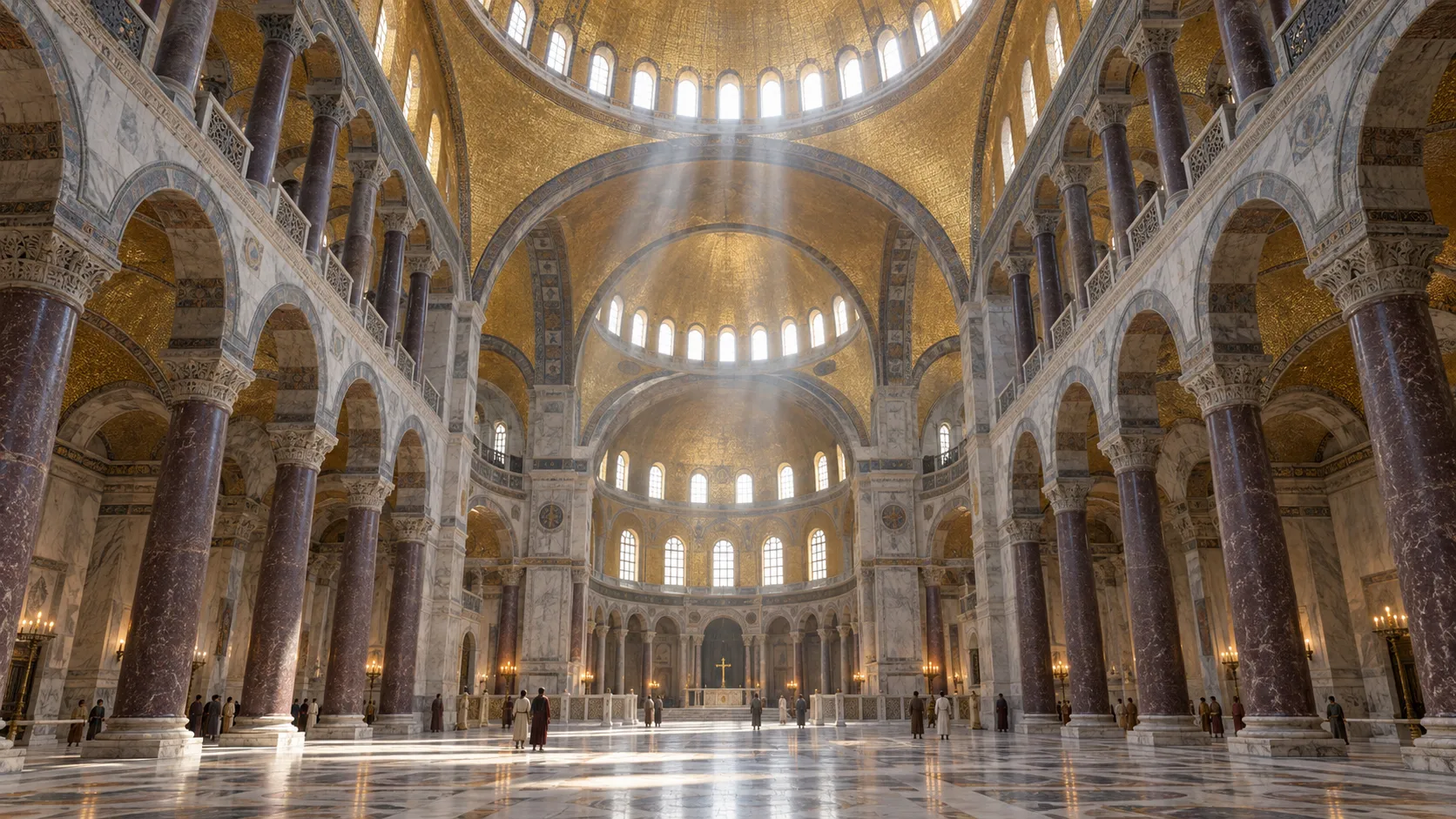
Justinian, Theodora, and an Imperial Comeback
Q: Which sixth-century emperor tried to reconquer former western Roman lands?
A: Justinian I.
Q: Who was Justinian's influential empress?
A: Theodora.
Q: What 532 uprising nearly drove Justinian from the throne?
A: The Nika riots.
Q: What word shouted by the rioters meant “conquer” or “win”?
A: Nika.
Q: Which great church did Justinian rebuild after the Nika riots?
A: Hagia Sophia.
Q: What does Hagia Sophia mean?
A: Holy Wisdom.
Q: Which two architects designed Justinian's Hagia Sophia?
A: Anthemius of Tralles and Isidore of Miletus.
Q: What feature makes Hagia Sophia's vast interior especially famous?
A: Its enormous central dome.
Q: What major legal compilation was produced under Justinian?
A: The Corpus Juris Civilis.
Q: What English name is often given to Justinian's legal compilation?
A: The Body of Civil Law.
Q: Which general won major campaigns for Justinian in Africa and Italy?
A: Belisarius.
Q: Which Germanic kingdom did Belisarius defeat in North Africa?
A: The Vandal Kingdom.
Q: Which people did Justinian's armies fight in the long Gothic War?
A: The Ostrogoths.
Q: What pandemic struck the empire during Justinian's reign?
A: The Plague of Justinian.
Q: Which church in Ravenna contains famous mosaics of Justinian and Theodora?
A: Basilica of San Vitale.
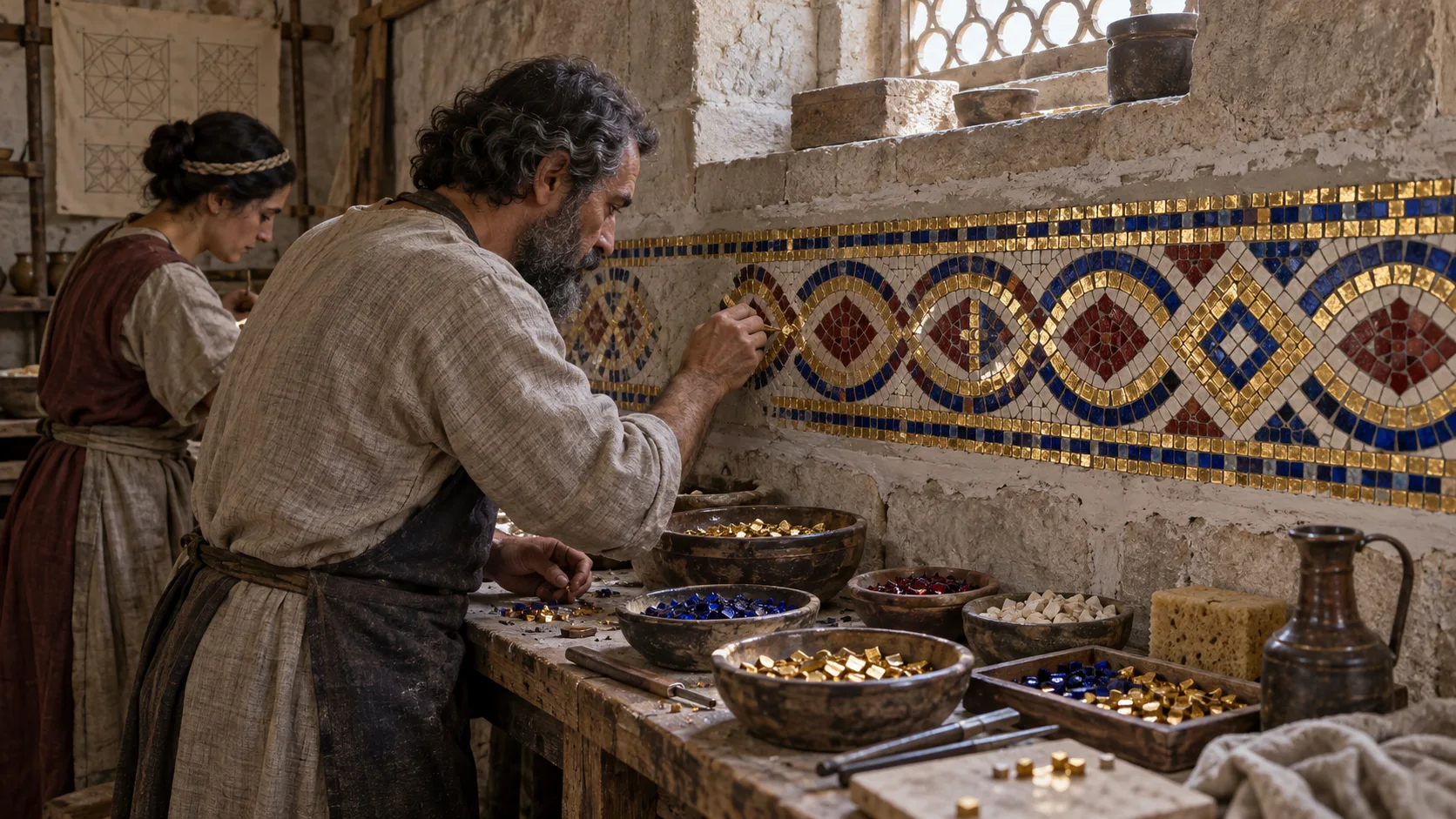
Icons, Councils, and Orthodox Christianity
Q: What branch of Christianity became central to Byzantine religious life?
A: Eastern Orthodox Christianity.
Q: What title did the leading bishop of Constantinople hold?
A: Patriarch of Constantinople.
Q: What is an icon in Byzantine Christianity?
A: A sacred image used in devotion.
Q: What movement opposed the veneration of religious images?
A: Iconoclasm.
Q: What were defenders of icons called?
A: Iconodules.
Q: Which empress helped restore the veneration of icons in 787?
A: Irene of Athens.
Q: What 843 event permanently restored icons in Byzantine worship?
A: The Triumph of Orthodoxy.
Q: What artistic medium made tiny colored pieces shimmer on church walls?
A: Mosaic.
Q: What is the name for the screen of icons separating a church's sanctuary from the nave?
A: The iconostasis.
Q: What church plan places a dome over a central square with four supporting arms?
A: The cross-in-square plan.
Q: What 1054 rupture conventionally marks the split between Rome and Constantinople?
A: The Great Schism.
Q: Which issue involved the Western addition of words meaning “and the Son” to the creed?
A: The Filioque controversy.
Q: Which missionary brothers carried Byzantine Christianity and literacy to the Slavs?
A: Cyril and Methodius.
Q: What alphabet did Cyril and Methodius create for their Slavic mission?
A: The Glagolitic alphabet.
Q: Which later alphabet was named in Cyril's honor?
A: The Cyrillic alphabet.
Armies, Admirals, and Secret Fire
Q: What incendiary weapon could burn on water and terrify enemy fleets?
A: Greek fire.
Q: Was the exact formula for Greek fire preserved for modern historians?
A: No.
Q: What armored cavalry soldiers served as shock troops?
A: Cataphracts.
Q: What elite guard included Scandinavian and later Anglo-Saxon warriors?
A: The Varangian Guard.
Q: Which weapon became especially associated with Varangian guardsmen?
A: A two-handed axe.
Q: What military-administrative districts organized much of the empire from the seventh century?
A: Themes.
Q: What title was given to the military governor of a theme?
A: Strategos.
Q: Which emperor reorganized the empire during wars with Persia and the early Arab conquests?
A: Heraclius.
Q: Which Persian dynasty fought a final exhausting war against Heraclius?
A: The Sasanian dynasty.
Q: Which emperor defended Constantinople during the Arab siege of 717 to 718?
A: Leo III.
Q: Which Bulgarian ruler received the title of tsar after victories over Byzantium?
A: Simeon I.
Q: Which emperor earned the nickname “Bulgar Slayer”?
A: Basil II.
Q: What 1071 battle ended in the capture of Emperor Romanos IV?
A: The Battle of Manzikert.
Q: Which Turkic power defeated the Byzantines at Manzikert?
A: The Seljuk Turks.
Q: What naval vessel was commonly used to project Greek fire?
A: A dromon.
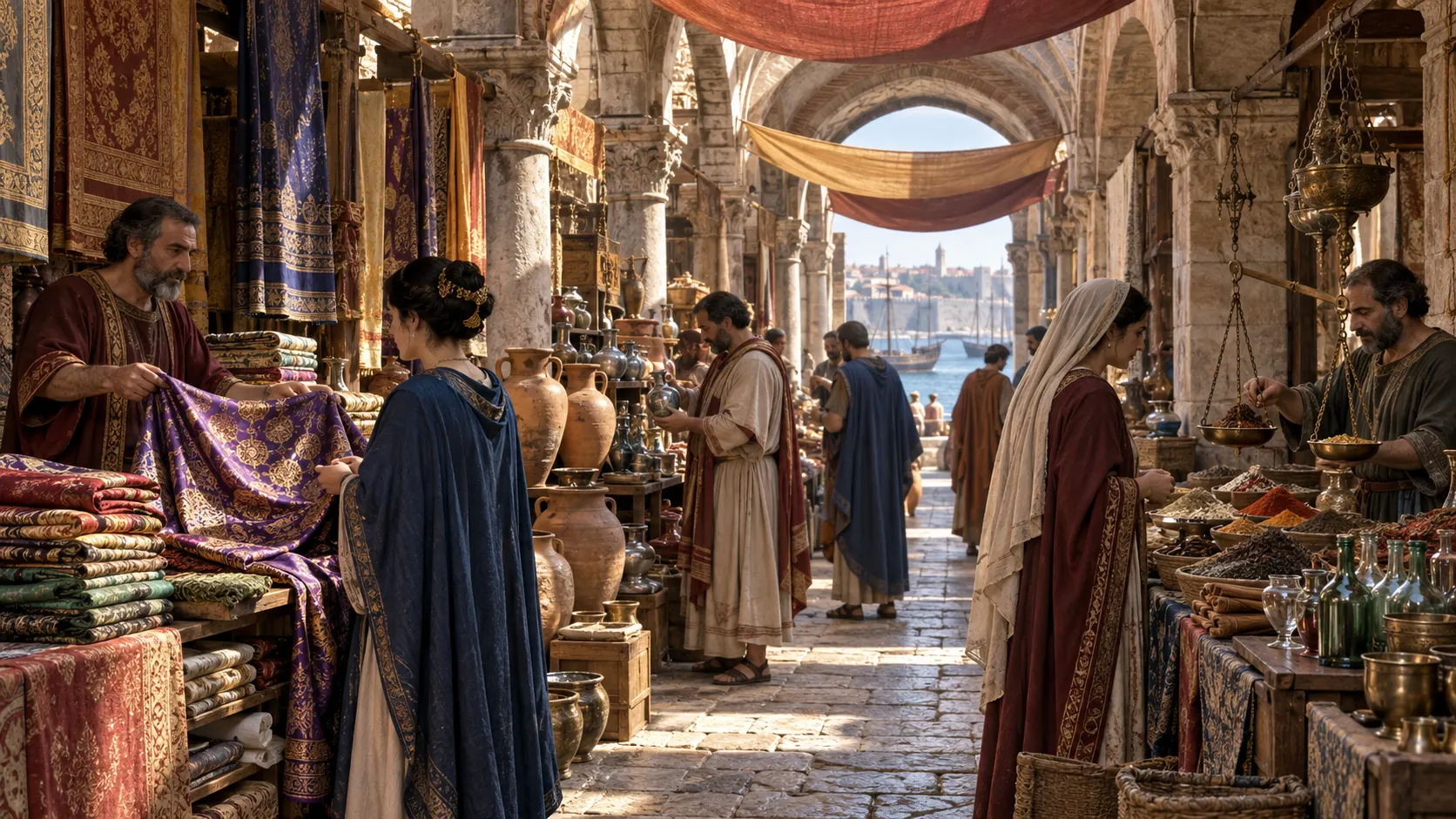
Silk, Gold, and Life in the Empire
Q: What long-lived Byzantine gold coin was introduced by Constantine I?
A: The solidus.
Q: What Greek name was commonly used for the solidus?
A: Nomisma.
Q: Which luxury fiber became a major Byzantine state industry?
A: Silk.
Q: According to Byzantine tradition, how were silkworm eggs brought from Asia under Justinian?
A: Hidden in hollow walking sticks.
Q: What deep red-purple dye signaled imperial status?
A: Tyrian purple.
Q: What shellfish produced the prized purple dye?
A: Murex snails.
Q: What strategic advantage made Constantinople a commercial hub?
A: Its position between major land and sea routes.
Q: Which Italian maritime republic secured extensive trading privileges in the empire?
A: Venice.
Q: What sweetener was commonly used before cane sugar became widespread?
A: Honey.
Q: What fermented fish sauce, called garos in Greek, continued a Roman culinary tradition?
A: Garos.
Q: What public institutions offered care to the sick and poor?
A: Hospitals and charitable foundations.
Q: Which influential scholar and courtier taught philosophy under Constantine IX?
A: Michael Psellos.
Q: Which ancient Greek author remained central to Byzantine medical study?
A: Galen.
Q: What branch of learning helped Byzantine scholars preserve and comment on ancient texts?
A: Classical philology.
Q: What collection of tenth-century agricultural knowledge is known as the Geoponika?
A: A Byzantine farming encyclopedia.
Dynasties, Diplomacy, and Brilliant Writers
Q: Which dynasty began with Basil I in 867?
A: The Macedonian dynasty.
Q: What name is given to the cultural revival under the Macedonian dynasty?
A: The Macedonian Renaissance.
Q: Which scholarly emperor wrote De Administrando Imperio?
A: Constantine VII.
Q: What was De Administrando Imperio intended to teach?
A: Advice on governing and foreign peoples.
Q: Which 11th-century empress ruled in her own right alongside her sister Theodora?
A: Zoe.
Q: Which historian wrote the Alexiad about the reign of her father?
A: Anna Komnene.
Q: Who was Anna Komnene's imperial father?
A: Alexios I Komnenos.
Q: Which dynasty led a military and cultural recovery beginning with Alexios I?
A: The Komnenian dynasty.
Q: What diplomatic strategy used marriages to build foreign alliances?
A: Dynastic marriage.
Q: Which Kievan ruler married the Byzantine princess Anna and accepted Christianity?
A: Vladimir the Great.
Q: In what year is the Christianization of Kievan Rus traditionally dated?
A: 988.
Q: What imperial ceremony impressed foreign visitors with elaborate ritual?
A: The Byzantine court ceremonial.
Q: Which sixth-century historian wrote Secret History and accounts of Justinian's wars?
A: Procopius.
Q: Which Byzantine princess married the Holy Roman emperor Otto II?
A: Theophanu.
Q: What technique did Byzantine diplomats often favor alongside warfare?
A: Alliances, gifts, and negotiation.
Crusaders, Ottomans, and the Final Siege
Q: Which emperor appealed to the West for military help before the First Crusade?
A: Alexios I Komnenos.
Q: Which crusade captured and sacked Constantinople in 1204?
A: The Fourth Crusade.
Q: What state did crusaders establish in Constantinople after 1204?
A: The Latin Empire.
Q: Which Byzantine successor state recaptured Constantinople in 1261?
A: The Empire of Nicaea.
Q: Which emperor reclaimed Constantinople for Byzantine rule in 1261?
A: Michael VIII Palaiologos.
Q: What was the final Byzantine ruling dynasty?
A: The Palaiologan dynasty.
Q: Which Ottoman sultan conquered Constantinople?
A: Mehmed II.
Q: In what year did Constantinople fall to the Ottomans?
A: 1453.
Q: Who was the last Byzantine emperor?
A: Constantine XI Palaiologos.
Q: What giant weapons helped breach Constantinople's defenses in 1453?
A: Ottoman cannons.
Q: How did Mehmed II bypass the chain across the Golden Horn?
A: He moved ships overland on greased timbers.
Q: On what date did Constantinople fall?
A: May 29, 1453.
Q: Which Byzantine outpost in the Peloponnese fell to the Ottomans in 1460?
A: The Despotate of the Morea.
Q: Which Byzantine successor state on the Black Sea fell in 1461?
A: The Empire of Trebizond.
Q: What Roman legal tradition influenced many later European legal systems?
A: Justinian's codification of Roman law.
The Empire's Echo Still Rings
If you kept every emperor, icon, and siege straight, your score deserves a mosaic in the palace. Continue the time travel with our famous people trivia or revisit modern eras with decades trivia.

Ellie Ewert is the founder and author of RandomTrivia.co, blending her passion for research with years of experience in content creation to deliver accurate, engaging, and well-sourced trivia. Dedicated to providing readers with trustworthy and entertaining facts, she applies meticulous fact-checking and SEO expertise to ensure every article meets the highest standards. Read more about our high standards in our Editorial Guidelines.