
The empire commonly called Aztec rose astonishingly fast, turning an island city in Lake Texcoco into the center of a tribute network spanning much of central Mexico. These 135 trivia questions cover the Mexica, Tenochtitlan, the Triple Alliance, Moctezuma II, chinampas, markets, gods, temples, warfare, calendars, Nahuatl, codices, Spanish conquest, and the Indigenous allies who helped reshape the region.
The first round is friendly. The last one belongs at the Templo Mayor.
Why the Aztec Empire Makes Great Trivia
The word Aztec is useful, but the people who built and ruled Tenochtitlan called themselves the Mexica. Their empire was not a single culturally uniform nation. It was a political and tribute system dominated by the Triple Alliance of Tenochtitlan, Texcoco, and Tlacopan.
The Metropolitan Museum and Mexico's National Institute of Anthropology and History anchor the archaeology and political history below. For more history, try our world history trivia, Ancient Egypt trivia, and geography trivia.
Mexica Origins, Lake Texcoco & Aztec Basics
Q: What name did the people who founded Tenochtitlan commonly use for themselves?
A: Mexica.
Q: What broader term is commonly used today for the empire centered on Tenochtitlan?
A: The Aztec Empire.
Q: In what broad region did the Aztec Empire develop?
A: Central Mexico in Mesoamerica.
Q: What language did the Mexica speak?
A: Nahuatl.
Q: What lake system surrounded the Mexica capital?
A: Lake Texcoco within the Valley of Mexico's interconnected lakes.
Q: What city became the Mexica capital?
A: Tenochtitlan.
Q: What year is traditionally given for Tenochtitlan's founding?
A: 1325.
Q: What sign does Mexica foundation tradition say indicated where the city should be built?
A: An eagle associated with a cactus, an image later central to Mexico's national emblem.
Q: What plant appears beneath the eagle in Mexico's national coat of arms?
A: A prickly pear cactus, or nopal.
Q: What is Aztlan?
A: The legendary ancestral homeland from which later traditions say the Mexica migrated.
Q: Is the exact historical location of Aztlan known?
A: No.
Q: What powerful city did the Mexica initially serve before building greater independence?
A: They operated within the political world dominated for a time by Azcapotzalco and the Tepanecs.
Q: What event in the early 15th century helped launch the Mexica-centered empire?
A: The defeat of Azcapotzalco and formation of the Triple Alliance.
Q: Around what year was the Triple Alliance formed?
A: 1428.
Q: Why is the label Aztec Empire convenient but imperfect?
A: It groups together a politically complex network in which Mexica rulers dominated many peoples who retained distinct languages, identities, and local governments.
Tenochtitlan, Tlatelolco & the Island Capital
Q: What modern city was built over and around the ruins of Tenochtitlan?
A: Mexico City.
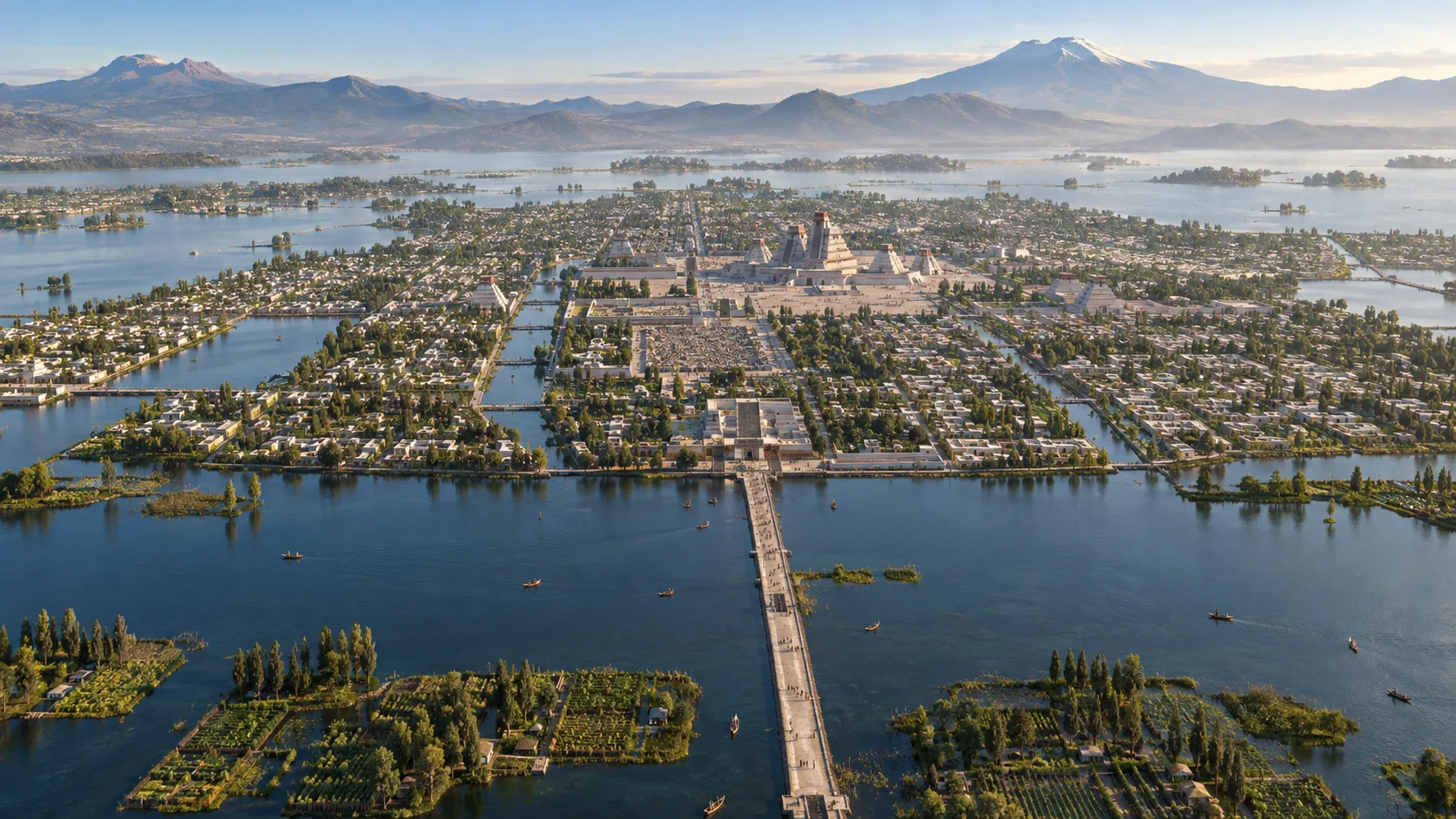
Q: What kind of location was Tenochtitlan built on?
A: Islands and reclaimed land within Lake Texcoco.
Q: What raised roads connected the island capital to the mainland?
A: Causeways.
Q: What did canals allow residents to do within the city?
A: Move people and goods by canoe through an extensive water-transport network.
Q: What neighboring city became famous for its enormous market?
A: Tlatelolco.
Q: Did Tlatelolco remain permanently independent from Tenochtitlan?
A: No. Tenochtitlan eventually conquered and incorporated it.
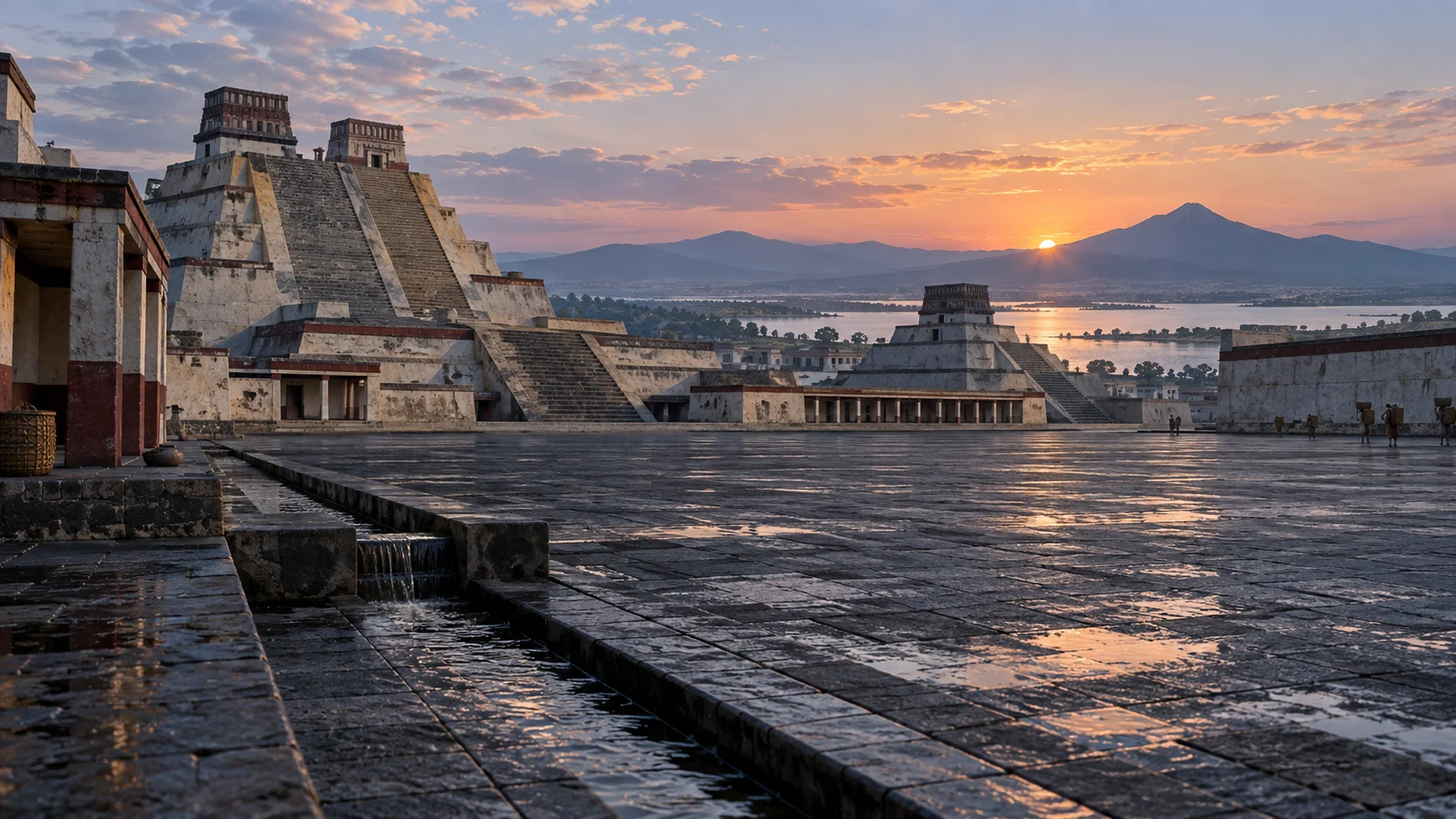
Q: What huge religious complex stood at Tenochtitlan's sacred center?
A: The Templo Mayor precinct.
Q: What was the Templo Mayor itself?
A: A large stepped temple platform with twin shrines at its summit.
Q: What two gods had the principal summit shrines of the Templo Mayor?
A: Huitzilopochtli and Tlaloc.
Q: What deity was Huitzilopochtli especially associated with?
A: The sun, warfare, and Mexica identity.
Q: What deity was Tlaloc especially associated with?
A: Rain, water, fertility, and agriculture.
Q: What did Spanish observers remark about Tenochtitlan's appearance?
A: Its size, canals, causeways, temples, markets, cleanliness, and lake setting impressed many eyewitnesses.
Q: Did Tenochtitlan obtain all of its freshwater directly from salty Lake Texcoco?
A: No. Aqueducts and water-management systems brought freshwater from springs and other sources.
Q: What major freshwater engineering structure is associated with Chapultepec?
A: An aqueduct carrying spring water toward the capital.
Q: What makes Tenochtitlan remarkable in urban-history trivia?
A: A rapidly expanding island capital supported a huge population through causeways, canals, markets, aqueducts, tribute, and intensive agriculture before the Spanish conquest.
The Triple Alliance, Tribute & Imperial Rule
Q: What three city-states formed the Triple Alliance?
A: Tenochtitlan, Texcoco, and Tlacopan.
Q: Which member eventually became the dominant partner?
A: Tenochtitlan.
Q: What did conquered provinces often owe the alliance?
A: Tribute in goods, labor, and resources.
Q: What kinds of tribute could provinces send?
A: Textiles, cacao, feathers, food, cotton, warrior costumes, luxury materials, and many other products.
Q: What surviving colonial manuscript records tribute owed to Tenochtitlan in pictorial form?
A: The Codex Mendoza.
Q: Did imperial conquest always replace every local ruler with a Mexica official?
A: No. Many conquered communities retained local rulers as long as tribute and political obligations were fulfilled.
Q: What title is often translated as ruler or speaker in Nahuatl?
A: Tlatoani.
Q: What title was used for the supreme ruler of Tenochtitlan?
A: Huey tlatoani, often translated as great speaker.
Q: Who was Itzcoatl?
A: A Mexica ruler associated with the victory over Azcapotzalco and rise of the Triple Alliance.
Q: Who was Moctezuma I?
A: A 15th-century ruler who expanded Mexica power after the alliance was established.
Q: Who ruled Tenochtitlan when Hernán Cortés arrived in 1519?
A: Moctezuma II, also called Motecuhzoma Xocoyotzin.
Q: What made the tribute empire politically vulnerable?
A: Some subject peoples resented tribute demands and military domination, giving the Spaniards potential Indigenous allies.
Q: What city-state became the Spaniards' most important Indigenous ally against Tenochtitlan?
A: Tlaxcala.
Q: Was Tlaxcala part of the Aztec Triple Alliance?
A: No. It remained an important independent rival.
Q: Why is describing the conquest as Spaniards versus Aztecs misleading?
A: Cortés depended on thousands of Indigenous allies with their own political goals, especially Tlaxcalans and other enemies of Mexica rule.
Warfare, Warriors & Captives
Q: What was one major political purpose of Mexica warfare?
A: Expanding tribute obligations and political dominance.
Q: Why were captives important in some Mexica wars?
A: Capturing enemies could bring military prestige and provide captives for ritual sacrifice.
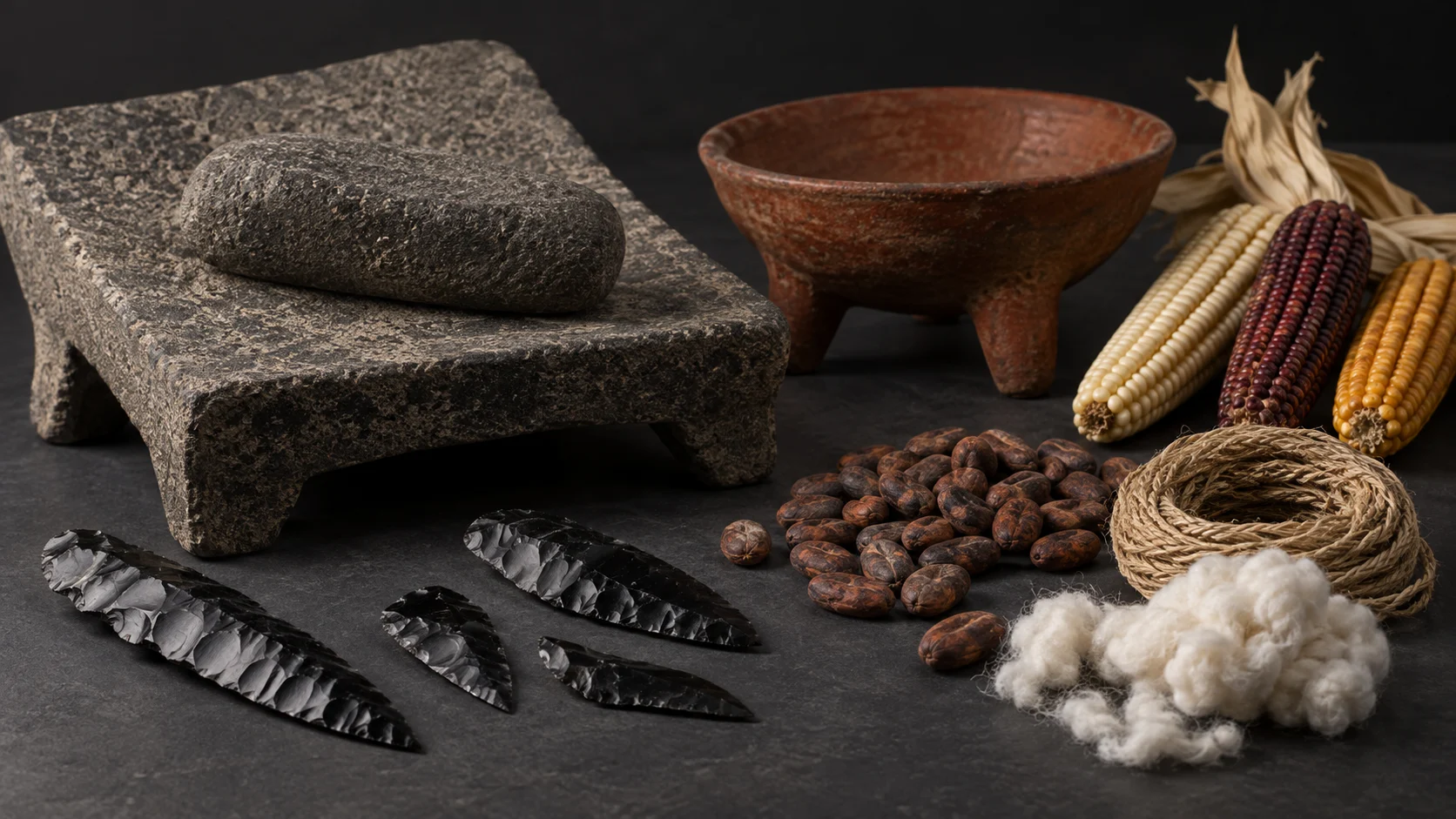
Q: What weapon used a wooden shaft edged with sharp obsidian blades?
A: The macuahuitl.
Q: What spear-throwing device increased projectile force?
A: The atlatl.
Q: What stone or volcanic glass made exceptionally sharp cutting edges?
A: Obsidian.
Q: What padded armor made from layered cotton could protect warriors?
A: Ichcahuipilli.
Q: What animal-themed elite warrior category is commonly called the Eagle Warriors?
A: Cuāuhpipiltin or eagle warriors in modern descriptions.
Q: What other famous animal-themed warrior group is commonly called Jaguar Warriors?
A: Jaguar warriors, associated with elite military status.
Q: Did every Mexica male automatically belong to an elite eagle or jaguar order?
A: No. Elite status depended on military achievement, social background, and institutional rules.
Q: What term is commonly translated as Flower War?
A: Xochiyaoyotl.
Q: Were Flower Wars simply friendly sporting matches?
A: No. They were real armed conflicts with political, military, ritual, and captive-taking dimensions.
Q: Why did capturing an enemy alive sometimes matter more than killing one immediately?
A: Captives could demonstrate individual warrior success and could be used in ritual sacrifice.
Q: Did the Mexica use horses in warfare before Spanish arrival?
A: No. Horses had disappeared from the Americas long before and were reintroduced by Europeans.
Q: What unfamiliar Spanish military technologies shocked Mesoamerican forces?
A: Horses, steel weapons, crossbows, firearms, and cannon were unfamiliar, although Spanish victory depended on far more than technology alone.
Q: Why is Aztec warfare often oversimplified?
A: It combined imperial expansion, local rivalry, tribute enforcement, status competition, captive taking, strategy, diplomacy, and ritual rather than one single motive.
Religion, Templo Mayor & Sacred Time
Q: What two gods occupied the twin summit shrines of the Templo Mayor?
A: Huitzilopochtli and Tlaloc.
Q: What did the pairing of Huitzilopochtli and Tlaloc symbolically connect?
A: Warfare and solar power with rain, agriculture, and fertility, two central foundations of Mexica state life.
Q: Who was Quetzalcoatl?
A: A major feathered-serpent deity with deep Mesoamerican roots predating the Mexica.
Q: Who was Tezcatlipoca?
A: A major deity associated with rulership, night, destiny, conflict, sorcery, and many other powers.
Q: Who was Coatlicue?
A: A powerful earth and mother deity in Mexica religion.
Q: What colossal sculpture in Mexico City depicts Coatlicue?
A: The famous Coatlicue statue in the National Museum of Anthropology.
Q: Who was Coyolxauhqui?
A: A lunar or celestial goddess whose myth is connected with Huitzilopochtli and the sacred mountain Coatepec.
Q: What enormous carved stone of Coyolxauhqui was found near the Templo Mayor?
A: A monumental circular relief depicting her dismembered body.
Q: What discovery in 1978 helped trigger major excavation of the Templo Mayor?
A: Workers uncovered the huge Coyolxauhqui stone.
Q: Did human sacrifice occur in Mexica religion?
A: Yes.
Q: Are exact totals for sacrificial victims easy to establish?
A: No. Historical claims vary widely and some colonial figures are debated, so precise totals should be treated cautiously.
Q: What 260-day ritual calendar did the Mexica use?
A: The tonalpohualli.
Q: What 365-day solar calendar did they use?
A: The xiuhpohualli.
Q: What happened when the 260-day and 365-day calendar cycles realigned?
A: They completed a 52-year Calendar Round.
Q: What major ceremony marked the completion of a 52-year cycle?
A: The New Fire ceremony.
Chinampas, Markets, Food & Daily Life
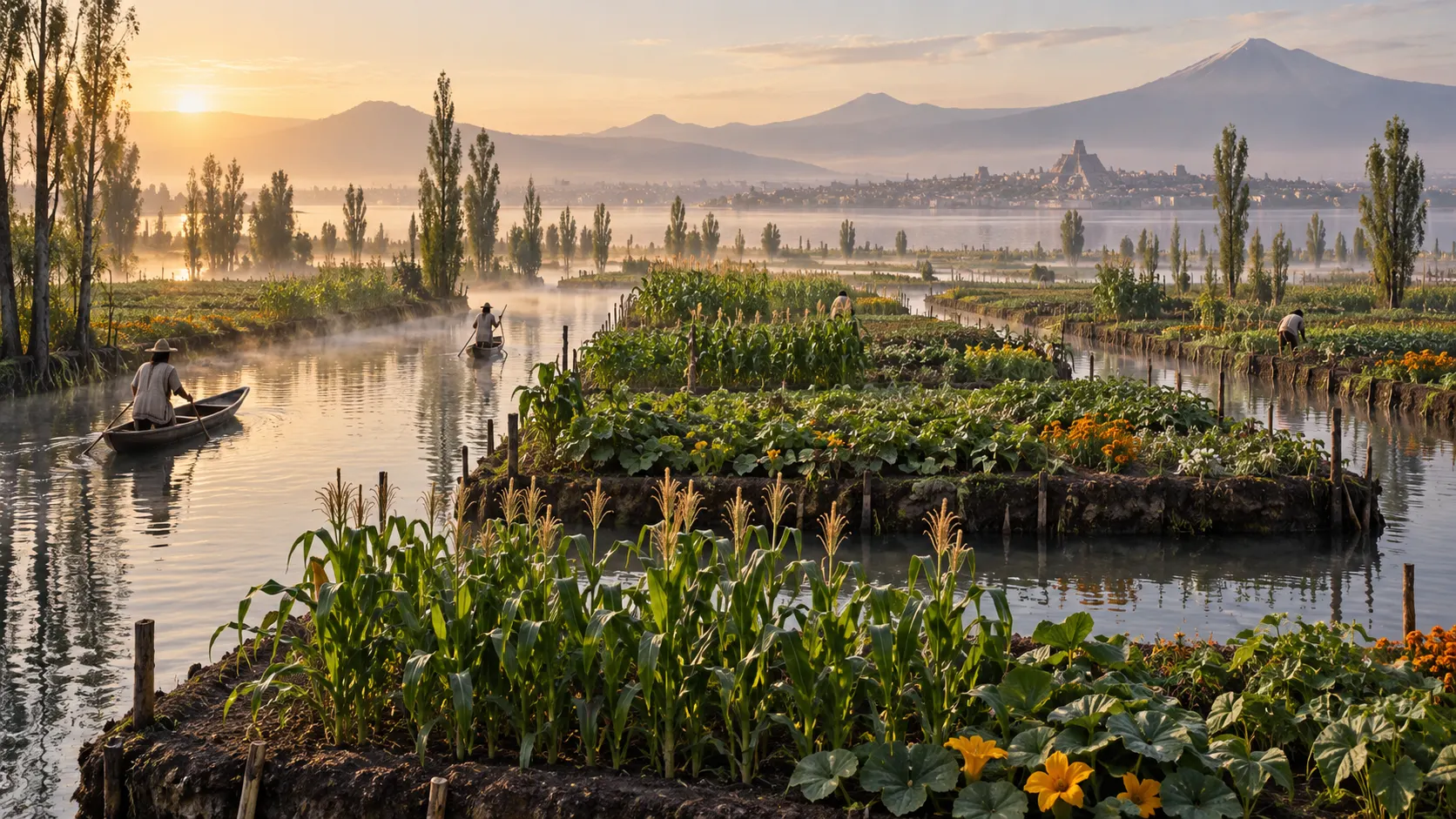
Q: What intensive farming system is strongly associated with the shallow lakes of the Valley of Mexico?
A: Chinampas.
Q: Were chinampas literally floating gardens drifting freely on water?
A: No. They were constructed raised agricultural plots anchored in shallow lake environments.
Q: Why were chinampas productive?
A: They benefited from fertile sediments, water access, careful maintenance, canals, and intensive cultivation.
Q: What staple crop dominated Mexica agriculture?
A: Maize.
Q: What two other staple crops often complemented maize?
A: Beans and squash.
Q: What spicy fruit was central to the cuisine?
A: Chile peppers.
Q: What seed was used to make elite drinks and could function as a trade currency?
A: Cacao beans.
Q: What domesticated bird was an important source of meat?
A: Turkey.
Q: What huge market was famous in Tlatelolco?
A: The Tlatelolco market.
Q: What kinds of goods could be found in the market?
A: Food, textiles, pottery, tools, feathers, cacao, obsidian, jewelry, medicines, animals, and many regional products.
Q: What professional merchant class conducted long-distance trade and sometimes gathered intelligence?
A: Pochteca merchants.
Q: What plant fiber was used for cloth and paper-like products among ordinary people?
A: Maguey, or agave, fibers.
Q: What luxury textile fiber was especially valuable and often collected as tribute?
A: Cotton.
Q: What drink made from fermented maguey sap was known in central Mexico?
A: Pulque.
Q: What makes Mexica economic life impressive in trivia terms?
A: A huge capital combined intensive lake agriculture, long-distance trade, enormous markets, specialized crafts, tribute, canoe transport, and regional supply networks.
Education, Society, Art & Nahuatl
Q: What was the calmecac?
A: A school associated especially with training elite youths for priestly, administrative, and leadership roles.
Q: What was the telpochcalli?
A: A neighborhood school that trained many commoner youths in civic duties, warfare, discipline, and culture.
Q: Did Mexica society provide organized education to young people?
A: Yes, through different institutions shaped by status, gender, and community role.
Q: What is Nahuatl?
A: The language of the Mexica and many other central Mexican peoples, still spoken today in multiple varieties.
Q: What English food word comes through Nahuatl from chocolatl or related cacao terminology?
A: Chocolate has roots in Indigenous Mesoamerican language traditions including Nahuatl.
Q: What English word for a red fruit comes from Nahuatl tomatl?
A: Tomato.
Q: What English word for a green fruit comes from Nahuatl ahuacatl?
A: Avocado.
Q: What were codices?
A: Painted or written manuscripts recording history, tribute, calendars, genealogy, land, ritual, and other knowledge.
Q: What materials could Mesoamerican codices use?
A: Bark paper, deerskin, or other prepared surfaces folded into screens or books.
Q: Did Mexica writing work exactly like an alphabet?
A: No. It combined pictorial signs, name glyphs, phonetic elements, numbers, and conventional symbols.
Q: What did featherworkers create?
A: Elaborate mosaics, shields, garments, headdresses, and luxury objects using brilliantly colored feathers.
Q: What blue-green stone was especially prized in ritual and elite art?
A: Turquoise.
Q: What volcanic glass was essential for blades, tools, mirrors, and ritual objects?
A: Obsidian.
Q: What did stone sculpture communicate besides decoration?
A: Divine power, historical memory, rulership, cosmology, warfare, tribute, and ritual meaning.
Q: Why is Nahuatl one of the strongest reminders that Mexica culture did not vanish in 1521?
A: Nahuatl remains a living language family spoken by communities in Mexico today.
Spanish Arrival, Smallpox & the Fall of Tenochtitlan
Q: Who led the Spanish expedition that reached the Mexica sphere in 1519?
A: Hernán Cortés.
Q: Who was Malintzin, also known as Doña Marina or La Malinche?
A: An Indigenous woman who became a crucial interpreter, adviser, and intermediary for Cortés.
Q: What other interpreter initially helped bridge Spanish and Maya languages?
A: Jerónimo de Aguilar.
Q: What Indigenous state became Cortés's most important military ally?
A: Tlaxcala.
Q: Did Cortés conquer Tenochtitlan with Spaniards alone?
A: No. Large Indigenous allied forces were essential.
Q: Who was the Mexica ruler when Cortés entered Tenochtitlan in 1519?
A: Moctezuma II.
Q: What happened to Moctezuma II in 1520?
A: He died during the escalating conflict, though accounts disagree on exactly how he was fatally injured.
Q: Who briefly succeeded Moctezuma and led resistance during a devastating epidemic?
A: Cuitlahuac.
Q: What disease swept through Tenochtitlan in 1520?
A: Smallpox.
Q: Why was smallpox so devastating?
A: Indigenous populations had no previous exposure to the virus and therefore lacked population-level acquired immunity.
Q: Who became the final independent Mexica ruler of Tenochtitlan?
A: Cuauhtemoc.
Q: What kind of military campaign finally defeated Tenochtitlan?
A: A prolonged siege by Spanish and Indigenous allied forces.
Q: On what date did Tenochtitlan fall?
A: August 13, 1521.
Q: What colonial city grew directly over the defeated capital?
A: Mexico City.
Q: Why is the conquest best understood as a multi-cause event?
A: Indigenous alliances, local rivalries, epidemic disease, siege warfare, Spanish weapons and horses, political disruption, and internal decisions all contributed.
Hard Aztec Empire Challenge
Q: What three cities formed the Triple Alliance?
A: Tenochtitlan, Texcoco, and Tlacopan.
Q: What title means great speaker and is commonly translated as emperor?
A: Huey tlatoani.
Q: What 260-day calendar guided ritual divination?
A: The tonalpohualli.
Q: What 365-day calendar tracked the solar year?
A: The xiuhpohualli.
Q: What ceremony marked the 52-year calendar cycle?
A: The New Fire ceremony.
Q: What market city was absorbed by Tenochtitlan but remained famous for commerce?
A: Tlatelolco.
Q: What agricultural system is commonly mislabeled as floating gardens?
A: Chinampas.
Q: What long-distance merchants could also serve diplomatic or intelligence functions?
A: Pochteca.
Q: What weapon combined wood with inset obsidian blades?
A: Macuahuitl.
Q: What monumental relief discovered in 1978 helped launch modern excavation of the Templo Mayor?
A: The Coyolxauhqui stone.
Q: What Codex records tribute goods and information about Mexica society in the early colonial period?
A: The Codex Mendoza.
Q: Which independent central Mexican state became a decisive Spanish ally?
A: Tlaxcala.
Q: Which epidemic severely weakened Tenochtitlan before its final siege?
A: Smallpox.
Q: What is the most useful correction to the phrase "the Aztecs vanished in 1521"?
A: The imperial government fell, but Nahua and other Indigenous peoples survived, adapted, resisted, and remain part of Mexico's living cultures.
Q: Why is Aztec Empire trivia especially deep?
A: Tenochtitlan's urban engineering, tribute politics, markets, intensive farming, Nahuatl, calendars, religious art, warfare, education, codices, Indigenous rivalries, epidemic disease, conquest, and living cultural continuities make the empire far more complex than a story about pyramids and sacrifice.
How Did You Score?
If huey tlatoani, Tlatelolco, pochteca, tonalpohualli, Coyolxauhqui, chinampas, Tlaxcala, and the August 13, 1521 fall of Tenochtitlan all came easily, your Mexica history is ready for the codices.
Keep exploring with our world history trivia, Ancient Egypt trivia, and geography trivia.

Ellie Simons creates and edits Random Trivia. She researches trivia using primary and authoritative sources whenever possible and is currently reviewing the site's older trivia library for accuracy, clarity, and playability. Read more on the About page.
About this quiz
Site editor: Ellie Simons. Read our Trivia Methodology to learn how questions are researched and updated. Page last updated: . Report an error.