
From Fort Sumter to Appomattox, the American Civil War reshaped the nation.
This mega-set blends famous battles and leaders with lesser-known stories of technology, medicine, emancipation, and memory.
Start with easier questions and work toward expert challenges as you explore the conflict from every angle.
Why the American Civil War Makes Great Trivia
The war touches nearly every theme trivia loves: strategy and surprises on the battlefield, towering personalities, political gambles, and social transformation.
It’s a story of technology meeting tradition, rifled muskets, telegraphs, railroads, while ordinary people on farms, in factories, and at sea faced extraordinary stakes.
It also leaves a deep cultural imprint: songs and speeches, new holidays, and debates over memory that continue today.
That rich mix makes the Civil War perfect for a set that moves from approachable warm-ups to brain-stretching detail.
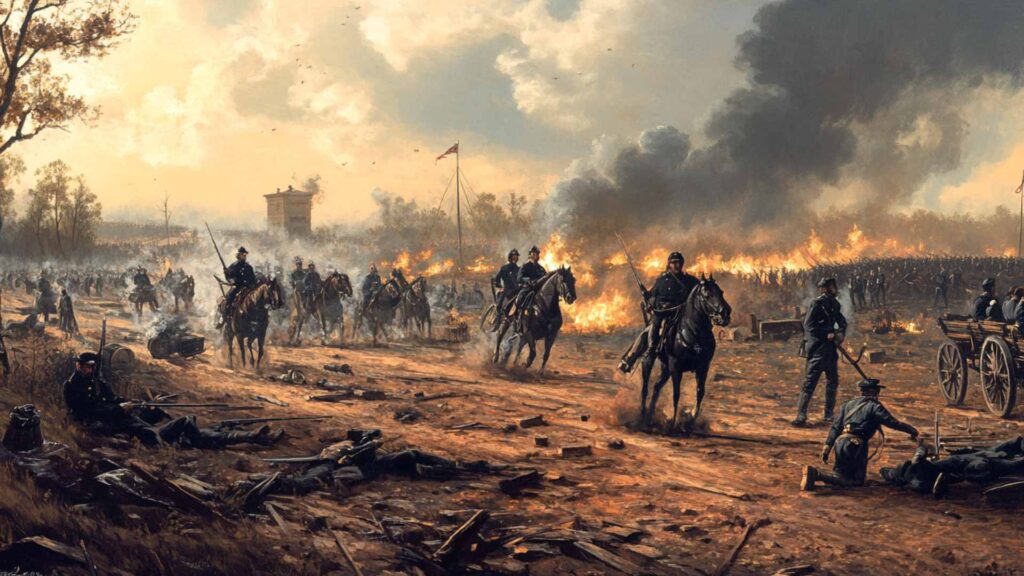
Causes & Road to War
Q: What single issue most sharply divided North and South before the war?
A: The expansion and morality of slavery.
Q: Which 1820 deal tried to balance free and slave states in Congress?
A: The Missouri Compromise.
Q: What 1850 law forced citizens to help capture people who had escaped slavery?
A: The Fugitive Slave Act of 1850.
Q: Which 1854 act opened Kansas and Nebraska to “popular sovereignty”?
A: The Kansas–Nebraska Act.
Q: The violence that followed in the territory became known as what?
A: “Bleeding Kansas.”
Q: What 1857 Supreme Court case ruled that Black people could not be U.S. citizens?
A: Dred Scott v. Sandford.
Q: Who led the 1859 raid on the federal armory at Harpers Ferry?
A: John Brown.
Q: Whose 1860 presidential victory triggered the first wave of secession?
A: Abraham Lincoln’s.
Q: Which state seceded first on December 20, 1860?
A: South Carolina.
Q: What was the new nation formed by the seceding states called?
A: The Confederate States of America.
Q: Who became the Confederacy’s president in February 1861?
A: Jefferson Davis.
Q: The Confederate Constitution did what regarding slavery?
A: Explicitly protected slavery and its expansion in member states.
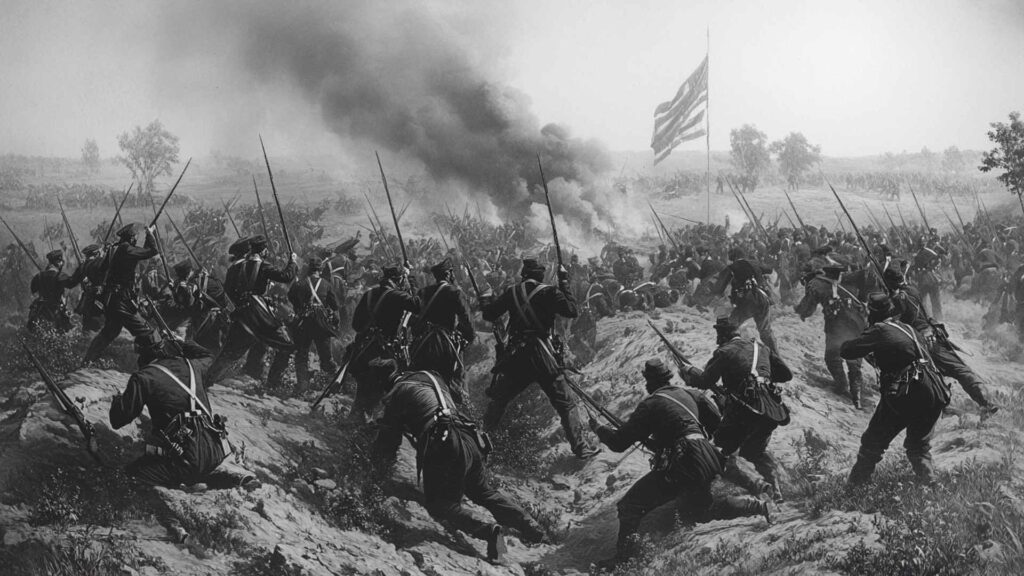
1861–62: From Sumter to Antietam
Q: Where were the war’s opening shots fired in April 1861?
A: Fort Sumter in Charleston Harbor.
Q: On what date did bombardment of Fort Sumter begin?
A: April 12, 1861.
Q: What was the first major land battle of the war?
A: First Bull Run (First Manassas).
Q: Which Confederate general earned the nickname “Stonewall” there?
A: Thomas J. “Stonewall” Jackson.
Q: Where did the ironclads USS Monitor and CSS Virginia clash in 1862?
A: Hampton Roads, Virginia.
Q: Which Union general led the Peninsula Campaign toward Richmond?
A: George B. McClellan.
Q: What single day remains the bloodiest in American military history?
A: September 17, 1862—the Battle of Antietam.
Q: Which captured document—Special Order 191—revealed Confederate plans before Antietam?
A: Robert E. Lee’s campaign orders.
Q: Which major Gulf port fell to Admiral David Farragut in April 1862?
A: New Orleans.
Q: What two-day battle in April 1862 shocked Americans with casualties near a European scale?
A: Shiloh (Pittsburg Landing).
Q: Which forts did Ulysses S. Grant capture in February 1862 to open Tennessee?
A: Forts Henry and Donelson.
Q: What tactical outcome at Antietam allowed Lincoln to issue a new policy?
A: A checked Confederate invasion—enough of a Union advantage to announce the Emancipation Proclamation.
Eastern Theater: Lee vs. the Army of the Potomac
Q: Who took command of the Army of Northern Virginia in June 1862?
A: Robert E. Lee.
Q: Which December 1862 battle saw disastrous Union assaults on fortified heights?
A: Fredericksburg.
Q: Which May 1863 battle is often called Lee’s tactical masterpiece?
A: Chancellorsville.
Q: Which key Confederate corps commander died after being wounded by friendly fire?
A: Thomas J. “Stonewall” Jackson.
Q: What was the largest battle of the war by overall forces engaged?
A: Gettysburg (July 1–3, 1863).
Q: What failed July 3 attack has come to symbolize Confederate defeat there?
A: Pickett’s Charge.
Q: On what ridge did the Union center hold firm at Gettysburg?
A: Cemetery Ridge.
Q: Which 20th Maine colonel famously defended Little Round Top?
A: Joshua Lawrence Chamberlain.
Q: What 1864 campaign pitted Grant against Lee in brutal, continuous combat?
A: The Overland Campaign.
Q: Name the June 1864 battle notorious for deadly frontal attacks in minutes.
A: Cold Harbor.
Q: What prolonged struggle followed south of Richmond from 1864 to 1865?
A: The Siege of Petersburg.
Q: Where did Lee surrender to Grant, effectively ending major fighting in Virginia?
A: Appomattox Court House, April 9, 1865.
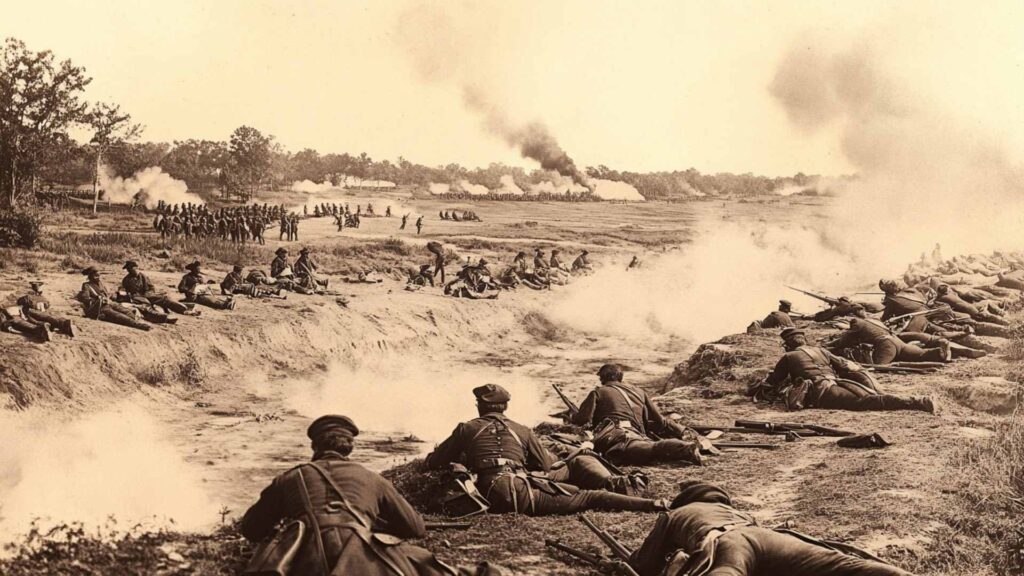
Western Theater: River, Rail, and the Heartland
Q: What was the Union’s strategic goal along the Mississippi River?
A: Control the river to split the Confederacy.
Q: Which fortress city surrendered on July 4, 1863, giving the Union the river?
A: Vicksburg.
Q: Which Union general’s success there made him a national figure?
A: Ulysses S. Grant.
Q: What 1863 battles around Chattanooga opened the Deep South to Union advance?
A: The Battles of Chattanooga—Lookout Mountain and Missionary Ridge.
Q: Who led the 1864 Atlanta Campaign for the Union?
A: William Tecumseh Sherman.
Q: When did Atlanta fall to Union forces?
A: September 2, 1864.
Q: What destructive 1864 march cut from Atlanta to the sea?
A: Sherman’s March to the Sea.
Q: What approach targeted railroads, depots, and infrastructure rather than civilians?
A: “Hard war” (systematic destruction of military resources).
Q: Which December 1864 battle shattered John Bell Hood’s army?
A: The Battle of Nashville.
Q: What bloody fight two weeks earlier cost the Confederacy many officers?
A: The Battle of Franklin.
Q: What late-1862/early-1863 clash near Murfreesboro ended as a Union strategic win?
A: The Battle of Stones River.
Q: What pair of July 1863 Union victories is often called the war’s turning point?
A: Gettysburg and Vicksburg.
Naval War & the Blockade
Q: What nickname described the Union plan to choke off Southern trade by sea?
A: The Anaconda Plan.
Q: What were “blockade runners”?
A: Fast vessels designed to slip through the Union blockade with supplies.
Q: Name the Union ironclad that battled CSS Virginia in 1862.
A: USS Monitor.
Q: Which 1861 victory gave the Union a crucial Atlantic base and coaling station?
A: Port Royal, South Carolina.
Q: What Confederate commerce raider was sunk off Cherbourg, France, in 1864?
A: CSS Alabama.
Q: Which Union sloop-of-war defeated it?
A: USS Kearsarge.
Q: Which August 1864 battle secured control of the Gulf approaches for the Union?
A: The Battle of Mobile Bay.
Q: What famous command is associated with Admiral David Farragut there?
A: “Damn the torpedoes, full speed ahead!” (a paraphrase of his order).
Q: In Civil War naval terms, what were “torpedoes”?
A: Anchored contact mines.
Q: Name the Confederate submarine that sank USS Housatonic.
A: H. L. Hunley.
Q: Who led the Union Mississippi River Squadron during the Vicksburg campaign?
A: Admiral David Dixon Porter.
Q: What two forts guarded Mobile Bay before the Union breakthrough?
A: Fort Morgan and Fort Gaines.

Leaders & Personalities
Q: Who was the U.S. president during most of the Civil War?
A: Abraham Lincoln.
Q: Who served as president of the Confederate States?
A: Jefferson Davis.
Q: Which general became overall Union commander in 1864?
A: Ulysses S. Grant (as General-in-Chief).
Q: Which Virginian led the Army of Northern Virginia for most of the war?
A: Robert E. Lee.
Q: Which young Union cavalry officer later died at Little Bighorn in 1876?
A: George Armstrong Custer.
Q: Which flamboyant Confederate cavalryman was famed for screening and raids?
A: J. E. B. Stuart.
Q: Which Union general orchestrated the March to the Sea?
A: William Tecumseh Sherman.
Q: Which Confederate lieutenant general earned a reputation as a master defender?
A: James Longstreet.
Q: Which Union general was nicknamed “The Rock of Chickamauga”?
A: George H. Thomas.
Q: Which Union admiral commanded at the Battle of Mobile Bay?
A: David Farragut.
Q: Which nurse became renowned for battlefield aid and later humanitarian work?
A: Clara Barton.
Q: Which abolitionist orator lobbied Lincoln to arm Black troops?
A: Frederick Douglass.
African Americans, Emancipation & the U.S. Colored Troops
Q: What proclamation, effective January 1, 1863, declared freedom in rebelling states?
A: The Emancipation Proclamation.
Q: Beyond military strategy, how did it redefine the Union’s war aims?
A: It made ending slavery a central goal alongside preserving the Union.
Q: About how many Black men served as soldiers in the U.S. Colored Troops?
A: Roughly 179,000.
Q: Approximately how many Black sailors served in the U.S. Navy?
A: About 18,000 (many recruited early in the war).
Q: Which celebrated regiment led assaults at Fort Wagner in 1863?
A: The 54th Massachusetts Volunteer Infantry.
Q: Who commanded the 54th Massachusetts?
A: Colonel Robert Gould Shaw.
Q: What 1864 legislation eventually equalized Black soldiers’ pay with white troops?
A: An act of Congress in 1864 granting equal pay, retroactive to January 1, 1864.
Q: What April 1862 law freed enslaved people in the nation’s capital with compensation?
A: The District of Columbia Compensated Emancipation Act.
Q: Which constitutional amendment abolished slavery nationwide in 1865?
A: The Thirteenth Amendment.
Q: What term described enslaved people who sought refuge behind Union lines?
A: “Contrabands of war.”
Q: Which 1864 incident is often cited for killings of surrendering Black troops?
A: The Fort Pillow massacre.
Q: Name one of Frederick Douglass’s sons who served in the 54th Massachusetts.
A: Lewis Douglass or Charles Douglass.
Life of Soldiers & Civilians
Q: What was the typical infantryman’s primary weapon?
A: A rifled musket, often a Springfield or imported Enfield.
Q: What conical bullet made rifled muskets deadlier at range?
A: The Minié (Minie) ball.
Q: What hard biscuit became a ration staple—and a running joke?
A: Hardtack.
Q: What word described leaving one’s unit without permission?
A: Desertion.
Q: What color were standard Union uniforms?
A: Dark blue.
Q: What color were Confederate uniforms commonly associated with?
A: Gray (though supply shortages caused wide variation).
Q: What nickname did Union troops often use for Confederates?
A: “Rebels” (or “Rebs”).
Q: Who were “sutlers” in Civil War camps?
A: Civilian merchants selling goods to soldiers.
Q: What July 1863 event in New York City turned deadly over conscription?
A: The New York City Draft Riots.
Q: Which volunteer organization led by women supported Union soldiers’ health?
A: The U.S. Sanitary Commission.
Q: Which Georgia prison became infamous for overcrowding and mortality?
A: Andersonville (Camp Sumter).
Q: Which hymn by Julia Ward Howe became a Union anthem?
A: “The Battle Hymn of the Republic.”
Technology, Medicine & Logistics
Q: What communication tool let Lincoln direct strategy in near real time?
A: The telegraph.
Q: What transportation network shaped how both sides moved men and supplies?
A: Railroads.
Q: Who led the Union Balloon Corps for aerial reconnaissance?
A: Thaddeus S. C. Lowe.
Q: What innovation made infantry fire more lethal than in earlier wars?
A: Rifled barrels firing Minié balls.
Q: Name a commonly used surgical anesthetic of the era.
A: Chloroform (ether was also used).
Q: Which caregiver became known as the “Angel of the Battlefield”?
A: Clara Barton.
Q: What early rapid-fire weapon saw limited but notable deployment?
A: The Gatling gun.
Q: What medical system, created by Jonathan Letterman, standardized evacuation and triage?
A: A dedicated ambulance corps with organized field hospitals and triage.
Q: What major ironworks in Richmond supplied Confederate artillery and armor?
A: Tredegar Iron Works.
Q: What nickname described rails heated and twisted to wreck Confederate logistics?
A: “Sherman’s neckties.”
Q: What critical Union logistics chief kept armies supplied in the field?
A: Quartermaster General Montgomery C. Meigs.
Q: Which Southern facility produced much of the Confederacy’s gunpowder?
A: The Augusta Powder Works in Georgia.
Aftermath, Reconstruction & Memory
Q: On what date did Lee surrender to Grant at Appomattox Court House?
A: April 9, 1865.
Q: What tragedy struck the nation five days later?
A: Abraham Lincoln was assassinated (shot April 14; he died April 15, 1865).
Q: Who became U.S. president after Lincoln’s death?
A: Andrew Johnson.
Q: Which constitutional amendment guaranteed birthright citizenship and equal protection?
A: The Fourteenth Amendment.
Q: Which amendment protected voting rights regardless of race?
A: The Fifteenth Amendment.
Q: What federal agency, created in 1865, aided formerly enslaved people and refugees?
A: The Freedmen’s Bureau.
Q: What June 19, 1865, announcement in Texas is now commemorated as a holiday?
A: Juneteenth—General Order No. 3 proclaiming freedom in Texas.
Q: What is the debated range of total Civil War deaths in modern scholarship?
A: About 620,000 to possibly around 750,000.
Q: Which Confederate raider continued operations until surrendering in Liverpool in November 1865?
A: CSS Shenandoah.
Q: What Union veterans’ organization shaped postwar memory and politics?
A: The Grand Army of the Republic (GAR).
Q: What tradition of decorating soldiers’ graves evolved into Memorial Day?
A: “Decoration Day,” widely observed after 1868.
Q: What 1872 international arbitration compensated the U.S. for British-built raiders?
A: The Alabama Claims (Geneva Arbitration).
Nice campaign!
Whether you aced the easy ones or outmaneuvered the trickier asks, this set spans the war’s causes, combat, and consequences.
Share it with your history crew or reload for another round and see who commands the field next.

Ellie Simons creates and edits Random Trivia. She researches trivia using primary and authoritative sources whenever possible and is currently reviewing the site's older trivia library for accuracy, clarity, and playability. Read more on the About page.
About this quiz
Site editor: Ellie Simons. Read our Trivia Methodology to learn how questions are researched and updated. Page last updated: . Report an error.