
Explore World War I through ten themed quiz rounds on its origins, Western and Eastern fronts, naval and air warfare, new weapons, the home front, global campaigns, and the postwar settlement.
These 120 questions let you focus on a front or run a full history game. For a shorter four-round overview, try our World War I trivia guide.
Why World War I Makes Great Trivia
World War I sits at the crossroads of old empires and modern warfare.
Cavalry charged into machine guns; biplanes and tanks appeared beside trenches; propaganda met mass politics. That collision of eras yields rich, surprising facts perfect for trivia.
It’s also truly global. Fighting stretched from Flanders to the Caucasus, East Africa to the Pacific.
The war’s cultural imprint, poetry, songs, memorials, still resonates, making well-rounded questions that connect history with daily life.
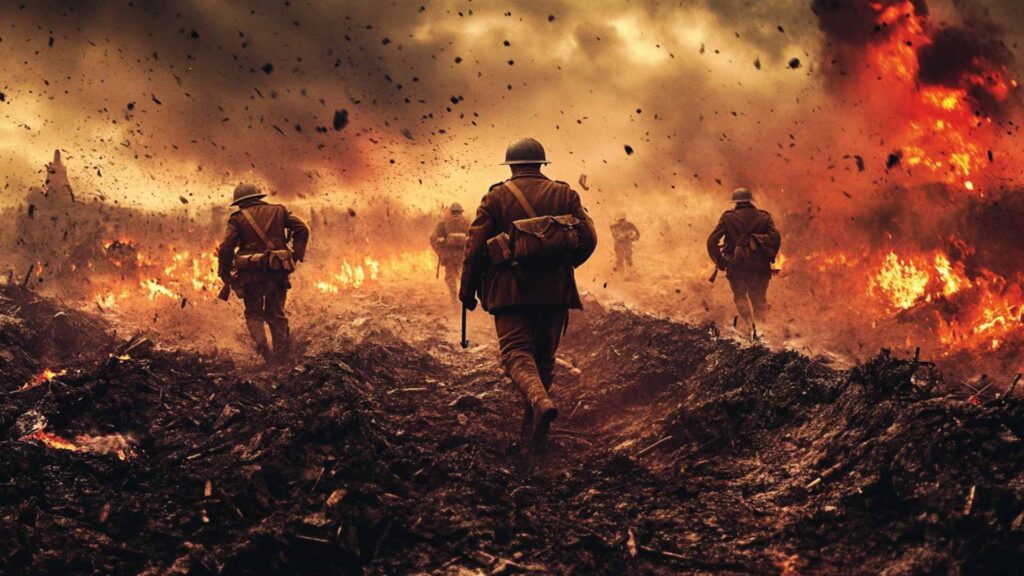
Origins & Outbreak (1914)
Q: What event is commonly cited as the spark that ignited World War I?
A: The assassination of Archduke Franz Ferdinand in Sarajevo on June 28, 1914.
Q: Which secret society’s member carried out the assassination?
A: Gavrilo Princip, linked to the Black Hand (and “Young Bosnia” activists).
Q: Which empire issued a harsh ultimatum to Serbia after the assassination?
A: Austria-Hungary, on July 23, 1914.
Q: What is the term for the diplomatic chain reaction that followed in July 1914?
A: The July Crisis.
Q: Which two alliance groups faced each other at the war’s start?
A: The Triple Entente (France, Russia, Britain) vs. the Triple Alliance (Germany, Austria-Hungary, Italy).
Q: What German strategy envisioned a rapid strike through Belgium to defeat France?
A: The Schlieffen Plan.
Q: What 1839 treaty Britain cited to defend Belgium’s neutrality?
A: The Treaty of London.
Q: On what date did Britain declare war on Germany?
A: August 4, 1914.
Q: Which country left the Triple Alliance and later joined the Entente?
A: Italy, in 1915.
Q: What phrase describes Germany’s early assurance of support to Austria-Hungary?
A: The “blank check.”
Q: Who was Germany’s monarch at the war’s outbreak?
A: Kaiser Wilhelm II.
Q: Which prewar crisis foreshadowed the tensions between Germany and France in Morocco?
A: The Second Moroccan (Agadir) Crisis of 1911.
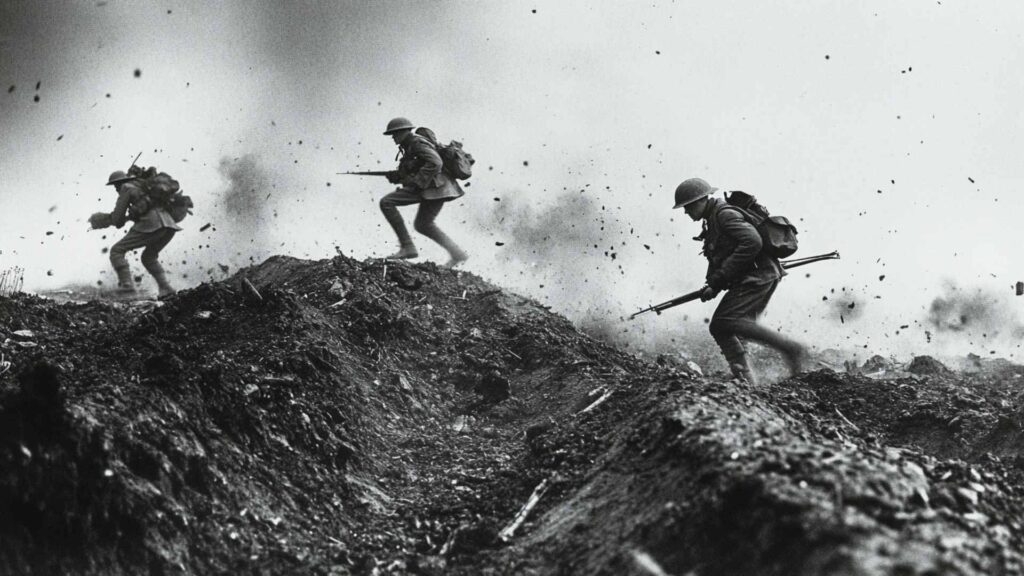
Western Front & Trench Life
Q: What term described the deadly gap between opposing trench lines?
A: No Man’s Land.
Q: Which obstacle made frontal attacks especially costly?
A: Barbed wire entanglements.
Q: What did “going over the top” mean to soldiers?
A: Climbing out of the trench to assault enemy lines.
Q: What routine at dawn and dusk kept soldiers vigilant?
A: “Stand-to.”
Q: Which painful condition from cold, wet trenches plagued soldiers’ feet?
A: Trench foot.
Q: Where did the first large-scale chlorine gas attack on the Western Front occur in 1915?
A: The Second Battle of Ypres.
Q: In which year did spontaneous Christmas ceasefires occur on parts of the front?
A: 1914.
Q: What artillery tactic advanced a wall of fire just ahead of attacking infantry?
A: The creeping barrage.
Q: What steel helmet introduced in 1915 became standard for British troops?
A: The Brodie helmet.
Q: What name was given to Germany’s elite infiltration troops late in the war?
A: Stormtroopers (using infiltration tactics).
Q: What were British “Pals battalions”?
A: Units of friends or co-workers who enlisted together, suffering tragic losses in battles like the Somme.
Q: Which famed African American regiment fought under French command and earned high honors?
A: The 369th Infantry Regiment, the “Harlem Hellfighters.”
Eastern, Italian & Balkan Fronts
Q: What 1914 battle saw Germany encircle and defeat Russia’s Second Army?
A: Tannenberg.
Q: Which Russian general led a successful 1916 offensive against Austria-Hungary?
A: General Alexei Brusilov (the Brusilov Offensive).
Q: Which 1915–1916 campaign sought to open the Dardanelles and aid Russia?
A: The Gallipoli campaign.
Q: Which Ottoman commander’s defense at Gallipoli later boosted his national stature?
A: Mustafa Kemal (Atatürk).
Q: Along which river were Italy and Austria-Hungary locked in repeated battles?
A: The Isonzo River.
Q: What 1917 battle saw Italy suffer a major defeat and a chaotic retreat?
A: The Battle of Caporetto.
Q: Which often-overlooked front saw Allied forces in Macedonia break through in 1918?
A: The Salonika (Macedonian) Front, leading to Bulgaria’s armistice.
Q: Which country entered the war in 1916 but faced occupation of its capital that same year?
A: Romania; Bucharest fell in December 1916.
Q: What fortress city in Galicia endured a long siege ending in 1915?
A: Przemyśl.
Q: Which 1916 revolt aimed to challenge Ottoman rule in the Hejaz and beyond?
A: The Arab Revolt, supported by Britain.
Q: What disastrous 1914–1915 winter battle pitted the Ottomans against Russia in the Caucasus?
A: The Battle of Sarikamish.
Q: What armistice ended Ottoman fighting in late 1918?
A: The Armistice of Mudros (October 30, 1918).
Naval War & U-boats
Q: What type of capital ship symbolized naval power in 1914?
A: The dreadnought battleship.
Q: What was the war’s largest naval battle, fought in 1916?
A: The Battle of Jutland.
Q: What were German submarines commonly called?
A: U-boats.
Q: What policy, resumed by Germany in 1917, targeted ships without warning?
A: Unrestricted submarine warfare.
Q: Which British passenger liner’s 1915 sinking outraged world opinion?
A: RMS Lusitania.
Q: What protective system drastically reduced shipping losses in 1917?
A: The convoy system.
Q: What were “Q-ships”?
A: Armed decoy merchant vessels used to lure and attack U-boats.
Q: Which intercepted message urged Mexico to consider war against the U.S. if America entered the conflict?
A: The Zimmermann Telegram.
Q: Who commanded Britain’s Grand Fleet at Jutland?
A: Admiral John Jellicoe (with Admiral David Beatty commanding battlecruisers).
Q: What 1918 effort laid thousands of mines between Scotland and Norway?
A: The North Sea Mine Barrage.
Q: What was the Allied economic strategy that starved Central Powers of imports?
A: The naval blockade of Germany (the “Hunger Blockade”).
Q: What dramatic postwar event befell the interned German fleet at Scapa Flow in 1919?
A: It was scuttled by its crews.
Air War & Aces
Q: What slang term described close-range aerial duels?
A: Dogfights.
Q: Which German ace, the “Red Baron,” became the war’s most famous pilot?
A: Manfred von Richthofen.
Q: Which Canadian ace was credited with 72 victories?
A: Billy Bishop.
Q: Who was America’s top-scoring ace of the war?
A: Eddie Rickenbacker.
Q: Which French pilot ended the war as the top Allied ace?
A: René Fonck.
Q: Which iconic British fighter was especially agile but tricky to fly?
A: The Sopwith Camel.
Q: Which triplane is closely associated with the Red Baron?
A: The Fokker Dr.I.
Q: Beyond combat, what key role did aircraft play for armies?
A: Reconnaissance and artillery spotting.
Q: What were tethered observation balloons primarily used for?
A: Directing artillery fire; “balloon busting” was a dangerous specialized task.
Q: What did British crews call early anti-aircraft fire?
A: “Archie.”
Q: When did the Royal Air Force (RAF) come into existence?
A: April 1, 1918, merging the RFC and RNAS.
Q: Who gets credit for downing the Red Baron?
A: Officially Captain Arthur Roy Brown at the time, though evidence suggests Australian ground fire may have been responsible; it remains debated.
Technology & Weapons
Q: Which rapid-fire weapons made frontal assaults devastatingly costly?
A: Water-cooled machine guns like the Maxim.
Q: When and where were tanks first used in battle?
A: By the British at the Somme in September 1916.
Q: Which 1917 chemical agent caused blistering and lingering contamination?
A: Mustard gas.
Q: What nickname was given to Germany’s massive 420 mm howitzers?
A: “Big Bertha.”
Q: What long-range German gun shelled Paris from over 100 km away in 1918?
A: The Paris Gun.
Q: Which weapon, pioneered by Germany, projected jets of fire into trenches?
A: The flamethrower.
Q: What protective gear replaced soft caps across armies during the war?
A: Steel helmets (Adrian, Brodie, and Stahlhelm).
Q: What light machine gun became a mainstay for British and Commonwealth forces?
A: The Lewis Gun.
Q: Which notoriously unreliable French automatic rifle frustrated troops?
A: The Chauchat.
Q: What field communications methods were common at the front?
A: Field telephones, runners, signal flags/lamps, and homing pigeons.
Q: Which medical innovation drastically reduced mortality from femur fractures?
A: The Thomas Splint.
Q: Which 1917 French tank—with a rotating turret—shaped future tank design?
A: The Renault FT.
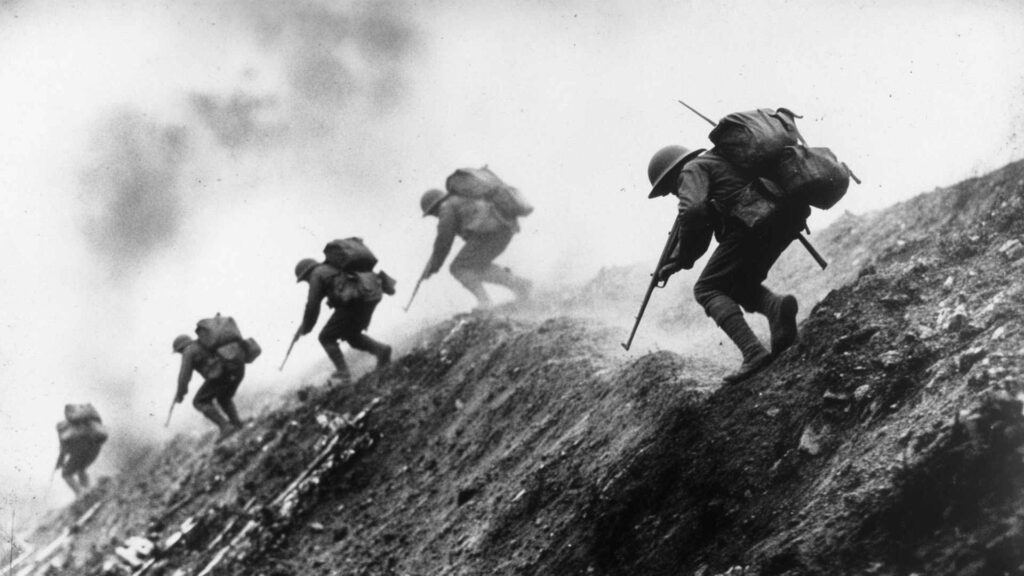
Major Battles & Turning Points
Q: What 1914 battle halted the German advance toward Paris?
A: The First Battle of the Marne.
Q: Which 1916 struggle became a symbol of French endurance with the cry “They shall not pass”?
A: Verdun.
Q: On the Somme’s first day (July 1, 1916), about how many British casualties occurred?
A: Around 57,000—one of the bloodiest days in British military history.
Q: What 1917 offensive is also known as Passchendaele, infamous for mud and attrition?
A: The Third Battle of Ypres.
Q: Which 1917 battle featured the first large, coordinated use of tanks?
A: The Battle of Cambrai.
Q: What 1918 offensive marked Germany’s last major push on the Western Front?
A: The Spring Offensive (e.g., Operation Michael).
Q: What August 1918 battle did Ludendorff call the “Black Day of the German Army”?
A: The Battle of Amiens.
Q: What 1918 campaign became the largest U.S. operation of the war?
A: The Meuse-Argonne Offensive.
Q: What April 1917 assault became a defining victory for the Canadian Corps?
A: Vimy Ridge.
Q: Which 1915 battle saw Britain use gas on a large scale but gain little ground?
A: The Battle of Loos.
Q: Which 1917 campaign included daring tunneling and a massive mine blast at Messines Ridge?
A: The Battle of Messines (part of the wider Ypres sector fighting).
Q: What September 1918 operation was the first major U.S. Army offensive under sole American command?
A: The Battle of Saint-Mihiel.
The Home Front & Propaganda
Q: What nickname was given to women working in British munitions plants?
A: “Munitionettes.”
Q: What policy managed scarce food and essentials in many countries by the late war?
A: Rationing.
Q: What U.S. government body coordinated propaganda and public opinion from 1917?
A: The Committee on Public Information (the Creel Committee).
Q: Which rousing 1917 song by George M. Cohan urged Americans to “make your daddy glad”?
A: “Over There.”
Q: What did governments sell to finance the war effort?
A: War bonds (e.g., Liberty Loans).
Q: Which 1917 U.S. law targeted espionage and interference with the draft?
A: The Espionage Act (followed by the 1918 Sedition Act).
Q: What sweeping British law from 1914 controlled many aspects of daily life?
A: The Defence of the Realm Act (DORA).
Q: Which iconic U.S. recruiting poster featured Uncle Sam pointing and saying, “I Want YOU”?
A: James Montgomery Flagg’s 1917 design.
Q: Which earlier British poster showed Lord Kitchener pointing with the words “Wants YOU”?
A: Alfred Leete’s 1914 poster.
Q: What global health crisis in 1918–1919 killed millions, including soldiers and civilians?
A: The influenza pandemic (often called “Spanish flu”).
Q: What term described people who declined military service on moral or religious grounds?
A: Conscientious objectors.
Q: Which poets’ works, like “Dulce et Decorum Est,” shaped cultural memory of the war?
A: Wilfred Owen (and also Siegfried Sassoon, among others).
Global & Colonial Dimensions
Q: What does ANZAC stand for?
A: Australian and New Zealand Army Corps.
Q: Which April 1917 victory is often seen as a nation-building moment for Canada?
A: Vimy Ridge.
Q: Approximately how many Indian soldiers served for the British Empire during the war?
A: About 1.3 million.
Q: Which German commander led a prolonged guerrilla campaign in East Africa?
A: General Paul von Lettow-Vorbeck.
Q: Which Asian power joined the Allies in 1914 and seized German Pacific holdings?
A: Japan.
Q: Which 1915 set of demands asserted Japanese influence over China?
A: The Twenty-One Demands.
Q: Which country declared war on Germany in 1917 and contributed the Chinese Labour Corps?
A: China.
Q: Which dominion captured German South-West Africa (now Namibia)?
A: South Africa.
Q: Which wartime uprising in the Middle East aimed to end Ottoman control with British support?
A: The Arab Revolt.
Q: What 1914 siege saw Japanese and British forces capture a German base in China?
A: The Siege of Qingdao (Tsingtao).
Q: What 1915–1917 mass deportations and killings of Armenians are widely recognized by historians as genocide?
A: The Armenian Genocide (terminology remains politically contested in some countries).
Q: Which Western Hemisphere power entered the war in April 1917 after provocations at sea and the Zimmermann Telegram?
A: The United States.
Aftermath, Treaties & Legacy
Q: On what date and hour did the Western Front cease fire under the Armistice?
A: November 11, 1918, at 11 a.m.
Q: Who were the “Big Four” at the Paris Peace Conference?
A: Woodrow Wilson (U.S.), Georges Clemenceau (France), David Lloyd George (U.K.), and Vittorio Orlando (Italy).
Q: When was the Treaty of Versailles signed?
A: June 28, 1919.
Q: What controversial article assigned responsibility for the war to Germany and its allies?
A: Article 231, the “war guilt clause.”
Q: What international body emerged from Wilson’s Fourteen Points but lacked U.S. membership?
A: The League of Nations.
Q: Which empires collapsed as a result of the war?
A: The German, Austro-Hungarian, Ottoman, and Russian Empires.
Q: Which new or reconstituted states appeared in Europe after the war?
A: Examples include Poland, Czechoslovakia, and the Kingdom of Serbs, Croats and Slovenes (later Yugoslavia).
Q: What government replaced the German monarchy in 1918?
A: The Weimar Republic.
Q: What system placed former Ottoman and German colonies under Allied administration?
A: The mandate system under the League of Nations.
Q: What 1917 British declaration supported “a national home for the Jewish people” in Palestine?
A: The Balfour Declaration.
Q: How were German reparations initially set in 1921?
A: At 132 billion gold marks (later revised).
Q: In what broad way did WWI set the stage for WWII?
A: Unresolved grievances, economic turmoil, and political radicalization—especially in Germany and parts of Eastern/Central Europe—helped pave the way.
From the mud of Flanders to the signatures at Versailles, World War I offers endless avenues for discovery.
Keep this set handy for quiz nights, or dive deeper into any thread that caught your curiosity.

Ellie Simons creates and edits Random Trivia. She researches trivia using primary and authoritative sources whenever possible and is currently reviewing the site's older trivia library for accuracy, clarity, and playability. Read more on the About page.
About this quiz
Site editor: Ellie Simons. Read our Trivia Methodology to learn how questions are researched and updated. Page last updated: . Report an error.