
Get ready for an attractive round of trivia about invisible fields, restless compasses, and mighty electromagnets.
These questions travel from refrigerator doors to Earth's core and far beyond our magnetic planet.
Magnetism 101
Q: What two poles does every ordinary bar magnet have?
A: North and south.
Q: What happens when like magnetic poles meet?
A: They repel.
Q: What happens when opposite magnetic poles meet?
A: They attract.
Q: What invisible region surrounds a magnet and exerts magnetic force?
A: A magnetic field.
Q: Where is a bar magnet's field usually strongest?
A: Near its poles.
Q: What do magnetic field lines show?
A: The field's direction and relative strength.
Q: Outside a bar magnet, field lines point from which pole to which pole?
A: From north to south.
Q: Do magnetic field lines form open paths or closed loops?
A: Closed loops.
Q: Can magnetic field lines cross one another?
A: No.
Q: What SI unit measures magnetic flux density?
A: The tesla.
Q: What symbol represents the tesla?
A: T.
Q: What SI unit measures magnetic flux?
A: The weber.
Q: What small unit of magnetic flux density equals one ten-thousandth of a tesla?
A: The gauss.
Q: What familiar particles produce magnetism through their motion and intrinsic magnetic moments?
A: Electrons.
Q: Can an isolated north or south magnetic pole be obtained by cutting a bar magnet in half?
A: No, each piece gains both poles.
Magnetic Materials
Q: What strong form of magnetism is displayed by iron?
A: Ferromagnetism.
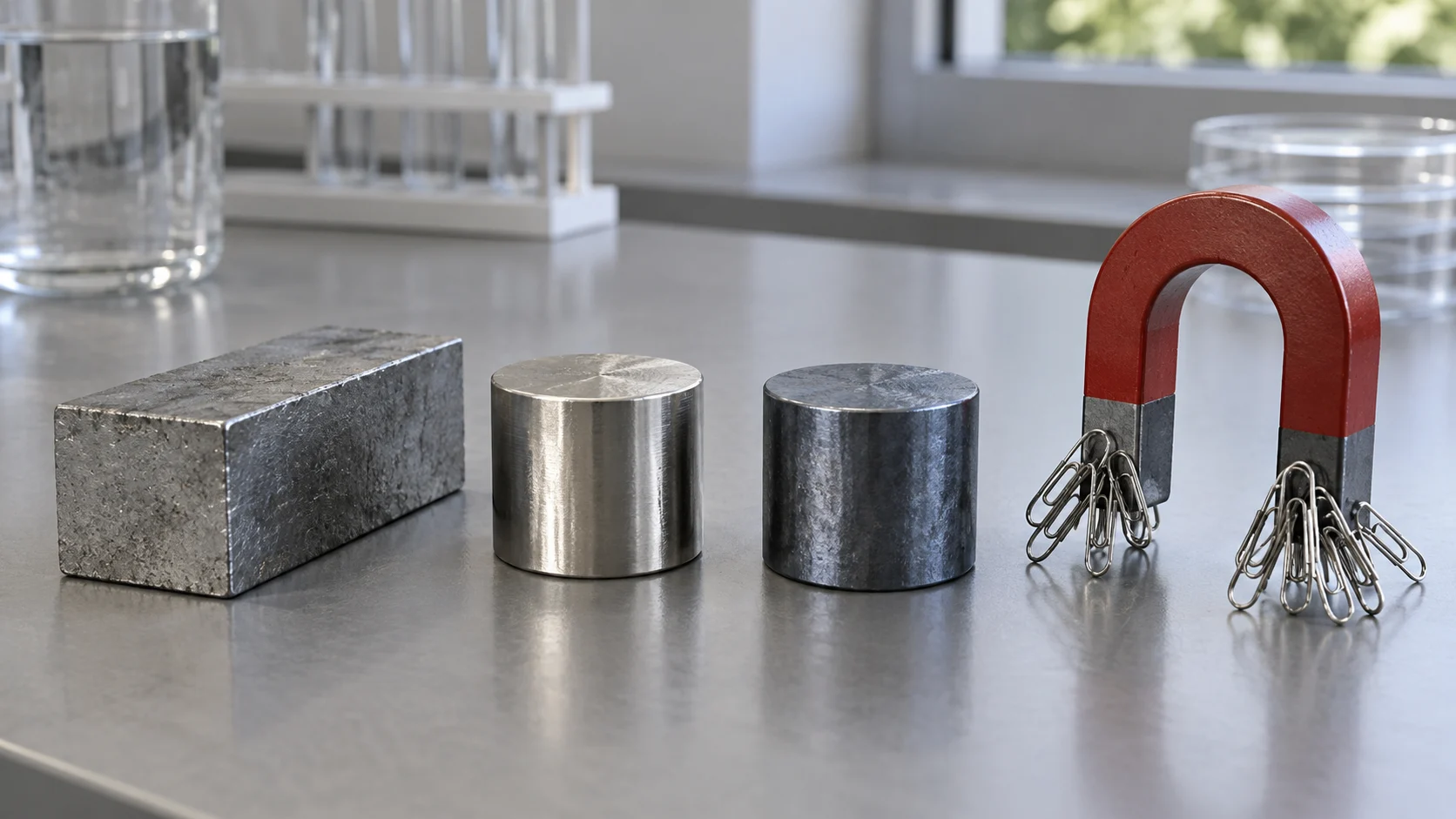
Q: Which common metal joins iron and cobalt as ferromagnetic at room temperature?
A: Nickel.
Q: What tiny aligned regions occur inside ferromagnetic materials?
A: Magnetic domains.
Q: What happens to many domains when iron becomes magnetized?
A: They align more strongly in one direction.
Q: What is a magnet called when it retains magnetism without an applied field?
A: A permanent magnet.
Q: What is a piece of iron that is magnetic only while influenced by a field called?
A: A temporary magnet.
Q: What kind of magnetism weakly repels a material from an applied field?
A: Diamagnetism.
Q: What kind of magnetism weakly attracts a material to an applied field?
A: Paramagnetism.
Q: Is copper ferromagnetic?
A: No.
Q: Is aluminum ferromagnetic at room temperature?
A: No, it is paramagnetic.
Q: What temperature marks the loss of spontaneous ferromagnetic order?
A: The Curie temperature.
Q: What permanent-magnet alloy contains aluminum, nickel, and cobalt?
A: Alnico.
Q: Which rare-earth element is used with iron and boron in very strong permanent magnets?
A: Neodymium.
Q: What ceramic magnetic materials are commonly made with iron oxides?
A: Ferrites.
Q: What mineral is naturally magnetic and was used in early compasses?
A: Lodestone.
Fields, Forces, and Motion
Q: What creates a magnetic field around a straight wire?
A: Electric current.
Q: What hand rule gives the magnetic-field direction around a current-carrying wire?
A: The right-hand rule.
Q: What force acts on a moving electric charge in a magnetic field?
A: The magnetic part of the Lorentz force.
Q: Does a stationary electric charge feel force from a static magnetic field alone?
A: No.
Q: When is magnetic force on a moving charge greatest relative to the field?
A: When the motion is perpendicular to the field.
Q: What path can a charged particle follow when moving perpendicular to a uniform magnetic field?
A: A circle.
Q: What path can result when a charged particle has motion both along and across a magnetic field?
A: A helix.
Q: What effect creates a voltage across a conductor carrying current in a magnetic field?
A: The Hall effect.
Q: What happens between two parallel wires carrying current in the same direction?
A: They attract.
Q: What happens between parallel wires carrying current in opposite directions?
A: They repel.
Q: What twisting effect does a magnetic field exert on a current loop?
A: Torque.
Q: What vector quantity describes the strength and orientation of a small magnet or current loop?
A: Magnetic dipole moment.
Q: What instrument measures magnetic-field strength or direction?
A: A magnetometer.
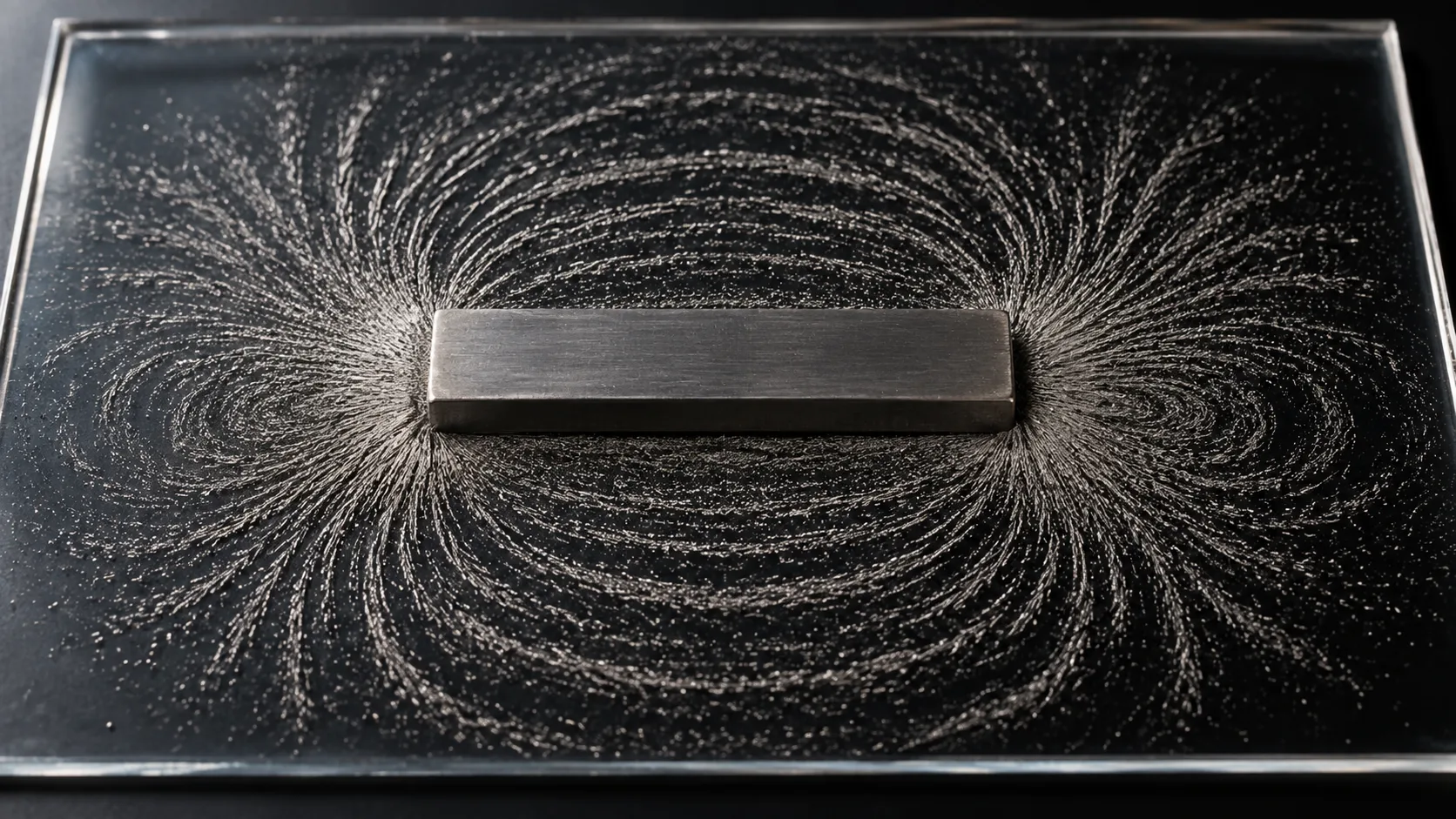
Q: What simple pattern appears when iron filings surround a bar magnet?
A: Curves that trace the magnetic field.
Q: Why do iron filings gather most densely near a bar magnet's ends?
A: The magnetic field is strongest there.
Earth's Giant Magnetic Field
Q: What instrument uses Earth's magnetic field to show direction?
A: A compass.
Q: Which end of a compass needle points roughly toward geographic north?
A: Its north-seeking end.
Q: What is the angle between magnetic north and true north called?
A: Magnetic declination.
Q: What is the downward or upward tilt of Earth's magnetic field called?
A: Magnetic inclination, or dip.
Q: What moving material generates most of Earth's magnetic field?
A: Liquid iron alloy in the outer core.
Q: What process in Earth's outer core sustains its magnetic field?
A: The geodynamo.
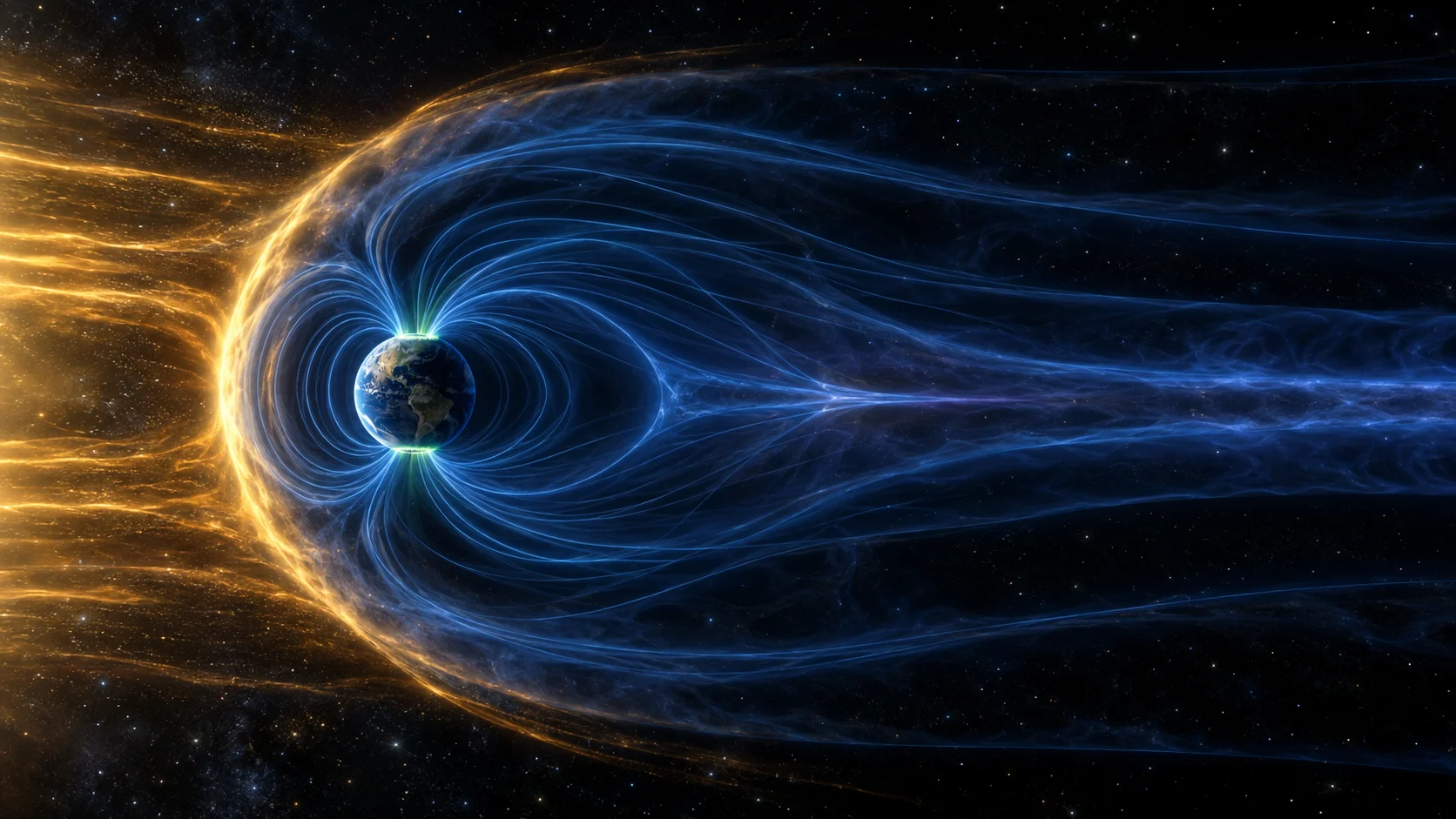
Q: What space region is dominated by Earth's magnetic field?
A: The magnetosphere.
Q: What stream of charged particles from the Sun buffets Earth's magnetosphere?
A: The solar wind.
Q: What glowing polar displays occur when charged particles excite atmospheric gases?
A: Auroras.
Q: What is the northern aurora commonly called?
A: Aurora borealis.
Q: What is the southern aurora commonly called?
A: Aurora australis.
Q: Do Earth's magnetic poles stay fixed in one place?
A: No, they drift.
Q: What happens during a geomagnetic reversal?
A: Earth's magnetic north and south orientations switch.
Q: What rocks preserve evidence of ancient magnetic-field directions?
A: Magnetized volcanic and sedimentary rocks.
Q: What theory gained key support from symmetrical magnetic stripes on the seafloor?
A: Seafloor spreading.
Electromagnets and Induction
Q: What is a coil of wire shaped like a cylinder called?
A: A solenoid.
Q: What happens to a solenoid's field when current increases?
A: It becomes stronger.
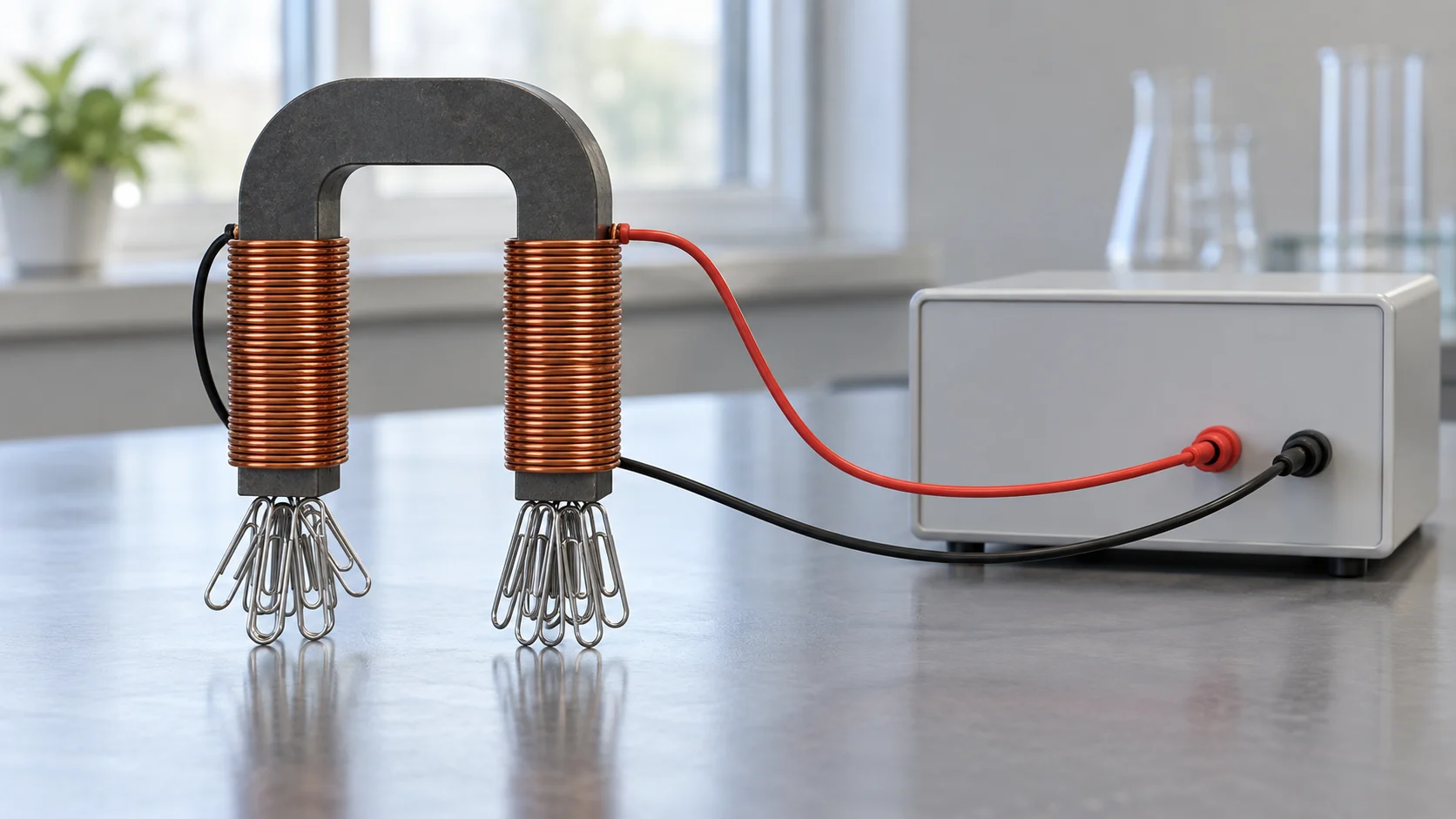
Q: What material is often placed inside a coil to strengthen an electromagnet?
A: Soft iron.
Q: What is a magnet produced by electric current called?
A: An electromagnet.
Q: What advantage does an electromagnet have over a permanent magnet?
A: Its field can be switched and adjusted.
Q: What phenomenon produces an emf when magnetic flux changes?
A: Electromagnetic induction.
Q: Which law says induced emf depends on the rate of change of magnetic flux?
A: Faraday's law.
Q: Which law says induced current opposes the change that created it?
A: Lenz's law.
Q: What can induce current in a coil without touching it?
A: A changing magnetic field.
Q: What device uses induction to convert mechanical energy into electrical energy?
A: A generator.
Q: What device uses magnetic force to convert electrical energy into motion?
A: An electric motor.
Q: What device transfers AC energy between coils through a changing magnetic field?
A: A transformer.
Q: What kind of current is needed for a conventional transformer to work continuously?
A: Alternating current.
Q: What circulating currents are induced within bulk conductors by changing magnetic fields?
A: Eddy currents.
Q: What cooking method heats a metal pan with induced electric currents?
A: Induction cooking.
Magnets on the Job
Q: What medical scanner uses strong magnetic fields and radio waves?
A: An MRI scanner.
Q: What does MRI stand for?
A: Magnetic resonance imaging.
Q: What audio device turns electrical signals into sound using a coil and magnet?
A: A loudspeaker.
Q: What audio device converts sound vibrations into electrical signals?
A: A microphone.
Q: What rail technology uses magnetic forces to levitate or propel trains?
A: Maglev.
Q: What scrapyard machine uses a large electromagnet to lift steel?
A: A magnetic crane.
Q: What component stores computer data in magnetized regions on spinning platters?
A: A hard disk drive.
Q: What familiar card can store data in a magnetic stripe?
A: A payment or identification card.
Q: What small device uses magnetism to hold a cabinet door closed?
A: A magnetic catch.
Q: What switch opens or closes when a nearby magnet moves its metal reeds?
A: A reed switch.
Q: What sensor can detect magnetic fields using the Hall effect?
A: A Hall-effect sensor.
Q: What navigation feature in a smartphone uses magnetic-field sensors?
A: The digital compass.
Q: What braking method uses eddy currents without physical contact?
A: Electromagnetic braking.
Q: What device produces a strong field from current in a superconducting coil?
A: A superconducting magnet.
Q: What happens to electrical resistance in a superconductor below its critical temperature?
A: It drops to zero.
Magnetism in Nature and Space
Q: Which planet has the strongest magnetic field of any planet in our solar system?
A: Jupiter.
Q: Which planet has no global internally generated magnetic field today?
A: Venus.
Q: Which planet lacks a global magnetic field today but has strong magnetism preserved in parts of its crust?
A: Mars.
Q: What solar structures are shaped by intense magnetic fields and appear dark against the Sun?
A: Sunspots.
Q: What explosive solar event releases energy from tangled magnetic fields?
A: A solar flare.
Q: What dense stellar remnant can possess an extremely powerful magnetic field?
A: A neutron star.
Q: What is a neutron star with an exceptionally strong magnetic field called?
A: A magnetar.
Q: What term describes an animal's ability to sense Earth's magnetic field?
A: Magnetoreception.
Q: Which migratory fish use magnetic cues to help navigate across the ocean?
A: Salmon.
Q: Which sea animals use magnetic cues during long ocean migrations?
A: Sea turtles.
Q: What iron oxide found in organisms and rocks is strongly magnetic?
A: Magnetite.
Q: What bacteria orient along magnetic-field lines using magnetite or greigite crystals?
A: Magnetotactic bacteria.
Q: What name is given to the chain of magnetic crystals inside magnetotactic bacteria?
A: A magnetosome chain.
Q: What shield helps protect Earth's atmosphere from charged solar particles?
A: The magnetosphere.
Q: What violent space-weather disturbance can disrupt satellites and power grids?
A: A geomagnetic storm.
Milestones in Magnetism
Q: Who wrote the influential 1269 treatise known as Epistola de magnete?
A: Petrus Peregrinus de Maricourt.
Q: Which English physician published a major study of magnets called De Magnete in 1600?
A: William Gilbert.
Q: What bold conclusion did William Gilbert draw about Earth?
A: Earth behaves like a giant magnet.
Q: Who discovered in 1820 that electric current deflects a compass needle?
A: Hans Christian Ørsted.
Q: Which French physicist developed mathematical laws relating electric currents and magnetism?
A: André-Marie Ampère.
Q: Who built an early practical electromagnet in 1825?
A: William Sturgeon.
Q: Which American scientist improved the electromagnet and gave his name to the SI unit of inductance?
A: Joseph Henry.
Q: Who discovered electromagnetic induction in 1831?
A: Michael Faraday.
Q: Which physicist independently discovered induction around the same time as Faraday?
A: Joseph Henry.
Q: Who formulated the rule for the direction of induced current?
A: Heinrich Lenz.
Q: Which physicist unified electricity, magnetism, and light in a set of equations?
A: James Clerk Maxwell.
Q: Which scientist demonstrated electromagnetic waves in the laboratory?
A: Heinrich Hertz.
Q: Which unit of magnetic flux density honors Nikola Tesla?
A: The tesla.
Q: Which physicist lends his name to the gauss unit of magnetic flux density?
A: Carl Friedrich Gauss.
Q: Which physicist gives his name to the temperature above which a ferromagnet loses spontaneous magnetization?
A: Pierre Curie.
You Are Positively Magnetic
If you attracted 120 correct answers, your trivia field is impressively strong. Follow the pull toward our science trivia and space trivia.

Ellie Ewert is the founder and author of RandomTrivia.co, blending her passion for research with years of experience in content creation to deliver accurate, engaging, and well-sourced trivia. Dedicated to providing readers with trustworthy and entertaining facts, she applies meticulous fact-checking and SEO expertise to ensure every article meets the highest standards. Read more about our high standards in our Editorial Guidelines.