
Chart a course through 120 Age of Exploration trivia questions covering Portuguese and Spanish voyages, Atlantic islands, navigation, Columbus, da Gama, Magellan's expedition, Indigenous civilizations, conquest, the Columbian Exchange, global trade, slavery, mapping, and the profound consequences of an era that connected distant regions while unleashing conquest, disease, forced labor, and enormous cultural change.
Portugal, Navigation & the Search for Sea Routes
Q: What centuries are most associated with the European Age of Exploration?
A: Roughly the 15th through 17th centuries, though exploration and expansion continued beyond them.
Q: Which European kingdom pioneered sustained Atlantic and African coastal voyages in the 1400s?
A: Portugal.
Q: What Portuguese prince is commonly associated with sponsoring early exploration?
A: Prince Henry the Navigator.
Q: Was Henry the Navigator personally captain of most famous voyages?
A: No. His importance came mainly through patronage and support for Portuguese expansion.
Q: What Atlantic island group did Portuguese settlers colonize in the 15th century?
A: Madeira.
Q: What other Atlantic archipelago became Portuguese territory?
A: The Azores.
Q: Why were Atlantic islands important to European expansion?
A: They became strategic ports and sites for plantation agriculture, trade, and experiments in colonial labor systems.
Q: What crop became especially important on Madeira and other Atlantic islands?
A: Sugar.
Q: What labor system became increasingly tied to Atlantic sugar production?
A: Enslaved labor.
Q: What African cape did Bartolomeu Dias round in 1488?
A: The Cape of Good Hope.
Q: What did Dias's voyage demonstrate?
A: Ships could sail around southern Africa toward the Indian Ocean.
Q: Who reached India by sailing around Africa in 1498?
A: Vasco da Gama.
Q: What Indian port did da Gama reach?
A: Calicut, now Kozhikode.
Q: Was the Indian Ocean an empty trade zone before Europeans arrived?
A: No. It already had dense, sophisticated networks linking Africa, the Middle East, India, Southeast Asia, and China.
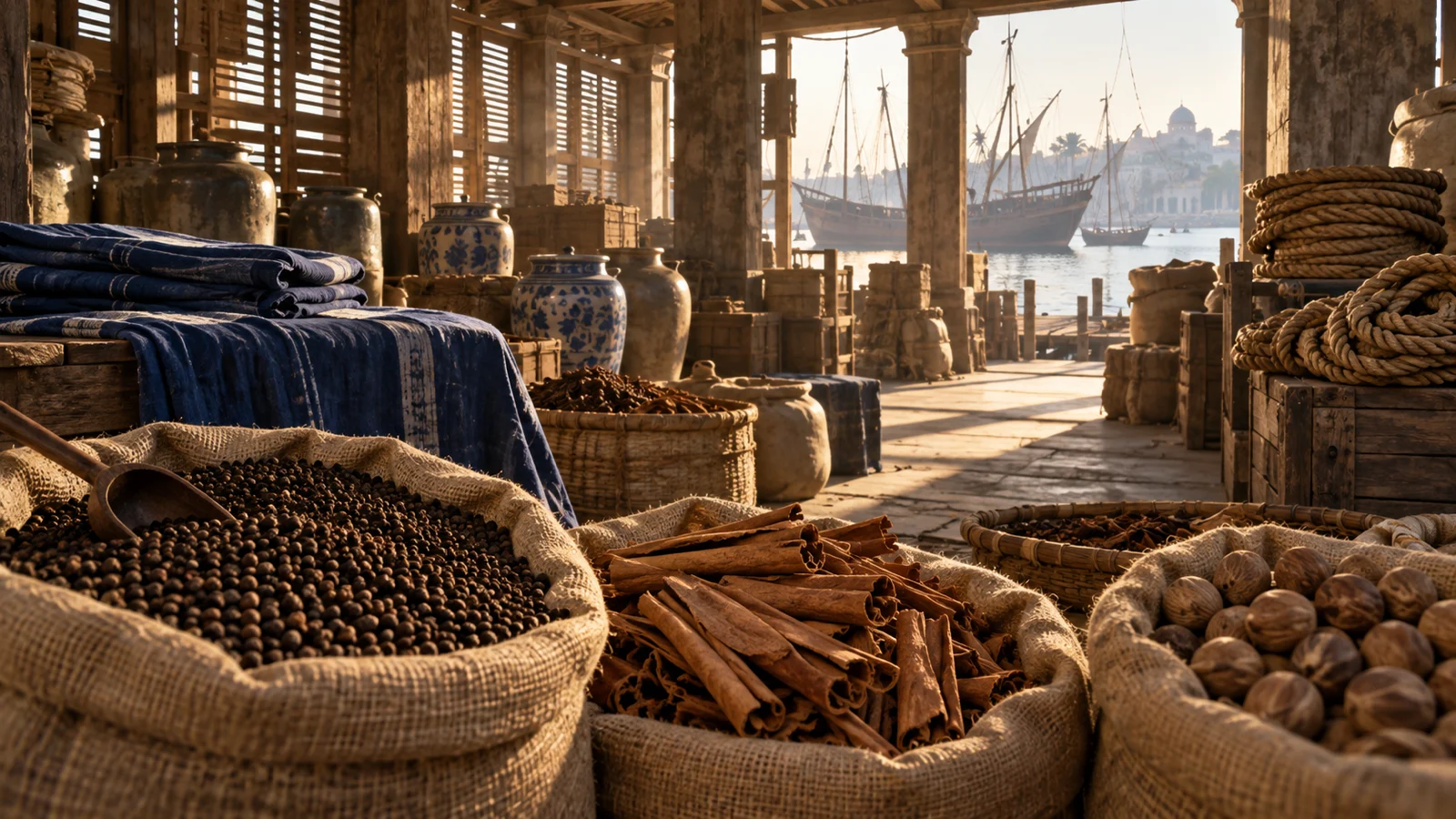
Q: What did Portuguese fleets seek in Indian Ocean trade?
A: Direct access to valuable goods such as spices and control over strategic routes.
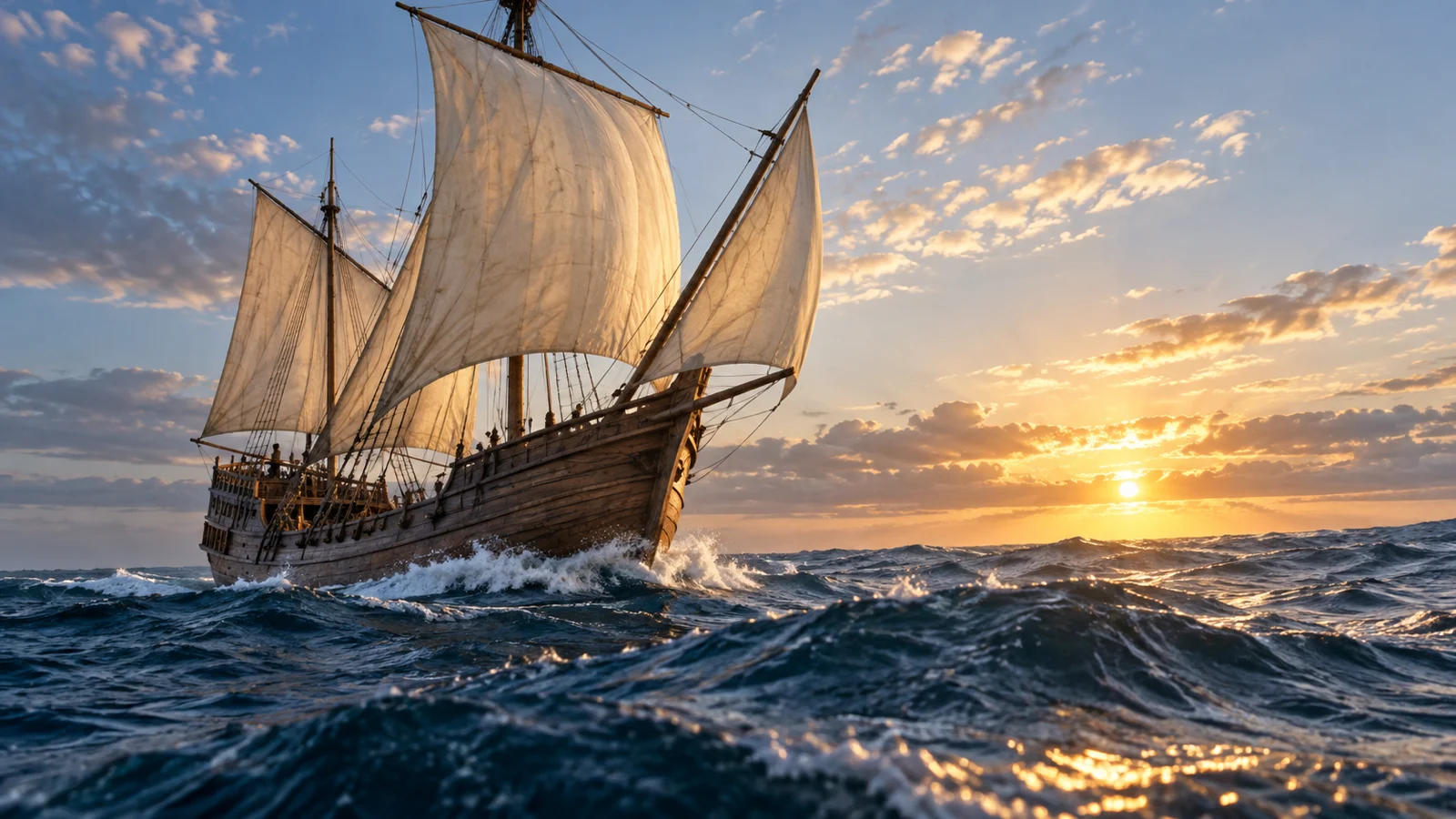
Q: What type of sailing ship became associated with Portuguese exploration?
A: The caravel.
Q: Why were caravels useful?
A: They were maneuverable and well suited to coastal exploration and Atlantic sailing.
Q: What triangular sail helped ships tack more effectively against the wind?
A: The lateen sail.
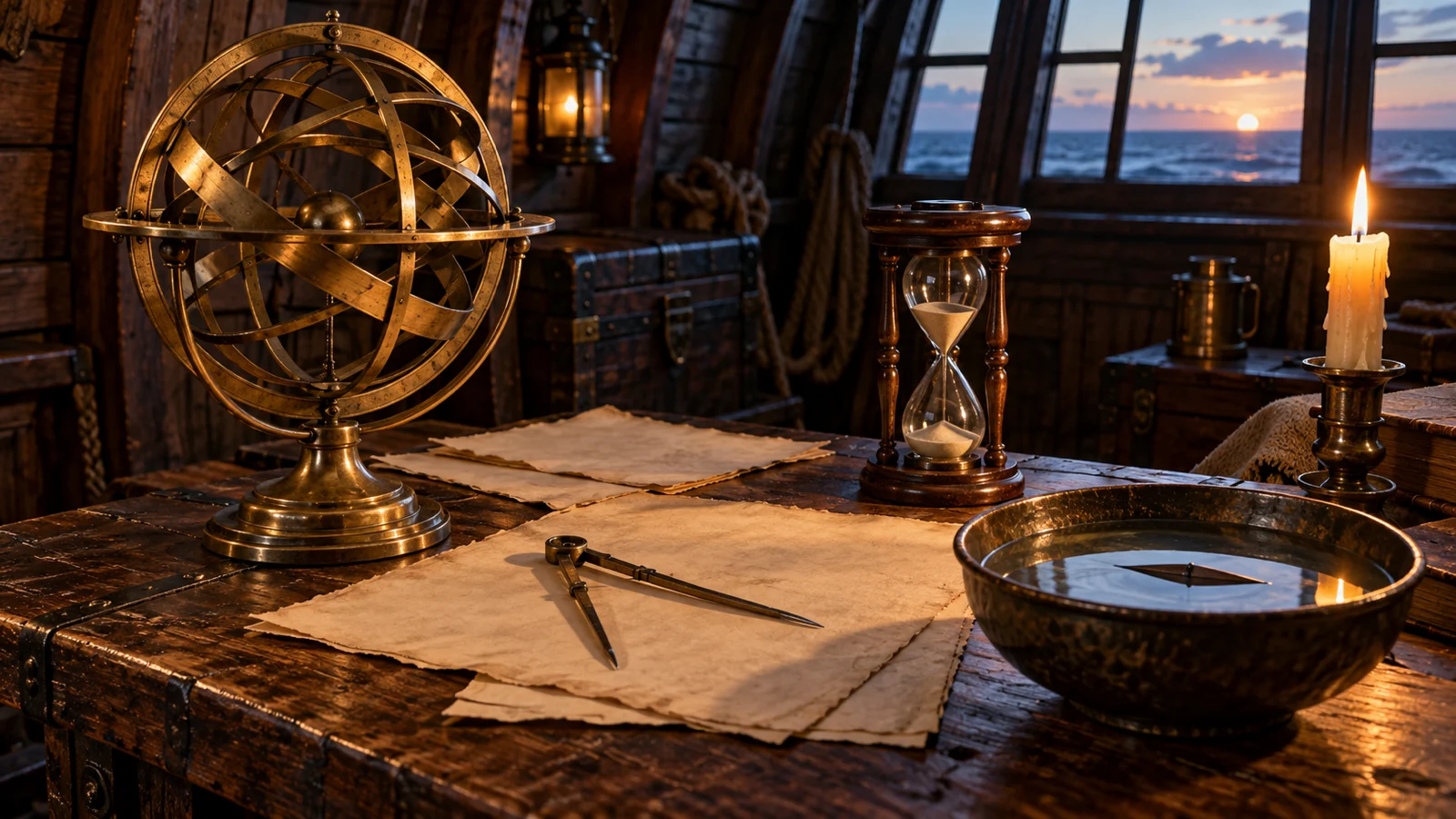
Q: What instrument helped sailors estimate latitude using celestial bodies?
A: The astrolabe and related navigational instruments.
Q: What did a magnetic compass help sailors determine?
A: Direction.
Q: What is dead reckoning?
A: Estimating position from a known point using direction, speed, and elapsed time.
Q: Why was determining longitude harder than latitude?
A: Accurate longitude required precise timekeeping or other difficult observations not easily available at sea.
Q: What were portolan charts?
A: Detailed nautical charts emphasizing coastlines, ports, and sailing directions.
Q: What did the volta do mar describe in Portuguese sailing?
A: Using Atlantic wind patterns by sailing a broad curve rather than hugging the coast directly.
Q: Why were winds and currents essential knowledge?
A: Sailing ships depended on predictable atmospheric and ocean patterns for efficient routes.
Q: What North African city did Portugal capture in 1415?
A: Ceuta.
Q: Why is Ceuta often treated as an early milestone in Portuguese expansion?
A: Its capture marked a major overseas military and commercial foothold.
Q: Did European exploration begin global long-distance travel?
A: No. African, Asian, Pacific, Islamic, and Indigenous societies had long traditions of navigation and exchange.
Q: What made this European expansion historically distinctive?
A: Sustained oceanic conquest, colonization, commercial networks, and armed empires increasingly linked the globe.
Q: Why is “Age of Exploration” an incomplete label?
A: It can understate conquest, enslavement, Indigenous displacement, and the fact that Europeans entered already inhabited and connected worlds.
Columbus, Magellan & Famous Voyages
Q: Who sailed west across the Atlantic in 1492 under the Spanish Crown?
A: Christopher Columbus.
Q: What monarchs backed Columbus's 1492 voyage?
A: Isabella I of Castile and Ferdinand II of Aragon.
Q: What three ships are associated with Columbus's first voyage?
A: Niña, Pinta, and Santa María.
Q: Which was Columbus's flagship?
A: Santa María.
Q: Where did Columbus first land in the Americas in 1492?
A: An island in the Bahamas whose exact modern identification remains debated.
Q: Did Columbus reach the mainland of modern United States on his first voyage?
A: No.
Q: Did Columbus believe he had discovered a completely unknown continent in 1492?
A: No. He believed he had reached islands near Asia.
Q: Were the Americas uninhabited when Columbus arrived?
A: No. Tens of millions of Indigenous people lived throughout the Americas in diverse societies.
Q: What Indigenous people did Columbus encounter in the Caribbean?
A: Taíno communities among others.
Q: How many transatlantic voyages did Columbus make?
A: Four.
Q: Did Columbus ever reach mainland South America?
A: Yes, during his third voyage.
Q: What treaty divided claimed overseas spheres between Spain and Portugal in 1494?
A: The Treaty of Tordesillas.
Q: What imaginary feature did Tordesillas use?
A: A north-south demarcation line in the Atlantic.
Q: Why did Portugal eventually control Brazil?
A: Brazil lay on Portugal's side of the Tordesillas division, reinforced by later colonization.
Q: Who commanded the expedition that began the first circumnavigation of Earth?
A: Ferdinand Magellan.
Q: What country was Magellan from?
A: Portugal, although he sailed for Spain.
Q: Did Magellan personally complete the circumnavigation?
A: No. He was killed in the Philippines in 1521.
Q: Who completed the expedition after Magellan's death?
A: Juan Sebastián Elcano ultimately commanded the surviving ship home.
Q: What ship completed the first circumnavigation?
A: Victoria.
Q: What passage at South America's southern tip is named after Magellan?
A: The Strait of Magellan.
Q: What ocean did Magellan name the Pacific?
A: The vast ocean west of the Americas, named for the relatively calm conditions he initially encountered.
Q: What did the first circumnavigation demonstrate dramatically?
A: The enormous scale of the Pacific and the practical global connection of the world's oceans.
Q: Who was the first European known to see the Pacific from the Americas after crossing the Isthmus of Panama?
A: Vasco Núñez de Balboa in 1513.
Q: Who explored parts of the North American Atlantic coast for England in 1497?
A: John Cabot, also known as Giovanni Caboto.
Q: Who explored the St. Lawrence River for France in the 1530s?
A: Jacques Cartier.
Q: Who founded Quebec for France in 1608?
A: Samuel de Champlain.
Q: Who led an English circumnavigation completed in 1580?
A: Francis Drake.
Q: Was Drake viewed the same way by Spain and England?
A: No. England celebrated him, while Spanish authorities regarded him as a pirate or privateer.
Q: What is a privateer?
A: A privately operated armed ship authorized by a government to attack enemy shipping.
Q: Why did exploration and piracy often overlap?
A: Rival states used private violence, raiding, and seizure of cargo as tools of imperial competition.
Conquest, Indigenous Civilizations & the Columbian Exchange
Q: What does the Columbian Exchange describe?
A: The large-scale transfer of plants, animals, diseases, people, and cultures between the Americas and Afro-Eurasia after 1492.
Q: What American crop became a major staple in Europe and beyond?
A: The potato.
Q: What American grain transformed diets in parts of Europe, Africa, and Asia?
A: Maize, or corn.
Q: What other American foods spread globally?
A: Tomatoes, cacao, chili peppers, peanuts, and many varieties of beans and squash.
Q: What major livestock animals did Europeans introduce widely to the Americas?
A: Horses, cattle, pigs, sheep, and goats.
Q: How did horses affect many Indigenous societies?
A: In some regions they transformed travel, hunting, warfare, trade, and culture.
Q: What diseases devastated Indigenous populations after sustained European contact?
A: Smallpox, measles, influenza, and other Old World diseases.
Q: Why were epidemic losses so severe?
A: Indigenous populations lacked prior exposure to many pathogens, while war, displacement, hunger, and forced labor worsened mortality.
Q: Did disease act independently of colonial violence?
A: No. Epidemics interacted with conquest, enslavement, displacement, and social disruption.
Q: What powerful Mesoamerican empire did Hernán Cortés confront?
A: The Aztec Empire, centered on the Mexica capital Tenochtitlan.
Q: What was the Aztec capital?
A: Tenochtitlan.
Q: Where is Tenochtitlan's site today?
A: Beneath central Mexico City.
Q: Did Cortés defeat the Aztec Empire with Spaniards alone?
A: No. Large numbers of Indigenous allies opposed to Mexica power were crucial.
Q: What Indigenous woman served as an interpreter and political intermediary for Cortés?
A: Malintzin, also known as Doña Marina or La Malinche.
Q: In what year did Tenochtitlan fall?
A: 1521.
Q: What South American empire did Francisco Pizarro invade?
A: The Inca Empire.
Q: Who was the Inca ruler captured at Cajamarca?
A: Atahualpa.
Q: What internal conflict had weakened the Inca Empire before Pizarro's arrival?
A: A civil war between Atahualpa and Huáscar.
Q: What epidemic had also disrupted the Andes before the main Spanish conquest?
A: Old World diseases, probably including smallpox, spread ahead of some Europeans.
Q: What was the encomienda system?
A: A Spanish colonial system granting colonists rights to Indigenous tribute and labor under claimed obligations of protection and Christian instruction.
Q: Did encomienda amount to benign employment?
A: No. It often enabled severe coercion, exploitation, and abuse.
Q: Who was Bartolomé de las Casas?
A: A Spanish Dominican friar who became a prominent critic of abuses against Indigenous peoples.
Q: Did Las Casas's advocacy end colonial exploitation?
A: No. It influenced debate and reforms, but coercive systems continued in many forms.
Q: What was the Atlantic slave trade?
A: The forced transportation of millions of enslaved Africans across the Atlantic, mainly to the Americas.
Q: What was the Middle Passage?
A: The brutal transatlantic voyage endured by enslaved Africans aboard slave ships.
Q: Why did plantation slavery expand dramatically in the Americas?
A: European demand for sugar, tobacco, cotton, coffee, and other commodities drove coerced labor systems.
Q: What crop was especially central to early Caribbean plantation slavery?
A: Sugar.
Q: What does cultural exchange mean in this period?
A: Languages, foods, religions, technologies, customs, and identities mixed under conditions ranging from cooperation to coercion.
Q: Did Indigenous peoples simply disappear after conquest?
A: No. Indigenous communities survived, adapted, resisted, rebuilt, and remain vital societies today.
Q: Why should exploration trivia include Indigenous perspectives?
A: The places Europeans “explored” were homelands with existing peoples, governments, trade networks, knowledge, and histories.
Global Trade, Mapping, Rival Empires & Legacy
Q: What was the Portuguese Estado da Índia?
A: A network of Portuguese forts, ports, fleets, and territories used to control parts of Indian Ocean trade.
Q: What Indian city became a major Portuguese colonial center?
A: Goa.
Q: What strategic Southeast Asian port did Portugal capture in 1511?
A: Malacca.
Q: What Chinese port became a long-term Portuguese trading settlement?
A: Macau.
Q: What islands were historically famous in European trade as the Spice Islands?
A: The Maluku, or Moluccas, in present-day Indonesia.
Q: What Dutch trading company was founded in 1602?
A: The Dutch East India Company.
Q: What initials commonly identify the Dutch East India Company?
A: VOC, from its Dutch name.
Q: What English trading company was chartered in 1600?
A: The English East India Company.
Q: What is a joint-stock company?
A: A business whose ownership is divided among investors who contribute capital and share risks and returns.
Q: What were the Manila galleons?
A: Spanish ships linking the Philippines and Mexico across the Pacific for more than two centuries.
Q: What American metal became central to global trade with Asia?
A: Silver.
Q: What Andean mining center became famous for enormous silver production?
A: Potosí.
Q: What coercive labor draft did Spanish authorities adapt in the Andes for mining?
A: The mita.
Q: How did privateering fit imperial rivalry?
A: Governments authorized private ships to raid enemy commerce and weaken rivals.
Q: What Spanish fleet attempted to invade England in 1588?
A: The Spanish Armada.
Q: Was the Armada defeated by one single cause?
A: No. English attacks, Spanish operational problems, weather, logistics, and the difficult return voyage all mattered.
Q: What famous world-map projection was published in 1569?
A: The Mercator projection.
Q: Who created the Mercator projection?
A: Gerardus Mercator.
Q: Why did sailors value the Mercator projection?
A: Constant compass bearings appear as straight lines.
Q: What major drawback does the Mercator projection have?
A: It greatly enlarges areas near the poles compared with regions near the equator.
Q: What is cartography?
A: The art and science of making maps.
Q: Did Pacific Islanders navigate long distances without European instruments?
A: Yes. Polynesian navigators used stars, swells, winds, birds, clouds, and generations of environmental knowledge.
Q: What is traditional Polynesian wayfinding?
A: Non-instrument navigation using memorized celestial and environmental patterns to cross large ocean distances.
Q: What Chinese admiral led enormous Indian Ocean voyages before Columbus?
A: Zheng He.
Q: When did Zheng He's Ming voyages occur?
A: Between 1405 and 1433.
Q: What Moroccan traveler crossed much of Africa and Eurasia in the 14th century?
A: Ibn Battuta.
Q: Why can the word “discovery” be misleading for European arrivals?
A: It can imply lands were unknown or empty despite existing Indigenous populations and regional knowledge.
Q: What ecological problems sometimes followed the Columbian Exchange?
A: Introduced species, altered landscapes, invasive organisms, and new diseases reshaped ecosystems.
Q: What made this era a turning point in economic history?
A: Atlantic, Pacific, and Indian Ocean systems became increasingly integrated into a truly global exchange network.
Q: What is the Age of Exploration's broadest legacy?
A: Global connections expanded dramatically, but so did colonial rule, forced migration, slavery, epidemic loss, cultural mixing, new borders, and enduring inequalities.
How Did You Score?
If the volta do mar, Tordesillas, Elcano, Malintzin, the Middle Passage, Potosí, VOC, and Mercator all came easily, your history trivia is ready to sail.

Ellie Simons creates and edits Random Trivia. She researches trivia using primary and authoritative sources whenever possible and is currently reviewing the site's older trivia library for accuracy, clarity, and playability. Read more on the About page.
Explore more questions in our history trivia guide.
About this quiz
Site editor: Ellie Simons. Read our Trivia Methodology to learn how questions are researched and updated. Page last updated: . Report an error.