
A turkey can run, fly, sleep in a tree, and derail a family dinner if thawing starts two days too late. These 120 questions cover wild turkey biology, domestication, cooking, Thanksgiving customs, leftovers, and a few myths worth retiring.
Wild Turkey Biology, Feathers & Behavior
Q: What is the scientific name of the wild turkey?
A: Meleagris gallopavo.
Q: What bird family includes turkeys?
A: Phasianidae, the family containing pheasants, chickens, quail, and related game birds.
Q: Which continent is the wild turkey native to?
A: North America.
Q: What is an adult male turkey commonly called?
A: A tom or gobbler.
Q: What is an adult female turkey called?
A: A hen.
Q: What is a young turkey called?
A: A poult.
Q: What is a young male turkey called?
A: A jake.
Q: What is a young female turkey called?
A: A jenny.
Q: What sound gives a male turkey the nickname gobbler?
A: The gobble, a loud breeding call used especially in spring.
Q: Which sex most famously gobbles?
A: Adult males, although hens make several other calls and can occasionally produce gobble-like sounds.
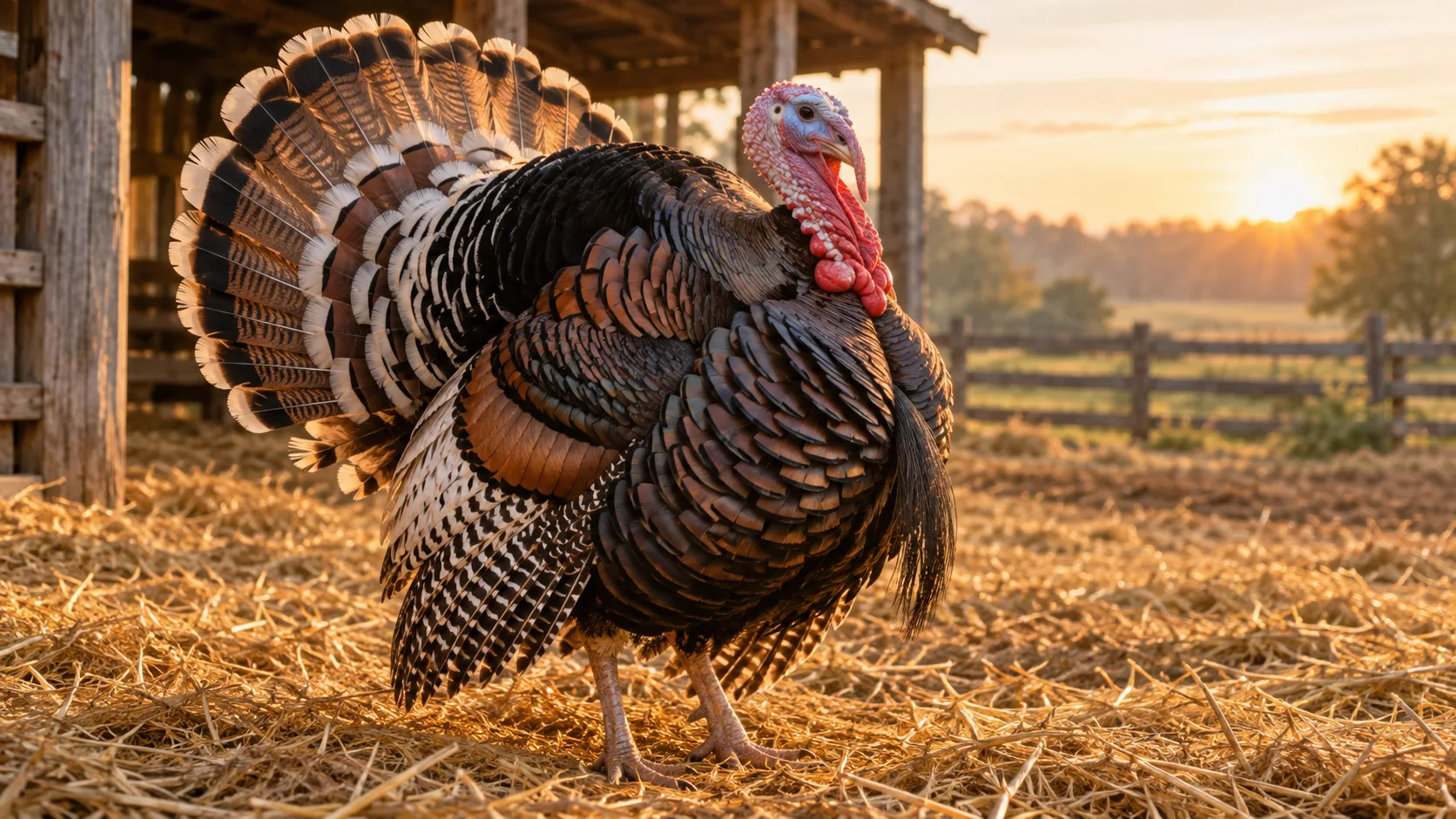
Q: What fleshy structure hangs over a turkey’s beak?
A: The snood.
Q: What fleshy skin hangs beneath a turkey’s chin and neck?
A: The wattle.
Q: What is the bare, bumpy skin on a turkey’s head and neck called?
A: Caruncles.
Q: How can a tom’s head color change during display?
A: Blood flow can shift exposed skin among red, white, and blue tones.
Q: What fan-shaped feature does a displaying tom spread?
A: His tail feathers.
Q: What behavior combines tail-fanning, wing-dragging, and puffed feathers?
A: Strutting, a courtship and dominance display.
Q: What hairlike tuft projects from many male turkeys’ chests?
A: A beard made of modified bristle-like feathers.
Q: Which sex can occasionally grow a beard besides males?
A: Some hens also develop beards.
Q: What sharp structures grow on the backs of male turkey legs?
A: Spurs.
Q: What do turkeys use their spurs for?
A: Fighting and defense, especially during competition between males.
Q: Can wild turkeys fly?
A: Wild turkeys can fly strongly for short distances, especially to escape or reach roosts.
Q: How fast can a wild turkey run?
A: It can reach roughly 18 to 25 mph over short distances.
Q: How fast can a wild turkey fly?
A: Short bursts may approach 50 to 55 mph.
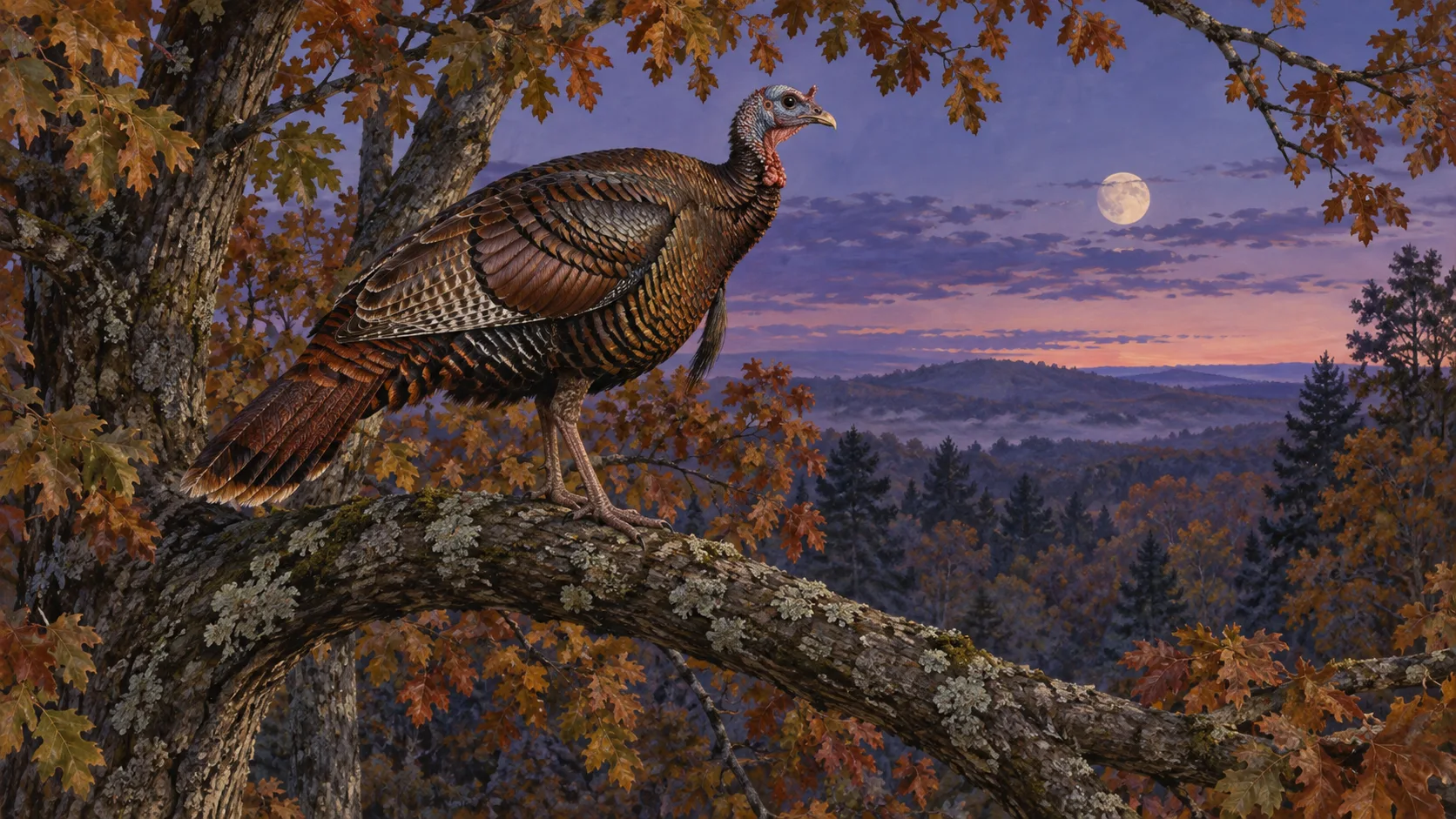
Q: Where do wild turkeys usually sleep?
A: On tree branches above the ground.
Q: Why do wild turkeys roost in trees?
A: Elevation helps protect them from many nighttime predators.
Q: How many toes does a turkey normally have on each foot?
A: Four, with three pointing forward and one smaller toe behind.
Q: What is unusual about a turkey’s field of vision?
A: Eyes on the sides of the head provide a wide view useful for detecting predators.
Q: What colors can wild turkey feathers show in sunlight?
A: Bronze, copper, green, red, and gold iridescence can appear across dark plumage.
Q: What is a group of turkeys commonly called?
A: A flock; “rafter” is also a popular collective noun.
Q: What diet category best describes wild turkeys?
A: Omnivores that eat seeds, nuts, fruits, plants, insects, and small animals.
Habitat, Domestication & Turkey History
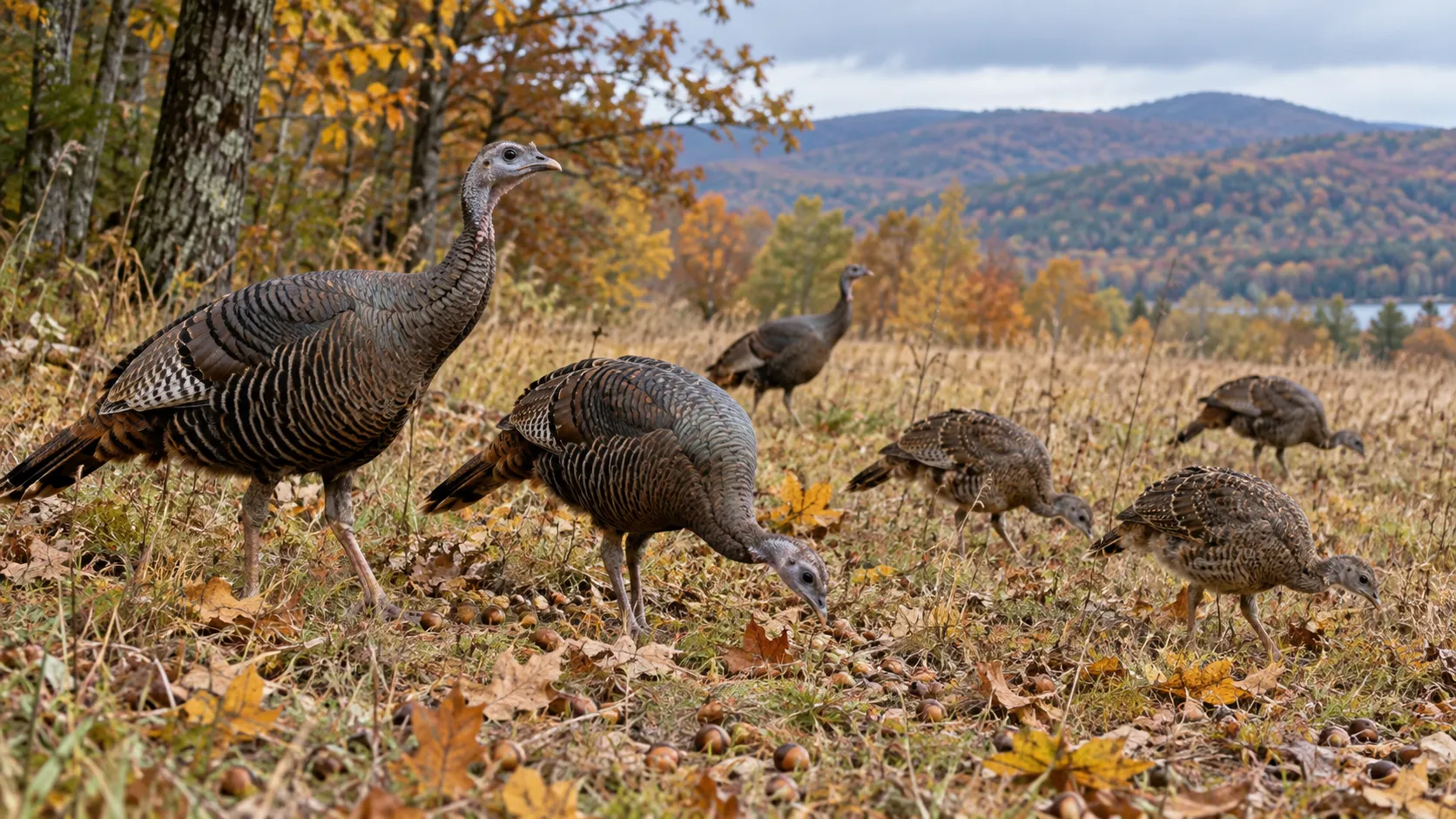
Q: What nut is an important autumn food for many wild turkeys?
A: Acorns.
Q: Which habitat combination suits wild turkeys particularly well?
A: A mix of mature woods, open clearings, water, and safe roost trees.
Q: Where does a hen build her nest?
A: In a shallow ground depression hidden beneath vegetation or brush.
Q: How many eggs are commonly found in a wild turkey clutch?
A: Often about 10 to 12, though clutch size varies.
Q: How long does a turkey hen incubate her eggs?
A: About 28 days.
Q: What can turkey poults do soon after hatching?
A: They can walk, follow the hen, and begin feeding, making them precocial birds.
Q: When can young wild turkeys begin flying to low roosts?
A: Within roughly two weeks, once their wing feathers develop enough.
Q: What predators may eat turkey eggs or poults?
A: Raccoons, skunks, snakes, foxes, coyotes, raptors, and other opportunistic predators.
Q: Which U.S. regions naturally support wild turkey populations?
A: Most of the contiguous United States where suitable woodland and edge habitat exist.
Q: How many generally recognized wild turkey subspecies occur in North America?
A: Six are commonly recognized, including Eastern, Osceola, Rio Grande, Merriam’s, Gould’s, and South Mexican.
Q: Which wild turkey subspecies is widespread across the eastern United States?
A: The Eastern wild turkey.
Q: Which subspecies is native primarily to peninsular Florida?
A: The Osceola wild turkey.
Q: Which subspecies is associated with the central plains and river corridors?
A: The Rio Grande wild turkey.
Q: Which subspecies is common in parts of the Rocky Mountain West?
A: Merriam’s wild turkey.
Q: Which large subspecies occurs in parts of Arizona, New Mexico, and Mexico?
A: Gould’s wild turkey.
Q: What caused wild turkey numbers to fall sharply by the early twentieth century?
A: Unregulated hunting and widespread forest clearing destroyed populations and habitat.
Q: What conservation method helped restore wild turkeys?
A: Wild birds were trapped and transferred to suitable habitat where populations had disappeared.
Q: Why did pen-raised turkey releases work poorly compared with trapping wild birds?
A: Captive birds often lacked survival skills and suitable wild genetics.
Q: Which Indigenous peoples first domesticated turkeys?
A: Peoples in Mesoamerica and the American Southwest domesticated turkey lineages long before European arrival.
Q: Where did the main ancestor of modern domestic turkeys originate?
A: Mesoamerica, particularly the region of present-day Mexico.
Q: What did Indigenous communities use turkeys for besides food?
A: Feathers, ritual purposes, tools, blankets, and other practical or cultural uses.
Q: How did domestic turkeys reach Europe?
A: Spanish explorers and colonists carried them from the Americas in the sixteenth century.
Q: How did European-bred turkeys return to English colonies in North America?
A: Settlers brought domesticated lines back across the Atlantic.
Q: Why is the bird called turkey in English?
A: European trade associations and confusion linked the unfamiliar bird with merchants or routes connected to Turkey.
Q: What older African bird contributed to the turkey naming confusion?
A: The guinea fowl, which Europeans sometimes obtained through Turkish trade networks.
Q: What is a domestic turkey breed with dark iridescent feathers called?
A: The Spanish Black or Black turkey.
Q: Which heritage breed is associated with colonial New England?
A: The Narragansett, developed from domestic turkey lines in the region.
Q: What broad-breasted breed dominates commercial U.S. turkey production?
A: The Broad Breasted White.
Q: Why are commercial turkeys usually white-feathered?
A: Light pinfeathers are less visible on the dressed carcass.
Q: Why do Broad Breasted White turkeys generally reproduce through artificial insemination?
A: Their body proportions make natural mating difficult.
Roasting, Thawing, Leftovers & Thanksgiving Dinner
Q: Which holiday is most strongly associated with roast turkey in the United States?
A: Thanksgiving.
Q: How certain is the claim that turkey was served at the 1621 Plymouth harvest gathering?
A: Wildfowl was recorded, but surviving accounts do not specifically confirm turkey.
Q: What meat was definitely mentioned in accounts of the 1621 gathering?
A: Venison brought by Wampanoag guests.
Q: When did turkey become firmly established as a Thanksgiving centerpiece?
A: During the eighteenth and nineteenth centuries, as national holiday customs developed.
Q: Which author campaigned for a national Thanksgiving holiday and wrote about turkey dinners?
A: Sarah Josepha Hale.
Q: Which president proclaimed a national Thanksgiving observance in 1863?
A: Abraham Lincoln.
Q: What appliance temperature is commonly recommended for roasting turkey?
A: An oven set to at least 325°F.
Q: What minimum internal temperature makes cooked turkey safe?
A: 165°F in the thickest breast and innermost thigh and wing areas.
Q: Where should a food thermometer avoid touching?
A: Bone, because bone temperature can give a misleading reading.
Q: What is the safest simple method for thawing a frozen turkey?
A: Slow thawing in the refrigerator.
Q: How much refrigerator thawing time is commonly allowed per four to five pounds?
A: About 24 hours.
Q: What faster safe thawing method keeps a turkey in cold water?
A: Submerge it in leakproof wrapping and change the cold water about every 30 minutes.
Q: Why should a turkey not thaw on the kitchen counter?
A: The surface can enter the bacterial danger zone while the center remains frozen.
Q: What must be removed from many turkey cavities before cooking?
A: The neck and packet of giblets.
Q: What are turkey giblets?
A: Edible organs usually including the heart, liver, and gizzard.
Q: What is a turkey gizzard?
A: A muscular digestive organ that grinds food.
Q: Why do cooks let a roast turkey rest before carving?
A: Resting lets juices redistribute and makes the meat easier to slice.
Q: How long is a large roast turkey often rested?
A: About 20 to 30 minutes, depending on size and serving plans.
Q: What dark-meat turkey parts contain more connective tissue?
A: The legs and thighs.
Q: Why does turkey breast dry out more easily than the legs?
A: Lean breast meat reaches its ideal doneness before tougher dark meat in many whole-bird roasts.
Q: What cooking method immerses a turkey in hot oil?
A: Deep-frying.
Q: Why must a deep-fry turkey be completely thawed and dry?
A: Water and ice flash into steam, violently throwing hot oil from the fryer.
Q: Where should turkey deep-frying take place?
A: Outdoors on a stable, nonflammable surface far from structures, never in a garage or on a deck.
Q: What determines how much oil a turkey fryer needs?
A: The fryer size and bird displacement, measured safely before heating the oil.
Q: What dish uses bread, vegetables, herbs, and broth beside the turkey?
A: Stuffing when cooked inside the bird, or dressing when baked separately in common American usage.
Q: What temperature should stuffing inside a turkey reach?
A: 165°F at its center.
Q: Why is separate dressing easier to cook safely?
A: It heats more evenly without slowing the turkey’s interior cooking.
Q: How soon should cooked turkey be refrigerated after dinner?
A: Within two hours, or sooner in very warm conditions.
Q: How long does cooked turkey usually keep safely in the refrigerator?
A: Three to four days when promptly chilled and stored at 40°F or below.
Q: What soup ingredient can be made by simmering the turkey carcass?
A: Stock, which uses bones and remaining connective tissue for flavor and body.
Presidential Pardons, Language & Hard Turkey Trivia
Q: What White House tradition is commonly called the turkey pardon?
A: A president ceremonially spares one or more turkeys presented before Thanksgiving.
Q: Which president formalized the annual turkey pardon ceremony in 1989?
A: George H. W. Bush.
Q: Which president is often credited in a popular but doubtful story with pardoning a turkey for his son?
A: Abraham Lincoln.
Q: What happened to many ceremonial turkeys before the modern pardon tradition?
A: Some were presented as gifts and intended for a holiday meal, while others were publicly spared.
Q: Why can pardoned commercial turkeys have short lives?
A: They are bred for rapid growth and may develop joint, heart, or respiratory problems.
Q: What phrase describes an unsuccessful stage production?
A: A turkey, an informal term for a flop.
Q: What does the phrase “talk turkey” mean?
A: To speak plainly and get down to serious business.
Q: What does “cold turkey” mean?
A: Stopping a habit abruptly rather than tapering gradually.
Q: What does “turkey shoot” mean figuratively?
A: An easy or one-sided contest, drawn from shooting events with favorable odds.
Q: Which bowling achievement is sometimes called a turkey?
A: Three consecutive strikes.
Q: What dance step is named for a turkey movement?
A: The turkey trot, a ragtime-era dance that became popular in the early twentieth century.
Q: What modern Thanksgiving race is often called a turkey trot?
A: A community fun run held on or near Thanksgiving morning.
Q: Which founding father wrote that the turkey was more respectable than the bald eagle?
A: Benjamin Franklin, in a private letter to his daughter.
Q: What did Benjamin Franklin actually propose as the national bird?
A: He did not formally propose the turkey; he criticized the eagle’s character in a humorous private comparison.
Q: Which animated holiday special follows Charlie Brown trying to host Thanksgiving?
A: A Charlie Brown Thanksgiving.
Q: Who prepares toast, popcorn, pretzel sticks, and jelly beans in that special?
A: Snoopy and Woodstock help create the unconventional meal.
Q: What turkey character appears in the movie Free Birds?
A: Reggie, a turkey recruited for a time-travel mission.
Q: What is the central mission in Free Birds?
A: Travel back to 1621 and remove turkey from the Thanksgiving menu.
Q: Which television comedy made a disastrous turkey drop famous?
A: WKRP in Cincinnati.
Q: What line closes the WKRP turkey-drop episode?
A: “As God is my witness, I thought turkeys could fly,” referring to domestic birds dropped from a helicopter.
Q: What distinction makes that WKRP joke biologically ironic?
A: Wild turkeys can fly, while heavy commercial domestic turkeys are poor fliers.
Q: What game uses a turkey’s dried wishbone?
A: Two people pull it apart, and the person with the larger piece traditionally makes a wish.
Q: What is the anatomical name for a bird’s wishbone?
A: The furcula.
Q: What bones fuse to form the furcula?
A: The two clavicles, or collarbones.
Q: Which Thanksgiving craft uses a traced hand as a turkey body?
A: A hand turkey, with fingers becoming tail feathers and the thumb becoming the head.
Q: What sound do hens often use to gather poults?
A: Soft clucks and assembly calls.
Q: How do male turkeys produce a drumming or spitting sound during courtship?
A: Specialized body movements and air release accompany the visual strut.
Q: What sensory ability is relatively poor in turkeys compared with sight and hearing?
A: Smell is generally less developed than their excellent vision and hearing.
Q: Why can a turkey see movement behind it without turning fully around?
A: Its side-positioned eyes provide a field of view approaching 270 degrees.
Q: What makes turkey trivia unexpectedly broad?
A: One bird connects Indigenous agriculture, wildlife restoration, food science, presidential theater, family customs, and truly terrible thawing arithmetic.
How Did You Score?
If you knew a snood from a wattle and a poult from a jake, you have earned the crispy skin. I lost dignity at the thawing questions because every Thanksgiving apparently begins with me doing refrigerator math.

Ellie Simons creates and edits Random Trivia. She researches trivia using primary and authoritative sources whenever possible and is currently reviewing the site's older trivia library for accuracy, clarity, and playability. Read more on the About page.
About this quiz
Site editor: Ellie Simons. Read our Trivia Methodology to learn how questions are researched and updated. Page last updated: . Report an error.