
Bring a jacket even if the forecast looks friendly, because San Francisco loves a dramatic entrance and a surprise patch of fog.
These San Francisco trivia questions climb through Gold Rush history, famous landmarks, colorful neighborhoods, food, arts, innovation, and championship sports.
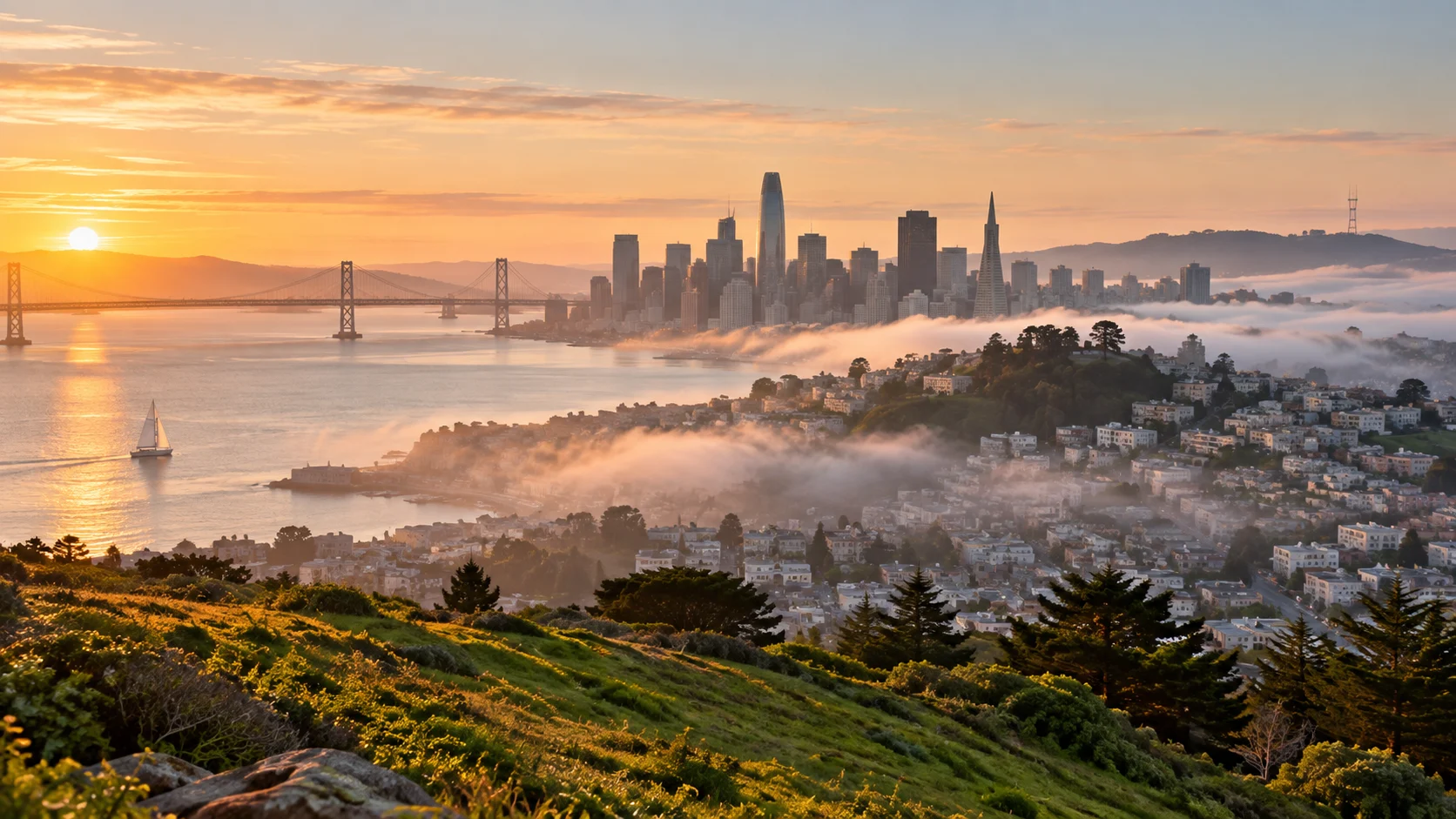
San Francisco by the Bay
Q: In which U.S. state is San Francisco located?
A: California.
Q: On what peninsula is San Francisco located?
A: The San Francisco Peninsula.
Q: Which body of water lies east of the city?
A: San Francisco Bay.
Q: Which ocean lies west of San Francisco?
A: The Pacific Ocean.
Q: What strait connects San Francisco Bay to the Pacific Ocean?
A: The Golden Gate.
Q: What nickname describes San Francisco's famously hilly terrain?
A: The City of Hills.
Q: What is the highest natural point in San Francisco?
A: Mount Davidson.
Q: Which two prominent peaks rise near the city's geographic center?
A: Twin Peaks.
Q: What small group of rocky islands lies about 27 miles west of the Golden Gate?
A: The Farallon Islands.
Q: What major fault runs just offshore from San Francisco?
A: The San Andreas Fault.
Q: What cool ocean current helps give San Francisco its mild summers?
A: The California Current.
Q: What weather feature often pours through the Golden Gate in summer?
A: Fog.
Q: What affectionate human name is often given to San Francisco's fog?
A: Karl.
Q: What county shares exactly the same boundaries as the city?
A: San Francisco County.
Q: Which bayfront city sits directly across the Golden Gate to the north?
A: Sausalito.
From Yerba Buena to the Gold Rush
Q: Which Indigenous people lived in the San Francisco area before European colonization?
A: The Ramaytush Ohlone.
Q: What Spanish mission was founded in San Francisco in 1776?
A: Mission San Francisco de Asís.
Q: By what popular name is Mission San Francisco de Asís better known?
A: Mission Dolores.
Q: What was the settlement of San Francisco called before 1847?
A: Yerba Buena.
Q: What does Yerba Buena mean in Spanish?
A: Good herb.
Q: Which country's forces took control of Yerba Buena in 1846?
A: The United States.
Q: What 1848 discovery transformed San Francisco into a booming port?
A: Gold at Sutter's Mill.
Q: What nickname was given to Gold Rush arrivals in 1849?
A: Forty-niners.
Q: What happened to many ships whose crews abandoned them during the Gold Rush?
A: They were converted into stores, hotels, or landfill.
Q: Which merchant founded a dry-goods business in San Francisco and later sold riveted denim pants?
A: Levi Strauss.
Q: Which banker founded the Bank of Italy in San Francisco in 1904?
A: A. P. Giannini.
Q: What did the Bank of Italy eventually become?
A: Bank of America.
Q: Which San Francisco neighborhood grew around the oldest and largest Chinatown in North America?
A: Chinatown.
Q: What 1882 federal law sharply restricted Chinese immigration?
A: The Chinese Exclusion Act.
Q: Which self-proclaimed emperor became a beloved 19th-century San Francisco character?
A: Emperor Norton.
Earthquakes, Fire, and Reinvention
Q: On what date did San Francisco's devastating 1906 earthquake strike?
A: April 18, 1906.
Q: Which fault ruptured during the 1906 earthquake?
A: The San Andreas Fault.
Q: What caused most of the destruction after the 1906 shaking stopped?
A: Fires.
Q: Why were firefighters hampered after the 1906 earthquake?
A: Broken water mains left too little water to fight the fires.
Q: What 1915 world's fair celebrated the city's recovery and the Panama Canal?
A: The Panama-Pacific International Exposition.
Q: Which surviving 1915 exposition structure has a classical rotunda and lagoon?
A: The Palace of Fine Arts.
Q: What artificial island was created for the 1939 Golden Gate International Exposition?
A: Treasure Island.
Q: Which 1989 earthquake interrupted the World Series?
A: The Loma Prieta earthquake.
Q: Which two Bay Area teams were playing in the 1989 World Series?
A: The San Francisco Giants and Oakland Athletics.
Q: What damaged double-deck freeway was removed from the waterfront after the 1989 earthquake?
A: The Embarcadero Freeway.
Q: Which auditorium hosted the signing of the United Nations Charter in 1945?
A: The Herbst Theatre in the War Memorial Veterans Building.
Q: What 1945 international gathering created the United Nations?
A: The San Francisco Conference.
Q: Which island processed many immigrants from Asia between 1910 and 1940?
A: Angel Island.
Q: What 1934 labor conflict shut down West Coast ports and included a general strike in San Francisco?
A: The West Coast waterfront strike.
Q: Which former military post at the Golden Gate became part of a national recreation area?
A: The Presidio.
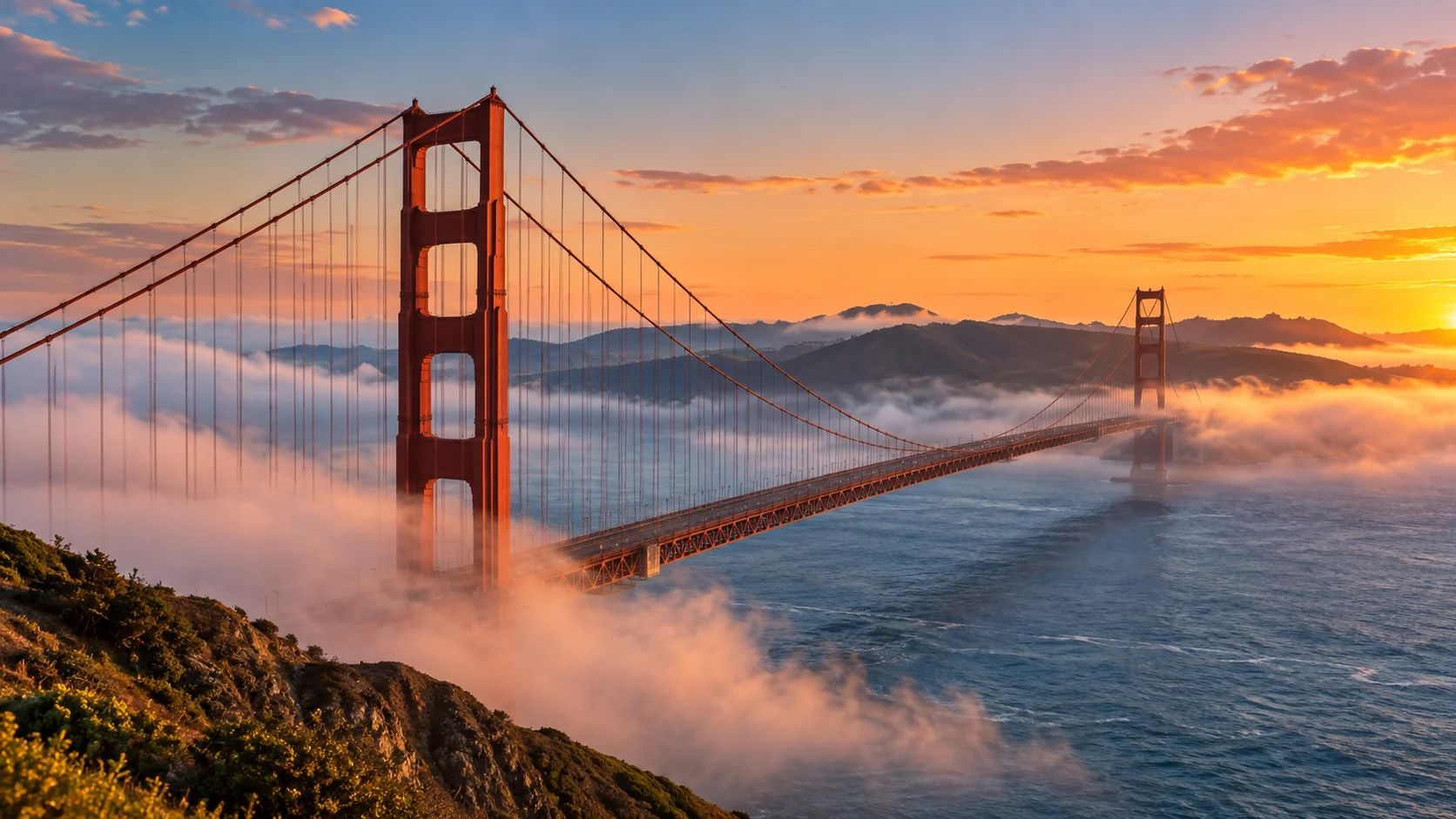
Bridges, Towers, and Postcard Landmarks
Q: In what year did the Golden Gate Bridge open?
A: 1937.
Q: What color is the Golden Gate Bridge?
A: International Orange.
Q: Who was chief engineer of the Golden Gate Bridge?
A: Joseph Strauss.
Q: Which engineer designed much of the Golden Gate Bridge's structural system?
A: Charles Alton Ellis.
Q: Which architect shaped the Golden Gate Bridge's Art Deco appearance?
A: Irving Morrow.
Q: What island prison once held Al Capone?
A: Alcatraz.
Q: What nickname was commonly given to Alcatraz Island?
A: The Rock.
Q: In what year did the federal prison on Alcatraz close?
A: 1963.
Q: Which hilltop tower was built with a bequest from Lillie Hitchcock Coit?
A: Coit Tower.
Q: What murals decorate the interior of Coit Tower?
A: New Deal-era frescoes depicting California life.
Q: What crooked block is famous for eight sharp turns?
A: Lombard Street between Hyde and Leavenworth.
Q: What waterfront marketplace occupies restored former chocolate-factory buildings?
A: Ghirardelli Square.
Q: What clock-towered building anchors the Embarcadero?
A: The Ferry Building.
Q: Which cluster of colorful Victorian houses faces Alamo Square?
A: The Painted Ladies.
Q: What pyramid-shaped skyscraper was once San Francisco's tallest building?
A: The Transamerica Pyramid.
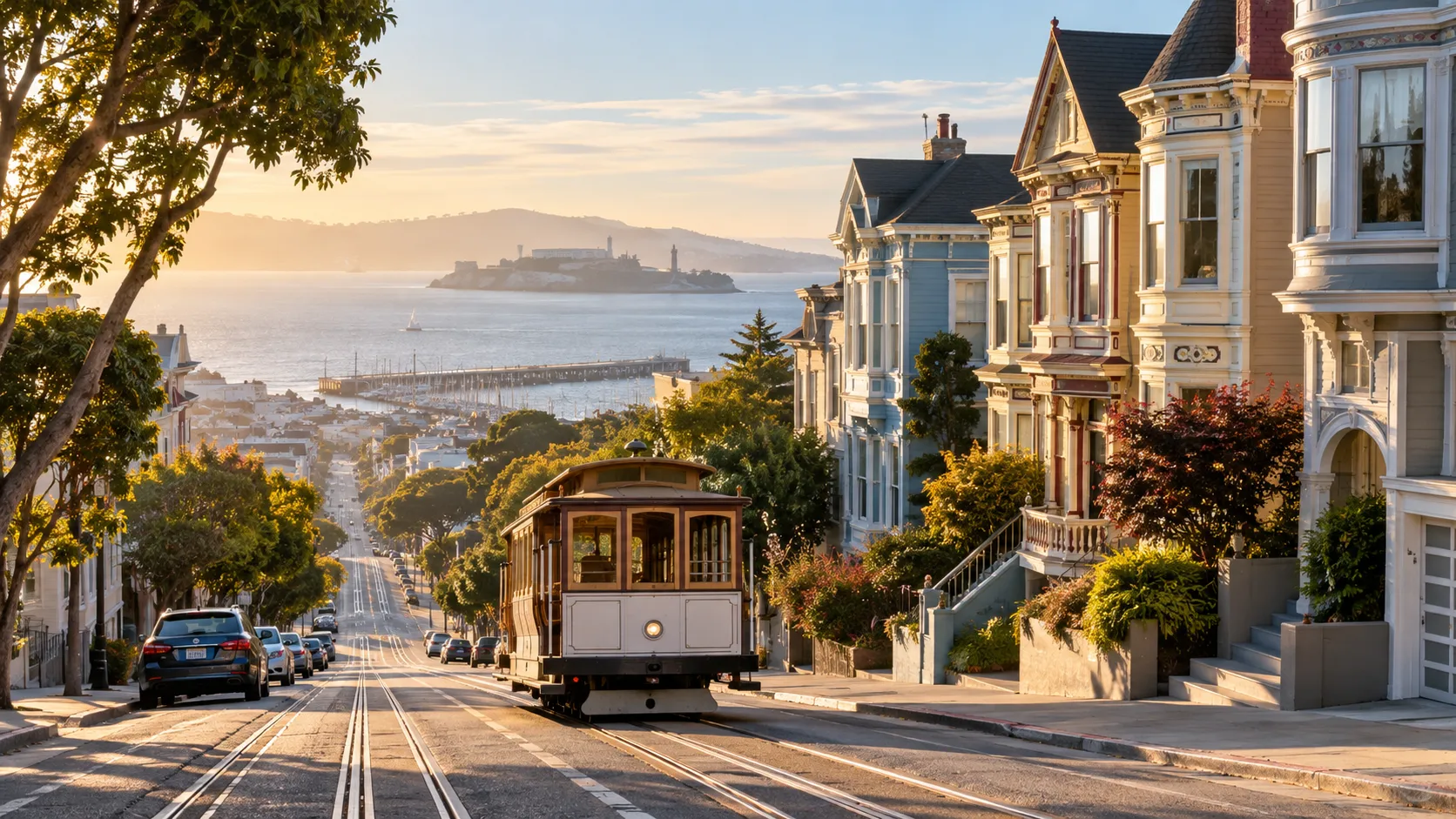
Neighborhoods, Streets, and Getting Around
Q: Which neighborhood became the heart of 1960s hippie culture?
A: Haight-Ashbury.
Q: Which neighborhood is a historic center of LGBTQ+ life and activism?
A: The Castro.
Q: Which district is known for murals, taquerias, and Mission Dolores?
A: The Mission District.
Q: Which neighborhood was a center of the Beat Generation?
A: North Beach.
Q: Which lively waterfront area is known for sea lions and Pier 39?
A: Fisherman's Wharf.
Q: Which neighborhood is famous for steep streets and grand hotels?
A: Nob Hill.
Q: What large park stretches from the city center toward the Pacific?
A: Golden Gate Park.
Q: Which conservatory in Golden Gate Park opened in 1879?
A: The Conservatory of Flowers.
Q: What Japanese garden in Golden Gate Park is the oldest public one of its kind in the United States?
A: The Japanese Tea Garden.
Q: What manually operated vehicles climb the city's hills?
A: Cable cars.
Q: Who invented San Francisco's cable car system?
A: Andrew Smith Hallidie.
Q: In what year did San Francisco's first cable car begin service?
A: 1873.
Q: What regional rail system connects San Francisco with the East Bay and other communities?
A: BART.
Q: What does BART stand for?
A: Bay Area Rapid Transit.
Q: What street forms the main spine of downtown shopping near Union Square?
A: Market Street.
Books, Beats, Music, and Museums
Q: Which bookstore co-founded by Lawrence Ferlinghetti became a Beat landmark?
A: City Lights Booksellers.
Q: Which poet's Howl was published by City Lights?
A: Allen Ginsberg.
Q: Which novelist wrote The Maltese Falcon, set in San Francisco?
A: Dashiell Hammett.
Q: Which Alfred Hitchcock film follows a detective through San Francisco?
A: Vertigo.
Q: Which 1967 song invited listeners to wear flowers in their hair?
A: “San Francisco (Be Sure to Wear Flowers in Your Hair).”
Q: Who recorded that 1967 flower-power anthem?
A: Scott McKenzie.
Q: Which band fronted by Jerry Garcia formed in the Bay Area?
A: The Grateful Dead.
Q: Which San Francisco band recorded “Somebody to Love” and “White Rabbit”?
A: Jefferson Airplane.
Q: Which guitarist led the Latin-rock band Santana?
A: Carlos Santana.
Q: Which concert hall is home to the San Francisco Symphony?
A: Davies Symphony Hall.
Q: Which opera company performs at the War Memorial Opera House?
A: San Francisco Opera.
Q: What museum in Golden Gate Park focuses on art from the Americas, Africa, and Oceania?
A: The de Young Museum.
Q: Which museum across from the de Young includes an aquarium, planetarium, and rainforest?
A: The California Academy of Sciences.
Q: Which modern-art museum is commonly abbreviated SFMOMA?
A: The San Francisco Museum of Modern Art.
Q: Which Walt Disney family museum occupies buildings in the Presidio?
A: The Walt Disney Family Museum.
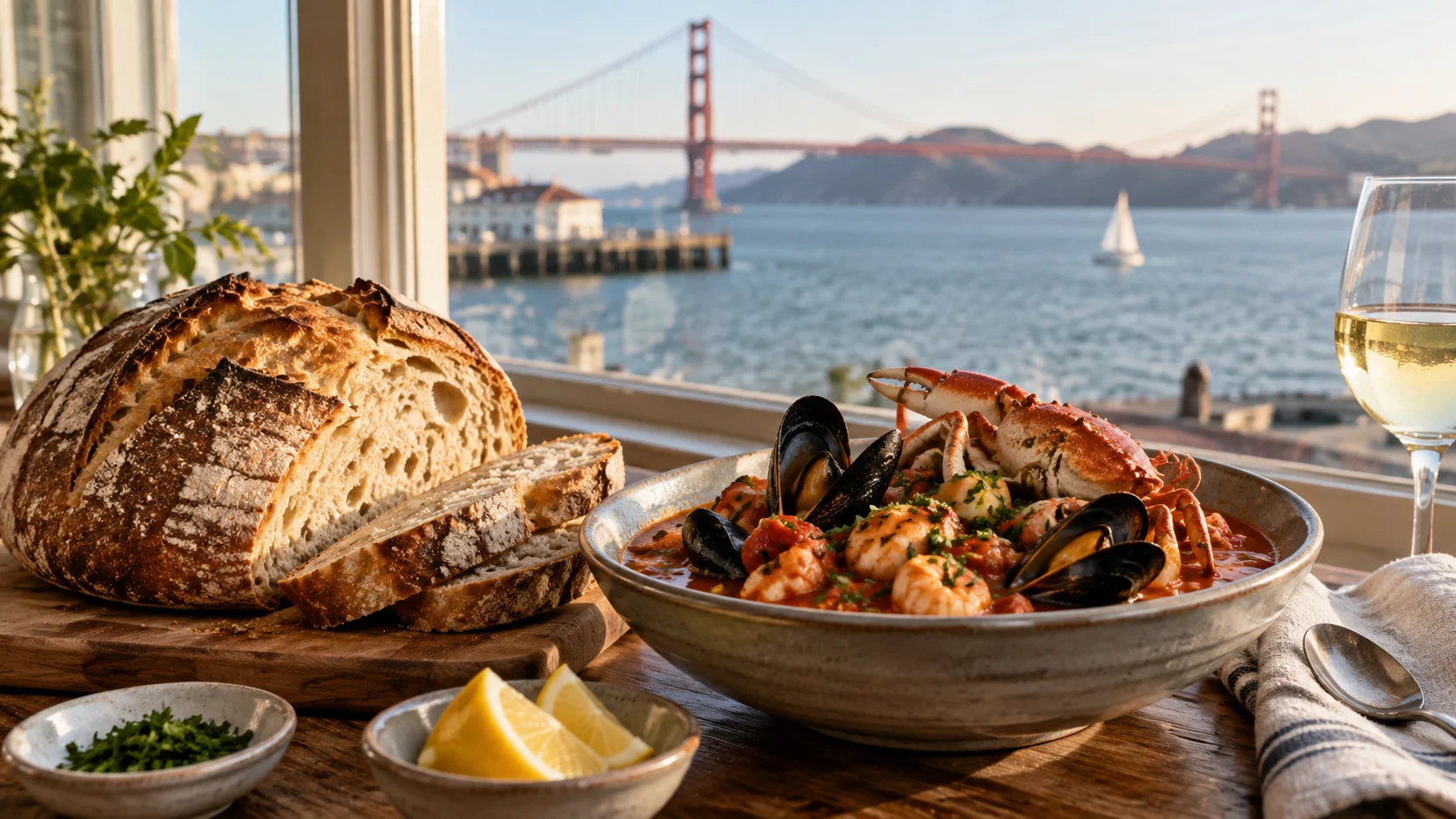
Sourdough, Seafood, and Local Originals
Q: Which tangy bread is a San Francisco specialty?
A: Sourdough.
Q: What seafood stew was created by Italian American fishers in San Francisco?
A: Cioppino.
Q: Which chocolate maker began in San Francisco in 1852?
A: Ghirardelli.
Q: What strong coffee drink became closely linked with North Beach's Italian cafés?
A: Espresso.
Q: What Mission District creation wraps an oversized flour tortilla around rice, beans, meat, and toppings?
A: The Mission burrito.
Q: Which Japanese immigrant is often credited with popularizing fortune cookies at the Japanese Tea Garden?
A: Makoto Hagiwara.
Q: Which Chinatown factory still folds fortune cookies by hand?
A: Golden Gate Fortune Cookie Factory.
Q: What coffee company opened its first store in nearby Berkeley in 1966?
A: Peet's Coffee.
Q: Which historic San Francisco restaurant began as a coffee stand during the Gold Rush?
A: Tadich Grill.
Q: What Gold Rush-era omelet combines eggs, oysters, and bacon?
A: Hangtown fry.
Q: Which Irish coffee landmark sits near the Hyde Street cable car turnaround?
A: The Buena Vista Cafe.
Q: What sweet was once produced in the waterfront factory now known as Ghirardelli Square?
A: Chocolate.
Q: Which seasonal crustacean is a prized local catch?
A: Dungeness crab.
Q: What farmers market fills the Ferry Building on selected days?
A: Ferry Plaza Farmers Market.
Q: Which clam-filled bread-bowl dish is a Fisherman's Wharf favorite?
A: Clam chowder in a sourdough bread bowl.
Innovation and Championship Teams
Q: Which denim company was founded in San Francisco in 1853?
A: Levi Strauss & Co.
Q: Which electronics company began in a nearby Palo Alto garage and became a Silicon Valley icon?
A: Hewlett-Packard.
Q: Which ride-sharing company was founded in San Francisco in 2009?
A: Uber.
Q: Which home-sharing platform was founded in San Francisco in 2008?
A: Airbnb.
Q: What waterfront ballpark is home to the San Francisco Giants?
A: Oracle Park.
Q: Which body of water beyond right field receives home runs known as splash hits?
A: McCovey Cove.
Q: Which Giants slugger hit 756 home runs to break Hank Aaron's career record?
A: Barry Bonds.
Q: Which Hall of Famer gave McCovey Cove its name?
A: Willie McCovey.
Q: Which legendary Giants center fielder made “The Catch” in the 1954 World Series?
A: Willie Mays.
Q: Which NFL team carries San Francisco's name?
A: The San Francisco 49ers.
Q: What does the 49ers' name honor?
A: Gold Rush prospectors who arrived in 1849.
Q: Which quarterback led the 49ers to four Super Bowl victories in the 1980s?
A: Joe Montana.
Q: Which NBA team moved its home games to San Francisco in 2019?
A: The Golden State Warriors.
Q: What arena is home to the Golden State Warriors?
A: Chase Center.
Q: Which famous sailing trophy was contested on San Francisco Bay in 2013?
A: The America's Cup.
One Last Climb
If you conquered every hill, cable car, and sourdough starter, your San Francisco score is looking golden. Keep the good trip going with our Greece trivia or revisit another era with decades trivia.

Ellie Ewert is the founder and author of RandomTrivia.co, blending her passion for research with years of experience in content creation to deliver accurate, engaging, and well-sourced trivia. Dedicated to providing readers with trustworthy and entertaining facts, she applies meticulous fact-checking and SEO expertise to ensure every article meets the highest standards. Read more about our high standards in our Editorial Guidelines.