
Kwanzaa has seven days, seven principles, seven candles, and approximately seven ways for me to mix up the Swahili before coffee. These 120 questions keep the names straight while exploring the history, symbols, greetings, and practical ideas behind the celebration.
Kwanzaa Origins, Dates & Foundations
Q: When does Kwanzaa begin each year?
A: December 26.
Q: When does Kwanzaa end each year?
A: January 1, making it a seven-day observance.
Q: Who created Kwanzaa?
A: Maulana Karenga, an American scholar and activist.
Q: In what year was Kwanzaa created?
A: 1966.
Q: Where was Kwanzaa created?
A: In the United States, amid the Black cultural and freedom movements of the 1960s.
Q: What three ideas does Kwanzaa especially celebrate?
A: Family, community, and culture.
Q: Which language supplies most Kwanzaa terms?
A: Swahili, a widely spoken African language.
Q: What does the name Kwanzaa refer to?
A: First fruits, drawing on African harvest celebrations.
Q: Which Swahili phrase inspired the holiday’s name?
A: Matunda ya kwanza, meaning first fruits.
Q: Why was an extra “a” added to Kwanzaa?
A: The seven letters let seven children at an early celebration each represent one letter.
Q: Is Kwanzaa a religious holiday?
A: No. It is a cultural holiday and can be observed alongside religious celebrations.
Q: Who is Kwanzaa primarily rooted in celebrating?
A: African Americans and the wider African diaspora.
Q: What does Pan-African mean in the context of Kwanzaa?
A: It emphasizes shared cultural ties among African people and people of African descent worldwide.
Q: How many days does Kwanzaa last?
A: Seven days.
Q: How many central principles guide Kwanzaa?
A: Seven, collectively called the Nguzo Saba.
Q: What does Nguzo Saba mean?
A: The Seven Principles.
Q: How many basic symbols does Kwanzaa traditionally have?
A: Seven basic symbols.
Q: What is the central purpose of the daily principles?
A: They turn cultural values into ideas families and communities can discuss and practice.
Q: Which decade gave rise to Kwanzaa?
A: The 1960s.
Q: What is the name of the Kwanzaa feast?
A: Karamu.
Q: On what date is Karamu usually held?
A: December 31.
Q: What kinds of activities often appear at a Karamu?
A: Music, dance, readings, food, and reflection on African and African American culture.
Q: Can a family celebrate both Kwanzaa and Christmas?
A: Yes. Kwanzaa is cultural rather than a replacement required for another holiday.
Q: Who can participate respectfully in Kwanzaa?
A: People of any background can learn about or join celebrations when invited and respectful of its African American roots.
Q: What annual rhythm does Kwanzaa encourage beyond its seven days?
A: Practicing its principles throughout the year.
Q: What is the first principle of Kwanzaa?
A: Umoja, or Unity.
Q: On which date is Umoja observed?
A: December 26.
Q: What does Umoja encourage?
A: Striving for unity in the family, community, nation, and race.
Q: What is the second principle of Kwanzaa?
A: Kujichagulia, or Self-Determination.
Q: On which date is Kujichagulia observed?
A: December 27.
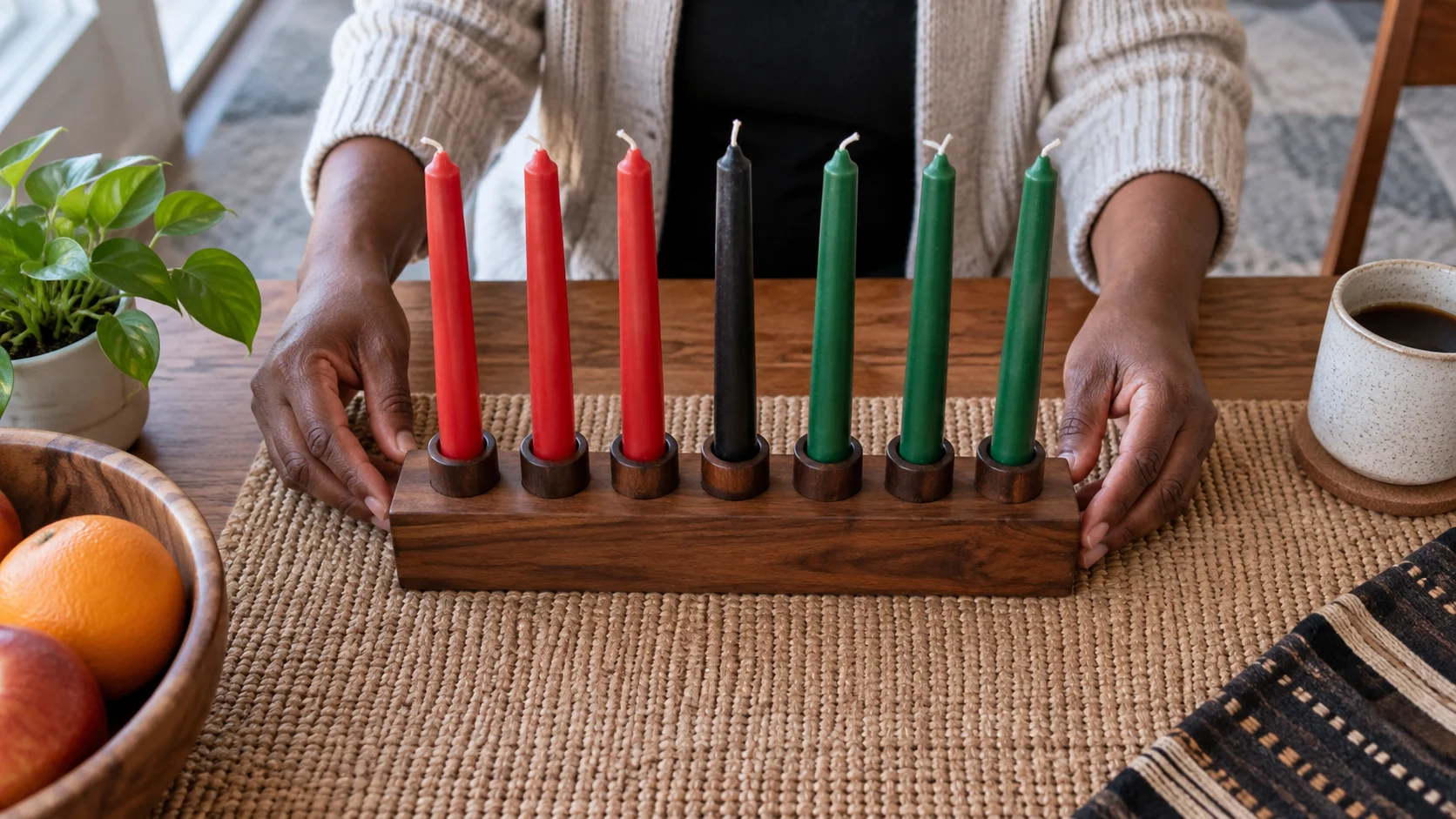
The Nguzo Saba: Seven Principles
Q: What does Kujichagulia ask people to do?
A: Define, name, create, and speak for themselves.
Q: What is the third principle of Kwanzaa?
A: Ujima, or Collective Work and Responsibility.
Q: On which date is Ujima observed?
A: December 28.
Q: What does Ujima encourage communities to do?
A: Build and maintain the community together and solve shared problems together.
Q: What is the fourth principle of Kwanzaa?
A: Ujamaa, or Cooperative Economics.
Q: On which date is Ujamaa observed?
A: December 29.
Q: What does Ujamaa encourage?
A: Building and supporting businesses that benefit the community collectively.
Q: What is the fifth principle of Kwanzaa?
A: Nia, or Purpose.
Q: On which date is Nia observed?
A: December 30.
Q: What does Nia emphasize?
A: Collective vocation directed toward building and developing the community.
Q: What is the sixth principle of Kwanzaa?
A: Kuumba, or Creativity.
Q: On which date is Kuumba observed?
A: December 31.
Q: What does Kuumba ask people to do?
A: Leave the community more beautiful and beneficial than they inherited it.
Q: What is the seventh principle of Kwanzaa?
A: Imani, or Faith.
Q: On which date is Imani observed?
A: January 1.
Q: What does Imani emphasize?
A: Belief in the people, families, leaders, teachers, and the justice of the community’s struggle.
Q: Which principle best fits a family resolving a disagreement together?
A: Umoja, because the goal is renewed unity.
Q: Which principle fits choosing your own name and speaking in your own voice?
A: Kujichagulia, or Self-Determination.
Q: Which principle fits neighbors jointly cleaning a neglected park?
A: Ujima, or Collective Work and Responsibility.
Q: Which principle fits deliberately shopping at community-owned businesses?
A: Ujamaa, or Cooperative Economics.
Q: Which principle fits setting a long-term community mission?
A: Nia, or Purpose.
Q: Which principle fits creating art that improves a shared space?
A: Kuumba, or Creativity.
Q: Which principle closes the Kwanzaa week?
A: Imani, or Faith.
Q: Which principle shares its day with the Karamu feast?
A: Kuumba, observed on December 31.
Q: Why are the principles discussed rather than merely memorized?
A: Kwanzaa treats them as practical standards for choices, relationships, and community life.
Q: What is a kinara?
A: The seven-branched candleholder used during Kwanzaa.
Q: How many candles does a kinara hold?
A: Seven.
Q: What is the Swahili name for the seven candles?
A: Mishumaa Saba.
Q: What three colors appear on Kwanzaa candles?
A: Black, red, and green.
Q: How many black candles are used?
A: One.
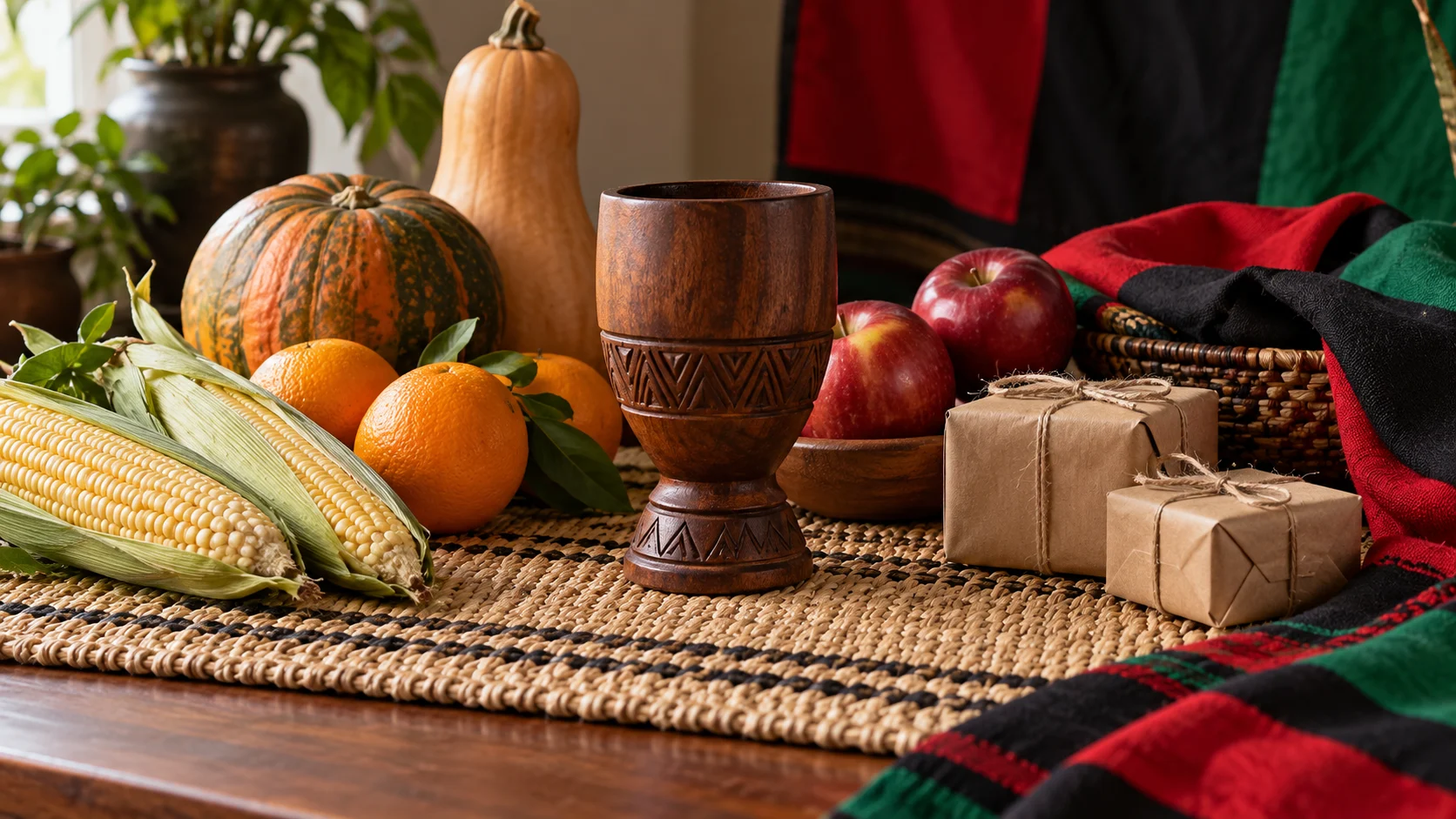
Kinara, Candles & the Seven Symbols
Q: How many red candles are used?
A: Three.
Q: How many green candles are used?
A: Three.
Q: Where is the black candle placed in the kinara?
A: In the center.
Q: What does the black candle represent?
A: African people.
Q: What do the red candles represent?
A: The struggle of African people.
Q: What do the green candles represent?
A: Hope and the future that comes from the struggle.
Q: Which candle is lit first?
A: The central black candle.
Q: What does mkeka mean in a Kwanzaa display?
A: The mat on which the other symbols are arranged.
Q: What does the mkeka symbolize?
A: Tradition and history as the foundation for building the future.
Q: What does mazao mean?
A: Crops, fruits, and vegetables representing the harvest.
Q: What does muhindi mean?
A: Corn.
Q: What does corn symbolize in Kwanzaa?
A: Children and the future they embody.
Q: How is corn sometimes counted in a family display?
A: One ear may be placed for each child in the household.
Q: What is the kikombe cha umoja?
A: The Unity Cup.
Q: What is the Unity Cup used for?
A: It is used in a communal libation honoring ancestors and reinforcing unity.
Q: What does zawadi mean?
A: Gifts.
Q: Who traditionally receives special attention in Kwanzaa gift-giving?
A: Children.
Q: What two kinds of gifts are especially encouraged for children?
A: A book and a heritage symbol.
Q: Why is a book encouraged as a Kwanzaa gift?
A: It supports learning and commitment to tradition.
Q: Why is a heritage symbol encouraged as a gift?
A: It reinforces cultural identity and connection.
Q: What visual tradition inspired Kwanzaa’s red, black, and green colors?
A: The Pan-African flag associated with Black liberation and unity.
Q: Who created the red, black, and green Pan-African flag?
A: The Universal Negro Improvement Association under Marcus Garvey’s leadership adopted it in 1920.
Q: What does the word kinara mean?
A: Candleholder.
Q: Which symbol literally supports the others in a traditional display?
A: The mkeka, or mat.
Q: Which symbol makes the harvest theme visible?
A: Mazao, the crops.
Q: Which symbol is lifted during a libation?
A: The kikombe cha umoja, or Unity Cup.
Q: Which symbol connects the celebration most directly with children?
A: Muhindi, or corn.
Q: Which symbol represents the rewards of parents’ labor and children’s growth?
A: Zawadi, or gifts.
Q: Why should a kinara not be casually called a menorah?
A: The two candleholders belong to different holidays, histories, and symbolic systems.
Q: What is the traditional Kwanzaa greeting question?
A: Habari gani?
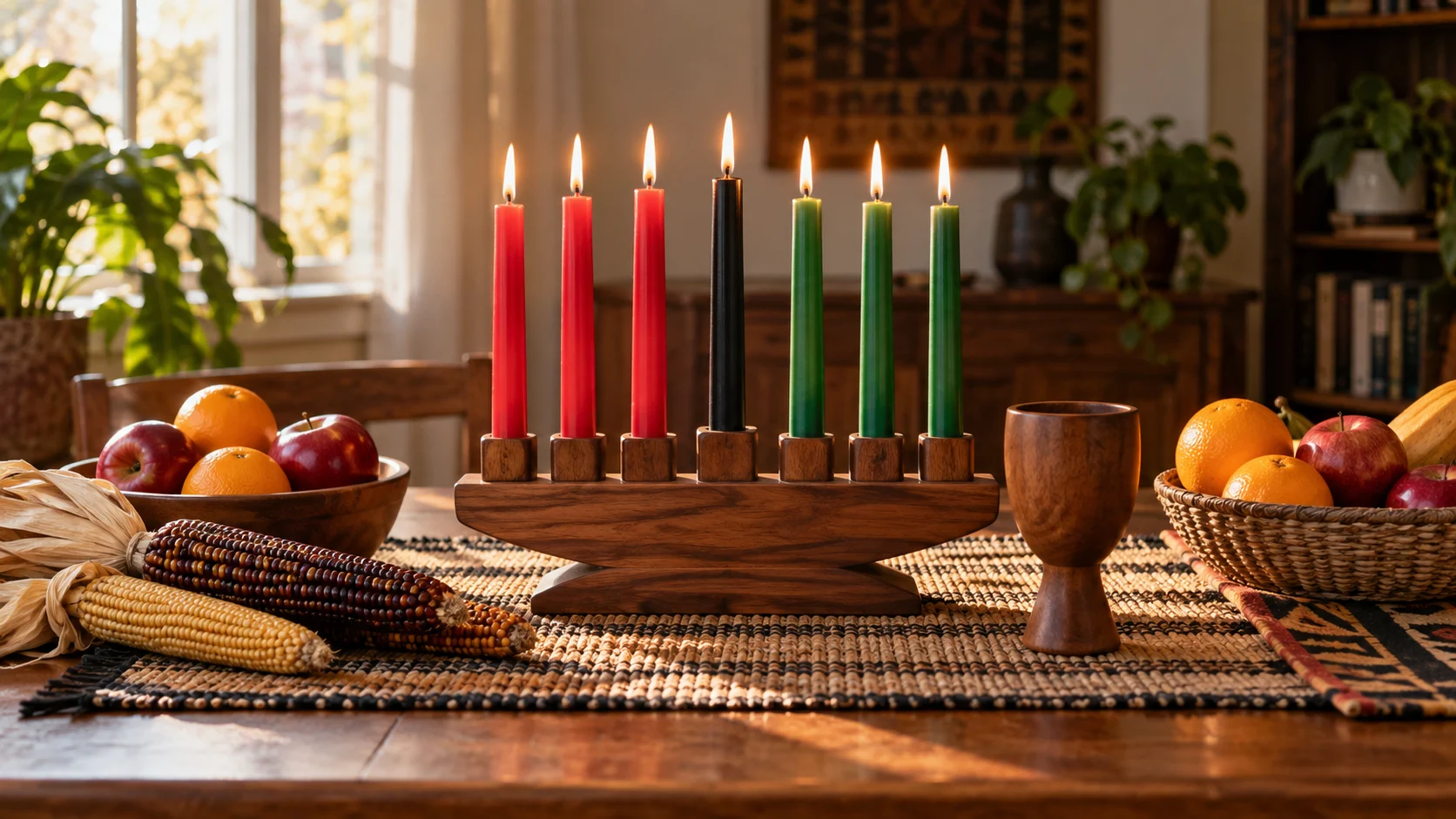
Greetings, Karamu & Living the Principles
Q: What does Habari gani mean?
A: What is the news?
Q: How is Habari gani traditionally answered?
A: With the Swahili name of the principle for that day.
Q: How would someone answer Habari gani on December 26?
A: Umoja.
Q: How would someone answer Habari gani on December 27?
A: Kujichagulia.
Q: How would someone answer Habari gani on December 28?
A: Ujima.
Q: How would someone answer Habari gani on December 29?
A: Ujamaa.
Q: How would someone answer Habari gani on December 30?
A: Nia.
Q: How would someone answer Habari gani on December 31?
A: Kuumba.
Q: How would someone answer Habari gani on January 1?
A: Imani.
Q: What phrase is commonly used to wish someone a happy Kwanzaa?
A: Joyous Kwanzaa.
Q: What does Karamu ya Imani mean?
A: Feast of Faith.
Q: Why are ancestors honored during Kwanzaa?
A: Remembering those who came before strengthens cultural continuity and responsibility.
Q: What does a libation involve?
A: Liquid is poured ceremonially while ancestors and shared commitments are honored.
Q: What role can storytelling play in a Kwanzaa celebration?
A: Stories preserve family memory, history, values, and cultural identity.
Q: What role can music and dance play during Kwanzaa?
A: They celebrate creativity and connect participants with African and diasporic traditions.
Q: Why are children central to many Kwanzaa activities?
A: They represent cultural survival, future leadership, and the next generation’s responsibility.
Q: What should guide the choice of Kwanzaa gifts?
A: The gifts should support growth, achievement, learning, and cultural grounding.
Q: What is one respectful way to begin learning about Kwanzaa?
A: Learn the seven principles and the meanings of the symbols before copying the display.
Q: Why is pronunciation worth practicing with Kwanzaa terms?
A: Using the Swahili words carefully shows respect and makes their meanings easier to remember.
Q: What everyday activity can express Ujamaa?
A: Choosing a community-owned shop or organizing a cooperative buying effort.
Q: What everyday activity can express Kuumba?
A: Writing, cooking, decorating, or solving a problem in a way that improves community life.
Q: What everyday activity can express Ujima?
A: Taking responsibility for a shared problem instead of waiting for someone else to fix it.
Q: What everyday activity can express Nia?
A: Connecting personal goals to the needs and progress of the community.
Q: What everyday activity can express Imani?
A: Supporting trustworthy community institutions and acting with confidence in collective progress.
Q: What everyday activity can express Kujichagulia?
A: Speaking for yourself and defining your identity on your own terms.
Q: What everyday activity can express Umoja?
A: Listening across differences and protecting family or community bonds.
Q: What date immediately follows the final day of Kwanzaa?
A: January 2.
Q: Why does Kwanzaa cross two calendar years?
A: Its fixed seven-day span begins December 26 and ends on New Year’s Day.
Q: What makes Kwanzaa distinct from a generic winter festival?
A: Its language, symbols, principles, and purpose are rooted in African American and Pan-African culture.
Q: What is the simplest accurate summary of Kwanzaa?
A: A seven-day African American cultural celebration of family, community, culture, and shared principles.
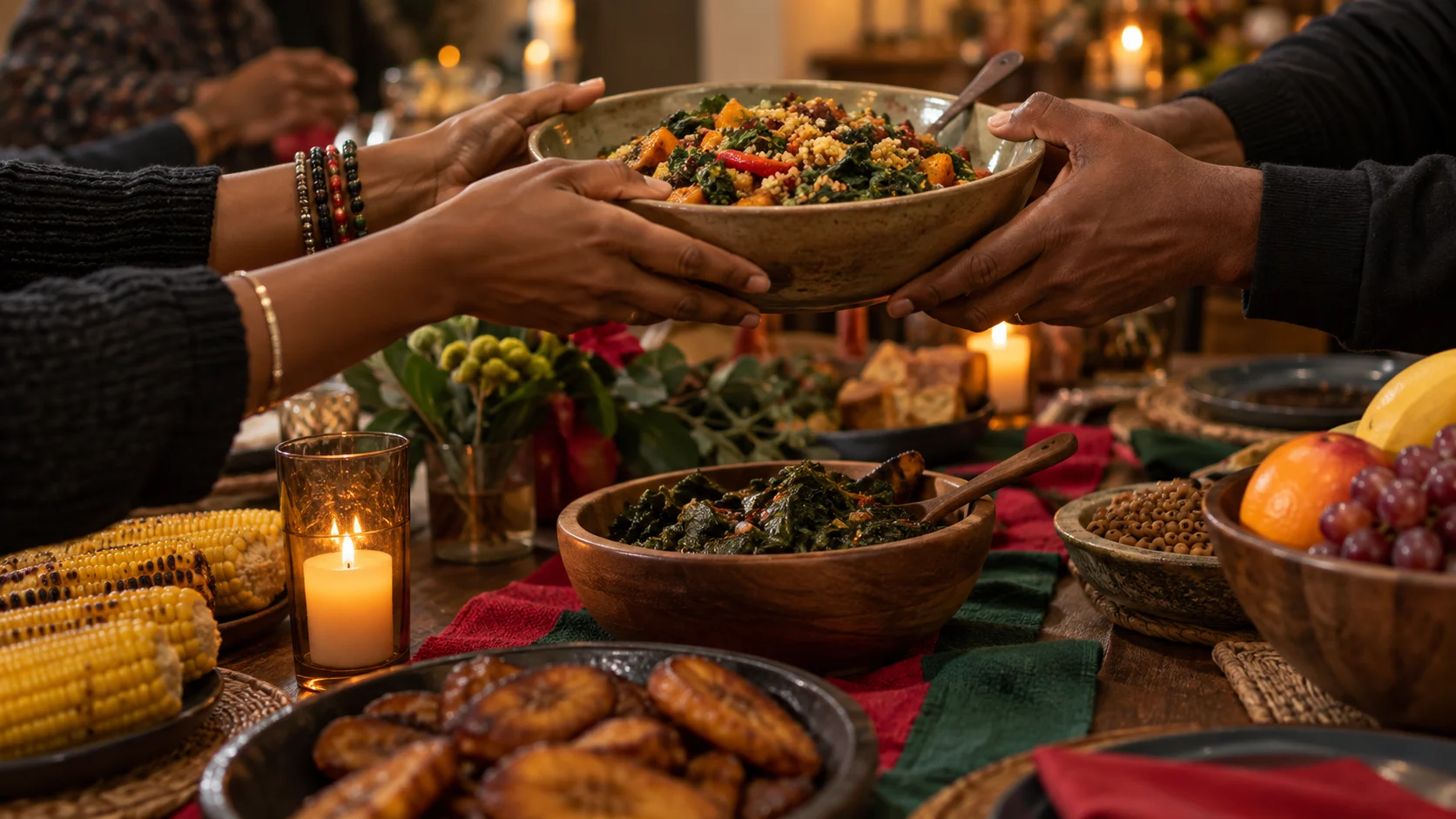
How Did You Score?
If you knew the difference between Ujima and Ujamaa, placed the black candle correctly, and answered all seven greetings, that is a beautiful score. I would hand you the Unity Cup, but ceremonial objects deserve more care than my quiz-night coffee mug.

Ellie Simons creates and edits Random Trivia. She researches trivia using primary and authoritative sources whenever possible and is currently reviewing the site's older trivia library for accuracy, clarity, and playability. Read more on the About page.
About this quiz
Site editor: Ellie Simons. Read our Trivia Methodology to learn how questions are researched and updated. Page last updated: . Report an error.