
Grab a pan and a sturdy pair of boots, because California's most famous rush was equal parts glittering hope and gritty reality.
These California Gold Rush trivia questions dig into the discovery, the journeys west, mining life, diverse communities, and the boom that reshaped a state.
The Discovery That Started the Rush
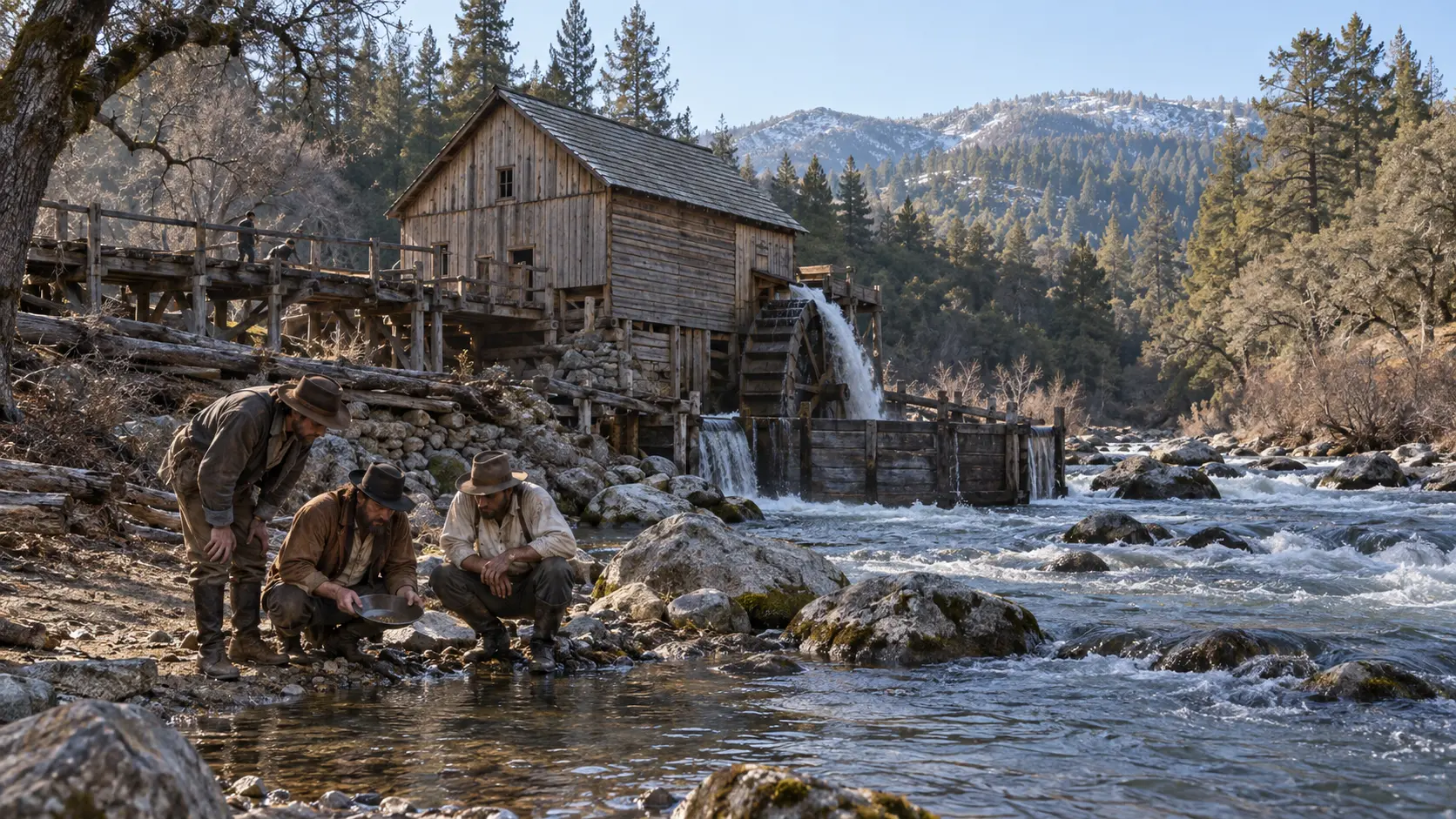
Q: Who discovered gold at Sutter's Mill in January 1848?
A: James W. Marshall.
Q: On what river was Sutter's Mill located?
A: The South Fork of the American River.
Q: Near what present-day California town did Marshall find gold?
A: Coloma.
Q: Who owned the sawmill where Marshall found gold?
A: John Sutter.
Q: On what date was gold discovered at Sutter's Mill?
A: January 24, 1848.
Q: What kind of facility was being built when Marshall spotted gold?
A: A water-powered sawmill.
Q: What treaty ending the Mexican-American War was signed days after the discovery?
A: The Treaty of Guadalupe Hidalgo.
Q: Which newspaper publisher helped spread the news through San Francisco?
A: Samuel Brannan.
Q: What did Brannan reportedly display while announcing the discovery?
A: A bottle of gold dust.
Q: Which U.S. president confirmed the gold discovery in a December 1848 message to Congress?
A: James K. Polk.
Q: What nickname was given to gold seekers who arrived in 1849?
A: Forty-niners.
Q: What Spanish name meaning “The Gilded One” became shorthand for a fabulous land of gold?
A: El Dorado.
Q: In which mountain range did the richest early diggings lie?
A: The Sierra Nevada.
Q: What name was given to the gold-rich western foothills of the Sierra Nevada?
A: The Mother Lode.
Q: Did John Sutter become rich from the rush sparked on his land?
A: No. The rush damaged his property and business interests.
Getting to California
Q: What overland route brought many emigrants toward California across the continent?
A: The California Trail.
Q: Which Missouri River town was a major jumping-off point for overland travelers?
A: Independence, Missouri.
Q: What type of wagon was commonly used on the overland journey?
A: A covered wagon.
Q: Which animals were usually preferred for pulling emigrant wagons?
A: Oxen.
Q: What disease killed many travelers on western trails?
A: Cholera.
Q: What mountain pass became a key entry through the Sierra Nevada?
A: Donner Pass.
Q: What famous 1846 wagon party became trapped near that pass?
A: The Donner Party.
Q: What sea route took travelers around the southern tip of South America?
A: The route around Cape Horn.
Q: What narrow land bridge did some travelers cross before taking another ship up the Pacific coast?
A: The Isthmus of Panama.
Q: What classical nickname was sometimes used for California Gold Rush adventurers?
A: Argonauts.
Q: What transportation shortcut across Panama opened in 1855?
A: The Panama Railroad.
Q: Roughly how long could an overland trip to California take in 1849?
A: About four to six months.
Q: Which fort in present-day Wyoming was an important landmark on the overland trails?
A: Fort Laramie.
Q: Which river did many emigrants follow west across Nebraska?
A: The Platte River.
Q: What phrase captured the urgency of reaching mountain passes before winter?
A: “California or bust.”
Pans, Sluices, and Mining Methods
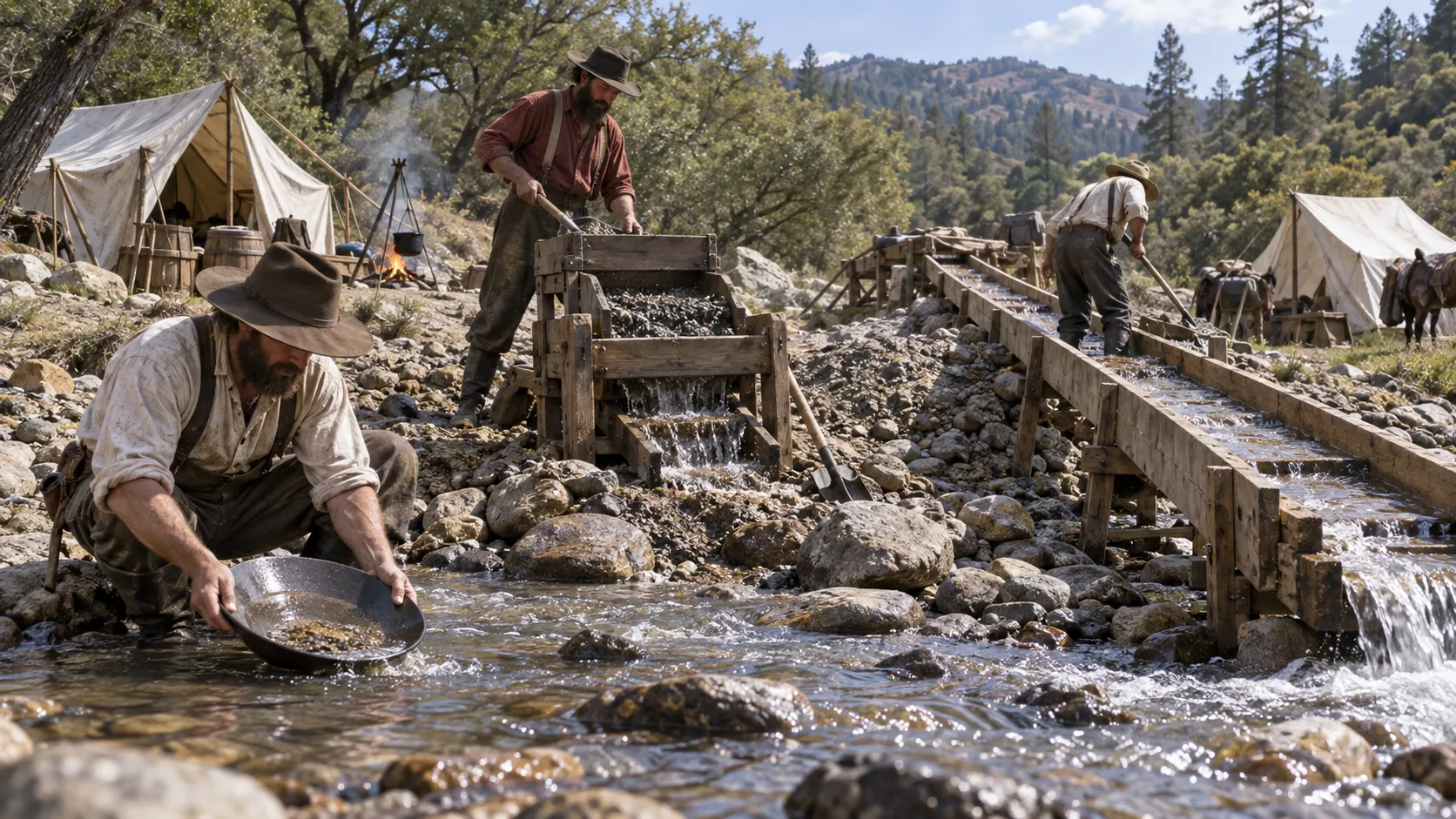
Q: What simple tool swirled water and gravel to separate out gold?
A: A gold pan.
Q: Why does gold settle toward the bottom of a pan?
A: It is denser than most sand and gravel.
Q: What wooden box used running water and riffles to trap gold?
A: A sluice box.
Q: What cradle-like device processed more gravel than a single pan?
A: A rocker, or cradle.
Q: What did miners call gold found loose in streambeds and gravel deposits?
A: Placer gold.
Q: What type of mining followed gold-bearing veins into solid rock?
A: Hard-rock, or quartz, mining.
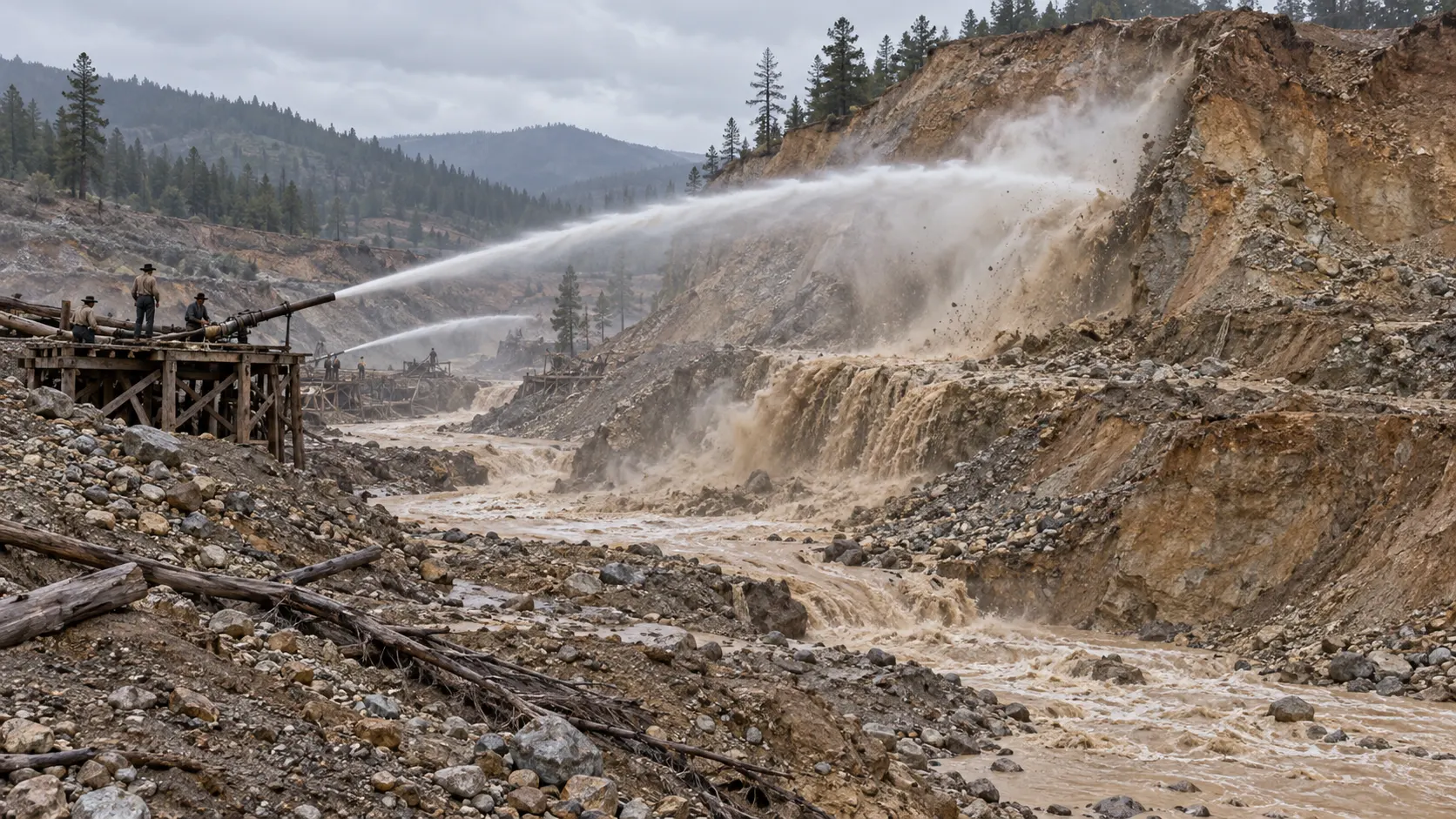
Q: What powerful method used high-pressure water to wash away hillsides?
A: Hydraulic mining.
Q: What environmental problem did hydraulic mining cause downstream?
A: Massive sediment buildup and flooding.
Q: What 1884 court ruling effectively stopped major hydraulic mining that harmed downstream farms?
A: The Sawyer Decision.
Q: What toxic metal was used to form an amalgam with gold?
A: Mercury.
Q: What did miners mean by “color”?
A: Visible flakes or traces of gold.
Q: What was a mining claim?
A: An asserted right to work a particular piece of ground.
Q: What did prospectors do when they “staked” a claim?
A: They marked its boundaries and declared it theirs to mine.
Q: What was a nugget?
A: A naturally occurring lump of gold.
Q: As easy-to-reach placer gold declined, what kind of operation increasingly replaced individual miners?
A: Large, company-financed mining operations.
Boomtowns and Gold Country
Q: Which port city exploded in population as the main gateway to the goldfields?
A: San Francisco.
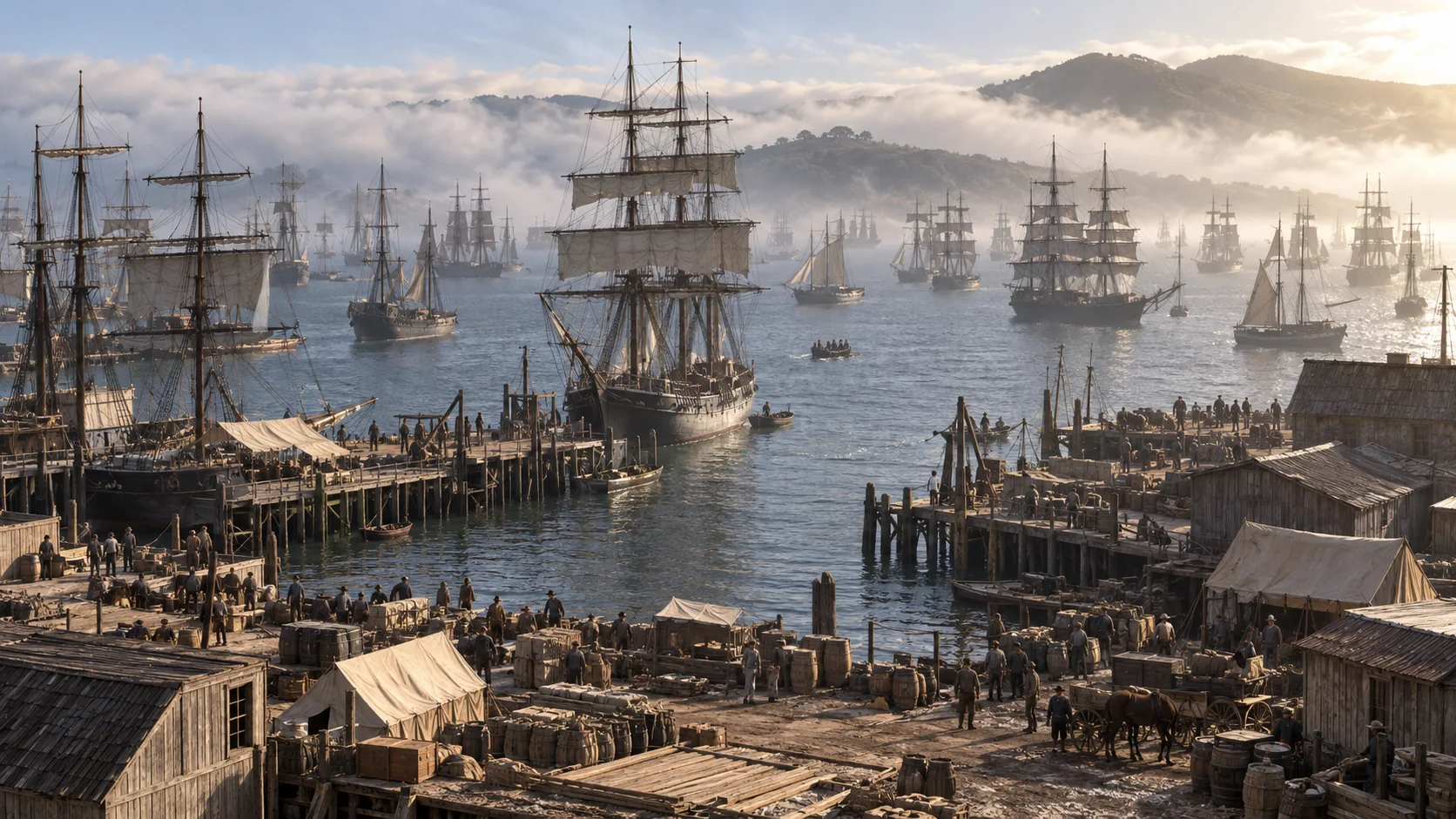
Q: What happened to many ships whose crews abandoned them in San Francisco Bay?
A: They were left behind and sometimes reused as buildings.
Q: Which city grew near John Sutter's fort and became California's capital?
A: Sacramento.
Q: What was the name of Sutter's settlement in present-day Sacramento?
A: New Helvetia.
Q: Which Gold Rush town became the county seat of Tuolumne County in 1850?
A: Sonora.
Q: Which Gold Country town is home to California's oldest existing theater building?
A: Nevada City.
Q: Which town began as Dry Diggings and was later nicknamed Hangtown?
A: Placerville.
Q: Which mining town served as a setting for Bret Harte's “The Outcasts of Poker Flat”?
A: Poker Flat.
Q: Which settlement became a major supply center at the confluence of the Yuba and Feather rivers?
A: Marysville.
Q: Which Calaveras County town became famous through Mark Twain's jumping frog story?
A: Angels Camp.
Q: What term describes a town that rapidly grew around mining activity?
A: A boomtown.
Q: What happened to some mining towns when nearby deposits ran out?
A: They became ghost towns.
Q: Which state historic park preserves the site of the original discovery at Sutter's Mill?
A: Marshall Gold Discovery State Historic Park.
Q: Which Gold Country town is known for its surviving 1850s firehouse and mining-era buildings?
A: Columbia.
Q: What number appears on the highway that winds through many Mother Lode towns?
A: 49.
Camp Life and Costly Dreams
Q: What was a prospector's basic shelter often made from?
A: Canvas, wood, or whatever materials were available.
Q: Why were prices so high in early mining camps?
A: Demand was enormous and supplies were difficult to transport.
Q: Which merchant made a fortune selling sturdy pants to miners?
A: Levi Strauss.
Q: Who partnered with Levi Strauss to patent riveted work pants in 1873?
A: Jacob Davis.
Q: What breakfast food became a camp staple because dried beans traveled well?
A: Beans.
Q: What illness caused by vitamin C deficiency could affect travelers with poor diets?
A: Scurvy.
Q: What crowded public business offered miners drinks, gambling, and entertainment?
A: A saloon.
Q: Who often earned more reliably than prospectors by selling food, tools, and lodging?
A: Merchants and service providers.
Q: What did miners call a valuable discovery of gold?
A: A strike.
Q: What did miners mean when they said a claim had “played out”?
A: It no longer yielded enough gold to be worthwhile.
Q: How were disputes often handled before formal courts reached remote camps?
A: Through locally created miners' meetings and rules.
Q: What danger could quickly destroy tightly packed wooden boomtowns?
A: Fire.
Q: What seasonal problem could isolate Sierra mining camps?
A: Heavy winter snow.
Q: Why did letters from home take so long to arrive?
A: Mail had to cross a continent or travel by sea.
Q: Did most individual miners become wealthy?
A: No. Most did not strike it rich.
A Global Rush and Its Human Cost
Q: From which country did tens of thousands of miners arrive during the Gold Rush?
A: China.
Q: What name did many Chinese immigrants use for California?
A: Gold Mountain.
Q: What 1850 California tax targeted foreign miners?
A: The Foreign Miners' Tax.
Q: Which groups were especially targeted by foreign miners' taxes and discriminatory enforcement?
A: Latin American and Chinese miners.
Q: From which Mexican state did many experienced miners come?
A: Sonora.
Q: What Spanish mining word for a dry placer entered California place names?
A: Placer.
Q: Which South American country sent many merchants and miners to California?
A: Chile.
Q: What happened to California's Native population during and after the Gold Rush?
A: It fell catastrophically because of violence, disease, displacement, and exploitation.
Q: What 1850 California law enabled coercive control and forced labor of many Native people?
A: The Act for the Government and Protection of Indians.
Q: Which Native people lived around the site of Sutter's Mill?
A: The Nisenan.
Q: What happened to many Native food sources as miners transformed rivers and land?
A: They were damaged or destroyed.
Q: What community grew in San Francisco as Chinese immigrants settled there?
A: Chinatown.
Q: Which free Black entrepreneur and abolitionist built wealth in Gold Rush-era California?
A: Mary Ellen Pleasant.
Q: Which formerly enslaved woman won a California court case to free herself and her children in 1856?
A: Biddy Mason.
Q: What made the Gold Rush population unusually international?
A: Fortune seekers arrived from Latin America, Europe, Asia, Australia, and across North America.
Statehood, Business, and Big Changes
Q: In what year did California become a U.S. state?
A: 1850.
Q: California entered the Union as part of what major congressional agreement?
A: The Compromise of 1850.
Q: Did California enter as a free state or a slave state?
A: A free state.
Q: At which city was California's first state constitution drafted in 1849?
A: Monterey.
Q: Which city served briefly as California's first state capital?
A: San Jose.
Q: Which city became California's permanent capital in 1854?
A: Sacramento.
Q: What 1849 constitutional decision helped California skip the territorial stage?
A: Voters approved a state constitution and applied directly for statehood.
Q: Which banking company began by offering express and financial services during the Gold Rush era?
A: Wells Fargo.
Q: Which Italian-born chocolatier founded a San Francisco chocolate company in 1852?
A: Domingo Ghirardelli.
Q: Which former Sacramento merchant became one of the “Big Four” builders of the Central Pacific Railroad?
A: Collis P. Huntington.
Q: Which financier founded the Bank of California in 1864?
A: William Chapman Ralston.
Q: What federal institution opened a branch in San Francisco in 1854 to turn gold into coins?
A: The United States Mint.
Q: What rapid demographic change did the Gold Rush bring to California?
A: A huge surge in non-Native population.
Q: Which sector expanded as farms supplied food to growing camps and cities?
A: Agriculture.
Q: What transcontinental railroad, completed in 1869, tied California more closely to eastern markets?
A: The first transcontinental railroad.
Symbols, Stories, and Lasting Legacies
Q: What Gold Rush nickname appears on California license plates?
A: The Golden State.
Q: What word on California's state seal means “I have found it”?
A: Eureka.
Q: Which NFL team takes its name from Gold Rush fortune seekers?
A: The San Francisco 49ers.
Q: What is the mascot of the San Francisco 49ers called?
A: Sourdough Sam.
Q: Which writer used Gold Rush-era California in stories such as “The Luck of Roaring Camp”?
A: Bret Harte.
Q: Which author drew on his time in the mining camps for “The Celebrated Jumping Frog of Calaveras County”?
A: Mark Twain.
Q: What was Mark Twain's birth name?
A: Samuel Langhorne Clemens.
Q: Which opera by Giacomo Puccini is set during the California Gold Rush?
A: La fanciulla del West, or The Girl of the Golden West.
Q: Which Charlie Chaplin film sends the Little Tramp to seek gold in the Klondike?
A: The Gold Rush.
Q: Was Chaplin's The Gold Rush set in California?
A: No. It was set during the Klondike Gold Rush.
Q: What California county is named for the gold-discovery region and uses “Old Hangtown” imagery?
A: El Dorado County.
Q: What annual event in Coloma commemorates James Marshall's discovery?
A: Gold Discovery Day.
Q: Which Gold Rush-era bread starter became a lasting San Francisco food symbol?
A: Sourdough.
Q: What enduring environmental legacy remains in some mining regions?
A: Altered waterways and mercury contamination.
Q: What larger American idea did the rush reinforce, despite its harsh realities?
A: The dream of sudden opportunity in the West.
You've Struck Trivia Gold
If you found every nugget without washing out, your score belongs in the Mother Lode. Keep chasing the past with our famous people trivia or explore another stretch of history with decades trivia.

Ellie Ewert is the founder and author of RandomTrivia.co, blending her passion for research with years of experience in content creation to deliver accurate, engaging, and well-sourced trivia. Dedicated to providing readers with trustworthy and entertaining facts, she applies meticulous fact-checking and SEO expertise to ensure every article meets the highest standards. Read more about our high standards in our Editorial Guidelines.