
R-E-S-P-E-C-T this quiz. These 86 Aretha Franklin trivia questions cover Detroit gospel roots, “Respect,” “Think,” Atlantic Records, Amazing Grace, The Blues Brothers, presidential performances, and her music honors. Each question names the song, person, or event it asks about.
Detroit, Gospel & Early Aretha
Q: What is Aretha Franklin's full name?
A: Aretha Louise Franklin.
Q: On what date was Aretha Franklin born?
A: March 25, 1942.
Q: In which U.S. state was Aretha Franklin born?
A: Tennessee.
Q: Which city is most associated with Aretha Franklin's upbringing?
A: Detroit.
Q: Who was Aretha Franklin's father?
A: Reverend C. L. Franklin.
Q: What was Aretha Franklin's father C. L. Franklin known for?
A: Baptist preaching and civil-rights involvement.
Q: Which church was central to Aretha Franklin's youth?
A: New Bethel Baptist Church.
Q: Which genre did Aretha Franklin sing first?
A: Gospel.
Q: Which instrument did Aretha Franklin play?
A: Piano.
Q: Where did Aretha Franklin develop much of her musicianship?
A: In church and at home.
Q: Which famous gospel singer was a Franklin family friend and mentor?
A: Mahalia Jackson.
Q: Which soul singer knew the Franklin family?
A: Sam Cooke, among many musicians.
Q: Which civil-rights leader visited the Franklin family home?
A: Martin Luther King Jr.
Q: Did Aretha Franklin record gospel music as a teenager?
A: Yes.
Q: Which label signed Aretha Franklin for early secular recordings?
A: Columbia Records.
Q: Who signed Aretha Franklin to Columbia Records?
A: John Hammond.
Q: Which musical styles did Columbia Records record Aretha Franklin in?
A: Jazz, standards, pop, blues, and adult vocals.
Q: Which record label did Aretha Franklin join in 1966?
A: Atlantic Records.
Q: Which producer guided Aretha Franklin's Atlantic recordings?
A: Jerry Wexler.
Q: Where did Aretha Franklin record 'I Never Loved a Man (The Way I Love You)'?
A: FAME Studios in Muscle Shoals, Alabama.
Q: Was Aretha Franklin's album I Never Loved a Man the Way I Love You recorded entirely at FAME Studios?
A: No. The session was cut short and much work continued in New York.
Q: Which instrument did Aretha Franklin use to help shape her arrangements?
A: Piano.
Q: Which vocal techniques did Aretha Franklin draw from gospel music?
A: Call-and-response, improvisation, emotional escalation, melisma, and dynamic control.
Respect, Think & the Atlantic Golden Era
Q: Who wrote and first recorded 'Respect'?
A: Otis Redding.
Q: In what year did Aretha Franklin release her version of 'Respect'?
A: 1967.
Q: What word does Aretha Franklin spell in 'Respect'?
A: R-E-S-P-E-C-T.
Q: What phrase follows the spelled-out title in Aretha Franklin's 'Respect'?
A: “Find out what it means to me.”
Q: Which of Aretha Franklin's sisters sang backing vocals on 'Respect'?
A: Carolyn and Erma Franklin.
Q: Which call-and-response phrase did Aretha Franklin add to 'Respect'?
A: 'Sock it to me.'
Q: Which two GRAMMY categories did 'Respect' win at the 1968 ceremony?
A: Best Rhythm & Blues Recording and Best Rhythm & Blues Solo Vocal Performance, Female. Source
Q: What song warns about a chain of fools?
A: “Chain of Fools.”
Q: Who wrote Aretha Franklin's 'Chain of Fools'?
A: Don Covay.
Q: Who played the opening guitar riff on Aretha Franklin's 'Chain of Fools'?
A: Joe South.
Q: What song did Aretha write herself with the command “Think”?
A: “Think.”
Q: What word is repeated in the freedom section of Aretha Franklin's 'Think'?
A: “Freedom.”
Q: What Dionne Warwick hit did Aretha cover?
A: “I Say a Little Prayer.”
Q: Who wrote 'I Say a Little Prayer'?
A: Burt Bacharach and Hal David.
Q: What Carole King/Gerry Goffin song did Aretha transform?
A: “(You Make Me Feel Like) A Natural Woman.”
Q: Which producer received a co-writing credit on '(You Make Me Feel Like) A Natural Woman'?
A: Jerry Wexler. Source
Q: What song asks listeners to call her?
A: “Call Me.”
Q: What song asks “Ain't No Way”?
A: “Ain't No Way.”
Q: Who wrote Aretha Franklin's 'Ain't No Way'?
A: Carolyn Franklin.
Q: How was songwriter Carolyn Franklin related to Aretha Franklin?
A: Aretha's sister.
Q: What nickname became standard for Aretha Franklin?
A: Queen of Soul.
Q: What did Aretha Franklin offer to do during Angela Davis's legal case?
A: She publicly expressed willingness to post bail during Davis's legal case.
Amazing Grace, Blues Brothers & Later Reinvention
Q: What 1972 live gospel album did Aretha record?
A: Amazing Grace.
Q: At which Los Angeles church was Aretha Franklin's Amazing Grace recorded?
A: New Temple Missionary Baptist Church in Los Angeles.
Q: Which minister helped lead Aretha Franklin's Amazing Grace performances?
A: Reverend James Cleveland.
Q: Which choir performed on Aretha Franklin's Amazing Grace?
A: Southern California Community Choir.
Q: How is Aretha Franklin's Amazing Grace often described in gospel sales history?
A: One of the best-selling gospel albums.
Q: Was Aretha Franklin's 1972 Amazing Grace performance filmed?
A: Yes.
Q: Why was the Amazing Grace concert film delayed for decades?
A: Technical synchronization issues and later rights disputes delayed release.
Q: Who directed the Amazing Grace concert footage?
A: Sydney Pollack.
Q: What 1980 film features Aretha?
A: The Blues Brothers.
Q: Whom does Aretha Franklin play in The Blues Brothers?
A: A restaurant owner married to Matt 'Guitar' Murphy's character.
Q: Which song does Aretha Franklin perform in The Blues Brothers?
A: “Think.”
Q: What label did Aretha join in the 1980s?
A: Arista Records.
Q: Who headed Arista Records when Aretha Franklin joined?
A: Clive Davis.
Q: What 1985 album gave her a major comeback?
A: Who's Zoomin' Who?
Q: Which Aretha Franklin hit includes 'freeway' in its title?
A: “Freeway of Love.”
Q: Which saxophonist plays on Aretha Franklin's 'Freeway of Love'?
A: Clarence Clemons.
Q: Which band was Clarence Clemons famous for?
A: Bruce Springsteen's E Street Band.
Q: What Annie Lennox/Eurythmics duet did Aretha record?
A: “Sisters Are Doin' It for Themselves.”
Q: What 1987 duet with George Michael hit No. 1?
A: “I Knew You Were Waiting (For Me).”
Q: Which GRAMMY category did Aretha Franklin and George Michael's 'I Knew You Were Waiting (For Me)' win at the 1988 ceremony?
A: Best R&B Performance by a Duo or Group with Vocal. Source
Q: What fear limited Aretha Franklin's air travel?
A: Fear of flying.
Q: How did Aretha Franklin often travel because of her fear of flying?
A: She often traveled by bus.
Presidents, Grammys, Legacy & Hard Aretha Trivia
Q: At which U.S. presidential inauguration did Aretha Franklin sing in 2009?
A: Barack Obama's first inauguration.
Q: Which song did Aretha Franklin perform at Barack Obama's 2009 inauguration?
A: “My Country, 'Tis of Thee.”
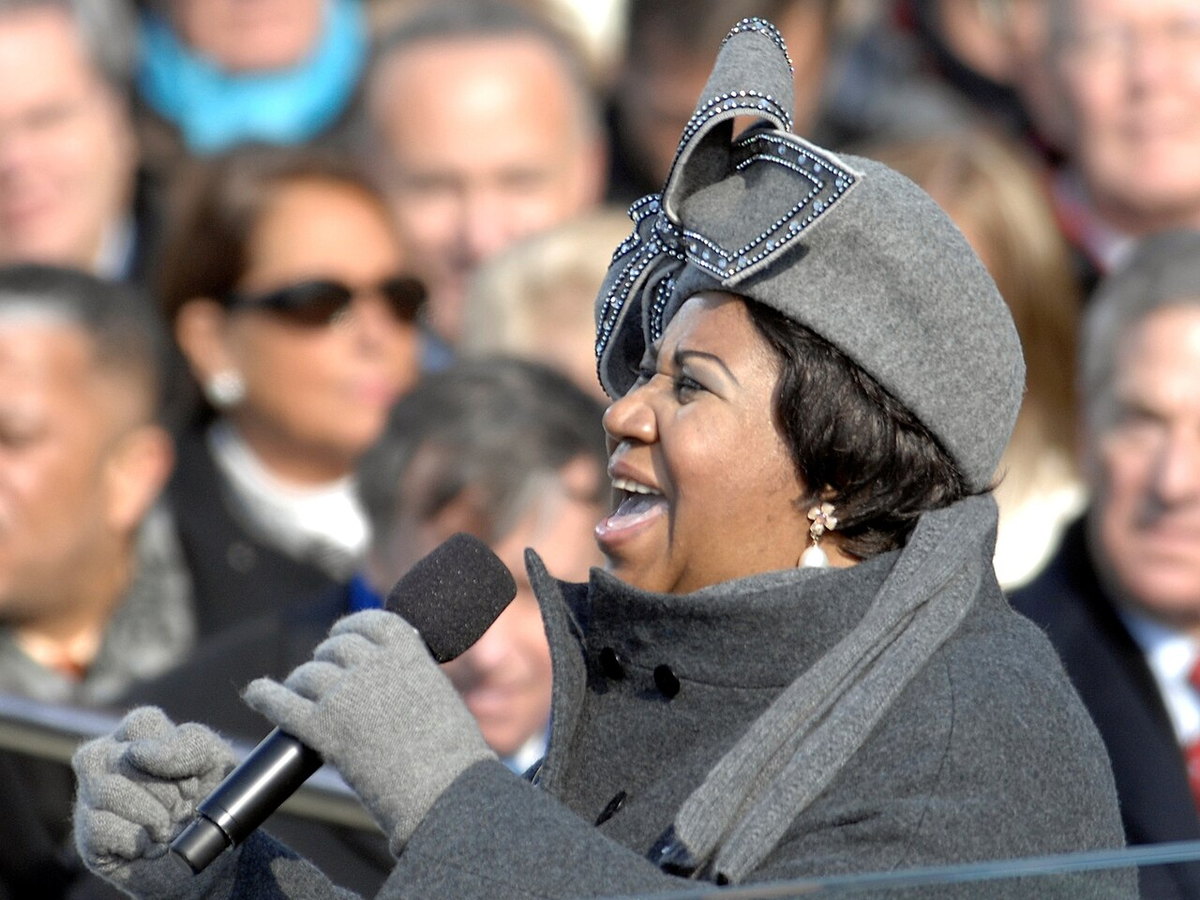
Q: What distinctive accessory did Aretha Franklin wear at Barack Obama's 2009 inauguration?
A: A gray hat with an oversized bow.
Q: Which song did Aretha Franklin perform at the 2015 Kennedy Center Honors?
A: “(You Make Me Feel Like) A Natural Woman.”
Q: Who was honored when Aretha Franklin sang 'A Natural Woman' at the 2015 Kennedy Center Honors?
A: Carole King.
Q: What did Aretha Franklin do onstage during her 2015 Kennedy Center Honors performance?
A: Played piano, sang powerfully, and dropped her fur coat dramatically.
Q: Which Rock & Roll Hall of Fame first did Aretha Franklin achieve?
A: She was the first woman inducted. Source
Q: In what year was Aretha Franklin inducted into the Rock & Roll Hall of Fame?
A: 1987. Source
Q: For how many consecutive years, from 1968 through 1975, did Aretha Franklin win a female R&B vocal GRAMMY?
A: Eight. Source
Q: Which two special Recording Academy honors did Aretha Franklin receive?
A: The GRAMMY Legend Award (1991) and Lifetime Achievement Award (1994). Source
Q: Which U.S. civilian honor did Aretha Franklin receive in 2005?
A: Presidential Medal of Freedom.
Q: Which U.S. president awarded Aretha Franklin the Presidential Medal of Freedom?
A: George W. Bush.
Q: On what date did Aretha Franklin die?
A: August 16, 2018.
Q: How old was Aretha Franklin when she died?
A: 76.
Q: What illness caused Aretha Franklin's death?
A: A pancreatic neuroendocrine tumor.
Q: Which city hosted Aretha Franklin's public memorial events?
A: Detroit.
Q: Which Jennifer Hudson film portrays Aretha Franklin?
A: Respect.
Q: Which singer did Aretha Franklin approve to portray her in the film Respect?
A: Jennifer Hudson.
Q: Which Cynthia Erivo series portrays Aretha Franklin?
A: Genius: Aretha.
How Did You Score?
If New Bethel, Muscle Shoals, “sock it to me,” Carolyn Franklin, Amazing Grace, The Blues Brothers, the inauguration hat, and the first-woman Rock Hall milestone all came easily, you earned Aretha-level respect.

Ellie Simons creates and edits Random Trivia. She researches trivia using primary and authoritative sources whenever possible and is currently reviewing the site's older trivia library for accuracy, clarity, and playability. Read more on the About page.
Explore more questions in our music trivia guide.
About this quiz
Site editor: Ellie Simons. Read our Trivia Methodology to learn how questions are researched and updated. Page last updated: . Report an error.