
Step into the world of togas, triumphs, and temples.
This Ancient Rome trivia set spans the city’s beginnings to its imperial zenith and slow transformation, mixing everyday life with epic battles and enduring culture.
Questions ramp from approachable to demanding so everyone can play along.
Foundations, Land & Legends
Q: On which river was Rome founded?
A: The Tiber.
Q: What is the traditional founding year of Rome?
A: 753 BCE.
Q: Which twin, in myth, became Rome’s first king?
A: Romulus.
Q: On which hill did elite early homes cluster?
A: The Palatine Hill.
Q: What does “Latium” refer to in Roman geography?
A: The region around Rome inhabited by Latins.
Q: What name did Romans give the Mediterranean Sea?
A: Mare Nostrum (“our sea”).
Q: What was Rome’s seaport at the Tiber’s mouth?
A: Ostia.
Q: What was the city’s central marketplace and civic heart?
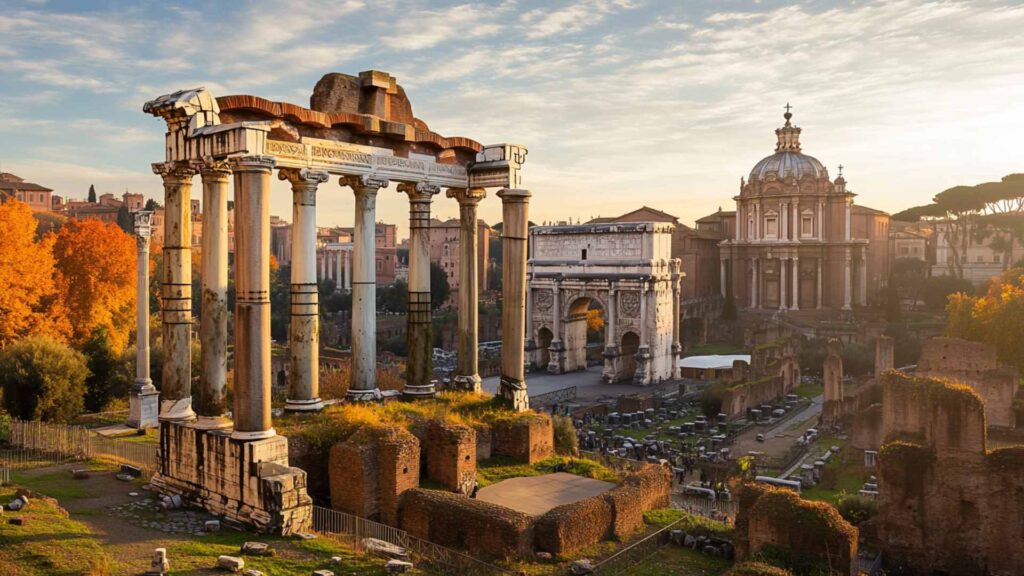
A: The Forum Romanum.
Q: Which famous early road first linked Rome to Capua?
A: The Via Appia (Appian Way).
Q: Which volcano buried Pompeii and Herculaneum in 79 CE?
A: Mount Vesuvius.
Q: After Carthage fell, what province centered on that city?
A: Africa Proconsularis.
Q: What mountain chain runs the length of the peninsula?
A: The Apennines.
Q: What did “Ager Romanus” originally mean?
A: Rome’s surrounding public/citizen land.
Q: What was the Campus Martius primarily used for early on?
A: Military musters, training, and public assemblies.

Government, Law & the Republic
Q: What does the abbreviation SPQR stand for?
A: Senatus Populusque Romanus.
Q: What were the highest annual magistrates in the Republic?
A: The consuls.
Q: Which plebeian officials held sacrosanctity and the veto?
A: Tribunes of the plebs.
Q: What were Rome’s first codified laws called?
A: The Twelve Tables.
Q: Which temporary office granted extraordinary powers for crises?
A: The dictatorship.
Q: What was the “cursus honorum”?
A: The ladder of public offices.
Q: Which law made plebiscites binding on all citizens (287 BCE)?
A: The Lex Hortensia.
Q: What system bound elites and non-elites in mutual obligations?
A: The patron–client system (clientela).
Q: Which assembly, organized by wealth, elected consuls?
A: The Comitia Centuriata (Centuriate Assembly).
Q: Which officials conducted the census and moral oversight?
A: The censors.
Q: What did “imperium” legally authorize?
A: Command over troops and the right to coerce.
Q: What 445 BCE law allowed patrician–plebeian intermarriage?
A: The Lex Canuleia.
Q: Which magistrates primarily oversaw courts and civil law?
A: The praetors.
Q: What 212 CE edict extended citizenship to most free men?
A: The Constitutio Antoniniana (by Caracalla).

Legions, Battles & Warfare
Q: What was the standard heavy infantryman of Rome called?
A: A legionary.
Q: What was the legionary’s heavy throwing spear?
A: The pilum.
Q: Which protective formation was nicknamed the “tortoise”?
A: The testudo.
Q: Who defeated Hannibal at Zama (202 BCE)?
A: Scipio Africanus.
Q: What catastrophic defeat occurred at Cannae (216 BCE)?
A: Hannibal encircled and destroyed a Roman army.
Q: What boarding device aided Rome early in the First Punic War?
A: The corvus.
Q: Who reformed the legions into cohort-based units?
A: Gaius Marius.
Q: Which siege in 52 BCE ended Caesar’s Gallic campaigns?
A: Alesia.
Q: Where were three legions lost in 9 CE?
A: The Teutoburg Forest.
Q: Which 53 BCE battle saw Crassus defeated by Parthia?
A: Carrhae.
Q: Which emperor completed the conquest of Dacia?
A: Trajan.
Q: What was a fortified Roman marching camp called?
A: A castra.
Q: Which elite force guarded the emperors in Rome?
A: The Praetorian Guard.
Q: What did a military diploma commonly grant auxiliaries?
A: Roman citizenship after honorable service.
Emperors & Imperial Politics
Q: Who is considered Rome’s first emperor?
A: Augustus.
Q: What modest title did Augustus favor for himself?
A: Princeps (“first citizen”).
Q: What is the name of the first imperial dynasty?
A: The Julio-Claudian dynasty.
Q: In what year did four emperors claim the throne?
A: 69 CE.
Q: Which emperor-philosopher co-authored the Meditations?
A: Marcus Aurelius.
Q: Which emperor built a defensive wall across northern Britain?
A: Hadrian.
Q: Under which emperor did the empire reach its greatest extent?
A: Trajan (around 117 CE).
Q: What reform divided rule among two Augusti and two Caesars?
A: Diocletian’s Tetrarchy.
Q: What did the Edict of Milan (313 CE) proclaim?
A: Religious toleration for Christianity.
Q: Which emperor refounded Byzantium as Constantinople?
A: Constantine I.
Q: Which emperor introduced the antoninianus coinage?
A: Caracalla.
Q: What term describes the instability of 235–284 CE?
A: The Crisis of the Third Century.
Q: Who was deposed in 476 CE, marking the Western fall?
A: Romulus Augustulus.
Q: Which emperor began building the Colosseum?
A: Vespasian (Titus dedicated it).

Daily Life & Roman Society
Q: What distinctive garment signaled adult male citizenship?
A: The toga (toga virilis).
Q: What was garum?
A: A fermented fish sauce.
Q: Who legally headed the Roman household?
A: The paterfamilias.
Q: What do “tria nomina” refer to?
A: A citizen’s three-part name.
Q: What were Rome’s multistory apartment blocks called?
A: Insulae.
Q: What do Romans call big public bath complexes?
A: Thermae.
Q: What was the grain dole to citizens called?
A: The frumentatio (part of the annona).
Q: What is the urban house of a wealthy Roman called?
A: A domus.
Q: And what is a countryside estate called?
A: A villa.
Q: What status did a freed slave hold?
A: Libertus (male) or liberta (female).
Q: Around what age did boys assume the toga virilis?
A: Mid-teens, often about 16.
Q: What were collegia?
A: Associations or guilds.
Q: What everyday writing medium used styluses and wax?
A: Wax tablets.
Q: What was the main evening meal called?
A: The cena.
Gods, Cults & Beliefs
Q: Who was the king of the Roman gods?
A: Jupiter.
Q: Which priestesses tended the sacred fire in Rome?
A: The Vestal Virgins.
Q: Which three gods formed the Capitoline Triad?
A: Jupiter, Juno, and Minerva.
Q: Which war god was father to Romulus in myth?
A: Mars.
Q: What household spirits guarded family and pantry?
A: The Lares and Penates.
Q: What was the liver-reading divination from Etruscan tradition?
A: Haruspicy.
Q: What was divination by interpreting bird signs?
A: Augury.
Q: Which winter festival featured gifts and role reversals?
A: Saturnalia.
Q: Which Egyptian goddess’s cult thrived in Rome?
A: Isis.
Q: Which mystery cult was popular among soldiers?
A: Mithraism (the cult of Mithras).
Q: What title did the chief priest of Rome hold?
A: Pontifex Maximus.
Q: What was the posthumous elevation of emperors to divinity?
A: Apotheosis / the imperial cult.
Q: Which 380 CE decree made Nicene Christianity state religion?
A: The Edict of Thessalonica (Theodosius I).
Q: What famous temple’s oculus still opens to the sky?
A: The Pantheon.
Building Big: Architecture & Engineering
Q: What is the Latin term for Roman concrete?
A: Opus caementicium.
Q: What was the Flavian Amphitheater better known as?
A: The Colosseum.
Q: Which building boasts a vast coffered dome and oculus?
A: The Pantheon.
Q: What were the elevated water channels into cities called?
A: Aqueducts.
Q: What underfloor heating system warmed baths and villas?
A: The hypocaust.
Q: What road is famed as the “Queen of Roads”?
A: The Via Appia.
Q: What ancient drain still partly functions in Rome?
A: The Cloaca Maxima.
Q: Which arch commemorates the Flavian victory in Judaea?
A: The Arch of Titus.
Q: What multi-level shopping complex did Trajan build?
A: Trajan’s Market.
Q: What volcanic ash made Roman concrete water-resistant?
A: Pozzolana.
Q: What diamond-pattern wall facing was common in Lazio?
A: Opus reticulatum.
Q: What marked distances along Roman roads?
A: Milestones.
Q: Which emperor built one of Rome’s largest bath complexes?
A: Caracalla (the Baths of Caracalla).
Q: What famous aqueduct bridge stands near Nîmes in Gaul?
A: The Pont du Gard.
Money, Trade & the Roman Economy
Q: What silver coin became the Republic’s workhorse?
A: The denarius.
Q: What large brass coin was common in the Empire?
A: The sestertius.
Q: What stable gold coin did Constantine popularize?
A: The solidus.
Q: Which province fed Rome with massive grain shipments?
A: Egypt.
Q: What were the large slave-worked estates called?
A: Latifundia.
Q: What courier and transport system served officials?
A: The cursus publicus.
Q: What harbor complex expanded Rome’s maritime capacity beyond Ostia?
A: Portus (harbors of Claudius and Trajan).
Q: Who issued the Edict on Maximum Prices in 301 CE?
A: Diocletian.
Q: What trade network brought silk westward?
A: The Silk Road.
Q: What general provincial levy did Rome exact?
A: Tribute (tributum).
Q: What mark “SC” on bronze coins indicated?
A: Senatus consulto (by decree of the Senate).
Q: What ship type hauled bulk grain to Italy?
A: Large navis oneraria (grain freighter).
Q: What standard Roman weight equaled roughly 0.33 kg?
A: The libra (Roman pound).
Q: What distinctive Spanish amphora carried olive oil empire-wide?
A: Dressel 20 amphorae from Baetica.
Language, Literacy & Literature
Q: What language dominated administration in the Latin West?
A: Latin.
Q: Which epic traces Rome’s mythical origins from Troy?
A: Virgil’s Aeneid.
Q: Which poet, author of Metamorphoses, was exiled?
A: Ovid.
Q: Which statesman is famed for orations and letters?
A: Cicero.
Q: Which historian wrote Annals and Histories?
A: Tacitus.
Q: Who penned The Twelve Caesars?
A: Suetonius.
Q: What is Livy’s massive history called?
A: Ab Urbe Condita.
Q: Whose letters describe the 79 CE eruption?
A: Pliny the Younger.
Q: Who compiled the encyclopedic Natural History?
A: Pliny the Elder.
Q: Which poet from Verona wrote intense love lyrics?
A: Catullus.
Q: What language predominated in the Eastern provinces?
A: Greek.
Q: In Roman numerals, what number is “IV”?
A: Four.
Q: What calendar reform did Julius Caesar sponsor?
A: The Julian calendar.
Q: On tombstones, what does “D.M.” stand for?
A: Dis Manibus (“to the spirits of the dead”).
Games, Spectacles & Culture
Q: What venue in Rome hosted chariot races for vast crowds?
A: The Circus Maximus.
Q: What were the two most dominant racing factions later on?
A: The Blues and the Greens.
Q: Which gladiator fought with a net and trident?
A: The retiarius.
Q: What was a gladiator training school called?
A: A ludus.
Q: What phrase describes politicians buying favor with shows and grain?
A: Panem et circenses (“bread and circuses”).
Q: What strategic Roman board game involved “little soldiers”?
A: Ludus latrunculorum.
Q: What small token or shard served as an arena ticket?
A: A tessera.
Q: Who typically funded public games as “editor”?
A: Magistrates or emperors.
Q: A triumph ended with sacrifices at which temple?
A: Jupiter Optimus Maximus on the Capitoline.
Q: Which playwright’s comedies inspired many later stock characters?
A: Plautus (also Terence, but Plautus is classic).
Q: How many laps were standard in a Circus race?
A: Seven.
Q: What were naumachiae?
A: Staged naval battles.
Q: What were the vela in amphitheaters?
A: Awnings that provided shade.
Q: Which heavy-helmeted gladiator fought the retiarius?
A: The secutor.
Whether you aced the emperors or nailed the nitty-gritty of Roman bricks, you’ve marched far along the Via Appia of knowledge.
Share this set, tweak it for your next quiz night, and keep building on a solid foundation. Ave, quizzer.

Ellie Simons creates and edits Random Trivia. She researches trivia using primary and authoritative sources whenever possible and is currently reviewing the site's older trivia library for accuracy, clarity, and playability. Read more on the About page.
Explore more rounds in our History trivia collection.
About this quiz
Site editor: Ellie Simons. Read our Trivia Methodology to learn how questions are researched and updated. Page last updated: . Report an error.