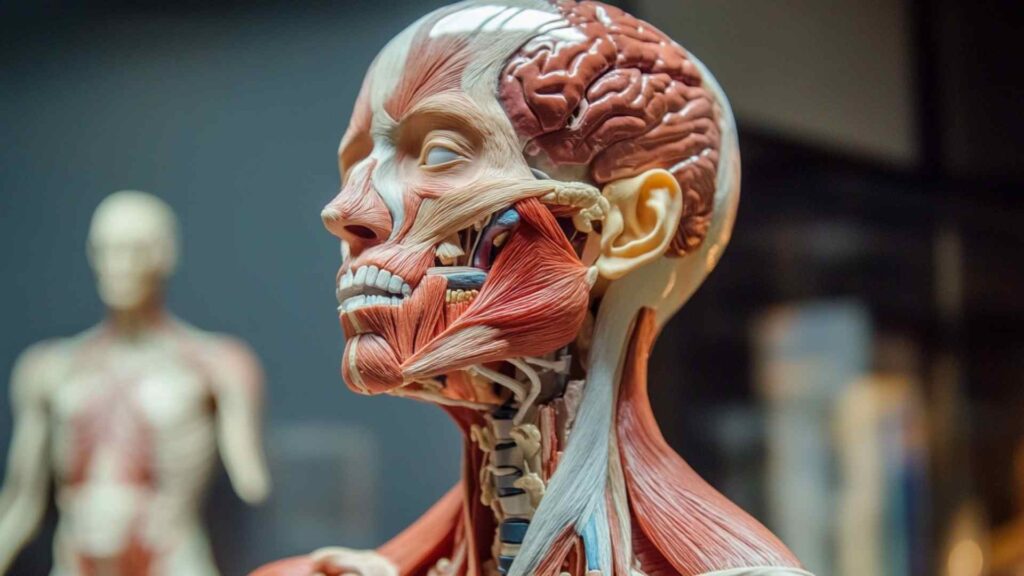
From bones and muscles to the brain, lungs, and hormones, human anatomy is a map of how we work.
This set blends quick wins with deeper challenges.
Start simple then climb into systems, structures, and functions. Perfect for students, quiz nights, and anyone who loves learning how bodies tick.
Anatomical Language & Histology
Q: What is the standard anatomical position used for describing the body?
A: Standing upright, facing forward, arms at sides, palms forward, feet together.
Q: Which plane divides the body into left and right portions?
A: The sagittal plane; the midsagittal runs exactly down the midline.
Q: Which plane splits the body into anterior and posterior parts?
A: The frontal (coronal) plane.
Q: Which plane separates the body into superior and inferior parts?
A: The transverse (horizontal or axial) plane.
Q: In anatomy, what do “medial” and “lateral” mean?
A: Medial is toward the midline; lateral is away from the midline.
Q: What do “proximal” and “distal” describe on a limb?
A: Proximal is closer to the limb’s attachment; distal is farther away.
Q: Define “ipsilateral” versus “contralateral.”
A: Ipsilateral = same side of the body; contralateral = opposite side.
Q: What do “pronation” and “supination” mean at the forearm?
A: Pronation turns the palm down; supination turns the palm up.
Q: What do “eversion” and “inversion” mean at the foot?
A: Eversion turns the sole outward; inversion turns the sole inward.
Q: Name the four basic tissue types in the body.
A: Epithelial, connective, muscle, and nervous tissue.
Q: Where would you find simple squamous epithelium and what’s its function?
A: In alveoli and capillaries; it permits rapid diffusion and filtration.
Q: Where is keratinized stratified squamous epithelium found?
A: The epidermis of skin, providing abrasion protection and water resistance.
Q: Contrast tight junctions and gap junctions.
A: Tight junctions seal between cells; gap junctions allow ion/signal passage.
Q: What are the main fibers in connective tissue?
A: Collagen (strength), elastic (recoil), and reticular (supportive mesh).
Q: Name the three types of cartilage with one example each.
A: Hyaline (trachea), elastic (epiglottis), fibrocartilage (intervertebral disc).
Q: What is an osteon (Haversian system)?
A: A concentric lamellar unit of compact bone surrounding a central canal.
Q: Where does adult hematopoiesis primarily occur?
A: Red bone marrow of axial skeleton, pelvis, proximal femur/humerus.
Q: List the layers of the epidermis (thick skin) from deep to superficial.
A: Basale, spinosum, granulosum, lucidum, corneum.
Q: What key structures do thick skin areas (palms/soles) lack?
A: Hair follicles and sebaceous glands (but have abundant sweat glands).
Q: What is the mesentery?
A: A double layer of peritoneum suspending intestines and carrying vessels/nerves.
Q: Which germ layer primarily forms the lining of the gut and respiratory tract?
A: Endoderm (with contributions from mesoderm for supporting tissues).

Skeletal System & Joints
Q: Approximately how many bones are in the adult human skeleton?
A: About 206 bones.
Q: What are the two major divisions of the skeleton?
A: Axial (skull, vertebral column, rib cage) and appendicular (limbs, girdles).
Q: What is the largest long bone in the body?
A: The femur.
Q: What is the smallest bone in the body?
A: The stapes in the middle ear.
Q: How many cervical vertebrae are there?
A: Seven (C1–C7).
Q: How many thoracic and lumbar vertebrae are there?
A: Twelve thoracic (T1–T12) and five lumbar (L1–L5).
Q: How many pairs of ribs do humans typically have?
A: Twelve pairs; ribs 1–7 are “true,” 8–12 “false,” 11–12 “floating.”
Q: What cavity on the scapula articulates with the humeral head?
A: The glenoid cavity (glenoid fossa).
Q: What socket of the pelvis receives the femoral head?
A: The acetabulum.
Q: The patella is what type of bone?
A: A sesamoid bone in the quadriceps tendon.
Q: Name the proximal row of carpal bones (lateral to medial).
A: Scaphoid, lunate, triquetrum, pisiform.
Q: Which tarsal bone forms the heel?
A: The calcaneus.
Q: In which bone is the foramen magnum located?
A: The occipital bone.
Q: What type of joint is the temporomandibular joint (TMJ)?
A: A modified hinge synovial joint with hinge and gliding movements.
Q: What type of synovial joint is the shoulder (glenohumeral) joint?
A: A ball-and-socket joint.
Q: What movement occurs primarily at the atlanto-axial joint?
A: Rotation (“no” motion) around the dens of C2.
Q: What are the two main parts of an intervertebral disc?
A: Annulus fibrosus and nucleus pulposus.
Q: Which ligament prevents anterior translation of the tibia?
A: The anterior cruciate ligament (ACL).
Q: Which suture connects the two parietal bones?
A: The sagittal suture.
Q: Which carpal bone is most commonly fractured?
A: The scaphoid, often tender in the anatomical snuffbox.
Q: What tissue lines the articular surfaces in most synovial joints?
A: Hyaline cartilage (for low-friction articulation).
Muscular System & Movement
Q: Name the three muscle tissue types.
A: Skeletal, cardiac, and smooth muscle.
Q: What is the functional contractile unit of striated muscle?
A: The sarcomere, Z-line to Z-line.
Q: Which filaments slide past each other during contraction?
A: Actin (thin) and myosin (thick).
Q: Which neurotransmitter triggers skeletal muscle contraction at the NMJ?
A: Acetylcholine.
Q: What is a motor unit?
A: One motor neuron and all the skeletal muscle fibers it innervates.
Q: Describe type I (slow-twitch) muscle fibers.
A: Fatigue-resistant, oxidative, suited for endurance and posture.
Q: Define “agonist” and “antagonist” in movement.
A: Agonist is prime mover; antagonist opposes the movement.
Q: Name the four muscles of the quadriceps femoris.
A: Rectus femoris, vastus lateralis, vastus medialis, vastus intermedius.
Q: Name the hamstring muscles.
A: Biceps femoris, semitendinosus, semimembranosus.
Q: Which muscles plantarflex the ankle and share the Achilles tendon?
A: Gastrocnemius and soleus, inserting on the calcaneus.
Q: Name the rotator cuff muscles.
A: Supraspinatus, infraspinatus, teres minor, subscapularis.
Q: Which muscle mainly abducts the shoulder beyond the first 15 degrees?
A: The deltoid (supraspinatus initiates the first ~15°).
Q: Which nerve innervates the diaphragm?
A: The phrenic nerve (C3–C5: “keeps the diaphragm alive”).
Q: Thumb opposition primarily uses which muscle and nerve?
A: Opponens pollicis via the median nerve (recurrent branch).
Q: What is the “pes anserinus”?
A: Conjoined tendinous insertion of sartorius, gracilis, semitendinosus on medial tibia.
Q: Which muscles stabilize the pelvis during single-leg stance?
A: Gluteus medius and minimus (hip abductors).
Q: What is the primary hip flexor?
A: Iliopsoas (psoas major + iliacus).
Q: What is the longest muscle in the human body?
A: Sartorius.
Q: Which nerve innervates muscles of facial expression?
A: The facial nerve (cranial nerve VII).
Q: What bone lies in the floor of the anatomical snuffbox?
A: The scaphoid.
Q: In the femoral triangle, what is the lateral-to-medial order of major structures?
A: Nerve → Artery → Vein → Lymphatics (NAVL).
Nervous System & Brain
Q: What structures comprise the central nervous system (CNS)?
A: The brain and spinal cord.
Q: What structures comprise the peripheral nervous system (PNS)?
A: Cranial/spinal nerves and peripheral ganglia.
Q: Name the main parts of a neuron.
A: Cell body (soma), dendrites, and axon.
Q: Who myelinates axons in the PNS vs. CNS?
A: Schwann cells (PNS) and oligodendrocytes (CNS).
Q: Name the three meninges from outermost to innermost.
A: Dura mater, arachnoid mater, pia mater.
Q: Where is cerebrospinal fluid (CSF) produced?
A: The choroid plexus of the ventricles.
Q: What is the primary function of the cerebellum?
A: Coordination, precision, and timing of movement.
Q: Which lobe of the brain primarily processes vision?
A: The occipital lobe.
Q: What is Broca’s area responsible for?
A: Motor aspects of speech production.
Q: What is Wernicke’s area responsible for?
A: Language comprehension.
Q: What role does the hippocampus play?
A: Formation of new declarative memories.
Q: What is the role of the basal ganglia?
A: Modulating initiation and control of movement.
Q: Contrast sympathetic and parasympathetic divisions.
A: Sympathetic: “fight/flight”; parasympathetic: “rest/digest.”
Q: Which cranial nerve supplies extensive parasympathetic outflow to thoracoabdominal organs?
A: The vagus nerve (CN X).
Q: What is the largest nerve in the body?
A: The sciatic nerve.
Q: Which dermatome is at the level of the umbilicus?
A: T10.
Q: Which cranial nerve mediates the sense of smell?
A: The olfactory nerve (CN I).
Q: Which cranial nerve provides major facial sensation?
A: The trigeminal nerve (CN V: V1 ophthalmic, V2 maxillary, V3 mandibular).
Q: Name the basic components of a reflex arc.
A: Receptor, sensory neuron, integration center, motor neuron, effector.
Q: What is the Circle of Willis?
A: Arterial anastomotic ring at the brain’s base providing collateral flow.
Q: Where is the primary motor cortex located?
A: Precentral gyrus of the frontal lobe (motor homunculus mapped somatotopically).

Cardiovascular & Lymphatic
Q: Name the four chambers of the heart.
A: Right/left atria and right/left ventricles.
Q: Which chamber pumps blood to the lungs?
A: The right ventricle via the pulmonary trunk/arteries.
Q: Name the four major heart valves.
A: Tricuspid, pulmonary, mitral (bicuspid), and aortic valves.
Q: Chordae tendineae are attached to which valves and muscles?
A: AV valves (tricuspid/mitral) anchored by papillary muscles.
Q: What is the heart’s natural pacemaker?
A: The sinoatrial (SA) node.
Q: Trace venous blood returning from the body to the lungs.
A: Venae cavae → right atrium → right ventricle → pulmonary artery.
Q: How do arteries and veins differ structurally?
A: Arteries have thicker muscular walls; veins have thinner walls and valves.
Q: What is the largest artery in the body?
A: The aorta.
Q: Which coronary artery is often nicknamed the “widowmaker”?
A: The proximal left anterior descending (LAD), due to critical supply.
Q: Which veins directly drain into the right atrium?
A: The superior and inferior venae cavae and coronary sinus.
Q: What structural feature makes capillaries ideal for exchange?
A: A single layer of endothelial cells with a thin basement membrane.
Q: What is the hepatic portal system?
A: Veins from the gut/spleen drain to the liver via the portal vein.
Q: Name two key fetal circulation shunts.
A: Foramen ovale (atria) and ductus arteriosus (pulmonary artery to aorta).
Q: What are the main cellular components of blood?
A: Red cells, white cells, and platelets suspended in plasma.
Q: Which blood type is the universal donor for red blood cells?
A: O negative (for packed RBC transfusion).
Q: Where does the thoracic duct drain lymph into the venous system?
A: At the left venous angle (left subclavian–internal jugular junction).
Q: What does the right lymphatic duct drain?
A: Right upper quadrant: right head/neck, right thorax, right upper limb.
Q: What is one of the spleen’s major functions?
A: Filtering blood and mounting immune responses.
Q: What do lymph nodes do?
A: Filter lymph and harbor lymphocytes/macrophages for immune surveillance.
Q: Where is a common site to palpate a peripheral pulse?
A: The radial artery at the wrist.
Q: List the physiologic cardiac conduction pathway.
A: SA node → AV node → His bundle → bundle branches → Purkinje fibers.

Respiratory System
Q: What is the primary function of the respiratory system?
A: Gas exchange—oxygen in, carbon dioxide out.
Q: Which structures constitute the upper vs. lower airway?
A: Upper: nose, nasal cavity, pharynx, larynx; lower: trachea, bronchi, lungs.
Q: What keeps the trachea from collapsing?
A: C-shaped rings of hyaline cartilage.
Q: How do the main bronchi differ?
A: The right is wider, shorter, more vertical; aspirated objects lodge there more often.
Q: Where does gas exchange occur?
A: Across thin alveolar-capillary membranes in the alveoli.
Q: What is the primary muscle of inspiration?
A: The diaphragm.
Q: Distinguish visceral and parietal pleura.
A: Visceral covers lung surfaces; parietal lines the thoracic wall/diaphragm.
Q: How many lobes do the lungs have?
A: Right lung: three; left lung: two plus the lingula.
Q: What is pulmonary surfactant and who secretes it?
A: A surface tension–lowering substance from type II pneumocytes.
Q: What is a normal adult resting respiratory rate?
A: Approximately 12–20 breaths per minute.
Q: How is most oxygen transported in blood?
A: Bound to hemoglobin within red blood cells.
Q: How is most carbon dioxide transported?
A: As bicarbonate ions after hydration via carbonic anhydrase.
Q: What do carotid and aortic bodies sense?
A: Changes in blood O₂, CO₂, and pH (chemoreception).
Q: What structure prevents food from entering the airway during swallowing?
A: The epiglottis.
Q: Which organ houses the vocal folds?
A: The larynx.
Q: What is “dead space” in respiration?
A: Ventilated air that does not participate in gas exchange.
Q: Define tidal volume.
A: The air moved in a normal quiet breath.
Q: What airway changes characterize asthma?
A: Reversible bronchoconstriction with mucus and inflammation.
Q: What is a pneumothorax?
A: Air in the pleural space causing partial or complete lung collapse.
Q: What adaptation occurs at high altitude?
A: Increased ventilation and, over days, increased erythropoietin-driven RBCs.
Q: Which law states that gas dissolved in a liquid is proportional to its partial pressure?
A: Henry’s law.
Digestive System & Metabolism
Q: List the main segments of the GI tract in order.
A: Mouth → esophagus → stomach → small intestine → large intestine → rectum → anus.
Q: Name three accessory digestive organs.
A: Liver, gallbladder, and pancreas.
Q: Which enzyme in saliva begins starch digestion?
A: Salivary amylase (ptyalin).
Q: Which cells make gastric acid and which make pepsinogen?
A: Parietal cells produce HCl; chief cells secrete pepsinogen.
Q: Name the three parts of the small intestine.
A: Duodenum, jejunum, and ileum.
Q: What is a primary function of the large intestine?
A: Water and electrolyte absorption; feces formation.
Q: What structures increase absorptive surface area in the small intestine?
A: Villi and microvilli (brush border).
Q: What does bile do and where is it stored?
A: Emulsifies fats; stored and concentrated in the gallbladder.
Q: Name key exocrine enzymes of the pancreas.
A: Amylase, lipase, and proteolytic zymogens (e.g., trypsinogen).
Q: What dual blood supply does the liver receive?
A: Hepatic artery (oxygenated) and portal vein (nutrient-rich).
Q: What forms the portal triad in the liver?
A: Branches of hepatic artery, portal vein, and bile duct.
Q: What are Kupffer cells?
A: Specialized macrophages lining hepatic sinusoids.
Q: Where are Peyer’s patches found and what is their role?
A: In the ileum; lymphoid tissue for gut immune surveillance.
Q: What glands in the duodenum secrete alkaline mucus?
A: Brunner glands.
Q: What does the sphincter of Oddi regulate?
A: Bile and pancreatic juice flow into the duodenum.
Q: What separates the small from the large intestine?
A: The ileocecal valve.
Q: What are lacteals and what do they transport?
A: Lymphatic capillaries that carry chylomicrons (dietary fat).
Q: Differentiate peristalsis from segmentation.
A: Peristalsis propels content; segmentation mixes without net propulsion.
Q: Distinguish glycogenesis and glycogenolysis.
A: Glycogenesis makes glycogen; glycogenolysis breaks it down to glucose.
Q: Where does gluconeogenesis primarily occur?
A: In the liver (and to a lesser extent the kidney).
Q: Which vitamins are fat-soluble?
A: Vitamins A, D, E, and K.
Endocrine, Renal & Reproductive Systems
Q: Name the major endocrine glands.
A: Pituitary, thyroid, parathyroids, adrenals, pancreas, gonads, and pineal.
Q: What do insulin and glucagon do to blood glucose?
A: Insulin lowers it; glucagon raises it.
Q: What do thyroid hormones (T₃/T₄) generally do?
A: Increase metabolic rate and influence growth and development.
Q: How do PTH and calcitonin affect calcium?
A: PTH raises serum calcium; calcitonin lowers it (physiologic role is modest).
Q: What do the three adrenal cortex zones produce (mnemonic “GFR”)?
A: Glomerulosa—mineralocorticoids (aldosterone); fasciculata—glucocorticoids (cortisol); reticularis—androgens.
Q: What does the adrenal medulla secrete?
A: Epinephrine and norepinephrine (catecholamines).
Q: Which hormones are released from the posterior pituitary?
A: Antidiuretic hormone (ADH/vasopressin) and oxytocin.
Q: Name key anterior pituitary hormones.
A: GH, TSH, ACTH, LH, FSH, and prolactin.
Q: Name the main parts of a nephron.
A: Glomerulus, proximal tubule, loop of Henle, distal tubule, collecting duct.
Q: What does the juxtaglomerular apparatus release and why?
A: Renin, in response to low renal perfusion/NaCl at the macula densa.
Q: What is the renin–angiotensin–aldosterone system’s effect?
A: Raises blood pressure and volume via angiotensin II and aldosterone.
Q: What does ADH do in the kidney?
A: Increases water reabsorption in collecting ducts via aquaporins.
Q: Which hormone from the kidney stimulates red blood cell production?
A: Erythropoietin (EPO).
Q: How do kidneys regulate acid–base balance?
A: Reabsorb bicarbonate and secrete hydrogen ions (and ammonium).
Q: Trace sperm from testis to exterior.
A: Testis → epididymis → vas deferens → ejaculatory duct → urethra.
Q: Contrast Sertoli and Leydig cells.
A: Sertoli support spermatogenesis; Leydig produce testosterone.
Q: What do FSH and LH do in the female cycle?
A: FSH stimulates follicle growth; LH triggers ovulation and luteinization.
Q: Name ovarian and uterine cycle phases.
A: Ovarian: follicular, ovulation, luteal; uterine: menstrual, proliferative, secretory.
Q: What does the placenta do, hormonally and functionally?
A: Enables maternal–fetal exchange; secretes hCG (and later progesterone/estrogens).
Q: How many vessels are in a typical umbilical cord?
A: Three: two arteries and one vein.
Q: What mechanism concentrates urine in the nephron loop?
A: The countercurrent multiplier with vasa recta countercurrent exchange.

Ellie Ewert is the founder and author of RandomTrivia.co, blending her passion for research with years of experience in content creation to deliver accurate, engaging, and well-sourced trivia. Dedicated to providing readers with trustworthy and entertaining facts, she applies meticulous fact-checking and SEO expertise to ensure every article meets the highest standards. Read more about our high standards in our Editorial Guidelines.