
Ready to trade pawns, spot forks, and put those little gray cells on the clock?
These chess trivia questions cover rules, openings, champions, famous matches, and history, with changing title facts dated through 2023.
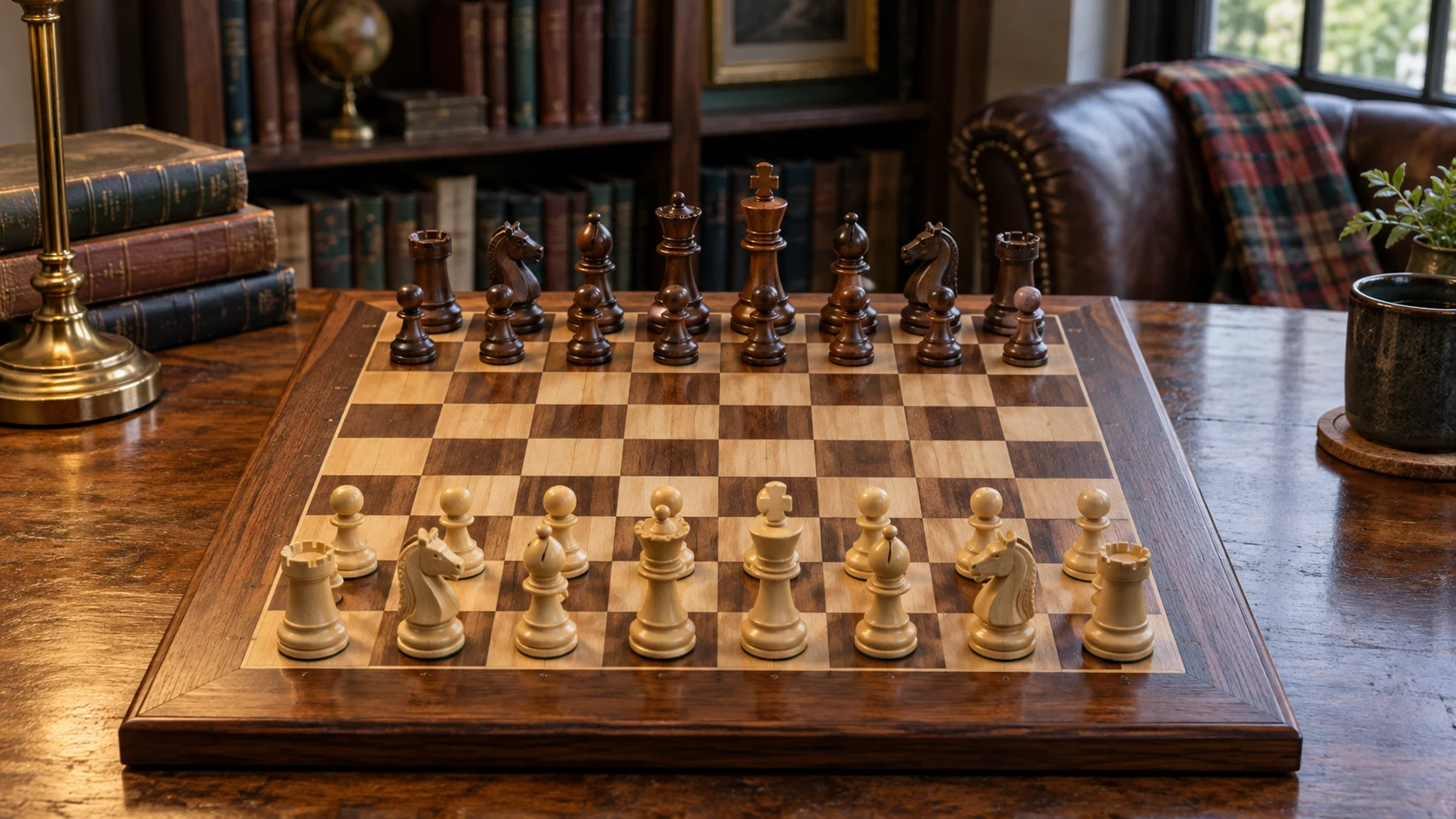
Board and Starting Position
Keep the game going with our board game trivia when this round is complete.
- How many squares are on a standard chessboard?
Answer: 64 squares arranged in eight ranks and eight files. - How many pieces does each player begin with?
Answer: 16 pieces: eight pawns and eight officers. - Which player makes the first move?
Answer: White always moves first under the Laws of Chess. - What is the goal of a chess game?
Answer: Checkmate the opposing king so no legal escape remains. - How many kings are on the board at the start?
Answer: Two, with one king belonging to each player. - Which piece is placed on its matching color at setup?
Answer: The queen, remembered by “queen on her color.” - What are the horizontal rows called?
Answer: Ranks, numbered one through eight from White's side. - What are the vertical columns called?
Answer: Files, labeled a through h from White's left. - Which two colors traditionally describe the sides?
Answer: White and Black, even when the pieces use other colors. - How many pawns begin on the board?
Answer: 16 pawns, eight for each player.
How Every Piece Moves
Keep the game going with our sports trivia when this round is complete.
- How does a rook move?
Answer: Any number of unobstructed squares horizontally or vertically. - How does a bishop move?
Answer: Any number of unobstructed squares diagonally. - How does a queen move?
Answer: Any number of unobstructed squares along ranks, files, or diagonals. - What unusual path does a knight take?
Answer: An L shape: two squares one way and one perpendicular. - Which piece can jump over other pieces?
Answer: The knight is the only standard piece that can leap. - How far may a king normally move?
Answer: One square in any direction, provided it stays safe. - Can a pawn move backward?
Answer: No, pawns move forward and capture diagonally forward. - When may a pawn advance two squares?
Answer: On its first move, if both squares ahead are clear. - What happens when a pawn reaches the farthest rank?
Answer: It promotes to a queen, rook, bishop, or knight. - Must a promoted pawn become a previously captured piece?
Answer: No, promotion can create an additional queen or other piece.
Checkmate, Castling, and Special Moves
Keep the game going with our history trivia when this round is complete.
- What does “check” mean?
Answer: The king is under immediate attack and must be protected. - What does “checkmate” mean?
Answer: The checked king has no legal move or defense. - What is stalemate?
Answer: A draw where the player to move has no legal move but is not in check. - What two pieces move during castling?
Answer: The king and one rook move in the same turn. - How many squares does the king move when castling?
Answer: Two squares toward the participating rook. - May a player castle out of check?
Answer: No, a king cannot castle while it is in check. - May a king castle through an attacked square?
Answer: No, the king's starting, crossing, and destination squares must be safe. - What is en passant?
Answer: A special pawn capture available immediately after an adjacent two-square pawn advance. - What is the touch-move rule?
Answer: A deliberately touched movable piece must be moved when legally possible. - What draw can be claimed after the same position appears three times?
Answer: A draw by threefold repetition.
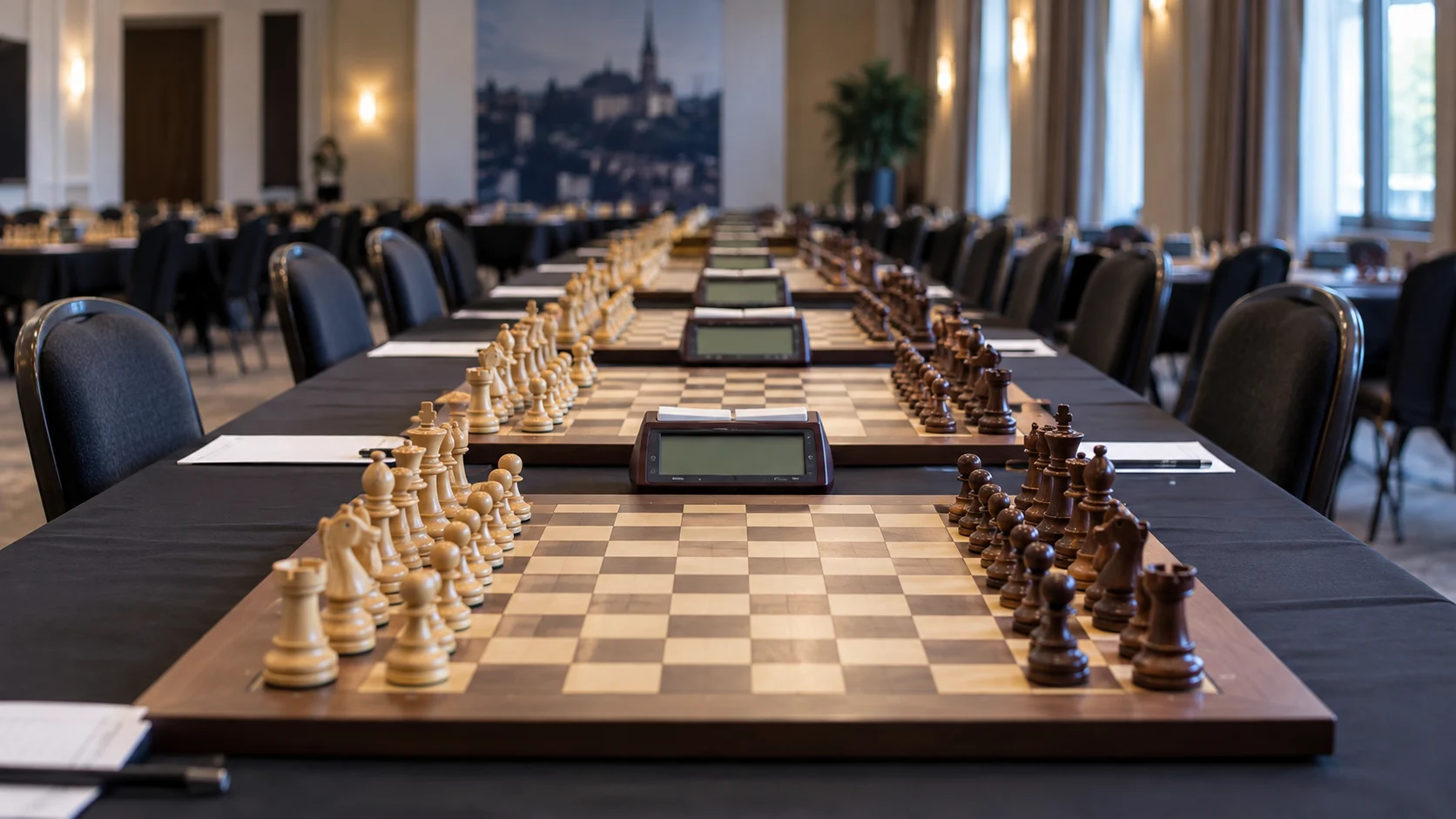
Draws, Clocks, and Tournament Rules
Keep the game going with our video game trivia when this round is complete.
- What is the fifty-move rule?
Answer: A draw may be claimed after 50 moves by each side without a pawn move or capture. - What is insufficient material?
Answer: A position where no legal sequence can produce checkmate. - Can two bare kings ever deliver checkmate?
Answer: No, king versus king is automatically drawn. - What is a resignation?
Answer: A player concedes the game before checkmate. - What does a chess clock measure?
Answer: Each player's remaining thinking time. - What usually happens when a player's time expires?
Answer: That player loses unless the opponent cannot possibly checkmate. - What is an illegal move?
Answer: A move that violates the rules, such as leaving one's king in check. - What is a draw by agreement?
Answer: Both players voluntarily agree to end the game drawn. - What notation symbol marks check?
Answer: A plus sign following the move. - What notation symbol commonly marks checkmate?
Answer: A hash sign, though double plus is also sometimes seen.
Material and the Three Phases
- What is the approximate traditional value of a pawn?
Answer: One point, used as the basic material unit. - What is a knight usually worth?
Answer: About three pawns, depending on the position. - What is a bishop usually worth?
Answer: About three pawns, often slightly more than a knight. - What is a rook usually worth?
Answer: About five pawns. - What is a queen usually worth?
Answer: About nine pawns. - What is the opening?
Answer: The first phase, when pieces develop and kings seek safety. - What is the middlegame?
Answer: The phase after development, often featuring tactics and strategic plans. - What is the endgame?
Answer: The late phase with fewer pieces, where kings become active. - What does development mean?
Answer: Bringing pieces from their starting squares into useful play. - What is material in chess?
Answer: The pieces and pawns a player currently has.
Tactics and Positional Terms
- What is a fork?
Answer: One piece attacks two or more targets at the same time. - What is a pin?
Answer: An attacked piece cannot safely move because it shields a more valuable piece. - What is a skewer?
Answer: A valuable piece is attacked and, after moving, exposes another target. - What is a discovered attack?
Answer: Moving one piece reveals an attack by a piece behind it. - What is a double check?
Answer: Two pieces attack the king simultaneously after one move. - What is a gambit?
Answer: An opening sacrifice, usually of material, offered for activity or time. - What is zugzwang?
Answer: Any legal move worsens the position for the player who must move. - What is a passed pawn?
Answer: A pawn with no opposing pawn able to block or capture it on adjacent files. - What is an isolated pawn?
Answer: A pawn with no friendly pawn on either neighboring file. - What is an open file?
Answer: A file containing no pawns of either color.
Famous Openings
- Which opening begins 1.e4 e5 2.Nf3 Nc6 3.Bb5?
Answer: The Ruy Lopez, also called the Spanish Game. - Which opening begins 1.e4 c5?
Answer: The Sicilian Defense. - Which defense begins 1.d4 Nf6 2.c4 g6 3.Nc3 Bg7?
Answer: The King's Indian Defense. - Which opening begins 1.d4 d5 2.c4?
Answer: The Queen's Gambit. - What is 1.e4 e5 2.Nf3 Nc6 3.Bc4 called?
Answer: The Italian Game. - Which defense starts 1.e4 e6?
Answer: The French Defense. - Which defense starts 1.e4 c6?
Answer: The Caro-Kann Defense. - Which opening begins 1.Nf3?
Answer: The Réti Opening. - What is the first move of the English Opening?
Answer: 1.c4. - What family of openings begins 1.d4 d5?
Answer: Closed Games.
Champions and Chess Organizations
- What international federation governs chess?
Answer: FIDE, the International Chess Federation. - In what year was FIDE founded?
Answer: 1924, in Paris. - Who became the first official World Chess Champion in 1886?
Answer: Wilhelm Steinitz. - Who defeated José Raúl Capablanca for the world title in 1927?
Answer: Alexander Alekhine. - Which champion was nicknamed the Patriarch of Soviet Chess?
Answer: Mikhail Botvinnik. - Who became the youngest undisputed world champion in 1985?
Answer: Garry Kasparov, at age 22. - Who ended Kasparov's world-title reign in 2000?
Answer: Vladimir Kramnik. - Which Indian champion first won the world title in 2000?
Answer: Viswanathan Anand. - Who won the classical world championship in 2013?
Answer: Magnus Carlsen. - Who became world champion by defeating Ian Nepomniachtchi in 2023?
Answer: Ding Liren.
Players, Titles, and Team Events
- Which American won the 1972 world championship?
Answer: Bobby Fischer. - Whom did Fischer defeat in the “Match of the Century”?
Answer: Boris Spassky. - In what city was the 1972 title match played?
Answer: Reykjavík, Iceland. - Who was the first woman awarded the grandmaster title through tournament results?
Answer: Nona Gaprindashvili. - Which champion dominated women's chess and entered the open world top ten?
Answer: Judit Polgár. - What title sits directly below grandmaster in FIDE's open titles?
Answer: International Master. - What minimum rating is associated with the grandmaster title requirement?
Answer: A 2500 FIDE rating at some point, plus qualifying norms. - What is a norm?
Answer: A tournament performance satisfying part of a title requirement. - Which team event awards the Hamilton-Russell Cup?
Answer: The open Chess Olympiad. - Is chess an Olympic medal sport?
Answer: No, the Chess Olympiad is separate from the Olympic Games.
Chess History and Technology
- What early Indian game is widely regarded as chess's ancestor?
Answer: Chaturanga. - What Persian game helped transmit chess westward?
Answer: Shatranj. - Which piece replaced the medieval fers as chess rules evolved?
Answer: The modern queen. - Around what century did the queen gain its powerful modern movement?
Answer: The late 15th century. - What famous 1851 game did Adolf Anderssen win against Lionel Kieseritzky?
Answer: The Immortal Game. - Who created the Elo rating system?
Answer: Arpad Elo. - What computer defeated Garry Kasparov in a 1997 match?
Answer: IBM's Deep Blue. - What is Chess960 also called?
Answer: Fischer Random Chess. - How are back-rank pieces arranged in Chess960?
Answer: Randomly, with bishops on opposite colors and king between rooks. - What is algebraic notation?
Answer: The standard system recording moves with piece letters and square coordinates.
Sources and Further Reading

Ellie Ewert is the founder and author of RandomTrivia.co, blending her passion for research with years of experience in content creation to deliver accurate, engaging, and well-sourced trivia. Dedicated to providing readers with trustworthy and entertaining facts, she applies meticulous fact-checking and SEO expertise to ensure every article meets the highest standards. Read more about our high standards in our Editorial Guidelines.