
Get ready for a family tree with billions of branches, because evolution has been tinkering with life for a very long time.
These evolution trivia questions explore natural selection, genetics, fossils, speciation, human origins, and the wonderfully weird evidence written into living things.
Evolution's Essential Ideas
Q: What is biological evolution?
A: Change in inherited traits of populations across generations.
Q: What process favors inherited traits that improve reproductive success in a particular environment?
A: Natural selection.
Q: What must a trait have for natural selection to act on it across generations?
A: Heritability.
Q: In evolutionary biology, what does fitness measure?
A: Relative reproductive success.
Q: Do individual organisms evolve during their lifetimes?
A: No, populations evolve across generations.
Q: What term describes a heritable feature shaped by selection for a function?
A: An adaptation.
Q: What is descent with modification?
A: Inheritance with changes accumulating through generations.
Q: What does common ancestry mean?
A: Different lineages descend from shared ancestors.
Q: Does evolution always produce greater complexity?
A: No.
Q: Is natural selection random?
A: No, although the mutations supplying variation do not arise because they are needed.
Q: What term describes observable differences among individuals in a population?
A: Variation.
Q: What environmental force affects which variants leave more offspring?
A: Selection pressure.
Q: What field studies how living things change through time?
A: Evolutionary biology.
Q: What is an evolutionary lineage?
A: A sequence of populations connected by descent.
Q: Is evolution a goal-directed climb toward perfection?
A: No.
Darwin, Wallace, and the Big Idea
Q: Who published On the Origin of Species in 1859?
A: Charles Darwin.
Q: Which naturalist independently developed the idea of natural selection?
A: Alfred Russel Wallace.
Q: Where were Darwin and Wallace's ideas jointly presented in 1858?
A: The Linnean Society of London.
Q: What ship carried Darwin on his famous voyage?
A: HMS Beagle.
Q: Who captained HMS Beagle during Darwin's voyage?
A: Robert FitzRoy.
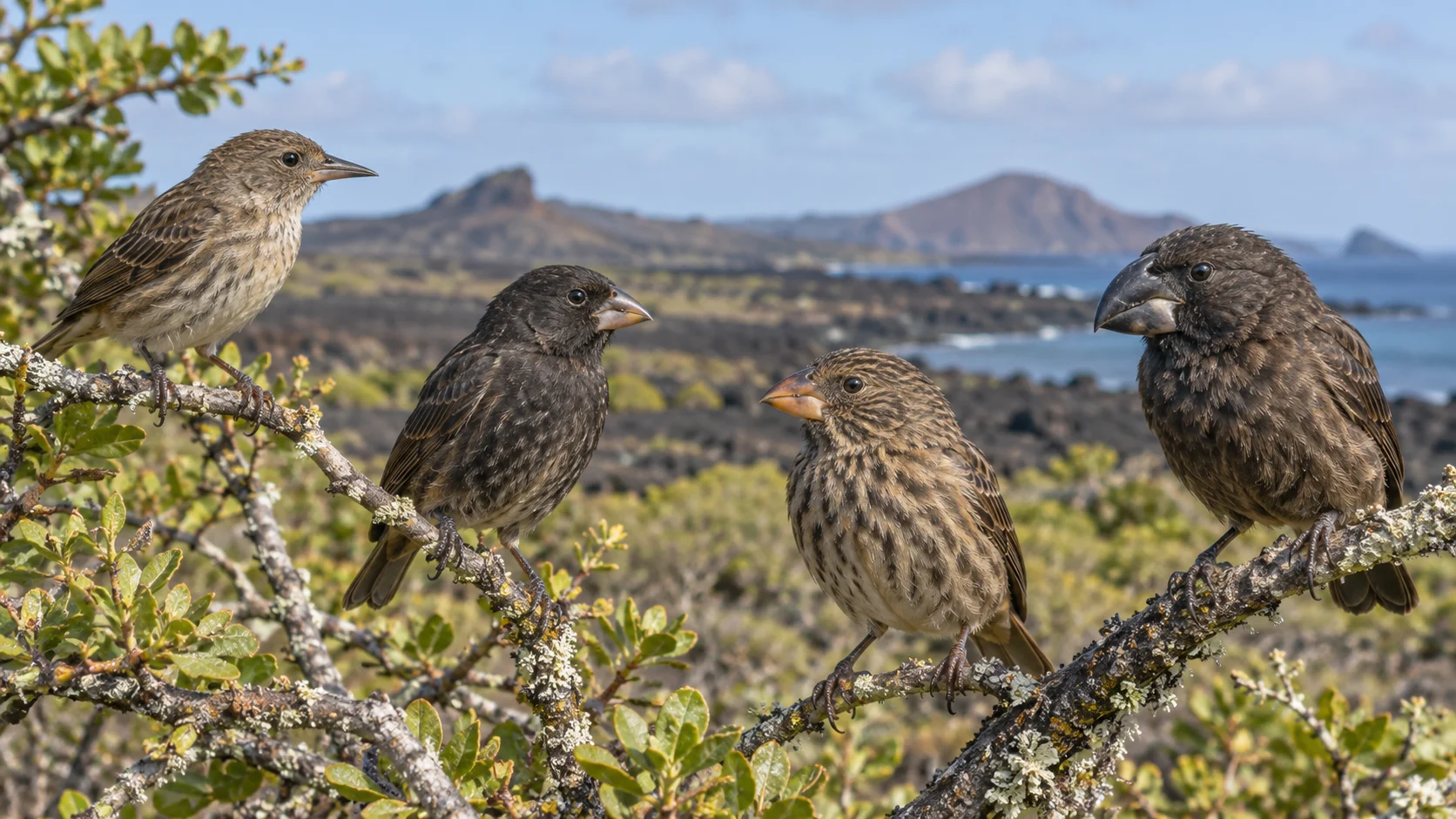
Q: Which Pacific islands became closely associated with Darwin's observations?
A: The Galápagos Islands.
Q: Which Galápagos birds later became icons of adaptive radiation?
A: Darwin's finches.
Q: Which giant reptiles varied among Galápagos islands and caught Darwin's attention?
A: Tortoises.
Q: Which economist's writing on population influenced Darwin and Wallace?
A: Thomas Robert Malthus.
Q: What artificial process did Darwin compare with natural selection?
A: Selective breeding.
Q: What phrase popularized by Herbert Spencer did Darwin later use?
A: “Survival of the fittest.”
Q: What region's wildlife inspired much of Wallace's work?
A: The Malay Archipelago.
Q: What biogeographic boundary between Asian and Australasian fauna bears Wallace's name?
A: The Wallace Line.
Q: What book did Wallace publish in 1869 about island biogeography?
A: The Malay Archipelago.
Q: Did Darwin know the modern genetic mechanism of inheritance?
A: No.
Genes, Mutations, and the Modern Synthesis
Q: Who discovered basic inheritance patterns using pea plants?
A: Gregor Mendel.
Q: What molecule carries genetic information in most organisms?
A: DNA.
Q: What is a mutation?
A: A change in genetic material.
Q: Can mutations be beneficial, neutral, or harmful depending on context?
A: Yes.
Q: What term means alternative versions of a gene?
A: Alleles.
Q: What is a population's gene pool?
A: All the alleles present in that population.
Q: What field joins genetics with the study of evolutionary change in populations?
A: Population genetics.
Q: What 20th-century framework united Mendelian genetics with natural selection?
A: The modern evolutionary synthesis.
Q: Which statistician developed key mathematical foundations for population genetics and selection?
A: Ronald Fisher.
Q: Which geneticist used fruit flies to study mutation and inheritance?
A: Thomas Hunt Morgan.
Q: What process during sexual reproduction shuffles alleles into new combinations?
A: Genetic recombination.
Q: What equation describes allele frequencies in an ideal non-evolving population?
A: The Hardy-Weinberg equation.
Q: What two scientists give the Hardy-Weinberg principle its name?
A: G. H. Hardy and Wilhelm Weinberg.
Q: What is a genotype?
A: An organism's genetic makeup at one or more loci.
Q: What is a phenotype?
A: Observable traits produced by genes and environment.
Drift, Gene Flow, and Changing Populations
Q: What mechanism changes allele frequencies by chance?
A: Genetic drift.
Q: Is genetic drift usually strongest in large or small populations?
A: Small populations.
Q: What is the founder effect?
A: Genetic change when a new population begins with few individuals.
Q: What is a population bottleneck?
A: A sharp reduction in population size and genetic diversity.
Q: What mechanism moves alleles between populations?
A: Gene flow.
Q: What type of selection favors one extreme of a trait?
A: Directional selection.
Q: What type of selection favors intermediate traits?
A: Stabilizing selection.
Q: What type of selection favors both extremes over the average?
A: Disruptive selection.
Q: What form of selection arises from differences in mating success?
A: Sexual selection.
Q: Who emphasized sexual selection in The Descent of Man?
A: Charles Darwin.
Q: What is balancing selection?
A: Selection that maintains multiple alleles in a population.
Q: What human allele can offer malaria protection in people with one copy?
A: The sickle-cell allele.
Q: What is frequency-dependent selection?
A: Selection whose effect depends on how common a trait is.
Q: What does neutral theory emphasize at the molecular level?
A: Random drift of selectively neutral mutations.
Q: Which scientist proposed the neutral theory of molecular evolution?
A: Motoo Kimura.
Fossils, Anatomy, and DNA Evidence
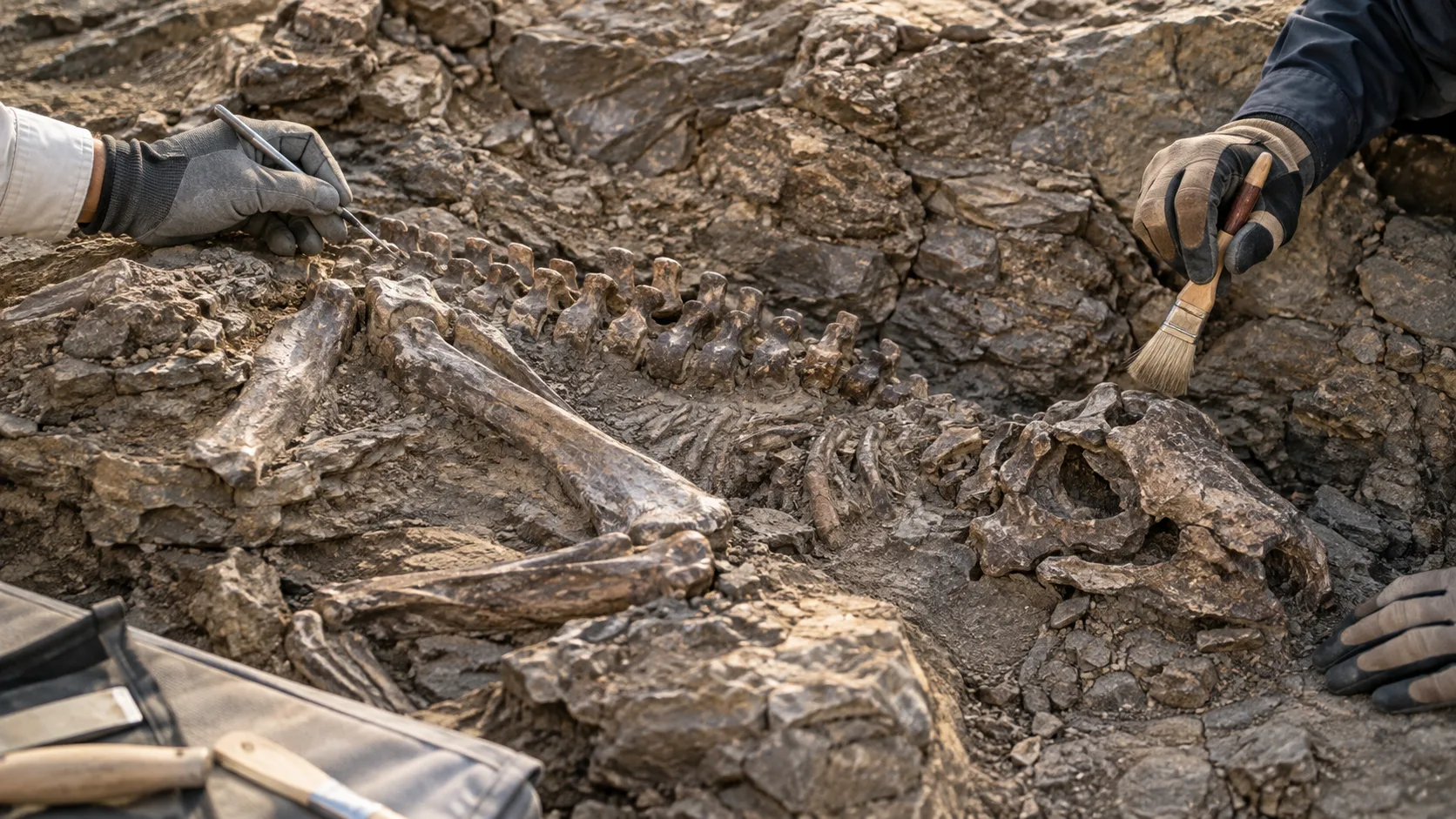
Q: What preserved remains or traces of ancient life are called?
A: Fossils.
Q: What branch of science studies fossils?
A: Paleontology.
Q: What principle places younger undisturbed rock layers above older ones?
A: The law of superposition.
Q: What dating method uses radioactive decay to estimate ages?
A: Radiometric dating.
Q: Which isotope is commonly used to date once-living material up to tens of thousands of years old?
A: Carbon-14.
Q: What are homologous structures?
A: Features inherited from a common ancestor.
Q: What are analogous structures?
A: Similar-function features that evolved independently.
Q: What reduced feature inherited from ancestors is called vestigial?
A: A vestigial structure.
Q: What transitional fossil links dinosaurs and early birds?
A: Archaeopteryx.
Q: What fossil fish has limb-like fins and features between fish and early tetrapods?
A: Tiktaalik.
Q: What whale ancestor had functional legs and lived partly on land?
A: Ambulocetus.
Q: Why do closely related species tend to have more similar DNA?
A: They share a more recent common ancestor.
Q: What shared genetic mistake can reveal common ancestry?
A: A shared pseudogene or inserted sequence.
Q: What does biogeography study?
A: The geographic distribution of organisms.
Q: Why are island species especially useful in evolutionary studies?
A: Isolation can produce distinctive lineages and adaptations.
Speciation and the Tree of Life
Q: What is speciation?
A: The formation of new species.
Q: What barrier is central to the biological species concept?
A: Reproductive isolation.
Q: What type of speciation begins with geographic separation?
A: Allopatric speciation.
Q: What type of speciation occurs without a geographic barrier?
A: Sympatric speciation.
Q: What chromosome change can create new plant species rapidly?
A: Polyploidy.
Q: What is adaptive radiation?
A: Rapid diversification from one ancestor into multiple ecological roles.
Q: Which Hawaiian insects provide a classic example of adaptive radiation?
A: Hawaiian fruit flies.
Q: What is convergent evolution?
A: Independent evolution of similar traits in unrelated lineages.
Q: What body shape evolved independently in sharks and dolphins?
A: A streamlined form.
Q: What is coevolution?
A: Reciprocal evolutionary change between interacting species.
Q: What branching diagram represents hypotheses of evolutionary relationships?
A: A phylogenetic tree.
Q: What does a node on a phylogenetic tree usually represent?
A: A common ancestor.
Q: What is a clade?
A: An ancestor and all its descendants.
Q: What field reconstructs evolutionary relationships using shared traits?
A: Phylogenetics.
Q: What are the three domains of life?
A: Bacteria, Archaea, and Eukarya.
Human Evolution Without the Ladder Myth
Q: Did humans evolve from modern chimpanzees?
A: No, humans and chimpanzees share a common ancestor.
Q: What order includes humans, apes, monkeys, and lemurs?
A: Primates.
Q: What family includes humans and the great apes?
A: Hominidae.
Q: What genus do modern humans belong to?
A: Homo.
Q: What is the scientific name of modern humans?
A: Homo sapiens.
Q: On which continent did Homo sapiens evolve?
A: Africa.
Q: What trait describes habitual walking on two legs?
A: Bipedalism.
Q: Which early hominin species includes the fossil nicknamed Lucy?
A: Australopithecus afarensis.
Q: In which country was Lucy discovered?
A: Ethiopia.
Q: Which human relative lived across Europe and western Asia?
A: Neanderthals.
Q: Did Homo sapiens interbreed with Neanderthals?
A: Yes.
Q: Which archaic human group was first identified largely through DNA from a Siberian cave?
A: Denisovans.
Q: What East African site preserves early hominin fossils and stone tools in layered deposits?
A: Olduvai Gorge.
Q: What stone-tool tradition is associated with early Homo and simple flakes?
A: Oldowan.
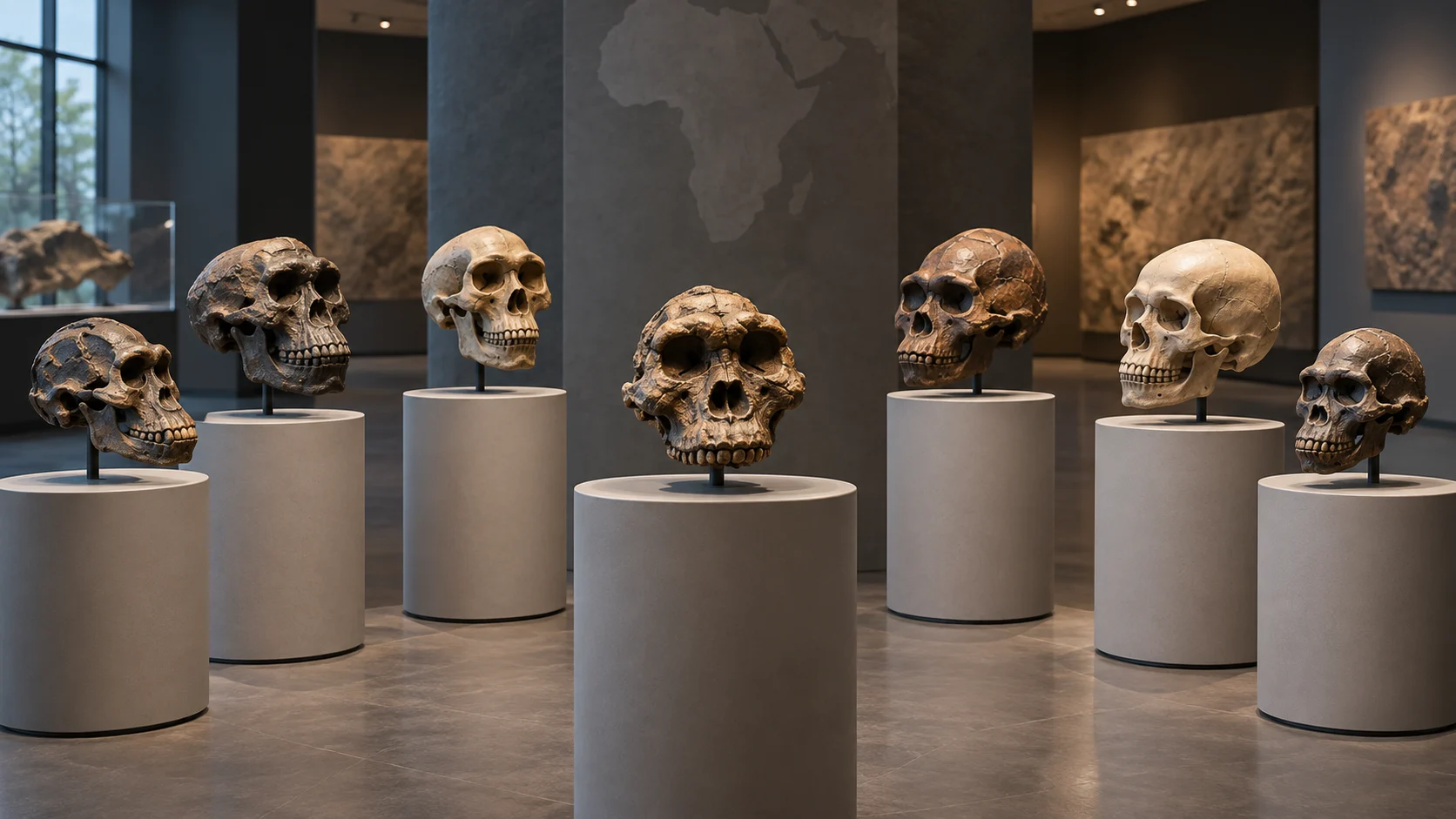
Q: Is human evolution best pictured as a straight ladder?
A: No, it is a branching tree with overlapping lineages.
Evolution Happening Before Our Eyes
Q: What is antibiotic resistance?
A: The ability of bacteria to survive drugs that once killed them.
Q: Do antibiotics cause bacteria to mutate because they need resistance?
A: No, antibiotics select resistant variants already arising by mutation or gene transfer.
Q: What process allows bacteria to exchange genes outside parent-to-offspring inheritance?
A: Horizontal gene transfer.
Q: Why are new influenza vaccines developed regularly?
A: Influenza viruses evolve rapidly.
Q: What is pesticide resistance?
A: Evolved survival of pests exposed to a pesticide.
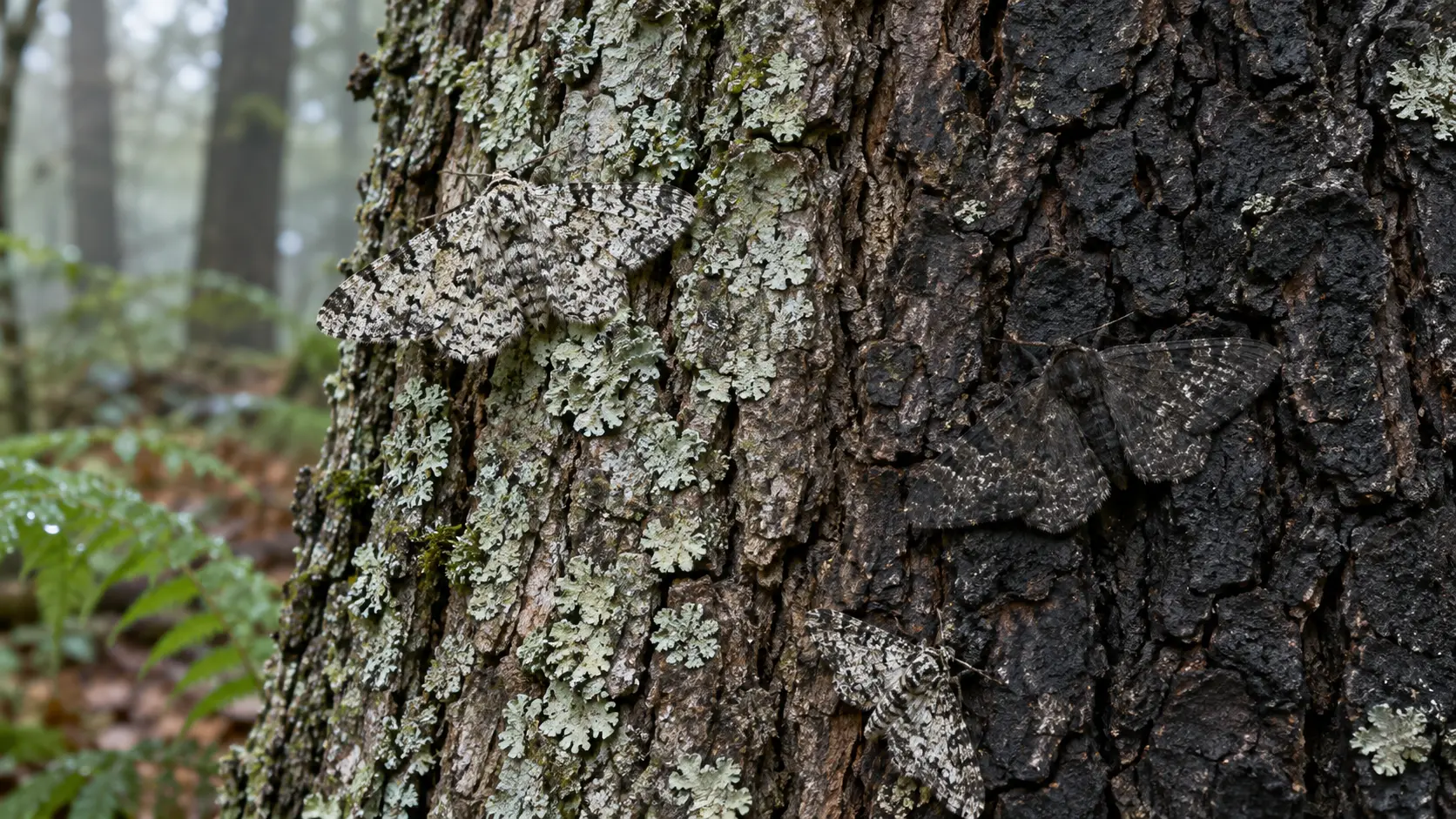
Q: What color change in peppered moth populations became a famous selection example?
A: Dark forms increased in polluted environments.
Q: What birds have shown measurable beak changes during Galápagos droughts?
A: Darwin's finches.
Q: What wild plant did humans selectively breed into cabbage, broccoli, kale, and cauliflower?
A: Brassica oleracea.
Q: From which wild species were domestic dogs descended?
A: Gray wolves.
Q: What human-directed evolutionary process produced dog breeds?
A: Artificial selection.
Q: What medical field uses evolutionary relationships to track outbreaks?
A: Genomic epidemiology.
Q: What conservation concern arises when a population loses genetic variation?
A: Reduced ability to adapt to change.
Q: What phenomenon can produce similar defenses in unrelated prey species?
A: Mimicry driven by natural selection.
Q: What is an evolutionary arms race?
A: Repeated reciprocal adaptation between interacting species.
Q: What simple fact makes evolution directly testable?
A: It produces measurable predictions about genes, traits, fossils, and ancestry.
Your Branch of the Quiz Is Complete
If you followed every mutation, fossil, and fork in the family tree, natural selection clearly favored your trivia instincts. Keep exploring big ideas with our famous people trivia and decades trivia.

Ellie Ewert is the founder and author of RandomTrivia.co, blending her passion for research with years of experience in content creation to deliver accurate, engaging, and well-sourced trivia. Dedicated to providing readers with trustworthy and entertaining facts, she applies meticulous fact-checking and SEO expertise to ensure every article meets the highest standards. Read more about our high standards in our Editorial Guidelines.