
Bring your best campaign-button energy, because this round follows generations of women who organized, argued, marched, and refused to be ignored.
These women's suffrage trivia questions center on the United States while placing its long voting-rights struggle alongside important international milestones and the work that continued after 1920.
Before Seneca Falls
Q: What does suffrage mean?
A: The right to vote in political elections.
Q: What term describes a person who campaigns for voting rights?
A: A suffragist.
Q: Which 18th-century writer argued for women's education in A Vindication of the Rights of Woman?
A: Mary Wollstonecraft.
Q: In what year was A Vindication of the Rights of Woman published?
A: 1792.
Q: Which future first lady urged her husband to “remember the ladies”?
A: Abigail Adams.
Q: To whom did Abigail Adams write that request?
A: John Adams.
Q: What reform movement brought many early U.S. women's rights activists into public organizing?
A: Abolitionism.
Q: Which Black abolitionist delivered the speech later known as “Ain't I a Woman?”
A: Sojourner Truth.
Q: At what 1851 convention did Sojourner Truth deliver that speech?
A: The Ohio Women's Rights Convention in Akron.
Q: Which sisters from South Carolina became prominent abolitionists and women's rights advocates?
A: Sarah and Angelina Grimké.
Q: Which Quaker minister became a leading abolitionist and women's rights advocate?
A: Lucretia Mott.
Q: At what 1840 gathering were Mott and other women denied full participation as delegates?
A: The World Anti-Slavery Convention in London.
Q: Which future suffrage leader met Lucretia Mott at that London convention?
A: Elizabeth Cady Stanton.
Q: What legal principle placed a married woman's legal identity under her husband's authority?
A: Coverture.
Q: What laws began giving married women control over property in the 19th century?
A: Married Women's Property Acts.
Seneca Falls and a Public Declaration
Q: What 1848 gathering is often called the first women's rights convention in the United States?
A: The Seneca Falls Convention.
Q: In which state was Seneca Falls held?
A: New York.
Q: Who were the two best-known organizers of the Seneca Falls Convention?
A: Elizabeth Cady Stanton and Lucretia Mott.
Q: What document was adopted at Seneca Falls?
A: The Declaration of Sentiments.
Q: Which founding document inspired the Declaration of Sentiments?
A: The Declaration of Independence.
Q: What famous opening claim did the Declaration of Sentiments make?
A: That all men and women are created equal.
Q: Which resolution at Seneca Falls was the most controversial?
A: The demand for women's voting rights.
Q: Which abolitionist spoke in support of the suffrage resolution at Seneca Falls?
A: Frederick Douglass.
Q: What newspaper did Frederick Douglass publish?
A: The North Star.
Q: About how many people signed the Declaration of Sentiments?
A: One hundred.
Q: How many of the signers were women?
A: Sixty-eight.
Q: At what kind of building did the Seneca Falls Convention meet?
A: Wesleyan Chapel.
Q: How many days did the Seneca Falls Convention last?
A: Two.
Q: What nearby city hosted a follow-up women's rights convention two weeks later?
A: Rochester, New York.
Q: Who became the first woman to preside over a public convention of men and women in the United States at Rochester?
A: Abigail Bush.
Stanton, Anthony, and Nineteenth-Century Organizing
Q: Which suffrage leader formed a famous partnership with Elizabeth Cady Stanton?
A: Susan B. Anthony.
Q: Which partner often wrote speeches while the other traveled and delivered them?
A: Stanton often wrote, and Anthony often organized and spoke.
Q: What newspaper did Stanton and Anthony publish beginning in 1868?
A: The Revolution.
Q: What slogan appeared on The Revolution's masthead?
A: “Men, their rights, and nothing more; women, their rights, and nothing less.”
Q: What organization did Stanton and Anthony form in 1869?
A: The National Woman Suffrage Association, or NWSA.
Q: Which two leaders formed the American Woman Suffrage Association in 1869?
A: Lucy Stone and Henry Blackwell.
Q: What constitutional amendment caused a major split among suffragists?
A: The 15th Amendment.
Q: Why did some women's rights activists oppose the 15th Amendment?
A: It protected voting rights for men regardless of race but did not include sex.
Q: Why did other suffragists support the 15th Amendment?
A: They saw Black men's voting rights as an urgent advance and continued pursuing women's suffrage.
Q: What organization united the NWSA and AWSA in 1890?
A: The National American Woman Suffrage Association, or NAWSA.
Q: Who became NAWSA's first president?
A: Elizabeth Cady Stanton.
Q: Who is recognized as the first woman to vote in a general election after Wyoming granted equal suffrage?
A: Louisa Swain.
Q: Which suffragist was arrested for voting in the 1872 presidential election?
A: Susan B. Anthony.
Q: In which New York city did Anthony cast that ballot?
A: Rochester.
Q: What was the result of Anthony's trial?
A: She was convicted and fined $100, which she refused to pay.
Black, Indigenous, and Working Women's Voices
Q: Which Black writer and activist helped found the National Association of Colored Women?
A: Mary Church Terrell.
Q: What was the National Association of Colored Women's motto?
A: “Lifting as we climb.”
Q: Which anti-lynching journalist helped found the Alpha Suffrage Club in Chicago?
A: Ida B. Wells.
Q: In what year was the Alpha Suffrage Club founded?
A: 1913.
Q: Which Black clubwoman became a leading suffrage organizer in Washington, D.C.?
A: Mary Church Terrell.
Q: Which poet and abolitionist spoke for women's rights and temperance after emancipation?
A: Frances Ellen Watkins Harper.
Q: Which Black educator founded a school that became Bethune-Cookman University?
A: Mary McLeod Bethune.
Q: Which Native American activist addressed suffrage meetings and co-founded the National Council of American Indians?
A: Zitkala-Ša.
Q: What federal law granted U.S. citizenship to all Native Americans born in the country in 1924?
A: The Indian Citizenship Act.
Q: Did the Indian Citizenship Act immediately guarantee voting access in every state?
A: No.
Q: Which labor organizer led the 1909 New York shirtwaist strike and supported suffrage?
A: Clara Lemlich.
Q: What was the 1909 garment workers' strike commonly called?
A: The Uprising of the 20,000.
Q: Which labor organization became a major base for working women's activism?
A: The Women's Trade Union League.
Q: Which Chinese American activist gave suffrage speeches as a teenager in New York?
A: Mabel Ping-Hua Lee.
Q: Could Mabel Ping-Hua Lee become a U.S. citizen when the 19th Amendment was ratified?
A: No, federal exclusion law barred Chinese immigrants from naturalization at the time.
Winning the West and State Campaigns
Q: Which territory granted women equal voting rights in 1869?
A: Wyoming Territory.
Q: What nickname did Wyoming adopt because of its early suffrage law?
A: The Equality State.
Q: Which territory granted women voting rights in 1870?
A: Utah Territory.
Q: Which western state approved women's suffrage by referendum in 1893?
A: Colorado.
Q: Which state entered the Union in 1896 with women's suffrage in its constitution?
A: Utah.
Q: Which state adopted women's suffrage in 1896 after a successful campaign?
A: Idaho.
Q: Which state became the first in the 20th century to grant women the vote in 1910?
A: Washington.
Q: In what year did California women win equal suffrage?
A: 1911.
Q: Which two states approved women's suffrage in 1912 along with Kansas?
A: Arizona and Oregon.
Q: Which territory gave women voting rights in 1913, years before becoming a state?
A: Alaska Territory.
Q: Which large eastern state granted women full voting rights in 1917?
A: New York.
Q: What map strategy used states with suffrage to build momentum for a federal amendment?
A: The state-by-state strategy.
Q: What voting right did some states grant women before full suffrage?
A: The right to vote in school elections.
Q: What other limited right did some states allow before full suffrage?
A: Municipal suffrage.
Q: Why were western victories important to the national campaign?
A: They demonstrated women could vote and created blocs of women voters.
Parades, Pickets, and a Bolder Campaign
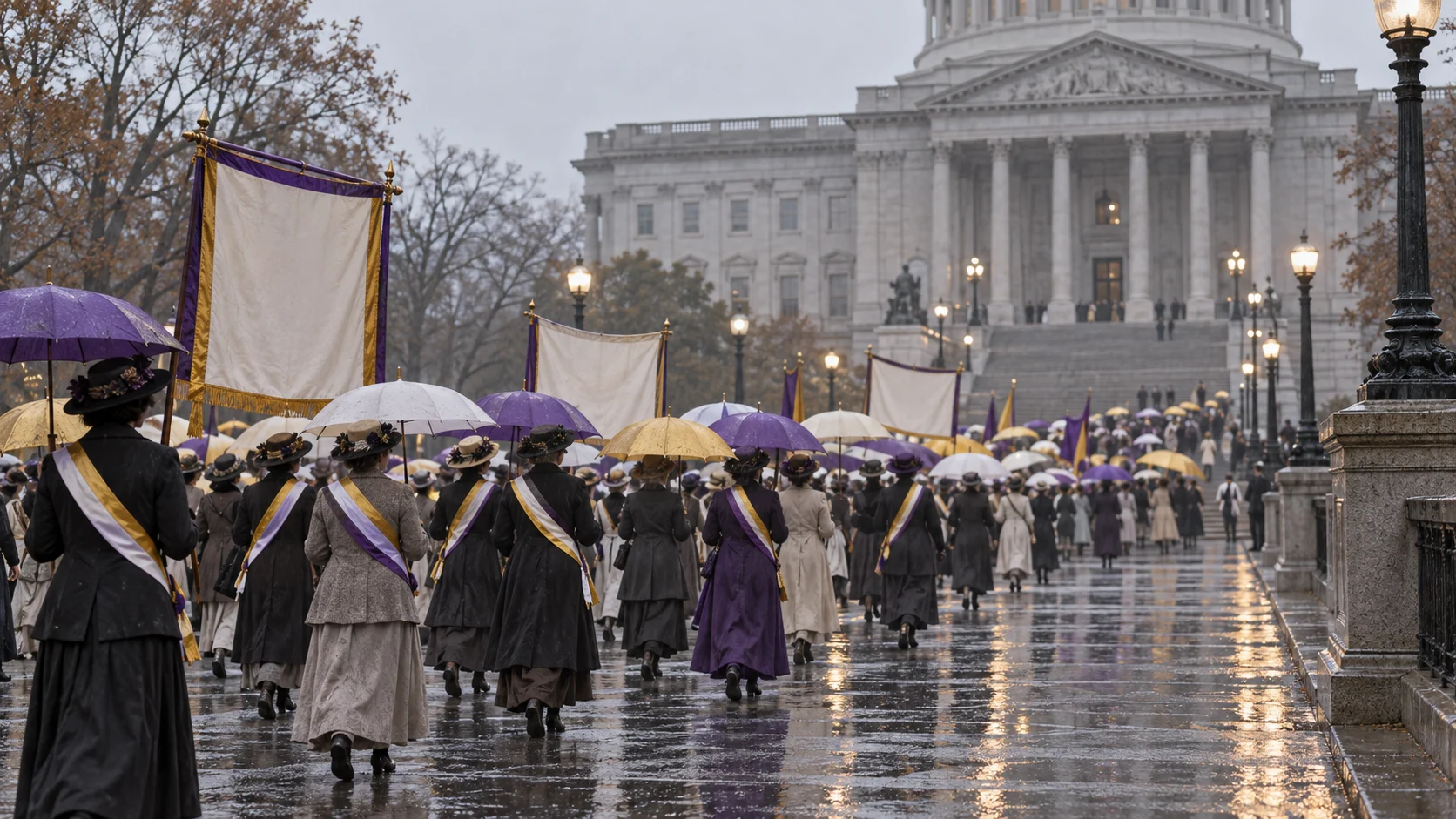
Q: Who organized the major 1913 suffrage procession in Washington, D.C.?
A: Alice Paul and Lucy Burns.
Q: When did the 1913 procession take place?
A: March 3, the day before Woodrow Wilson's inauguration.
Q: Who rode a white horse at the head of the 1913 procession?
A: Inez Milholland.
Q: What organization did Alice Paul and Lucy Burns form in 1916?
A: The National Woman's Party.
Q: What group picketed the White House beginning in 1917?
A: The Silent Sentinels.
Q: Who was president during the White House picketing campaign?
A: Woodrow Wilson.
Q: Where were many arrested suffrage picketers imprisoned?
A: The Occoquan Workhouse.
Q: What name was given to the brutal treatment of imprisoned suffragists on November 14, 1917?
A: The Night of Terror.
Q: What protest tactic did some imprisoned suffragists use?
A: Hunger strikes.
Q: How did prison officials respond to some hunger strikes?
A: They force-fed the women.
Q: Which British suffragette organization influenced Alice Paul's militant tactics?
A: The Women's Social and Political Union.
Q: Who led the Women's Social and Political Union?
A: Emmeline Pankhurst.
Q: Which NAWSA president promoted the “Winning Plan”?
A: Carrie Chapman Catt.
Q: What did the Winning Plan combine?
A: State campaigns with a coordinated push for a federal amendment.
Q: Which prominent suffragist died after collapsing during a 1916 speech tour?
A: Inez Milholland.
The 19th Amendment
Q: Which amendment prohibits denying the vote on account of sex?
A: The 19th Amendment.
Q: In what year did Congress pass the 19th Amendment?
A: 1919.
Q: In what year was the 19th Amendment ratified?
A: 1920.
Q: How many states had to ratify the amendment in 1920?
A: Thirty-six.
Q: Which state became the crucial 36th state to ratify?
A: Tennessee.
Q: Which young Tennessee legislator cast a decisive vote for ratification?
A: Harry T. Burn.
Q: Who urged Harry Burn to support ratification in a famous letter?
A: His mother, Febb Burn.
Q: What color rose did amendment supporters wear in Tennessee?
A: Yellow.
Q: What color rose did opponents wear?
A: Red.
Q: On what date was the 19th Amendment certified?
A: August 26, 1920.
Q: Which U.S. secretary of state certified the amendment?
A: Bainbridge Colby.
Q: What earlier nickname was commonly used for the proposed 19th Amendment?
A: The Susan B. Anthony Amendment.
Q: Did Susan B. Anthony live to see the amendment ratified?
A: No.
Q: What annual U.S. observance falls on August 26?
A: Women's Equality Day.
Q: Did the 19th Amendment remove every barrier faced by women voters?
A: No.
Global Milestones and the Work Beyond 1920
Q: Which self-governing country became the first to grant women national voting rights in 1893?
A: New Zealand.
Q: Which activist led New Zealand's major suffrage petition campaign?
A: Kate Sheppard.
Q: Which country became the first in Europe to grant women full political rights in 1906?
A: Finland.
Q: In what year did Norway grant women full national suffrage?
A: 1913.
Q: Which 1918 British law enfranchised many women over age 30?
A: The Representation of the People Act 1918.
Q: When did British women gain voting rights on equal terms with men?
A: 1928.
Q: In what year did French women gain the right to vote?
A: 1944.
Q: In what year did Swiss women gain the vote in federal elections?
A: 1971.
Q: Which U.S. law of 1924 expanded citizenship but did not end state voting barriers for Native Americans?
A: The Indian Citizenship Act.
Q: What tactics continued to suppress many Black women voters after 1920?
A: Poll taxes, literacy tests, intimidation, and violence.
Q: Which federal law of 1965 attacked racial discrimination in voting?
A: The Voting Rights Act.
Q: Which organization did Carrie Chapman Catt found in 1920 to educate women voters?
A: The League of Women Voters.
Q: What equal-rights amendment did Alice Paul first introduce in 1923?
A: The Equal Rights Amendment.
Q: Has the Equal Rights Amendment been added to the U.S. Constitution?
A: No, its legal status remains disputed and it has not been certified as part of the Constitution.
Q: What is a central lesson of suffrage history?
A: Legal victories matter, but equal access also requires removing practical barriers to voting.
Your Ballot Is Counted
That score carries the determination of petitions, parades, speeches, and countless local meetings. Meet more history-makers in our famous people trivia, or keep exploring the era with decades trivia.

Ellie Ewert is the founder and author of RandomTrivia.co, blending her passion for research with years of experience in content creation to deliver accurate, engaging, and well-sourced trivia. Dedicated to providing readers with trustworthy and entertaining facts, she applies meticulous fact-checking and SEO expertise to ensure every article meets the highest standards. Read more about our high standards in our Editorial Guidelines.