
Pack your curiosity and leave room for one more pastry, because France offers far more than postcard views.
These France trivia questions travel through famous landmarks, dramatic history, regional traditions, art, science, food, and a few delightful details beyond Paris.
France on the Map
Q: What is the capital of France?
A: Paris.
Q: What is the official name of France?
A: The French Republic.
Q: What nickname refers to mainland France's roughly six-sided shape?
A: L'Hexagone, or the Hexagon.
Q: Which sea lies along France's southeastern coast?
A: The Mediterranean Sea.
Q: Which ocean borders western France?
A: The Atlantic Ocean.
Q: What channel separates northern France from southern England?
A: The English Channel.
Q: Which mountain range forms much of the border between France and Spain?
A: The Pyrenees.
Q: Which mountain range rises along France's border with Italy and Switzerland?
A: The Alps.
Q: What famous Alpine peak straddles the France-Italy border area?
A: Mont Blanc.
Q: What is the longest river flowing entirely within France?
A: The Loire.
Q: Which river flows through Paris?
A: The Seine.
Q: Which major river flows through Lyon toward the Mediterranean?
A: The Rhône.
Q: Which French overseas region shares a border with Brazil?
A: French Guiana.
Q: Which island in the Mediterranean is a territorial collectivity of France?
A: Corsica.
Q: How many administrative regions does France have, including overseas regions?
A: Eighteen.
Paris Landmarks and City Life
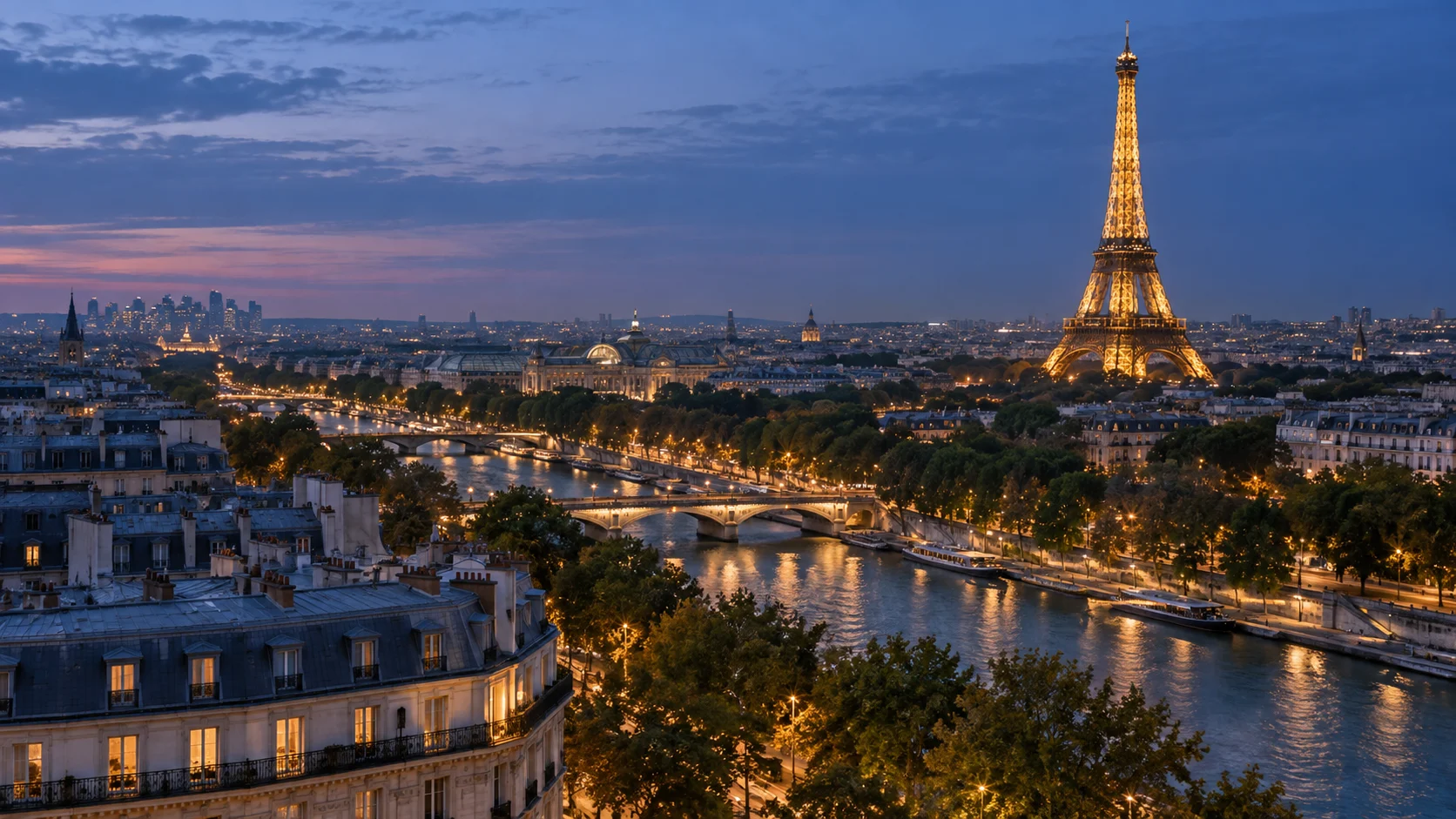
Q: Which iron landmark was built for the 1889 World's Fair?
A: The Eiffel Tower.
Q: Which engineer's company designed and built the Eiffel Tower?
A: Gustave Eiffel.
Q: Which museum occupies a former royal palace in Paris?
A: The Louvre.
Q: What glass structure marks the main entrance to the Louvre?
A: The Louvre Pyramid.
Q: Which cathedral stands on the Île de la Cité?
A: Notre-Dame de Paris.
Q: What broad avenue ends at the Arc de Triomphe?
A: The Champs-Élysées.
Q: Which monument honors those who fought and died for France, including an Unknown Soldier?
A: The Arc de Triomphe.
Q: What white-domed basilica crowns Montmartre?
A: Sacré-Cœur.
Q: Which grand palace complex lies southwest of Paris?
A: Versailles.
Q: What glittering gallery is one of Versailles's most famous rooms?
A: The Hall of Mirrors.
Q: Which Paris museum occupies a former railway station?
A: The Musée d'Orsay.
Q: What Paris district is historically associated with artists and the Moulin Rouge?
A: Montmartre.
Q: What is the name of Paris's famous cabaret with a red windmill?
A: Moulin Rouge.
Q: Into how many numbered arrondissements is Paris divided?
A: Twenty.
Q: What nickname celebrates Paris as a center of ideas and culture?
A: The City of Light.
From Gaul to Revolution
Q: What ancient people inhabited much of present-day France before Roman conquest?
A: The Gauls.
Q: Which Roman general conquered Gaul?
A: Julius Caesar.
Q: Which Frankish king converted to Christianity around the end of the fifth century?
A: Clovis I.
Q: Which ruler was crowned emperor in the year 800?
A: Charlemagne.
Q: What long medieval conflict pitted France against England from 1337 to 1453?
A: The Hundred Years' War.
Q: Which teenage heroine helped rally French forces at Orléans?
A: Joan of Arc.
Q: Which French king was known as the Sun King?
A: Louis XIV.
Q: Which royal residence did Louis XIV transform into a symbol of absolute monarchy?
A: The Palace of Versailles.
Q: What prison was stormed on July 14, 1789?
A: The Bastille.
Q: In what year was the First French Republic proclaimed?
A: 1792.
Q: What execution device became associated with the Reign of Terror?
A: The guillotine.
Q: Who crowned himself Emperor of the French in 1804?
A: Napoleon Bonaparte.
Q: At what 1815 battle was Napoleon finally defeated?
A: Waterloo.
Q: What national holiday does France celebrate on July 14?
A: Bastille Day, officially the French National Day.
Q: What three-word national motto emerged from the revolutionary tradition?
A: Liberté, égalité, fraternité.
Modern France and World Events
Q: What 1870 conflict helped bring down France's Second Empire?
A: The Franco-Prussian War.
Q: Which republic governed France for most of the period from 1870 to 1940?
A: The Third Republic.
Q: What military alliance did France join with Britain and Russia before World War I?
A: The Triple Entente.
Q: Which 1916 battle became one of France's defining World War I struggles?
A: The Battle of Verdun.
Q: What government controlled part of France while collaborating with Nazi Germany?
A: Vichy France.
Q: Who led the Free French movement during World War II?
A: Charles de Gaulle.
Q: What Allied invasion began on the Normandy coast on June 6, 1944?
A: D-Day.
Q: Which city served as a major port and objective during the Normandy campaign?
A: Cherbourg.
Q: In what year was Paris liberated from German occupation?
A: 1944.
Q: Which constitution established France's Fifth Republic?
A: The Constitution of 1958.
Q: Who became the first president of the Fifth Republic?
A: Charles de Gaulle.
Q: Which European organization did France help found with the 1957 Treaty of Rome?
A: The European Economic Community, a predecessor of the European Union.
Q: What currency did France adopt in place of the franc?
A: The euro.
Q: What 1994 tunnel connects France and the United Kingdom beneath the English Channel?
A: The Channel Tunnel.
Q: Which city hosts an official seat of the European Parliament?
A: Strasbourg.
Art, Literature, and French Culture
Q: Who painted the Mona Lisa, now displayed in the Louvre?
A: Leonardo da Vinci.
Q: Which French artist painted Impression, Sunrise?
A: Claude Monet.
Q: What art movement took its name from Monet's Impression, Sunrise?
A: Impressionism.
Q: Which artist painted dancers and rehearsal rooms in 19th-century Paris?
A: Edgar Degas.
Q: Who sculpted The Thinker?
A: Auguste Rodin.
Q: Which French writer created Les Misérables and The Hunchback of Notre-Dame?
A: Victor Hugo.
Q: Who wrote The Three Musketeers and The Count of Monte Cristo?
A: Alexandre Dumas.
Q: Which novelist wrote Madame Bovary?
A: Gustave Flaubert.
Q: Which French author wrote The Stranger?
A: Albert Camus.
Q: Who wrote the monumental novel sequence In Search of Lost Time?
A: Marcel Proust.
Q: Which institution has advised on the French language since 1635?
A: The Académie Française.
Q: Which cardinal founded the Académie Française?
A: Cardinal Richelieu.
Q: What top prize is awarded at the Cannes Film Festival?
A: The Palme d'Or.
Q: What decorative style takes its name from the French phrase for decorative arts?
A: Art Deco.
Q: What French word describes a skilled creator or craftsperson?
A: Artisan.
A Tour of French Food
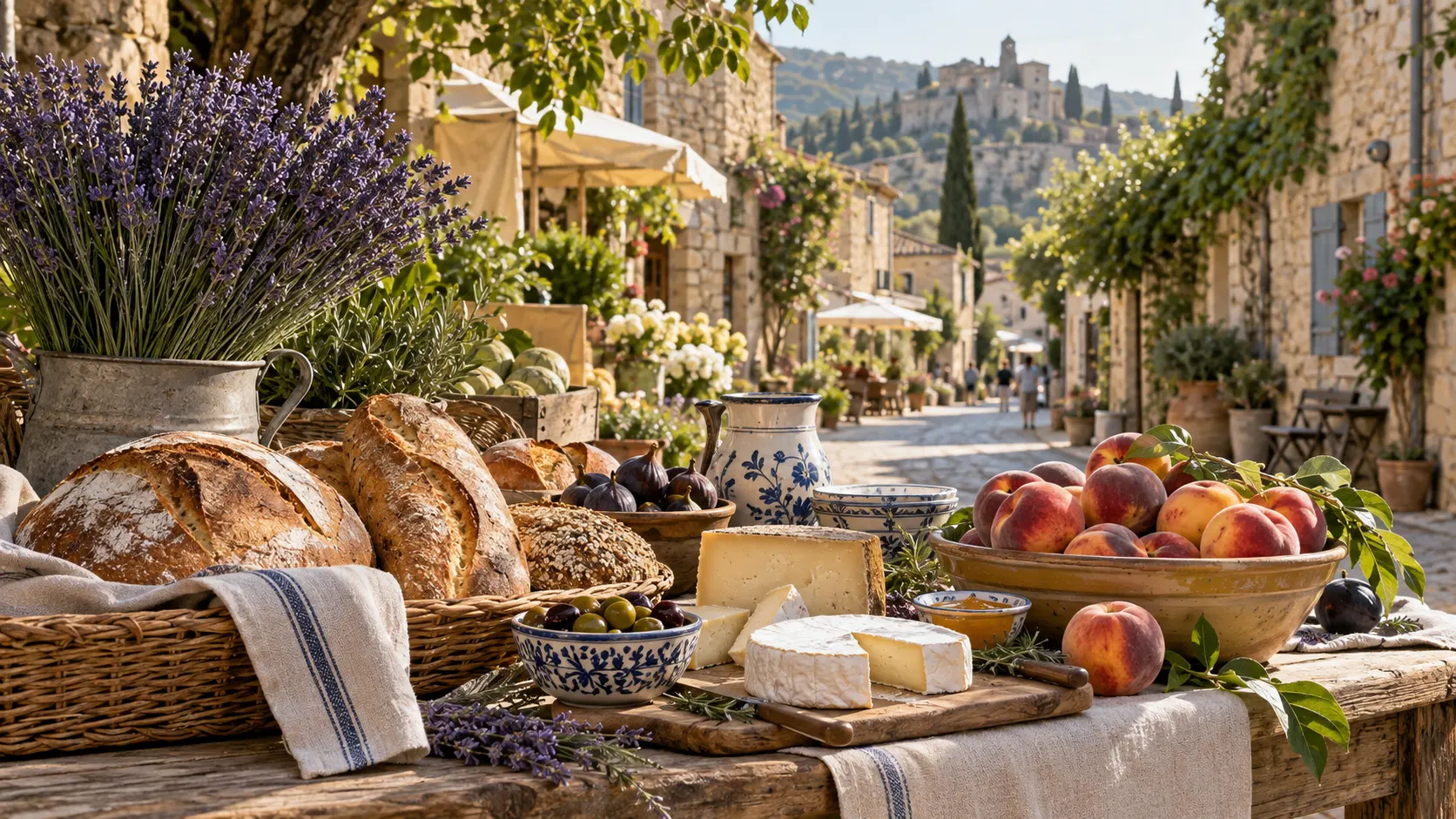
Q: What long, crusty loaf is a French bakery staple?
A: A baguette.
Q: What crescent-shaped laminated pastry is a classic French breakfast choice?
A: A croissant.
Q: Which layered pastry shares its name with the French words for a thousand sheets?
A: Mille-feuille.
Q: What Provençal vegetable dish features tomatoes, zucchini, eggplant, and peppers?
A: Ratatouille.
Q: Which fish stew is associated with Marseille?
A: Bouillabaisse.
Q: Which savory tart comes from Lorraine?
A: Quiche Lorraine.
Q: Which thin pancakes are strongly associated with Brittany?
A: Crêpes.
Q: What slow-cooked bean dish is associated with southwestern France?
A: Cassoulet.
Q: What dish braises chicken in wine?
A: Coq au vin.
Q: What name is used for cooked land snails served as food?
A: Escargots.
Q: Which soft cheese takes its name from a town in Normandy?
A: Camembert.
Q: Which blue cheese is aged in caves in southern France?
A: Roquefort.
Q: What sparkling wine can legally carry the name of its French region?
A: Champagne.
Q: What almond-based sandwich cookie comes in many colors and flavors?
A: A macaron.
Q: What cake containing a hidden charm is eaten for Epiphany?
A: Galette des rois.
Cities and Regions Beyond Paris
Q: Which Mediterranean city is France's oldest major city?
A: Marseille.
Q: Which two rivers meet in Lyon?
A: The Rhône and Saône.
Q: Which city is famous for its annual Festival of Lights?
A: Lyon.
Q: Which city is known for wine and sits on the Garonne River?
A: Bordeaux.
Q: Which southern city is nicknamed La Ville Rose for its pinkish brick?
A: Toulouse.
Q: Which Riviera city hosts a famous film festival?
A: Cannes.
Q: Which city hosts a major carnival and the Promenade des Anglais?
A: Nice.
Q: Which northeastern city blends French and German architectural influences?
A: Strasbourg.
Q: Which city is historically associated with Dijon mustard?
A: Dijon.
Q: Which region is famous for lavender fields and towns such as Avignon?
A: Provence.
Q: Which northwestern region is known for megaliths, crêpes, and Celtic heritage?
A: Brittany.
Q: Which region gives its name to a famous white wine often made from Chardonnay grapes?
A: Burgundy.
Q: Which Loire Valley town is closely associated with Joan of Arc's military victory?
A: Orléans.
Q: Which French city near Belgium was historically a textile center?
A: Lille.
Q: Which Alpine town is known as a gateway to Mont Blanc?
A: Chamonix.
French Science, Inventions, and Sports
Q: Which scientist developed pasteurization?
A: Louis Pasteur.
Q: Which Polish-born French scientist shared pioneering work on radioactivity?
A: Marie Curie.
Q: Which brothers helped pioneer projected motion pictures in the 1890s?
A: Auguste and Louis Lumière.
Q: Who invented the reading system of raised dots that bears his name?
A: Louis Braille.
Q: Which brothers launched an early successful hot-air balloon in 1783?
A: Joseph-Michel and Jacques-Étienne Montgolfier.
Q: What high-speed French train service is known by the initials TGV?
A: Train à Grande Vitesse.
Q: Which supersonic passenger jet was developed jointly by France and Britain?
A: Concorde.
Q: In what year was the first Tour de France held?
A: 1903.
Q: What color jersey identifies the Tour de France leader?
A: Yellow.
Q: On what surface is the French Open tennis tournament played?
A: Clay.
Q: What name is commonly used for the French Open venue?
A: Roland-Garros.
Q: What nickname is given to France's national soccer team?
A: Les Bleus.
Q: In which two years did France win the men's FIFA World Cup?
A: 1998 and 2018.
Q: What 24-hour motor race is held in France?
A: The 24 Hours of Le Mans.
Q: Which ball game associated with Provence is played by tossing metal boules?
A: Pétanque.
Au Revoir, but Not Goodbye
If you made it from Gaul to galette without getting lost, your French knowledge is in fine form. Keep exploring the world with our decades trivia and famous people trivia.

Ellie Simons creates and edits Random Trivia. She researches trivia using primary and authoritative sources whenever possible and is currently reviewing the site's older trivia library for accuracy, clarity, and playability. Read more on the About page.
About this quiz
Site editor: Ellie Simons. Read our Trivia Methodology to learn how questions are researched and updated. Page last updated: . Report an error.