
The winter solstice is a precise astronomical moment with a very human reputation: darkness, firelight, food, and someone insisting the days are longer now. They are, technically, so I brought 120 questions to prove it.
The Astronomy of the Winter Solstice
Q: What is the winter solstice?
A: It is the moment when a hemisphere reaches its greatest tilt away from the Sun.
Q: When does the Northern Hemisphere winter solstice usually occur?
A: It usually falls on December 21 or 22.
Q: When does the Southern Hemisphere winter solstice usually occur?
A: It usually falls on June 20 or 21.
Q: What season begins astronomically at the winter solstice?
A: Astronomical winter begins, although meteorological winter starts earlier.
Q: Why is the winter solstice the shortest day of the year?
A: That hemisphere receives its shortest interval of daylight and longest night.
Q: What does the word solstice mean?
A: It comes from Latin words meaning Sun and to stand still.
Q: Why does the Sun appear to stand still near a solstice?
A: Its noon position changes very little for several days before reversing direction.
Q: What causes Earth's seasons?
A: Earth's roughly 23.5-degree axial tilt changes sunlight angle and day length during its orbit.
Q: What does not cause Earth's seasons?
A: Changing distance from the Sun is not the main cause of seasons.
Q: Is Earth closest to the Sun during the Northern Hemisphere winter?
A: Yes, perihelion usually occurs in early January, proving distance is not the seasonal driver.
Q: What is Earth's closest point to the Sun called?
A: It is called perihelion.
Q: What is Earth's farthest point from the Sun called?
A: It is called aphelion and occurs in early July.
Q: Where is the Sun directly overhead at the December solstice?
A: It is overhead at solar noon along the Tropic of Capricorn.
Q: Where is the Sun directly overhead at the June solstice?
A: It is overhead at solar noon along the Tropic of Cancer.
Q: What latitude defines the Tropic of Capricorn?
A: It lies at about 23.5 degrees south latitude.
Q: What latitude defines the Tropic of Cancer?
A: It lies at about 23.5 degrees north latitude.
Q: What happens inside the Arctic Circle near the December solstice?
A: Some locations experience at least one full day without sunrise.
Q: What happens inside the Antarctic Circle near the December solstice?
A: Some locations experience at least one full day without sunset.
Q: What is polar night?
A: It is a period when the Sun stays below the horizon for at least 24 hours.
Q: What is the midnight Sun?
A: It is the Sun remaining visible at local midnight during the polar summer.
Q: How many solstices occur each year?
A: There are two, one in June and one in December.
Q: How many equinoxes occur each year?
A: There are two, normally in March and September.
Q: How does an equinox differ from a solstice?
A: An equinox has nearly equal day and night, while a solstice marks extreme daylight length.
Q: Why does the exact solstice time change each year?
A: The calendar year and Earth's orbital year do not match exactly, with leap years correcting drift.
Q: Is the solstice an entire calendar day?
A: Astronomically it is a precise moment, though people celebrate the surrounding day.
Q: What is solar declination?
A: It is the Sun's angular position north or south of Earth's equator.
Q: What is the Sun's declination at the December solstice?
A: It is roughly 23.5 degrees south.
Q: What is the Sun's declination at the June solstice?
A: It is roughly 23.5 degrees north.
Q: What happens to Northern Hemisphere daylight after the December solstice?
A: Daylight gradually increases as Earth continues along its orbit.
Q: What happens to Southern Hemisphere daylight after its June winter solstice?
A: Daylight gradually increases there as well.
Daylight, Weather, and the Low Winter Sun
Q: Why is the solstice not always the earliest sunset?
A: Solar noon shifts on the clock, separating the earliest sunset from the shortest day.
Q: Why is the solstice not always the latest sunrise?
A: The same clock effect often pushes the latest sunrise days after the solstice.
Q: What is the equation of time?
A: It describes the difference between apparent solar time and uniform clock time.
Q: How does latitude affect solstice daylight?
A: Higher latitudes have more extreme differences between winter and summer daylight.
Q: How does the winter solstice feel near the equator?
A: Day length changes only slightly, so the solstice is less visually dramatic.
Q: What happens to day length at the poles on a solstice?
A: One pole is in continuous darkness while the other receives continuous daylight.
Q: Why is winter sunlight less warming at high latitudes?
A: Its low angle spreads energy over a larger area and sends it through more atmosphere.
Q: Why does snow strengthen winter cooling?
A: Bright snow reflects much incoming sunlight instead of absorbing it.
Q: What is albedo?
A: Albedo is the fraction of incoming light a surface reflects.
Q: Which has higher albedo, fresh snow or dark soil?
A: Fresh snow reflects far more sunlight than dark soil.
Q: Why can the coldest weeks arrive after the winter solstice?
A: Land and oceans keep losing more heat than they gain for weeks afterward.
Q: What is seasonal lag?
A: It is the delay between peak solar conditions and peak seasonal temperatures.
Q: Why do oceans increase seasonal lag?
A: Water warms and cools slowly because it stores a large amount of heat.
Q: Why can continental interiors have harsher winters?
A: Land changes temperature faster than oceans and lacks their moderating influence.
Q: What is civil twilight?
A: It is the bright twilight when the Sun sits no more than 6 degrees below the horizon.
Q: What is nautical twilight?
A: It occurs when the Sun is 6 to 12 degrees below the horizon.
Q: What is astronomical twilight?
A: It occurs when the Sun is 12 to 18 degrees below the horizon.
Q: Why can polar night still include twilight?
A: The Sun may remain just below the horizon and illuminate the sky indirectly.
Q: What is a sun pillar?
A: It is a vertical-looking shaft of light formed by reflection from flat ice crystals.
Q: What is a halo around the winter Sun?
A: It is a ring produced when ice crystals refract and reflect sunlight.
Q: What are sundogs?
A: They are bright colored spots beside the Sun created by ice crystals.
Q: Why are long shadows common near the winter solstice?
A: The low Sun angle stretches shadows across the ground.
Q: Which direction does the noon Sun appear in the Northern Hemisphere?
A: It appears generally toward the south.
Q: Which direction does the noon Sun appear in the Southern Hemisphere?
A: It appears generally toward the north.
Q: How can a simple vertical stick track the approaching solstice?
A: Its noon shadow length changes until reaching a yearly extreme.
Q: What is a gnomon?
A: It is the shadow-casting part of a sundial.
Q: What does a winter solstice sunrise point do afterward?
A: It reverses its horizon drift and moves gradually toward the summer sunrise point.
Q: Why do mountains alter local solstice daylight?
A: They can block a low winter Sun long before the geometric sunset.
Q: Why can city buildings alter perceived day length?
A: Tall structures delay sunrise or advance sunset for observers at street level.
Q: What does photoperiod mean?
A: It means the length of daylight within a 24-hour cycle.
Midwinter Traditions Around the World
Q: Which prehistoric monument famously frames solstice light in England?
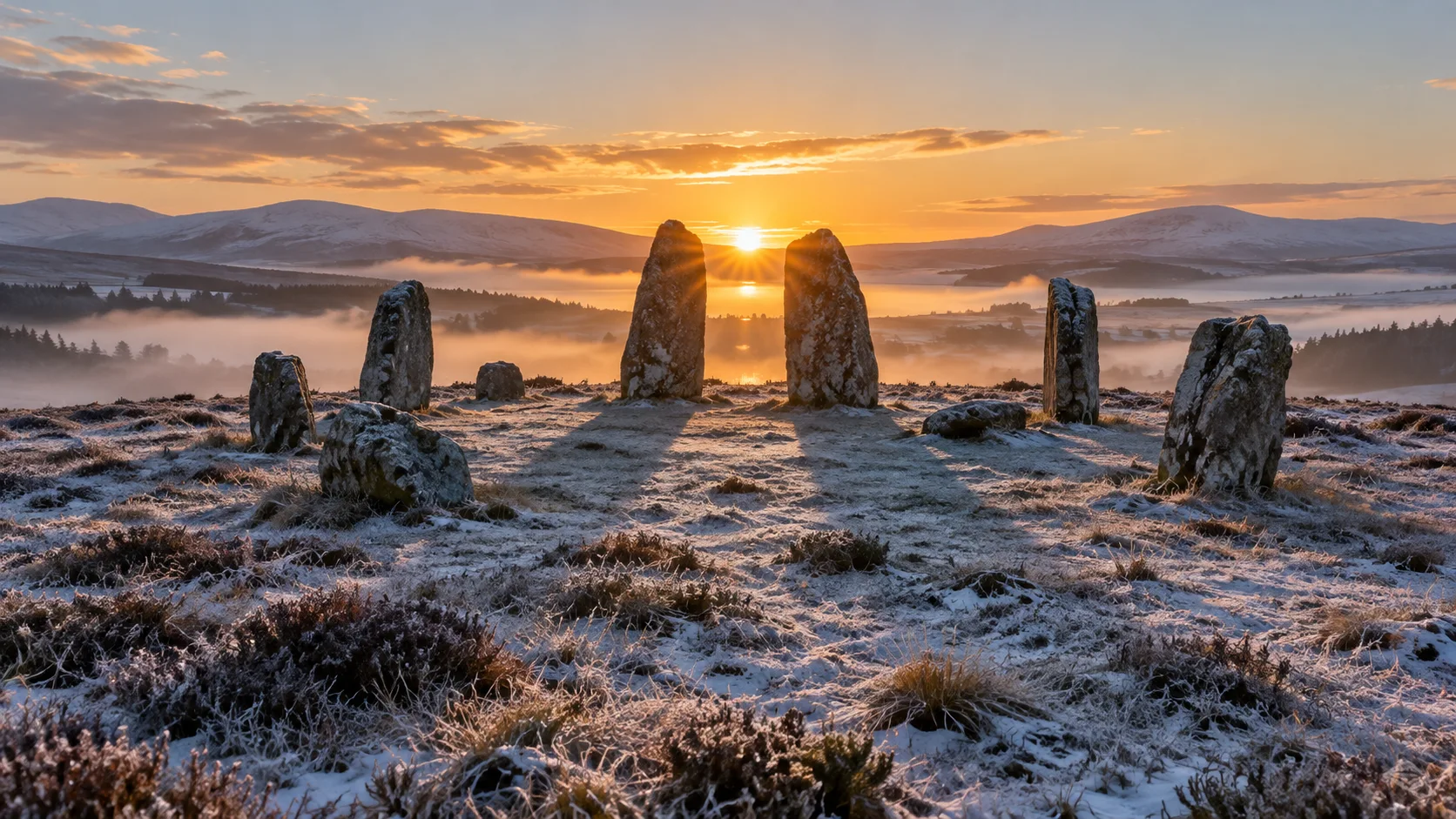
A: Stonehenge aligns with solstice directions, including the midwinter sunset axis.
Q: Which Irish passage tomb receives winter solstice sunrise light?
A: Newgrange has a roof-box that channels sunlight into its passage and chamber.
Q: How old is Newgrange compared with Egypt's Great Pyramid?
A: Newgrange is several centuries older than the Great Pyramid.
Q: Which Scottish chambered tomb receives midwinter sunset light?
A: Maeshowe in Orkney is illuminated along its entrance passage near the solstice.
Q: Which ancient Roman festival was held in December?
A: Saturnalia honored Saturn with feasting, gifts, and temporary social role reversals.
Q: Who was Saturn in Roman religion?
A: He was associated with agriculture, abundance, and a remembered golden age.
Q: What greenery did Romans use during winter festivities?
A: Evergreen branches were among decorations symbolizing continuing life.
Q: What is Yule?
A: Yule refers to Germanic midwinter traditions and later Christmas-season customs.
Q: What does the Yule log tradition involve?
A: A specially chosen log was burned during winter festivities, with customs varying widely.
Q: Why are evergreens common in midwinter traditions?
A: They remain green when many plants are dormant, making them symbols of endurance.
Q: What is Dongzhi?
A: It is an East Asian festival marking the winter solstice and the return of longer daylight.
Q: What does Dongzhi mean literally?
A: The name can be translated as winter's arrival or winter extreme.
Q: Which food is associated with Dongzhi in parts of southern China?
A: Tangyuan, sweet or savory glutinous rice balls, symbolize reunion and togetherness.
Q: Which food is associated with Dongzhi in parts of northern China?
A: Dumplings are a popular seasonal food in many northern communities.
Q: What is Shab-e Yalda?
A: It is an Iranian celebration of the year's longest night.
Q: Which fruits are often served for Yalda?
A: Pomegranates and watermelon are traditional choices, bright with symbolic color.
Q: What activity commonly accompanies Yalda gatherings?
A: Families stay up together, share food, tell stories, and read poetry.
Q: What is Toji in Japan?
A: Toji is the Japanese term for the winter solstice.
Q: What citrus bath is associated with Japanese solstice customs?
A: A yuzu bath is enjoyed for its fragrance and seasonal associations.
Q: Which squash is commonly eaten around Toji?
A: Kabocha squash is a traditional solstice food in Japan.
Q: What is Inti Raymi?
A: It is an Andean festival honoring the Sun around the Southern Hemisphere winter solstice.
Q: Which former empire celebrated Inti Raymi?
A: The Inca Empire held the historic ceremony in honor of Inti.
Q: Where is a major modern Inti Raymi celebration held?
A: Cusco, Peru, hosts a large annual reenactment and festival.
Q: Why does Inti Raymi occur in June?
A: June brings the winter solstice to the Southern Hemisphere.
Q: What is Soyal?
A: It is a winter solstice ceremony practiced by Hopi communities in the American Southwest.
Q: Why should Soyal be described with care?
A: It is a living sacred tradition, not merely a costume or generic seasonal party.
Q: What is the Feast of Saint Lucy?
A: It is a December 13 Christian observance especially prominent in Scandinavia.
Q: Why is Saint Lucy associated with light?
A: Her feast became a bright winter observance during the darkest part of the year.
Q: What is Montol in Cornwall?
A: It is a modern midwinter arts and community festival inspired by older Cornish customs.
Q: Why do solstice traditions differ so widely?
A: Communities shaped celebrations around local climate, religion, history, and available foods.
Nature, Observation, and the Return of Light
Q: How do deciduous trees respond to shortening days?
A: Many use changing photoperiod and temperature cues to enter dormancy and shed leaves.
Q: Why do evergreens keep their needles through winter?
A: Tough, waxy needles conserve water and tolerate freezing conditions.
Q: What is winter dormancy?
A: It is a slowed state that protects plants through cold or unfavorable conditions.
Q: How do some animals respond to shorter winter days?
A: Photoperiod helps trigger migration, coat changes, breeding cycles, or reduced activity.
Q: What is hibernation?
A: It is a prolonged state of greatly reduced metabolism and body activity.
Q: Does every sleepy winter animal truly hibernate?
A: No, some enter shallower torpor and can wake more easily.
Q: What is torpor?
A: It is a temporary controlled drop in metabolism, temperature, and activity.
Q: Why do snowshoe hares change coat color?
A: Seasonal molting improves camouflage against snow in winter and earth in summer.
Q: How can mismatched snow harm white-coated animals?
A: A white coat stands out when snow arrives late or melts early.
Q: Why are bird feeders busy near the winter solstice?
A: Short daylight leaves birds less time to find enough calories for long cold nights.
Q: How do chickadees survive freezing nights?
A: They fluff insulating feathers, shelter carefully, and can lower body temperature slightly.
Q: Why do many birds form winter flocks?
A: Groups improve food finding, predator detection, and sometimes nighttime warmth.
Q: What is a winter roost?
A: It is a sheltered place where birds or bats rest together or alone overnight.
Q: Why can clear winter nights become extremely cold?
A: Cloudless skies allow ground heat to radiate efficiently into space.
Q: Why can clouds keep winter nights warmer?
A: Clouds absorb and re-radiate some outgoing infrared energy toward the surface.
Q: What causes frost?
A: Water vapor deposits or freezes on surfaces that cool below the frost point.
Q: What is hoarfrost?
A: It is a delicate deposit of interlocking ice crystals formed directly from water vapor.
Q: Why does breath look cloudy in cold air?
A: Warm moist breath condenses into tiny droplets or ice crystals.
Q: What is the meteorological definition of winter?
A: In the Northern Hemisphere it is December through February, based on calendar months.
Q: Why do meteorologists use whole-month seasons?
A: Fixed months make climate records and seasonal comparisons easier.
Q: What is astronomical winter based on?
A: It is based on Earth's orbital position between the winter solstice and spring equinox.
Q: What is a solstice countdown useful for?
A: It can track the return of daylight without pretending temperatures improve immediately.
Q: How can someone safely watch a solstice sunrise?
A: Choose a legal open viewpoint, dress warmly, and never stare at the Sun through optics.
Q: Why are sunglasses not enough for viewing the Sun through binoculars?
A: Optics concentrate sunlight and can cause instant, permanent eye injury.
Q: What equipment is required for direct solar viewing?
A: Use properly certified solar filters designed for the specific viewing method.
Q: How can a phone record changing winter light safely?
A: Photograph the horizon from the same spot and time over several weeks.
Q: What should a solstice journal record?
A: Sunrise, sunset, weather, shadows, wildlife, and personal observations all work well.
Q: Why is exact location important when comparing day length?
A: Latitude, longitude, elevation, and horizon shape change local sunrise and sunset times.
Q: What is one reliable way to celebrate without borrowing sacred customs?
A: Cook a seasonal meal, walk at daylight, observe nature, or learn local history.
Q: What makes the winter solstice scientifically satisfying?
A: From the darkest turning point onward, daylight begins a slow, measurable return.
How Did You Score?
If you knew the equation of time, I am sincerely impressed. If you only remembered that the days start growing again, you kept the most comforting fact.

Ellie Simons creates and edits Random Trivia. She researches trivia using primary and authoritative sources whenever possible and is currently reviewing the site's older trivia library for accuracy, clarity, and playability. Read more on the About page.
About this quiz
Site editor: Ellie Simons. Read our Trivia Methodology to learn how questions are researched and updated. Page last updated: . Report an error.