
Find your table, practice “Prost,” and remember that a Maß is not a dainty sample. These 120 Oktoberfest trivia questions cover Munich’s royal wedding, brewery rules, giant tents, Bavarian clothing, brass bands, festival food, historic rides, and the annual challenge of carrying several glass mugs at once.
Keep the celebration going with our world festivals trivia, food trivia, and world street food trivia.
Oktoberfest Origins, Munich & the Royal Wedding
Oktoberfest began with a wedding reception that got wonderfully out of hand and lasted for generations. My own wedding leftovers managed three days, so Munich clearly planned with more ambition.
Q: Where is the original Oktoberfest held?
A: Munich, the capital of Bavaria, Germany.
Q: When was the first Oktoberfest held?
A: 1810.
Q: What royal event inspired the first Oktoberfest?
A: The wedding of Crown Prince Ludwig and Princess Therese.
Q: When did Ludwig and Therese marry?
A: October 12, 1810.
Q: Who did Crown Prince Ludwig later become?
A: King Ludwig I of Bavaria.
Q: What was Princess Therese’s full title before marriage?
A: Princess Therese of Saxe-Hildburghausen.
Q: What public event concluded the original wedding celebration?
A: Horse races.
Q: Where did Munich residents gather for the 1810 festivities?
A: Fields outside the city gates.
Q: What is the Oktoberfest grounds called?
A: Theresienwiese.
Q: Who was Theresienwiese named after?
A: Princess Therese.
Q: What does “Wiese” mean in German?
A: Meadow.
Q: What nickname do Munich residents use for the festival grounds?
A: The Wiesn.
Q: Why was the celebration repeated in 1811?
A: The successful horse race became an annual event alongside an agricultural show.
Q: What exhibition joined the festival in 1811?
A: The Bavarian Central Agricultural Festival.
Q: How often is the agricultural show traditionally held today?
A: Every four years, though schedules can change.
Q: Which German state is home to Munich?
A: Bavaria.
Q: What is Bavaria called in German?
A: Bayern.
Q: Which river flows through Munich?
A: The Isar River.
Q: Why does Oktoberfest now begin in September?
A: Earlier dates offer longer daylight and generally milder weather.
Q: When does Munich Oktoberfest usually end?
A: On the first Sunday in October, subject to calendar extensions.
Q: Which German national holiday can extend Oktoberfest?
A: German Unity Day on October 3.
Q: What happened to the original horse races over time?
A: They eventually disappeared from the annual festival program.
Q: Which epidemic caused early Oktoberfest cancellations?
A: Cholera caused cancellations in the 19th century.
Q: Which major conflicts caused multiple Oktoberfest cancellations?
A: The Napoleonic Wars and both World Wars.
Q: What replaced full Oktoberfest during some postwar years?
A: Smaller autumn festivals.
Q: Which modern pandemic canceled Oktoberfest in 2020 and 2021?
A: COVID-19.
Q: What does “Oktoberfest” literally combine?
A: The German words for October and festival.
Q: What organization runs the Munich festival?
A: The City of Munich.
Q: Who owns the Theresienwiese grounds?
A: The City of Munich.
Q: Why is Munich’s Oktoberfest considered the standard for the name?
A: It is the original event from which celebrations worldwide borrow traditions.
Beer Tents, Munich Breweries & the First Keg
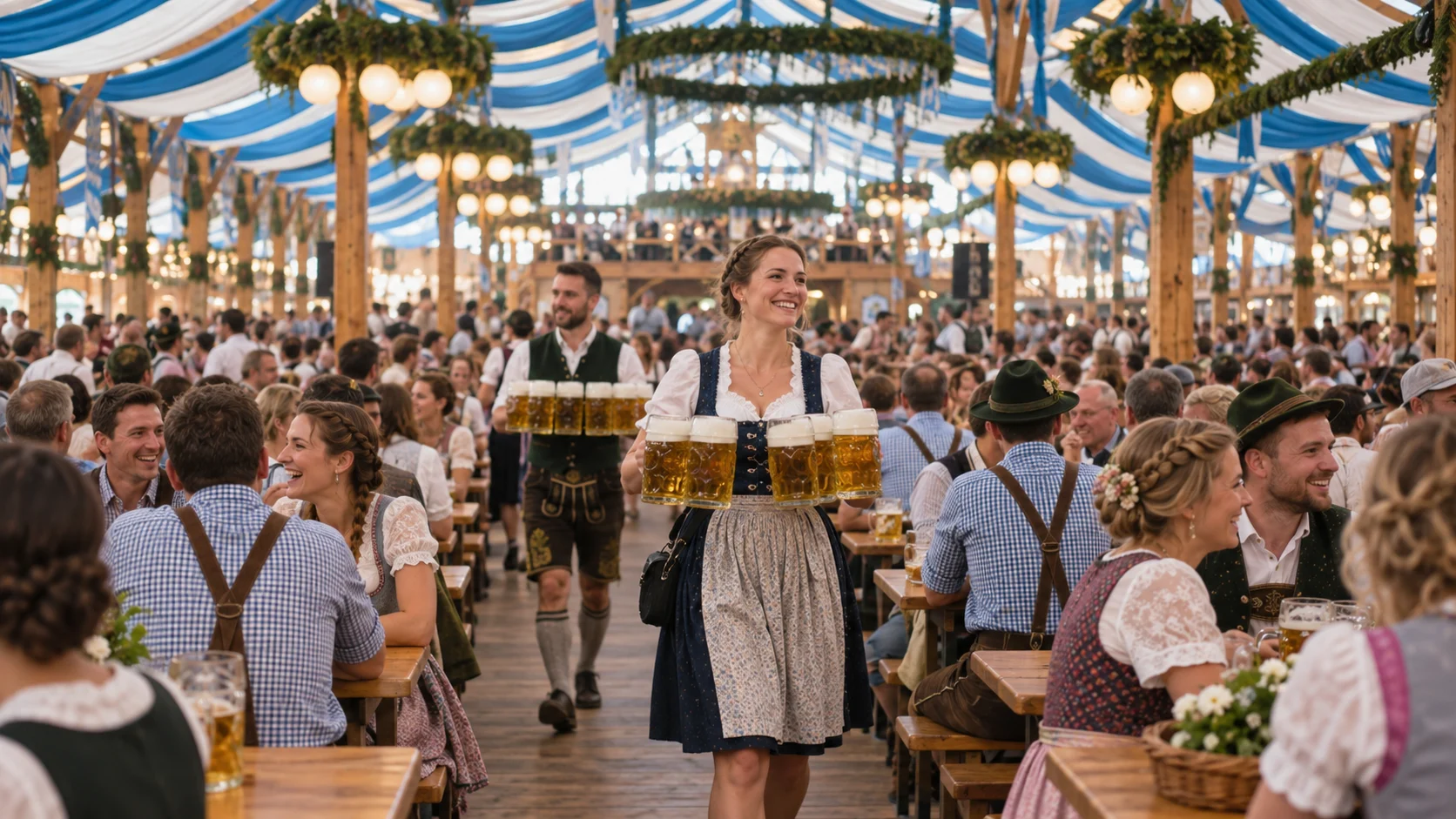
Oktoberfest beer service looks casual until you notice the rules, reservations, brewery limits, and servers carrying an alarming number of glass mugs. I would spill two before leaving the kitchen.
Q: What does a Maß hold at Oktoberfest?
A: One liter of beer, about 34 U.S. fluid ounces.
Q: How is “Maß” pronounced in Bavarian German?
A: Roughly like “mahss.”
Q: What is the heavy one-liter beer mug called?
A: A Maßkrug.
Q: What material are modern Oktoberfest beer mugs usually made from?
A: Thick glass.
Q: Which breweries may serve official Oktoberfest beer at Munich’s festival?
A: Six traditional Munich breweries.
Q: What are the six Munich Oktoberfest breweries?
A: Augustiner, Hacker-Pschorr, Hofbräu, Löwenbräu, Paulaner, and Spaten.
Q: Which brewery serves beer from wooden barrels in its main tent?
A: Augustiner.
Q: What German word describes the large festival tents?
A: Festzelte.
Q: What does “Festzelt” mean?
A: Festival tent.
Q: Which tent hosts the official opening keg ceremony?
A: Schottenhamel.
Q: What phrase does Munich’s mayor announce after tapping the first keg?
A: “O’zapft is!”
Q: What does “O’zapft is!” mean?
A: “It is tapped!” in Bavarian dialect.
Q: When did the mayoral first-keg tradition begin?
A: 1950.
Q: Which Munich mayor began the first-keg tradition?
A: Thomas Wimmer.
Q: What happens after the first keg is successfully tapped?
A: A signal tells the other tents that beer service may begin.
Q: What loud signal traditionally announces the festival opening?
A: Twelve gun salutes.
Q: Which tent is famous for international visitors and standing-room energy?
A: The Hofbräu Festzelt.
Q: Which tent is associated with a large lion above its entrance?
A: The Löwenbräu-Festzelt.
Q: What does the Löwenbräu lion periodically do?
A: It roars and drinks from a beer mug.
Q: Which tent is known for its crossbow competition?
A: The Armbrustschützenzelt.
Q: Which smaller tent specializes in wine and sparkling wine?
A: Kufflers Weinzelt.
Q: What drink is served alongside beer in the Weinzelt?
A: Wine and sparkling wine, with beer available during limited hours.
Q: Which fish dish gives the Fischer-Vroni tent its identity?
A: Steckerlfisch, fish grilled on a stick.
Q: What is an Oktoberfest table reservation?
A: A booking for seats and usually prepaid food-and-drink vouchers.
Q: How much admission does Munich Oktoberfest charge for the festival grounds?
A: General entry is free, though certain attractions or special areas charge fees.
Q: What should visitors remember about unreserved tent seating?
A: Seats can fill early, especially evenings and weekends.
Q: What alcohol-free option do Oktoberfest breweries provide?
A: Nonalcoholic beer, along with soft drinks and water.
Q: What strength is Oktoberfest beer compared with many everyday lagers?
A: It is generally stronger, often around 6 percent alcohol by volume.
Q: What style is modern Munich Oktoberfestbier typically?
A: A pale, smooth, malt-forward lager.
Q: What older amber lager style remains closely associated with Oktoberfest abroad?
A: Märzen.
Bavarian Clothing, Music, Parades & Food
Traditional clothing at Oktoberfest is more than a costume rack, and Bavarian food is far more than one giant pretzel. Still, I will not pretend the giant pretzel is not doing excellent work.
Q: What traditional leather garment do many men wear?
A: Lederhosen.
Q: What does “Lederhosen” literally mean?
A: Leather pants.
Q: What traditional dress do many women wear?
A: A dirndl.
Q: What main pieces form a dirndl outfit?
A: A bodice, blouse, full skirt, and apron.
Q: What can the position of a dirndl apron bow traditionally signal?
A: Relationship status, though modern wearers may not follow the code.
Q: What does a bow tied on the wearer’s left traditionally suggest?
A: Single or unmarried.
Q: What does a bow tied on the wearer’s right traditionally suggest?
A: Married or in a committed relationship.
Q: What does a bow tied in front at the center traditionally suggest?
A: The meaning varies, often youth or uncertainty rather than one universal status.
Q: What does a bow tied at the back traditionally suggest?
A: It may indicate widowhood or service staff, depending on context.
Q: What wool jacket is part of some Bavarian traditional outfits?
A: A Janker.
Q: What soft felt hat may accompany traditional Bavarian clothing?
A: A Tyrolean-style hat.
Q: What is the opening-day parade called?
A: The parade of Oktoberfest landlords and breweries.
Q: What vehicles carry beer in the opening parade?
A: Decorated horse-drawn brewery wagons.
Q: What major costume parade occurs on the first festival Sunday?
A: The traditional costume and marksmen’s parade.
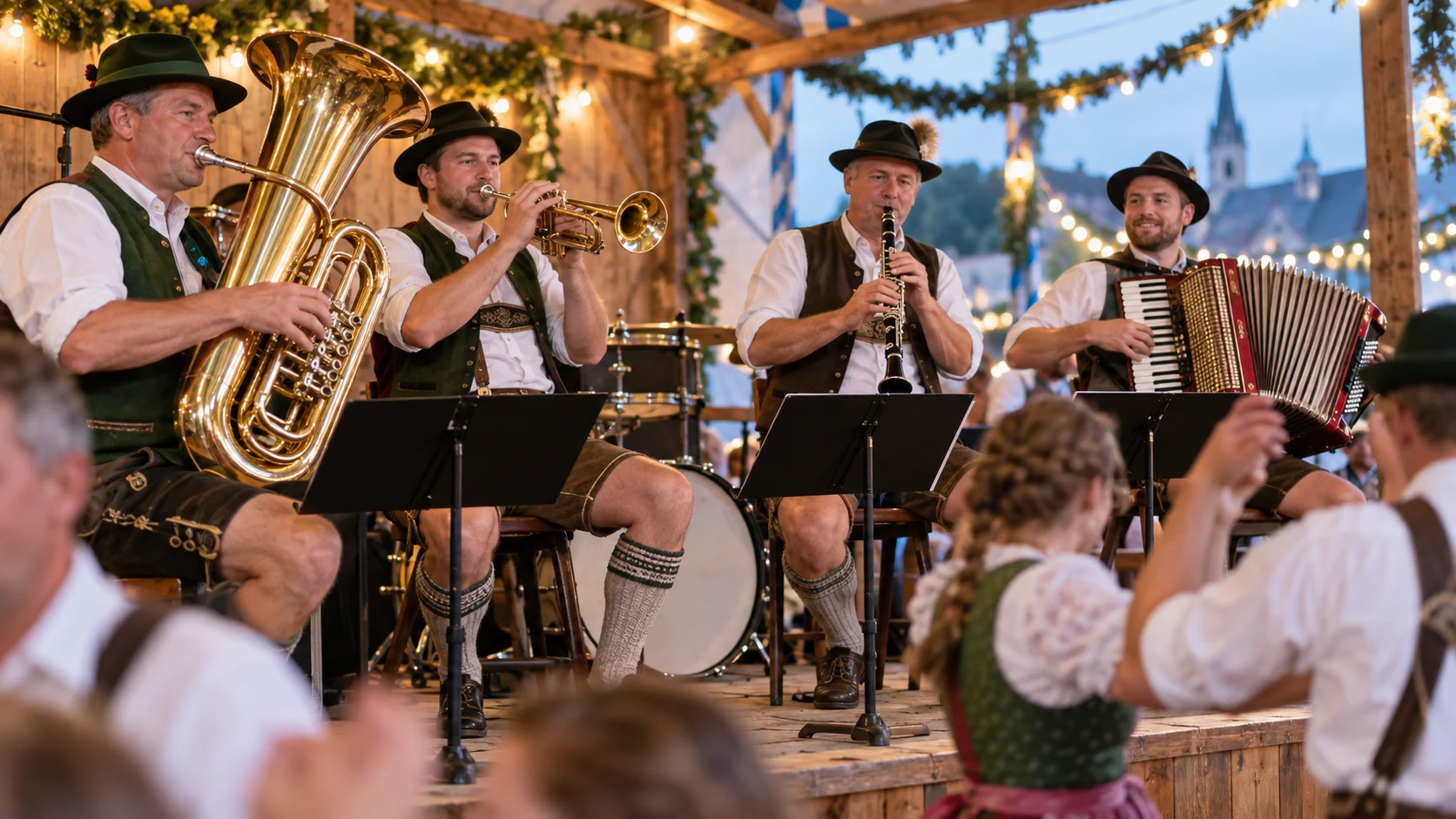
Q: What German word describes brass-band music?
A: Blasmusik.
Q: Which song often prompts crowds to raise their mugs?
A: “Ein Prosit der Gemütlichkeit.”
Q: What does “Ein Prosit” invite people to do?
A: Offer a toast.
Q: What does “Gemütlichkeit” suggest?
A: Warmth, comfort, friendliness, and good cheer.
Q: What German toast is commonly said before drinking?
A: “Prost!”
Q: What should mugs do during a traditional toast?
A: Clink while drinkers make friendly eye contact.
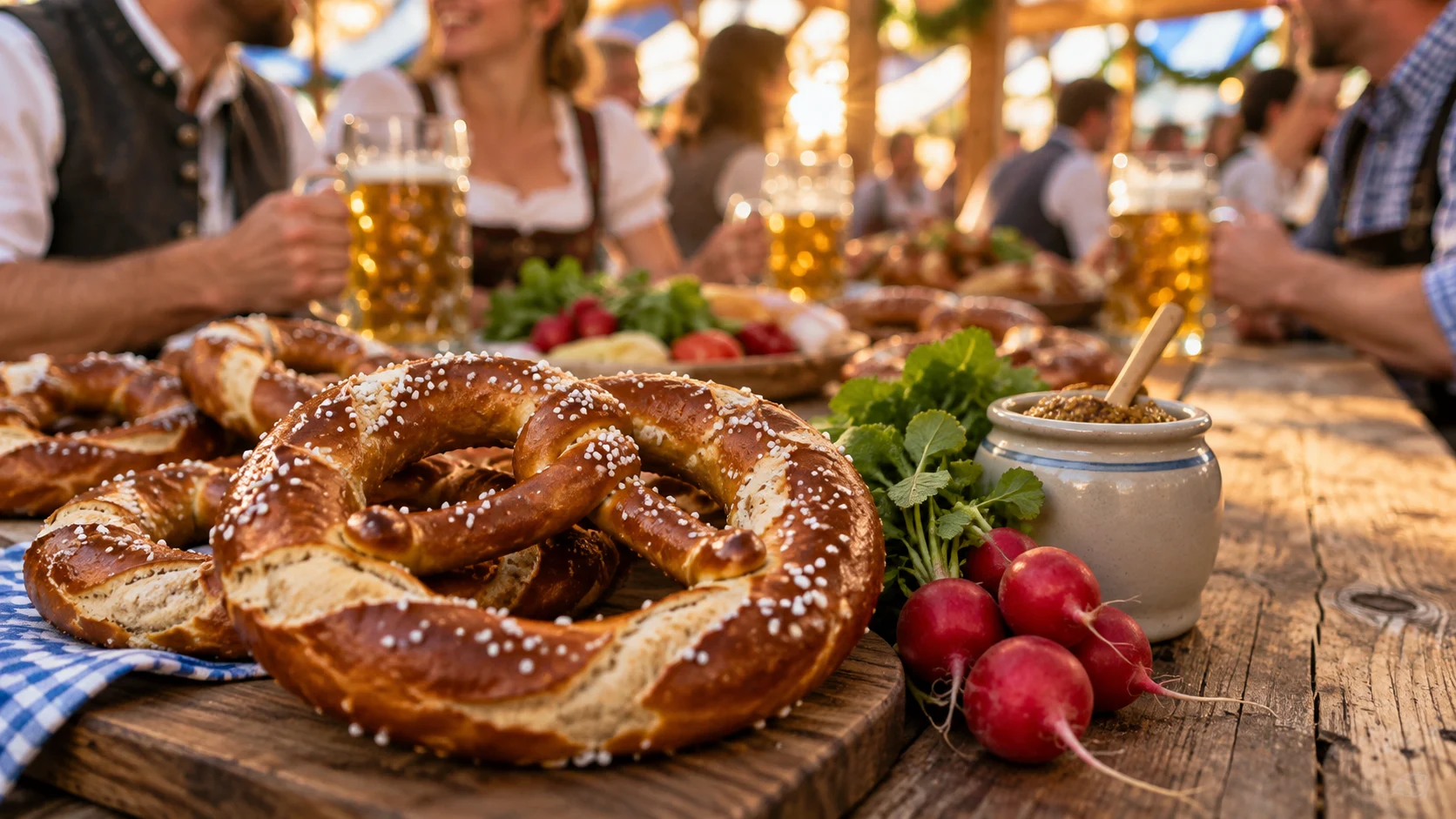
Q: What is a Brezn?
A: The Bavarian word for a pretzel.
Q: What roast chicken is an Oktoberfest staple?
A: Hendl.
Q: What is Schweinshaxe?
A: Roasted pork knuckle.
Q: What is Weißwurst?
A: A pale Bavarian sausage made mainly from veal and pork back bacon.
Q: What sweet condiment traditionally accompanies Weißwurst?
A: Sweet Bavarian mustard.
Q: What is Obatzda?
A: A seasoned Bavarian cheese spread.
Q: What is Kaiserschmarrn?
A: A shredded sweet pancake served with sugar and fruit compote.
Q: What is Lebkuchenherz?
A: A heart-shaped decorated gingerbread cookie.
Q: What messages appear on Lebkuchen hearts?
A: Affectionate, humorous, or festival-themed phrases written in icing.
Q: Which reddish-brown snack is made from seasoned roasted nuts?
A: Gebrannte Mandeln, or candied almonds.
Rides, Traditions, Records & Oktoberfest Around the World
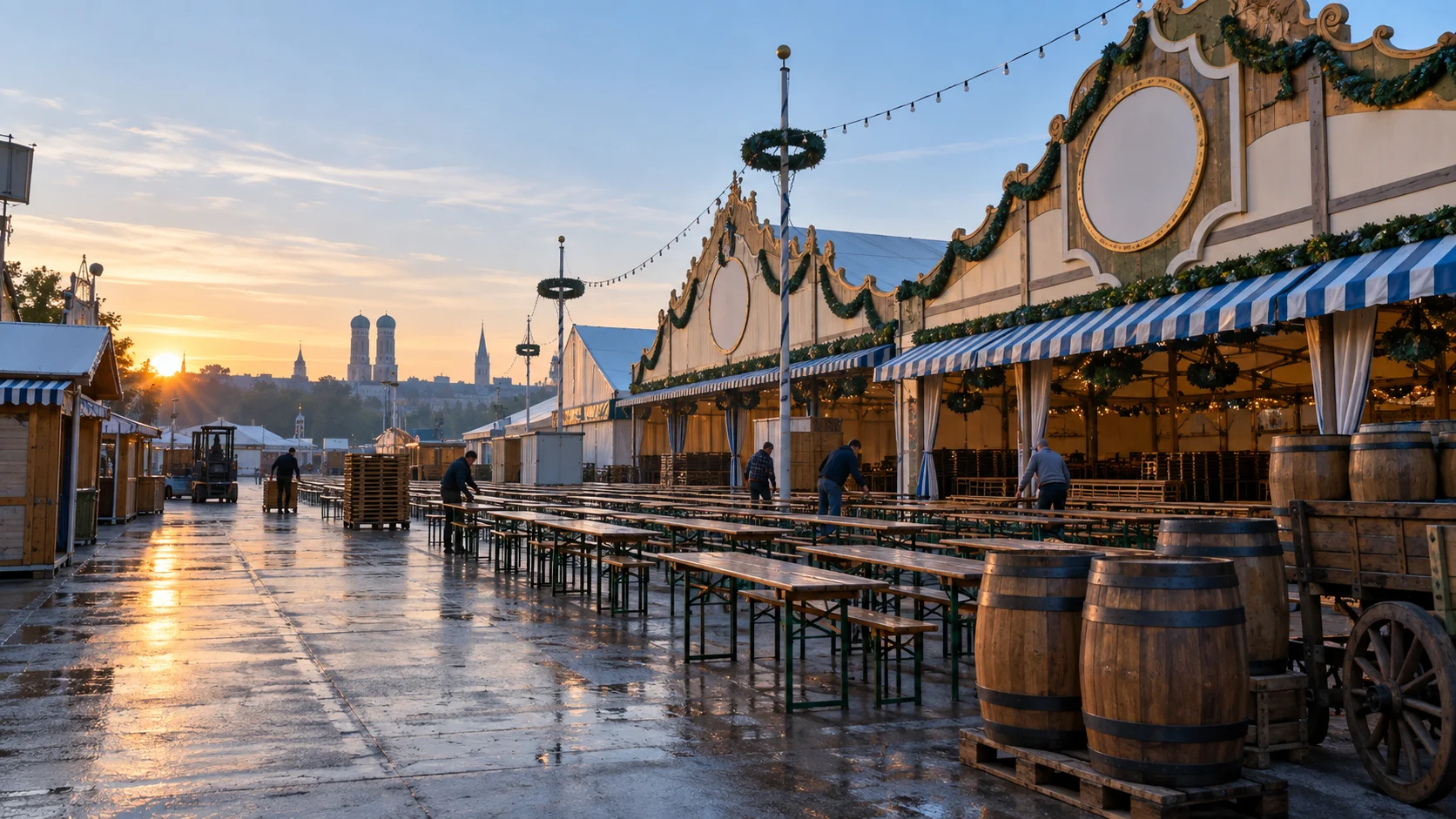
The Wiesn is also a giant fairground with rides, family days, lost property, and its own small post office. Beer gets the headlines, but Munich built an entire temporary city around it.
Q: What is the Oide Wiesn?
A: A nostalgic festival area featuring historic rides, music, and traditional atmosphere.
Q: What does “Oide Wiesn” mean in Bavarian dialect?
A: Old Oktoberfest.
Q: When was the Oide Wiesn introduced?
A: 2010 for Oktoberfest’s 200th anniversary.
Q: What classic attraction gives visitors a view over the grounds?
A: The Ferris wheel.
Q: What unusual rotating attraction challenges people to stay on a moving platform?
A: The Teufelsrad, or Devil’s Wheel.
Q: What historic show attraction uses a moving staircase and slide?
A: The Toboggan.
Q: What is the Krinoline?
A: A historic carousel-style ride accompanied by a live brass band.
Q: What practical service reunites visitors with misplaced belongings?
A: The Oktoberfest lost-and-found office.
Q: What surprising items are regularly turned in?
A: Phones, wallets, keys, clothing, eyeglasses, and occasionally dentures.
Q: What special area makes Oktoberfest more accessible to families?
A: Family days and child-friendly rides, services, and quieter periods.
Q: Which weekday often features discounted family offers?
A: Tuesday.
Q: What rule generally applies to smoking inside festival tents?
A: Smoking is prohibited inside.
Q: What security item restriction affects large bags?
A: Large bags and backpacks are generally not allowed.
Q: What transport method is strongly recommended for reaching Oktoberfest?
A: Munich public transportation.
Q: Which U-Bahn station directly serves Theresienwiese?
A: Theresienwiese station.
Q: Why is driving to Oktoberfest discouraged?
A: Parking is scarce and alcohol makes public transportation the safer choice.
Q: Which colors appear on Munich’s traditional city flag?
A: Black and gold.
Q: Which figure appears on Munich’s coat of arms?
A: The Münchner Kindl, a small monk figure.
Q: What does Munich’s name historically refer to?
A: Monks, reflected in the Old High German phrase “by the monks.”
Q: Which city hosts the large Oktoberfest Zinzinnati in the United States?
A: Cincinnati, Ohio.
Q: Which Canadian city hosts a major Oktoberfest celebration?
A: Kitchener-Waterloo, Ontario.
Q: Which Brazilian city is known for a large German-style Oktoberfest?
A: Blumenau, Santa Catarina.
Q: Why does Blumenau have strong German cultural traditions?
A: German-speaking immigrants helped settle the region in the 19th century.
Q: Which Namibian city hosts a long-running Oktoberfest celebration?
A: Windhoek.
Q: What separates Munich Oktoberfest from most overseas versions?
A: It has direct continuity with the 1810 Bavarian celebration and city-regulated traditions.
Q: What is a Volksfest?
A: A German public festival combining food, drink, entertainment, and fairground attractions.
Q: Which other famous German beer festival takes place in Stuttgart?
A: Cannstatter Volksfest.
Q: What is Starkbierfest?
A: Munich’s strong-beer festival traditionally held during Lent.
Q: Why should visitors pace themselves with a one-liter Maß?
A: The serving is large and the beer is stronger than many standard lagers.
Q: What makes Oktoberfest trivia broader than beer trivia?
A: Royal history, Bavarian language, clothing, food, music, engineering, and civic traditions all shape the festival.
How Did You Score?
If Therese, the Wiesn, Schottenhamel, “O’zapft is,” Augustiner barrels, dirndl bow positions, Obatzda, and the Teufelsrad all stayed upright, your score deserves a full brass-band toast. I am claiming partial credit for knowing exactly where the pretzels are.

Ellie Simons creates and edits Random Trivia. She researches trivia using primary and authoritative sources whenever possible and is currently reviewing the site's older trivia library for accuracy, clarity, and playability. Read more on the About page.
About this quiz
Site editor: Ellie Simons. Read our Trivia Methodology to learn how questions are researched and updated. Page last updated: . Report an error.