
Feather your nest with facts. These 120 bird trivia questions cover flight, feathers, beaks, eggs, migration, songs, raptors, owls, penguins, hummingbirds, parrots, seabirds, record holders, evolution, intelligence, conservation, and the tiny anatomical tricks that let birds do everything from hover backward to sleep while crossing an ocean.
Bird Basics, Feathers & Flight
Q: What class of animals includes modern birds?
A: Aves.
Q: What body covering is unique to birds among living animals?
A: Feathers.
Q: What are feathers made largely from?
A: Keratin, a structural protein also found in hair and nails.
Q: What is molting?
A: The process of shedding and replacing feathers.
Q: What is preening?
A: Using the beak to clean, arrange, and maintain feathers.
Q: What gland supplies oil used by many birds during preening?
A: The uropygial, or preen, gland.
Q: Do all birds fly?
A: No. Penguins, ostriches, emus, kiwis, and several other birds are flightless.
Q: What is the largest living bird by mass?
A: The ostrich.
Q: What is the smallest living bird species?
A: The bee hummingbird of Cuba.
Q: What bird can truly hover by flapping its wings?
A: Hummingbirds are the best-known specialists at sustained hovering.
Q: What bird can fly backward under its own wing power?
A: Hummingbirds.
Q: Why are many bird bones described as pneumatic?
A: Some contain air spaces connected with the respiratory system, reducing weight while maintaining structure.
Q: Are all bird bones hollow?
A: No. Bird skeletons include solid and marrow-containing bones as well as pneumatic ones.
Q: What large chest bone anchors major flight muscles in many flying birds?
A: The keeled sternum.
Q: What is a bird's beak also called?
A: A bill.
Q: Do modern birds have true teeth?
A: No. Modern birds have toothless beaks.
Q: What organ helps many birds grind food?
A: The gizzard.
Q: Why do some birds swallow grit?
A: Small stones can help the gizzard mechanically grind tough food.
Q: What is a crop?
A: An expanded part of the esophagus used by many birds to temporarily store food.
Q: What is a cloaca?
A: A shared opening for digestive, urinary, and reproductive systems in most birds.
Q: Are birds warm-blooded?
A: Yes. They maintain high internal body temperatures through metabolism.
Q: What makes bird respiration especially efficient?
A: Lungs work with air sacs to maintain largely one-way airflow through gas-exchange structures.
Q: Why do flying birds need high metabolic rates?
A: Powered flight requires large amounts of energy and oxygen.
Q: What are primary feathers mainly important for?
A: Producing thrust and controlling flight near the wing tips.
Q: What are tail feathers used for in flight?
A: Steering, braking, balance, and display.
Q: What is soaring?
A: Staying aloft with little flapping by using rising air or favorable winds.
Q: What is a thermal?
A: A rising column of warm air that soaring birds can use to gain altitude.
Q: Why do many large soaring birds have broad wings?
A: Broad wings generate lift efficiently at relatively low speeds.
Q: What is wing loading?
A: Body weight relative to wing area, an important factor in flight performance.
Q: What group of dinosaurs gave rise to birds?
A: Feathered theropod dinosaurs.
Raptors, Owls, Penguins, Parrots & More
Q: What is a raptor in bird terminology?
A: A bird of prey adapted for hunting, usually with strong feet and a hooked beak.
Q: What bird is the national emblem of the United States?
A: The bald eagle.
Q: Is a bald eagle actually bald?
A: No. Adults have white-feathered heads.
Q: What bird is famous for the fastest measured hunting dive?
A: The peregrine falcon.
Q: What is a falcon's high-speed hunting dive called?
A: A stoop.
Q: What feature helps many owls fly quietly?
A: Specialized feather edges and soft plumage reduce flight noise.
Q: Can an owl rotate its head all the way around 360 degrees?
A: No. Some owls can turn their heads about 270 degrees.
Q: Why do owls turn their heads so far?
A: Their large eyes are relatively fixed in their sockets, so the head supplies much of the viewing movement.
Q: What are owl pellets?
A: Regurgitated masses of indigestible prey parts such as bones, fur, and feathers.
Q: Are all owls strictly nocturnal?
A: No. Some are active during daylight or at dawn and dusk.
Q: What group of birds is famously adapted for swimming rather than flying?
A: Penguins.
Q: Where do wild penguins naturally live?
A: The Southern Hemisphere, from Antarctica to temperate and even equatorial regions.
Q: Do wild polar bears and penguins normally meet?
A: No. Polar bears live in the Arctic, while penguins are native to the Southern Hemisphere.
Q: What is the largest living penguin species?
A: The emperor penguin.
Q: Which parent incubates an emperor penguin egg through much of the Antarctic winter?
A: The male.
Q: What is a group of parrots known for?
A: Strong curved bills, grasping feet, intelligence, and often complex vocal behavior.
Q: What arrangement of toes do parrots typically have?
A: Zygodactyl feet, with two toes forward and two backward.
Q: What parrot is famous for exceptional vocal imitation and cognitive research?
A: The African grey parrot.
Q: What famous African grey was studied by Irene Pepperberg?
A: Alex.
Q: What New Zealand parrot is large, nocturnal, and flightless?
A: The kākāpō.
Q: What New Zealand parrot is known for curiosity and problem-solving in alpine areas?
A: The kea.
Q: What bird has a pouch-like bill used while fishing?
A: Pelicans.
Q: Does a pelican store fish in its pouch for long periods?
A: No. The pouch mainly helps scoop and drain water while catching prey.
Q: What seabird is famous for extremely long-distance gliding?
A: The albatross.
Q: What living bird has the largest wingspan?
A: The wandering albatross is generally recognized for the largest wingspan.
Q: What bird group includes ducks, geese, and swans?
A: Waterfowl in the order Anseriformes.
Q: Why do ducks have an oil-resistant feather coat?
A: Preening and feather structure help keep insulating plumage from becoming waterlogged.
Q: What long-legged pink bird gets much of its color from pigments in its diet?
A: The flamingo.
Q: What pigments help make flamingos pink?
A: Carotenoid pigments obtained through food.
Q: What bird is famous for a huge colorful bill despite a relatively lightweight structure?
A: The toucan.
Migration, Nests, Eggs & Bird Behavior
Q: What is bird migration?
A: Regular seasonal movement between breeding, feeding, or wintering areas.
Q: What bird is famous for an exceptionally long annual migration between polar regions?
A: The Arctic tern.
Q: What cues can birds use for navigation?
A: The Sun, stars, landmarks, odors, polarized light, and Earth's magnetic field.
Q: What is magnetoreception?
A: The ability to detect information from Earth's magnetic field.
Q: Do all birds migrate?
A: No. Many species remain in the same general region year-round.
Q: What is a flyway?
A: A broad geographic route used by migrating birds.
Q: Why do many birds migrate at night?
A: Cooler, calmer conditions can reduce heat stress and energy costs, while stars aid navigation.
Q: What is zugunruhe?
A: Migratory restlessness shown by birds around the time they would normally migrate.
Q: Can some birds sleep while flying?
A: Yes. Research shows some species can use brief unihemispheric or whole-brain sleep during flight.
Q: What is unihemispheric sleep?
A: A state in which one brain hemisphere sleeps while the other remains more alert.
Q: Why do birds build nests?
A: Primarily to hold eggs and provide a place for incubation and young.
Q: Do all birds build elaborate nests?
A: No. Some use simple scrapes, cavities, cliffs, burrows, or even lay eggs on bare ground.
Q: What bird is famous for building hanging woven nests?
A: Weaverbirds.
Q: What birds are famous for elaborate courtship structures called bowers?
A: Bowerbirds.
Q: Is a bower usually the nest where eggs are laid?
A: No. It is mainly a courtship display structure.
Q: What is incubation?
A: Keeping eggs at suitable conditions so embryos can develop.
Q: What is a brood patch?
A: An area of exposed, highly vascular skin that helps transfer body heat to eggs.
Q: What is the largest egg laid by any living bird?
A: The ostrich egg.
Q: Which living bird lays the largest egg relative to its body size?
A: The kiwi.
Q: What is brood parasitism?
A: Laying eggs in another bird's nest and leaving the host to raise the young.
Q: What bird is famous for brood parasitism in Europe?
A: The common cuckoo.
Q: What North American bird is a well-known brood parasite?
A: The brown-headed cowbird.
Q: What is a bird song often used for?
A: Attracting mates and defending territory.
Q: What is the syrinx?
A: The specialized vocal organ of birds, located near the base of the trachea.
Q: Can some songbirds produce two different tones at once?
A: Yes. The two sides of the syrinx can be controlled with remarkable independence.
Q: What is mimicry in birdsong?
A: Copying sounds made by other birds, animals, people, or the environment.
Q: What Australian bird is famous for extraordinary sound mimicry?
A: The superb lyrebird.
Q: Why do woodpeckers drum on trees or other surfaces?
A: Drumming communicates territory and courtship, while pecking can also find food or excavate cavities.
Q: What adaptation helps protect a woodpecker during repeated impacts?
A: Specialized skull, beak, neck, and impact mechanics distribute forces, though the system is more complex than a simple shock absorber.
Q: What is mobbing behavior?
A: Birds collectively harassing or attacking a predator to drive it away.
Bird Intelligence, Records & Conservation
Q: What bird family includes crows, ravens, jays, and magpies?
A: Corvidae, whose members are called corvids.
Q: Can some crows make and use tools?
A: Yes. New Caledonian crows are especially famous for sophisticated tool use.
Q: Are ravens known for play behavior?
A: Yes. Ravens have been observed sliding, manipulating objects, and engaging in social play.
Q: What bird is famous for remembering thousands of hidden seed caches?
A: Clark's nutcracker.
Q: What ability made homing pigeons historically useful?
A: They can navigate back to their home loft over long distances.
Q: What once-enormous North American bird species went extinct in 1914?
A: The passenger pigeon.
Q: What flightless island bird became a symbol of human-caused extinction?
A: The dodo of Mauritius.
Q: What giant flightless birds once lived in New Zealand?
A: Moa.
Q: Why is the kākāpō a major conservation story?
A: Intensive management has helped a critically endangered flightless parrot recover from extremely low numbers.
Q: What giant North American scavenger was saved from extinction through captive breeding?
A: The California condor.
Q: What pesticide contributed to eggshell thinning in bald eagles and peregrine falcons?
A: DDT and its breakdown products.
Q: What Rachel Carson book helped draw attention to pesticide impacts on birds and ecosystems?
A: Silent Spring.
Q: What U.S. law protects many native migratory birds under international treaties?
A: The Migratory Bird Treaty Act.
Q: What common building feature kills many birds through collisions?
A: Reflective or transparent glass windows.
Q: Why can free-ranging domestic cats threaten wild birds?
A: Cats are effective predators and kill large numbers of birds and other wildlife.
Q: How can artificial light at night affect migrating birds?
A: It can attract, disorient, and concentrate nocturnal migrants around buildings.
Q: What makes glass more bird-friendly?
A: Visible patterns or treatments that help birds recognize it as a barrier.
Q: What global bird-observation platform is run by the Cornell Lab of Ornithology?
A: eBird.
Q: What long-running winter bird survey is organized by the National Audubon Society?
A: The Christmas Bird Count.
Q: What is bird banding?
A: Attaching a uniquely marked band to a bird so researchers can study movement, survival, and population biology.
Q: Where is a standard bird band usually placed?
A: Around the leg.
Q: What bird has one of the highest documented flight altitudes after a collision with an aircraft above 11,000 meters?
A: Rüppell's griffon vulture.
Q: What penguin is an exceptional deep diver, reaching hundreds of meters below the surface?
A: The emperor penguin.
Q: What hummingbird has a bill so long that it exceeds the length of the rest of its body?
A: The sword-billed hummingbird.
Q: What large African wetland bird is famous for bill-clattering and a shoe-shaped beak?
A: The shoebill.
Q: What African raptor hunts many ground animals with powerful kicks?
A: The secretarybird.
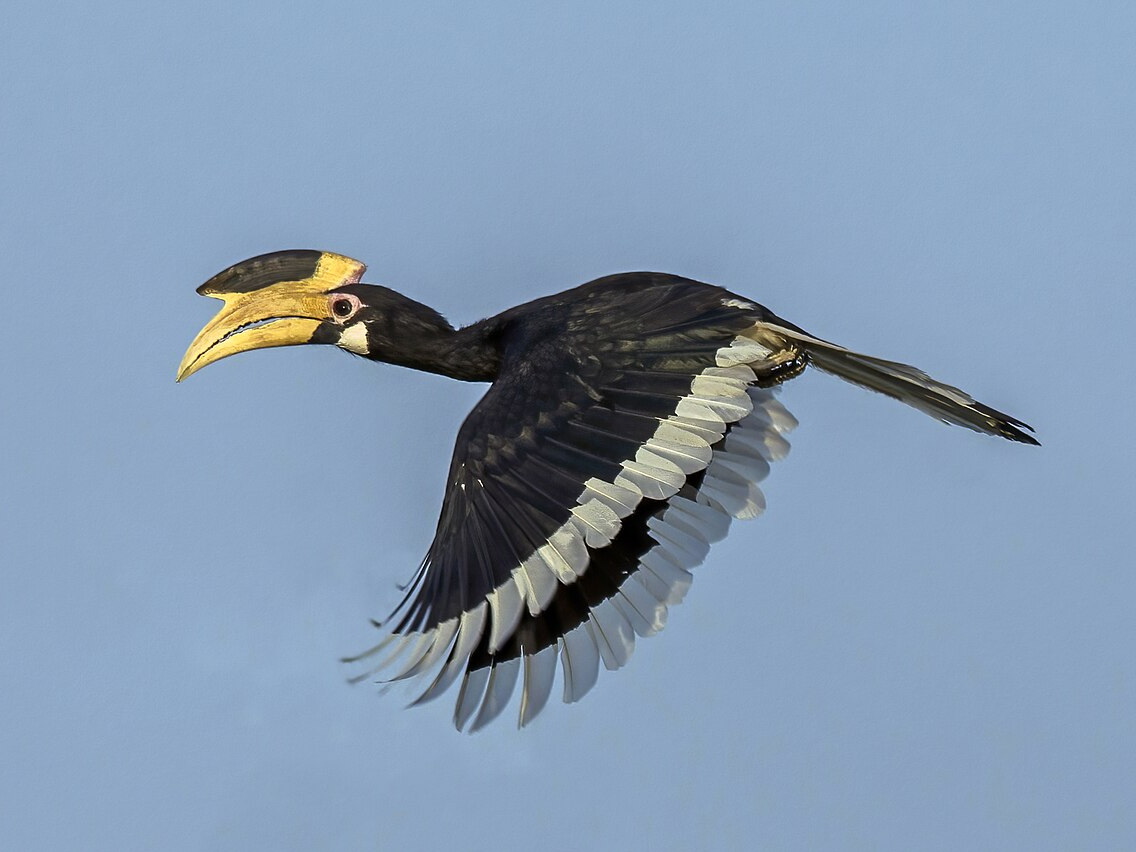
Q: What bird family includes species whose females may seal themselves inside tree cavities while nesting?
A: Hornbills.
Q: What unusual feature do young hoatzin chicks have on their wings?
A: Claws that help them climb through vegetation.
Q: Why do loons sit relatively low in the water?
A: Their comparatively dense bones and diving adaptations reduce buoyancy.
Q: In modern evolutionary classification, are birds dinosaurs?
A: Yes. Birds are the surviving lineage of theropod dinosaurs.
How Did You Score?
If you knew your syrinx from your stoop, your kākāpō from your kea, and your Arctic tern from your wandering albatross, your bird trivia is ready to take flight.

Ellie Simons creates and edits Random Trivia. She researches trivia using primary and authoritative sources whenever possible and is currently reviewing the site's older trivia library for accuracy, clarity, and playability. Read more on the About page.
Explore more rounds in our Animal trivia collection.
About this quiz
Site editor: Ellie Simons. Read our Trivia Methodology to learn how questions are researched and updated. Page last updated: . Report an error.