
Grab a slice. These 120 pizza trivia questions travel from Naples and the art of the pizzaiuolo to Margherita, marinara, dough, mozzarella, wood-fired ovens, New York slices, Chicago deep dish, Detroit-style corners, regional toppings, terminology, and the food history behind one of the world's favorite dinners.
Neapolitan tradition is grounded in UNESCO's official heritage listing. Keep eating with our food trivia, and Italy trivia.
Naples, Neapolitan Pizza & Early History
Q: What Italian city is most closely associated with modern pizza's development?
A: Naples.
Q: What region of Italy contains Naples?
A: Campania.
Q: What is a pizzaiuolo?
A: A pizza maker, especially in the Neapolitan tradition.
Q: In what year did UNESCO inscribe the art of Neapolitan pizzaiuolo?
A: 2017.
Q: Is UNESCO's inscription for pizza as a physical food item?
A: No, it recognizes the living craft and cultural practice of Neapolitan pizzaiuoli.
Q: What type of oven is central to UNESCO's description?
A: Wood-fired oven.
Q: What does a pizzaiuolo rotate during baking?
A: The pizza.
Q: What does cornicione mean in pizza language?
A: The raised outer rim or crust.
Q: What does bottega mean in the UNESCO tradition?
A: The workshop or shop where the craft is practiced and transmitted.
Q: How was pizzaiuolo knowledge traditionally passed on?
A: Apprentices learned by observing and practicing with experienced makers.
Q: Were flatbreads invented in Naples?
A: No, flatbreads are far older and appear in many cultures.
Q: What New World ingredient eventually became central to many pizzas?
A: Tomato.
Q: Where did tomatoes originate before reaching Europe?
A: The Americas.
Q: Did Europeans immediately embrace tomatoes as pizza sauce?
A: No, tomato use in European cooking developed gradually.
Q: What class of Neapolitans helped make early pizza a popular street food?
A: Working-class urban residents.
Q: Why was pizza practical street food?
A: It was inexpensive, portable, filling, and could be topped with readily available ingredients.
Q: What does pizza marinara traditionally contain?
A: Tomato, garlic, oregano, and olive oil, without cheese.
Q: Does “marinara” mean it must contain seafood?
A: No.
Q: What does the name traditionally connect with?
A: A simple style associated by tradition with seafaring households and marinai, or sailors.
Q: What famous pizza uses tomato, mozzarella, and basil?
A: Pizza Margherita.
Q: What colors do those ingredients evoke?
A: Red, white, and green.
Q: What national flag uses those colors?
A: Italy's.
Q: Which queen is linked by famous tradition to Pizza Margherita?
A: Queen Margherita of Savoy.
Q: Which pizzaiolo is traditionally credited with serving it to her?
A: Raffaele Esposito.
Q: Is every detail of the Margherita origin story beyond historical debate?
A: No, the popular story is famous but historians debate parts of its development.
Q: What cheese is traditionally used on Margherita?
A: Mozzarella.
Q: What herb supplies the green?
A: Basil.
Q: What ingredient supplies the red?
A: Tomato.
Q: What ingredient supplies the white?
A: Mozzarella.
Q: Why does Naples remain central to pizza history?
A: It developed a highly influential craft tradition that became a global reference point.
Dough, Cheese, Sauce & Baking
Q: What four basic ingredients can make a simple pizza dough?
A: Flour, water, salt, and yeast.
Q: What does yeast do in dough?
A: Ferments sugars and produces gas that helps dough rise.
Q: What protein network gives wheat dough elasticity?
A: Gluten.
Q: What does kneading develop?
A: Gluten structure.
Q: What is proofing?
A: Letting dough ferment and rise before baking.
Q: Why do some doughs ferment slowly in a refrigerator?
A: Long fermentation can improve flavor, extensibility, and handling.
Q: What does hydration mean in dough?
A: The ratio of water to flour, usually expressed as a percentage.
Q: What does higher hydration generally mean?
A: More water relative to flour.
Q: Why can high-hydration dough be challenging?
A: It is often stickier and requires careful handling.
Q: What type of flour is strongly associated with Neapolitan pizza?
A: Finely milled Italian “00” flour.
Q: Does “00” directly mean the flour has zero protein?
A: No, it refers to Italian milling classification.
Q: What tomato variety is strongly associated with Naples pizza tradition?
A: San Marzano tomatoes.
Q: What fresh cheese is made from stretched curd?
A: Mozzarella.
Q: What animal's milk is used for mozzarella di bufala?
A: Water buffalo.
Q: What is fior di latte?
A: Cow's-milk mozzarella.
Q: What does EVOO stand for in recipe shorthand?
A: Extra-virgin olive oil.
Q: Why is a very hot oven useful for Neapolitan pizza?
A: It cooks the thin pizza quickly while puffing and spotting the rim.
Q: What is leopard spotting?
A: Small charred spots on a well-baked pizza crust.
Q: Does char automatically mean the pizza is burned beyond use?
A: No, controlled charring can be a desired flavor and texture.
Q: What tool slides pizza into an oven?
A: A pizza peel.
Q: What is a turning peel?
A: A smaller round peel used to rotate pizza while baking.
Q: Why is a pizza rotated?
A: To bake it evenly in an oven with intense directional heat.
Q: What is a pizza stone?
A: A heat-retaining baking surface used to mimic a masonry oven floor.
Q: What is a baking steel?
A: A metal plate that transfers heat rapidly into dough.
Q: Why should wet toppings be controlled?
A: Excess moisture can make crust soggy.
Q: What is a white pizza?
A: Pizza made without tomato sauce.
Q: What does pizza bianca literally mean?
A: White pizza.
Q: What is a calzone?
A: Folded pizza dough enclosing fillings.
Q: Is a calzone simply a pizza slice folded after baking?
A: No, it is usually filled and sealed before baking or frying.
Q: What is the key difference between a crisp and chewy crust?
A: Flour, hydration, fermentation, thickness, oven heat, baking surface, and time all matter.
American Pizza Styles
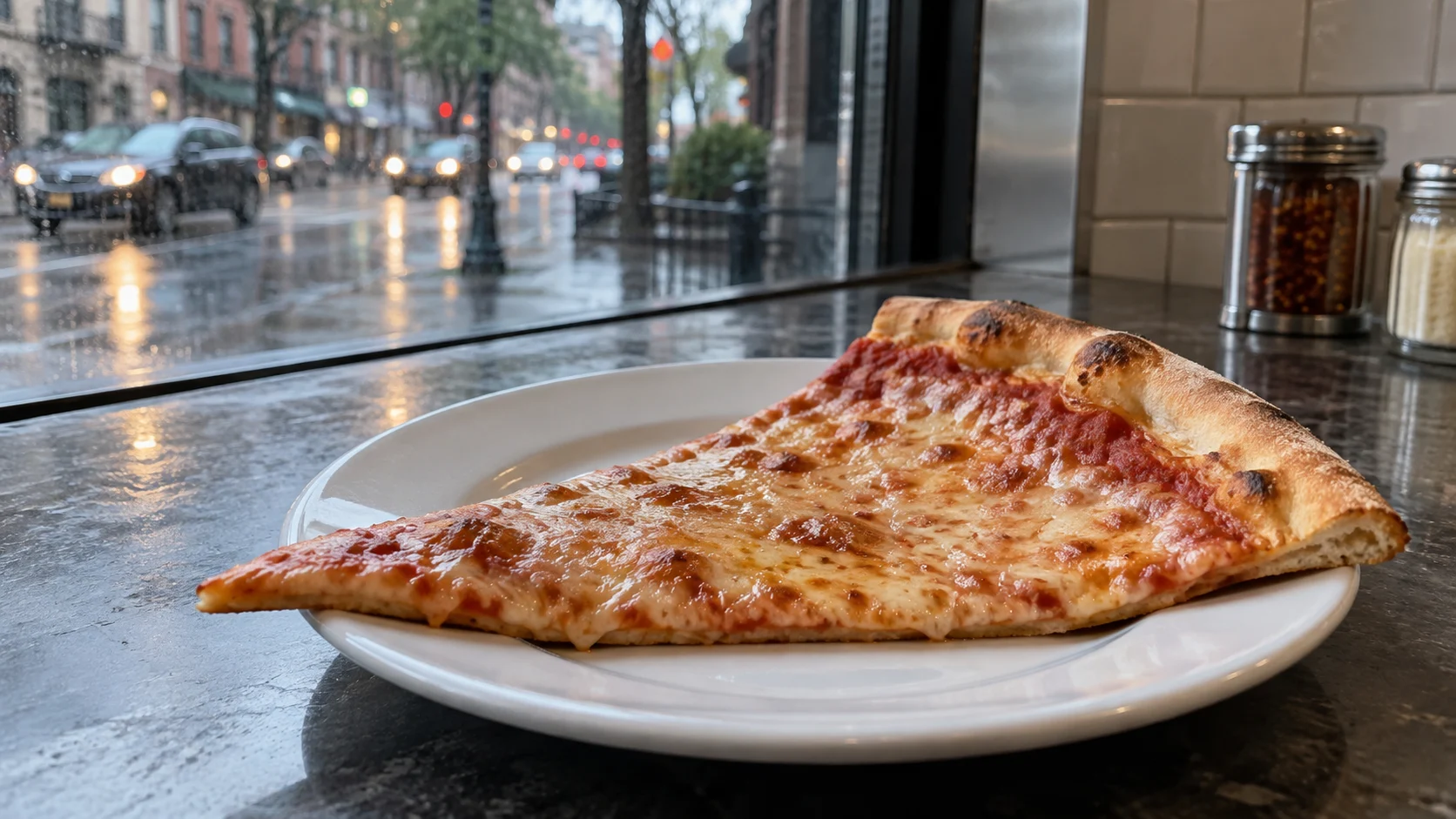
Q: What city is famous for large, thin, foldable slices?
A: New York City.
Q: What is a common way to eat a large New York slice?
A: Fold it lengthwise.
Q: What cheese commonly covers a New York cheese pizza?
A: Low-moisture mozzarella.
Q: What city is famous for deep-dish pizza?
A: Chicago.
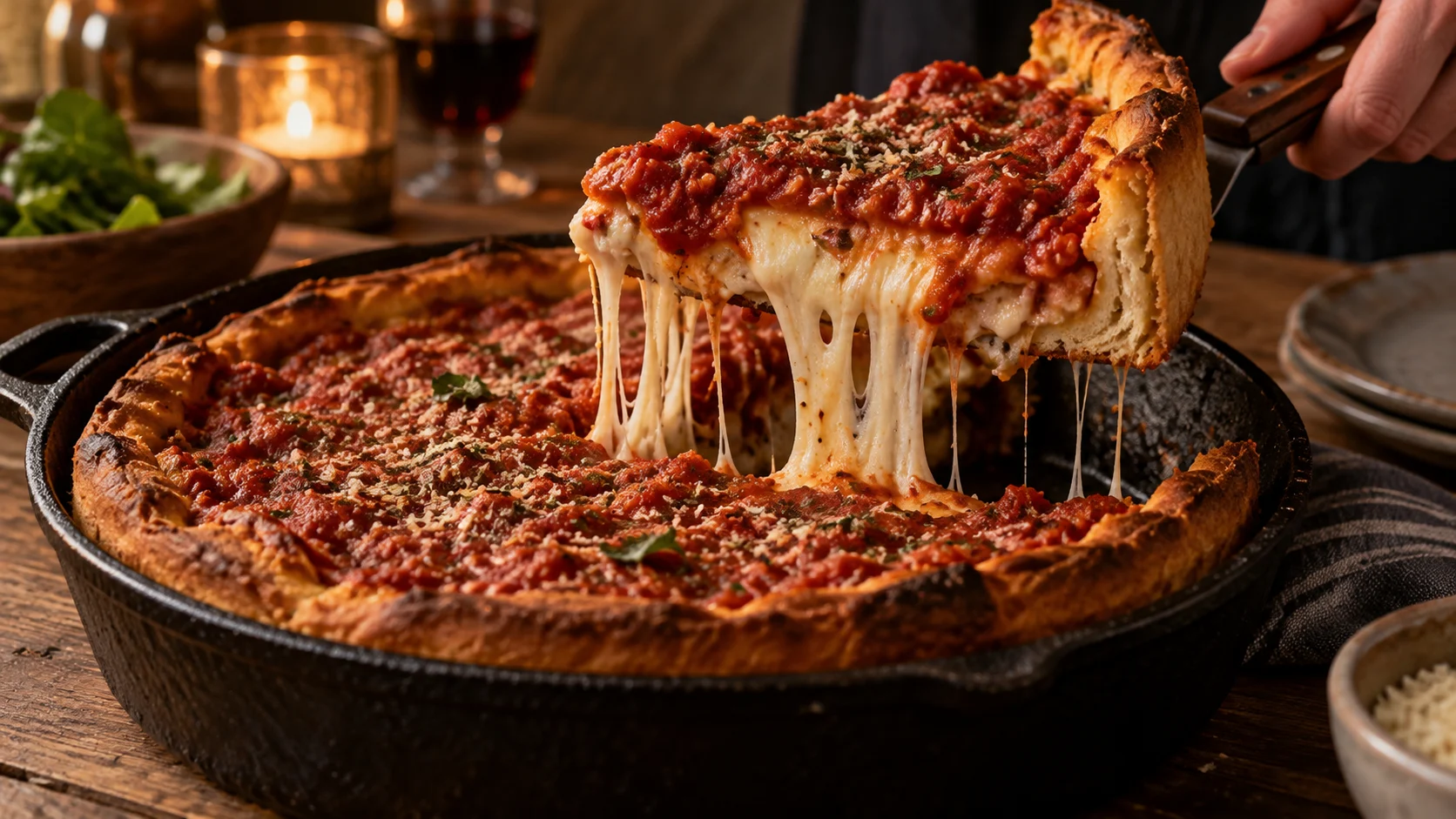
Q: What kind of pan is used for Chicago deep dish?
A: A deep, round pan.
Q: What order often distinguishes deep-dish assembly?
A: Cheese and fillings can go beneath tomato sauce.
Q: What other thin Chicago style is a major local tradition?
A: Tavern-style pizza.
Q: How is tavern-style pizza often cut?
A: Into squares.
Q: What city is famous for rectangular pan pizza with crispy cheese edges?
A: Detroit.
Q: What kind of pans inspired Detroit-style pizza?
A: Rectangular industrial-style metal pans.
Q: What Wisconsin cheese is strongly associated with classic Detroit style?
A: Brick cheese.
Q: What creates Detroit pizza's caramelized edge?
A: Cheese baked against the hot pan.
Q: What is Sicilian-American pizza often shaped like?
A: A thick rectangular pan pizza.
Q: What northeastern style is baked in an oiled rectangular pan and associated with Rhode Island and Massachusetts variations?
A: Bakery and sheet-pan pizza traditions vary by region.
Q: What Connecticut city is famous for apizza?
A: New Haven.
Q: How is “apizza” commonly pronounced locally?
A: Roughly “ah-beetz.”
Q: What cooking style is associated with New Haven apizza?
A: Very hot coal-fired ovens and thin charred crust.
Q: What unusual clam topping is a New Haven classic?
A: White clam pizza.
Q: What city is associated with St. Louis-style pizza?
A: St. Louis.
Q: What processed cheese blend is associated with St. Louis style?
A: Provel.
Q: How is St. Louis pizza often cut?
A: Into squares.
Q: What does “party cut” often mean?
A: Cutting a round pizza into small squares rather than wedges.
Q: What does “grandma pizza” generally describe?
A: A rectangular, relatively thin home-style pan pizza associated with Long Island Italian-American cooking.
Q: What is bar pizza?
A: A small thin pizza style associated with taverns in parts of the Northeast.
Q: Are American pizza styles simply failed copies of Naples?
A: No, they developed distinct local ingredients, ovens, immigrant histories, and preferences.
Q: What ingredient became especially common on American pizza?
A: Pepperoni.
Q: Is pepperoni a traditional Italian salami name?
A: It is an Italian-American cured meat term, not the standard Italian word for that exact product.
Q: What does peperoni mean in Italian with one p after the first syllable?
A: Peppers.
Q: What controversial fruit topping sparks endless arguments?
A: Pineapple.
Q: Why is American pizza trivia so varied?
A: Immigration and local food cultures created sharply different regional styles.
Global Styles, Toppings & Hard Pizza Trivia
Q: What country besides Italy has made pizza a deeply local food culture?
A: Many countries, including the United States, Brazil, Japan, Argentina, and others.
Q: What city is associated with Argentine fugazzeta?
A: Buenos Aires.
Q: What is fugazzeta known for?
A: Thick crust, lots of cheese, and onion, often with a stuffed-cheese format.
Q: What Brazilian pizza topping combination surprises many visitors?
A: Regional pizzas can use ingredients from corn and hearts of palm to eggs and creamy cheeses.
Q: What Japanese ingredient can appear on local pizza?
A: Seafood, mayonnaise-style sauces, corn, teriyaki flavors, and other local toppings.
Q: What does prosciutto mean?
A: Italian cured ham.
Q: What peppery green commonly tops pizza after baking?
A: Arugula, also called rocket.
Q: What mushroom is a common pizza topping?
A: Many varieties, including button mushrooms.
Q: What salty small fish appears on classic pizzas?
A: Anchovies.
Q: What small fruit is used as a savory pizza topping and comes in green or black varieties?
A: Olives.
Q: What spicy cured sausage is America's classic pizza topping?
A: Pepperoni.
Q: What herb is classic on Margherita?
A: Basil.
Q: What herb is classic on marinara?
A: Oregano.
Q: What does quattro formaggi mean?
A: Four cheeses.
Q: What does quattro stagioni mean?
A: Four seasons.
Q: How is a quattro stagioni pizza often arranged?
A: Different toppings occupy separate quarters representing seasons.
Q: What does capricciosa mean in a pizza name?
A: It refers to a classic Italian pizza with varied toppings, often including ham, mushrooms, artichokes, and olives.
Q: What is burrata?
A: A fresh cheese with a mozzarella shell and creamy stracciatella filling.
Q: Why is burrata usually added carefully or after baking?
A: Its creamy center can be damaged by intense heat.
Q: What does “extra cheese” change besides flavor?
A: Moisture, browning, oil, weight, and how a slice holds together.
Q: Why does pizza reheat differently in a skillet than a microwave?
A: A skillet restores bottom crispness while microwaves can soften crust.
Q: What is a pizza screen?
A: A perforated metal disk used to support pizza while allowing heat to reach the bottom.
Q: What is semolina sometimes used for during pizza making?
A: Helping dough slide from a peel and adding texture.
Q: What does stretching by hand preserve better than aggressively rolling?
A: Gas pockets around the rim.
Q: Why might a pizzaiuolo avoid a rolling pin?
A: It can press gas out of the fermented dough.
Q: What is the “windowpane test” used for?
A: Checking gluten development by stretching dough thinly.
Q: What year did UNESCO recognize Neapolitan pizzaiuolo art?
A: 2017.
Q: What exactly did UNESCO recognize?
A: The knowledge, gestures, preparation, baking, social ritual, and transmission of the craft.
Q: Why is Pizza Margherita's royal origin best phrased as tradition rather than unquestioned fact?
A: The story is iconic, but historians debate how neatly the later legend matches the development of the pizza.
Q: Why is pizza especially deep trivia material?
A: Ancient flatbreads, New World tomatoes, Naples craft, immigration, regional ovens, fermentation, cheese science, and global adaptation all meet in one food.
How Did You Score?
If pizzaiuolo, cornicione, fior di latte, New Haven apizza, Provel, brick cheese, fugazzeta, and UNESCO's actual 2017 inscription all came easily, your pizza trivia is fully baked.

Ellie Simons creates and edits Random Trivia. She researches trivia using primary and authoritative sources whenever possible and is currently reviewing the site's older trivia library for accuracy, clarity, and playability. Read more on the About page.
Explore more rounds in our Food trivia collection.
About this quiz
Site editor: Ellie Simons. Read our Trivia Methodology to learn how questions are researched and updated. Page last updated: . Report an error.